




Written by: Aaron Rovner, Founder, Saas Hero | Last updated: September 6, 2026
Key Takeaways
- PropTech digital marketing in 2026 focuses on intent-driven SEO, ABM, LinkedIn thought leadership, and paid media that convert complex buying committees into qualified pipeline and ARR across 6–12 month sales cycles.
- Marketing success is measured by CRM outcomes such as qualified pipeline, CAC payback, and closed-won revenue instead of form-fill volume or lead counts.
- Multi-channel strategies across SEO, ABM, LinkedIn, paid media, and AI search work best when a revenue-first measurement framework aligns with committee dynamics and stakeholder pain points.
- Boards now evaluate marketing performance through finance metrics such as pipeline coverage, CAC payback under 12–18 months, and LTV:CAC ratios of 3:1.
- Book a discovery call with SaaSHero to build a revenue-first PropTech marketing engine that delivers measurable pipeline and ARR.
Executive Summary: Revenue-First PropTech Marketing In 2026
Most PropTech marketing underperforms because teams treat digital channels as a lead-generation activity instead of a revenue engine. In 2026, the stakes are higher. The global PropTech market is valued at roughly $51 billion in 2026, according to an average of multiple market trackers synthesized by Core Advisors, and AI adoption among property management firms jumped from 20% to 58% in a single year. Boards now frame marketing conversations around CAC payback, pipeline coverage, and closed-won ARR.
Key points for any VP of Marketing or CMO evaluating a PropTech marketing strategy in 2026:
- PropTech sales cycles often run 9–18 months with 8–15 stakeholders across operations, IT, finance, and legal, so marketing must map to committee dynamics instead of individual leads.
- A multi-channel strategy across SEO, ABM, LinkedIn, paid media, and AI search performs well only when a revenue-first measurement framework unifies the effort.
- Campaigns should be tuned to CRM outcomes such as qualified pipeline, lifecycle stage, and closed revenue instead of form-fill counts.
- Success is defined through pipeline, CAC payback, and ARR rather than lead volume.
- A focused 90-day action plan can establish the foundation for a defensible, board-ready marketing engine.
Book a discovery call to see how SaaSHero builds revenue-first PropTech marketing programs that stand up to board scrutiny.
PropTech Buyer Dynamics: Long Cycles And Complex Committees
PropTech buying behavior differs from shorter-cycle B2B SaaS. Enterprise real estate and property technology purchases involve 8–15 stakeholders across operations, IT, finance, and legal, with average sales cycles of 9–18 months. Gartner’s B2B buying journey research confirms that buyers spend only 17% of their total buying time meeting with potential vendors. The remaining time goes to independent research, internal deliberation, and committee alignment.
Deals with an ACV of $100K–$500K typically take 6–12 months and involve 8–15 stakeholders. At the same time, 86% of B2B purchases stall at some point in the cycle. A single unengaged stakeholder can stop a deal late in the process.
These dynamics shape PropTech marketing strategy in specific ways:
- Content should address each stakeholder’s distinct pain points. CFOs focus on ROI and NOI impact, IT leaders focus on integration and security, and end-users focus on workflow fit and usability.
- Lead nurturing sits at the center of the motion and supports progress across the full committee.
- A PropTech deal at $50K–$100K ACV often doubles both the timeline and stakeholder count of mainstream SaaS deals at the same price point.
Multi-Channel PropTech Strategy Tied Directly To Revenue
Every marketing tactic should connect to qualified pipeline and ARR instead of surface-level form fills. The channels below work as a system. Each channel performs best when it supports the others.
Intent SEO And Content Marketing For High-Value Searches
Target high-intent keywords such as “property management software for commercial real estate” and “CRE investment management platform alternatives.” Create content that answers specific buyer questions at each stage of the committee’s research. Prioritize comparison pages, category pages, and case studies that speak to operational pain. These pages earn citations from AI search engines and educate stakeholders before they contact sales. For a deeper look at SEO execution, see SaaSHero’s PropTech SEO Marketing: 2026 Playbook for Net-New ARR.
ABM That Targets The Full Buying Committee
Use ABM platforms such as 6sense and Demandbase to identify accounts that show buying signals, then map the full committee before outreach. Identify five roles, including initiator, economic buyer, user stakeholder, influencer, and blocker, and assign role-specific messaging to each. Multi-threaded engagement across all stakeholders in parallel outperforms a single-champion approach. Measure account-level engagement instead of individual lead scores.
Companies that execute ABM correctly report 60% higher win rates, 208% more revenue from target accounts, and an 84% improvement in customer relationships. For a full breakdown of PropTech ABM budget allocation, see SaaSHero’s PropTech Marketing Budget Guide: 2026 Allocation Strategies.
LinkedIn Ads And Executive Thought Leadership
LinkedIn functions as a demand-creation channel rather than a direct demo source. Buyers rarely open LinkedIn with an immediate intent to purchase software. Run a three-stage messaging cadence that starts with awareness content for cold ICP audiences, then moves to consideration content with solutions, frameworks, and social proof for engagers, and finishes with conversion-focused asks for warm audiences only. Share executive thought leadership and case studies to build trust with committee members who research independently.
Paid Media That Captures High-Intent Demand
Use paid search on Google Ads and Microsoft Ads to capture existing demand. Structure campaigns around specific buyer intents and build landing pages that speak directly to those intents. Headline copy usually delivers the highest impact on a landing page. Maintain strict negative keyword hygiene. Many accounts fail because they generate large volumes of irrelevant traffic.

AI Search Visibility Across ChatGPT And AI Overviews
A significant share of B2B software research now runs through ChatGPT, Google AI Overviews, Gemini, and Perplexity. These systems return a short recommendation set, often three or four vendors, assembled from what the model can find and cite. To earn citations:
- Structure content with clear H2s and answer-first openings.
- Include specific data points and original research.
- Create comparison and alternatives content, since a large share of high-intent B2B prompts are comparative.
- Publish recent, authoritative content because AI surfaces favor freshness.
- Track appearance rate across engines, not just Google rankings, because visibility does not transfer between AI engines.
Board-Ready Metrics For PropTech Marketing
PropTech marketing performance should be judged on pipeline, CAC, and ARR instead of raw lead counts. The table below summarizes relative channel benchmarks:
| Channel | Fully-Loaded CAC | Payback Period (At $1,375 Monthly Margin) | Source |
|---|---|---|---|
| Thought-Leadership SEO | $647 | 0.5 months | First Page Sage 2026 via GigRadar |
| Google Ads | $802 | 0.6 months | First Page Sage 2026 via GigRadar |
| LinkedIn Ads | $982 | 0.7 months | First Page Sage 2026 via GigRadar |
| Account-Based Marketing | $4,664 | 3.4 months | First Page Sage 2026 via GigRadar |
These payback figures assume a $1,375 monthly margin and work best as relative channel comparisons instead of absolute PropTech norms. For B2B SaaS companies with $75K–$150K ACV, which is a common PropTech range, healthy CAC payback targets run under 18 months.

Additional benchmarks that boards expect to see include:
- LTV:CAC Of 3:1 as a generally healthy level for SaaS.
- CAC Payback Under 12 Months as a strong outcome, even though the evidence does not specify a typical range for mid-market SaaS with longer cycles.
- Pipeline Coverage Of 3–4x the sales target, depending on win rate, and enterprise teams with 15–25% win rates often need 4x to 7x to forecast reliably.
Set up reporting that connects ad spend directly to CRM outcomes. Multi-touch attribution usually provides more accuracy for long B2B sales cycles than last-click models, which understate every upper-funnel channel. Build dashboards in Looker Studio or your CRM that show pipeline created by channel, cost per SQL, and payback period. This approach turns board reporting into an always-on view instead of a manual project the week before each meeting.
Ninety-Day Action Plan For Revenue-First PropTech Marketing
Days 1–30: Foundation
- Audit current tracking and CRM integration, then confirm that campaigns optimize around CRM data instead of simple form submissions.
- Define ICP and buyer personas and map buying committee roles for your top 50 target accounts.
- Publish comparison pages and category pages that target high-intent keywords.
Days 31–60: Activation
- Launch ABM campaigns that target accounts showing buying signals, with role-specific messaging for each committee member.
- Begin LinkedIn thought leadership with a three-stage messaging cadence across awareness, consideration, and conversion.
- Start paid search programs focused on high-intent keywords with dedicated landing pages.
Days 61–90: Optimization
- Review performance data and cut underperformers, then adjust audiences and budget allocation based on CRM-measured outcomes.
- Test landing page headlines and messaging against conversion data, since headline copy usually delivers the highest leverage.
- Build a prompt set of 30–50 buyer questions and establish a baseline of visibility across ChatGPT, Perplexity, and AI Overviews.
Common PropTech Marketing Pitfalls To Avoid
- Treating All Channels Equally: Identify which channel produces qualified pipeline at the lowest CAC, then allocate budget based on CRM-measured performance instead of platform-reported conversions.
- Ignoring The Post-Click Experience: Review landing pages regularly and treat headline copy as the highest-leverage conversion element to test first.
- Using Last-Click Attribution Only: Implement multi-touch attribution that connects ad spend to CRM outcomes so upper-funnel channels receive accurate credit.
- Failing To Align Sales And Marketing: Define shared metrics such as SQL, opportunity, and pipeline, then review them jointly on a weekly cadence to maintain alignment.
Book a discovery call with SaaSHero to audit your current PropTech marketing setup and identify revenue leaks.
Why SaaSHero Fits B2B PropTech Digital Marketing
SaaSHero operates as an outsourced inbound growth team for B2B companies, with one team owning strategy and execution across paid media, creative, landing pages, and reporting. This structure removes the need to manage multiple agencies. All optimization runs against CRM revenue data instead of form-fill counts.

Several factors make SaaSHero a strong PropTech marketing partner for VP-level buyers:
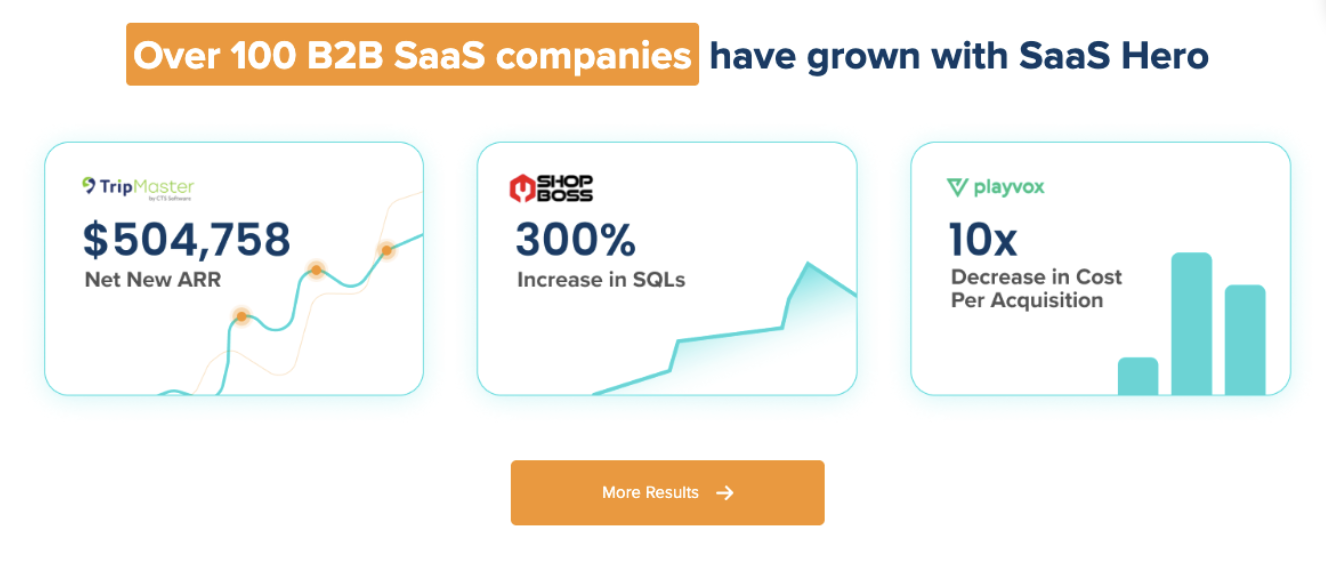
- B2B SaaS Experience At Scale: Founded in 2018, SaaSHero has served more than 100 B2B companies and manages roughly $16M in annual ad spend, with over $60M managed over its lifetime.
- Revenue-First Approach: Every campaign is tuned to CRM outcomes such as qualified pipeline, lifecycle stage, and closed revenue instead of the conversion counts ad platforms report.
- Full-Funnel Ownership: Paid media, creative, landing pages, and reporting come from one integrated team. Nothing is outsourced, and all 20 specialists are full-time employees.
- Verified Track Record: Google Premier Partner status places SaaSHero in the top 3% of agencies, and the team has held G2 High Performer recognition for more than two years, currently ranked #20 of approximately 6,000 agencies.
- PropTech Category Experience: Named clients include Leasecake in real estate tech, with ApartmentIQ cited as a fit example that reflects the single-marketer engagement model common in PropTech.
The flat-fee model indexes to total ad spend instead of channel count, so testing new channels does not increase fees. For a broader look at how these principles apply to property management specifically, see SaaSHero’s guide on PropTech Marketing For Property Management In 2026 and PropTech Marketing Strategies That Drive Net New ARR In 2026.
Frequently Asked Questions
Is Digital Marketing Still Worth It For PropTech In 2026?
Digital marketing still delivers strong value for PropTech in 2026 when teams measure performance against revenue outcomes. The global PropTech market is estimated at roughly $51–55 billion in 2026, though estimates vary by research firm, AI adoption among property management firms jumped from 20% to 58% in a single year, and venture capital investment in PropTech reached $16.7 billion in 2025. Digital marketing provides the primary vehicle for reaching the 6–15 stakeholders who research independently before contacting sales. The key lies in optimizing to CRM data instead of form fills. An agency or internal team that reports cost per lead while your board asks about pipeline coverage focuses on the wrong problem.
How Much Should A PropTech Company Spend On Marketing?
B2B SaaS marketing spend as a percentage of ARR varies by stage and funding, with a median of about 8% of ARR, and common ranges include 10–20% for growth-stage companies, while early-stage companies often spend 15–40% and mature companies 5–15%. SaaSHero uses a $15k+ monthly ad spend floor as a qualification criterion for its engagements, although the evidence does not generalize this threshold to all mid-market PropTech companies. Budget allocation should follow CRM-measured performance. Channels that produce qualified pipeline at an acceptable CAC payback earn more budget, and channels that produce form fills without pipeline lose it. Whoever owns the full acquisition chain should make the channel-mix decision instead of inheriting it from a prior agency engagement.
How Long Does It Take To See Results From PropTech Digital Marketing?
With a 6–12 month sales cycle, teams should expect 60–90 days to establish tracking, launch campaigns, and gather initial data, then a full sales cycle to see closed-won revenue attributable to marketing. AI search visibility compounds over a similar 60–90 day window. Many teams make the mistake of measuring weekly against closed revenue and concluding that the program fails before a single deal has time to close. Set reporting expectations at the start. In-flight pipeline by channel serves as the right leading indicator, and closed-won ARR functions as the lagging indicator.
Should We Prioritize AI Search Or Traditional SEO?
AI search and traditional SEO support each other and should grow together. Google AI Overviews draw on already-indexed and already-ranking pages, so traditional SEO directly supports AI visibility in those engines. For ChatGPT and other training-based models, consistent citations across independent sources over time matter more than publishing large numbers of new pages. Prioritize comparison content, original data, and clear answer-first structure. Build a prompt set of 30–50 buyer questions, establish a baseline of citation presence across ChatGPT, Perplexity, and Google AI Overviews, and track appearance rate as the core metric instead of rank position alone.
What Is The Biggest Mistake PropTech Companies Make With Digital Marketing?
The most damaging mistake involves optimizing campaigns to form-fill counts instead of CRM revenue data. Ad platforms behave like self-fulfilling systems. When teams optimize for a form fill, the platforms find people most likely to complete forms, including students, competitors, job seekers, and existing customers, while reporting a falling cost per conversion. The dashboard improves in the metrics that look good in a weekly standup, while the pipeline number that the board watches remains flat. The fix involves feeding the algorithm high-quality data such as qualified opportunities and lifecycle-stage events as the optimization signal instead of raw form submissions. This approach requires connecting the ad platforms to the CRM and maintaining a primary-versus-secondary conversion architecture, work that many agencies skip and many internal teams cannot support.
Conclusion: Turn PropTech Marketing Into A Revenue Engine
PropTech companies that win in 2026 treat digital marketing as a revenue engine instead of a lead-generation exercise. This approach requires a clear view of the multi-stakeholder buyer, a multi-channel strategy unified by CRM-measured outcomes, and a focus on metrics that withstand board scrutiny. A disciplined 90-day plan then compounds over a full sales cycle.
If you want a partner to own the entire strategy and execution so you avoid day-to-day agency management, SaaSHero brings eight years of B2B SaaS experience, more than $60M in managed ad spend, and a revenue-first approach that optimizes to your CRM data. Book a discovery call to see how SaaSHero can help you turn PropTech marketing into measurable pipeline and ARR.