Written by: Aaron Rovner, Founder, Saas Hero | Last updated: July 11, 2026
Key Takeaways for 2026 K-12 EdTech Growth
The K-12 EdTech buying cycle typically spans 12–18 months and follows a July 1–June 30 fiscal year, with most spend concentrated in spring and early summer.
Vendors that align outreach, pilots, and ad spend with quarterly stakeholder actions and attribution windows capture a larger share of annual district budgets.
State-by-state budget deadlines and procurement rules create timing variations that require segmented campaign calendars and clear compliance planning.
Standard last-click attribution breaks on long sales cycles, while SaaSHero’s GCLID-to-closed-won framework attributes revenue accurately across 6–18-month K-12 pipelines.
Schedule a call with SaaSHero to receive a customized 2026 K-12 campaign calendar and attribution setup that turns school procurement cycles into predictable Net New ARR.
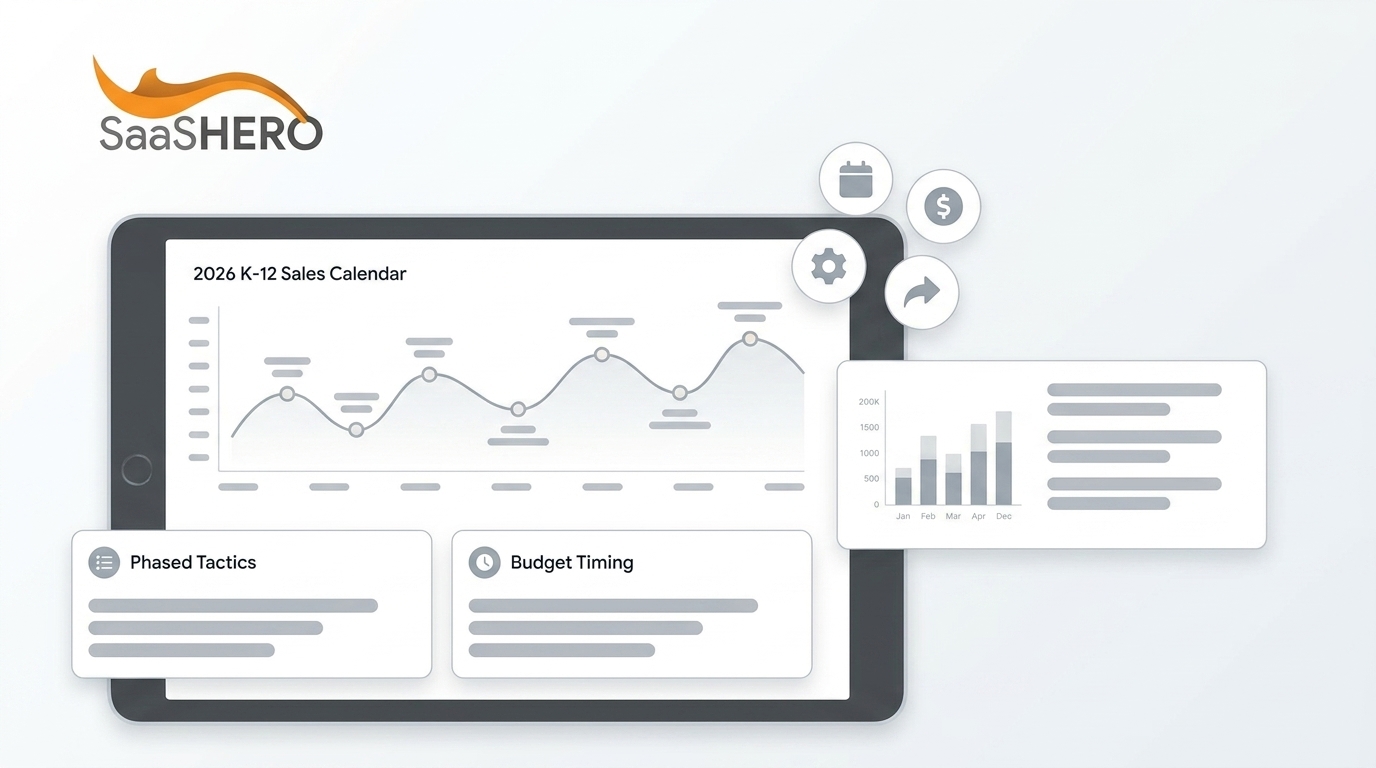
2026 Quarterly Calendar for K-12 EdTech Revenue
Quarter (2026)
Primary Actions
Stakeholder Entry Points
Attribution Window
Q1: Jan–Mar
Launch LinkedIn campaigns targeting CTOs and Curriculum Directors, publish board-presentation support assets, and monitor state aid notice releases (NJ state aid notices available around March 12, 2026).
Superintendent, CTO/IT Director, Curriculum Director
Capture first-touch GCLID, open the 12–18-month pipeline, and tag all MQLs as “Budget Development” stage.
Q2: Apr–May
Activate competitor-conquest paid search, submit cooperative-contract POs by early May, deploy pricing-transparency landing pages, and support RFP responses.
Procurement/Finance Office, Principal, School Board
Measure mid-touch attribution, track April’s typically higher deal sizes, and map influenced pipeline to closed-won ARR.
Q3: Jun–Aug
Run fiscal year-end sprint outreach, issue implementation onboarding sequences, and start new-fiscal-year relationship campaigns for districts with July budget starts.
Procurement/Finance Office, IT Director
Record last-touch closes, track July’s higher average PO values, and log closed-won ARR dates against original GCLIDs.
Q4: Sep–Nov
Launch fall pilot programs with 3–5 teacher cohorts, run awareness LinkedIn campaigns, and publish needs-assessment content for the next fiscal cycle.
Teachers, Principals, Curriculum Directors
Open a new 12–18-month pipeline, tag pilot participants as “Needs Assessment” stage, and begin multi-touch sequences.
Downloadable Asset: Download the free 2026 K-12 Procurement Timeline Template, a pre-built spreadsheet mapping every phase, stakeholder, and state deadline to your campaign calendar. Schedule your call to receive it directly from the SaaSHero team.
Budget Development (Nov–Jan 2026): Finance offices draft line items. This phase shows the lowest PO volume of the year but offers the strongest leverage for shaping budget language.
Higher education institutions often operate on 3–9-month cycles with decentralized departmental purchasing authority. A department chair or dean can frequently approve software contracts without full board review, and fiscal years vary by institution. For EdTech SaaS vendors, K-12 campaigns require at least 12 months of pipeline runway and multi-stakeholder nurture sequences, while higher-ed campaigns can use shorter, more direct conversion funnels targeting individual department heads.
State-by-State 2026 Budget and Procurement Milestones
State fiscal calendars create variation that can shift EdTech procurement windows by weeks or months. The following deadlines apply to the 2026–2027 school year.
“FERPA-compliant DPA ready on day one. LTI 1.3 certified. Student Data Privacy Consortium signatory.”
Superintendent
Strategic district goals and board confidence
Vendor relationships that create political risk at board meetings
“Used by [comparable district]. Board-presentation deck included. References available.”
Procurement / Finance Office
Competitive bidding compliance and budget alignment
Vendors who cannot navigate cooperative contracts or RFP timelines
“Available on Sourcewell contract #XXXX. Bypasses standalone RFP. PO-ready in 30–60 days.”
Downloadable Asset: Download the Competitor-Conquest Landing-Page Brief for EdTech RFPs, a ready-to-deploy page template built for each stakeholder intent type. Schedule a walkthrough and the SaaSHero team will build it with you.
September 1–15: Identify 3–5 teacher champions through LinkedIn outreach targeting grade-level or subject-area educators, then offer a no-cost, structured 8-week pilot with defined success metrics.
September 15–30: Before launching the pilot with students, execute a FERPA-compliant Data Processing Agreement so no student data touches the platform without a legal foundation. Reference the Student Data Privacy Consortium template for the district’s state.
October 1–31: Track daily active user rates weekly, then share usage dashboards with the Principal and Curriculum Director to build internal advocacy before budget conversations begin.
November 1–15: Compile pilot results into a board-ready one-pager that summarizes DAU rate, teacher satisfaction score, standards-alignment evidence, and projected district-wide cost per student.
November 15–30: Present findings to the CTO and Superintendent so they can position the full contract as a budget line item for the November–January budget development phase.
February: Publish a transparent pricing page with per-student and district-wide tiers, then deploy competitor-conquest paid search targeting “[Competitor] pricing” and “[Competitor] alternatives” keywords to capture districts in active evaluation.
March: Once districts have pricing clarity, provide procurement templates that remove the next friction point, including a pre-filled cooperative-contract reference sheet (Sourcewell, OMNIA Partners, TIPS, E&I, Equalis Group) and a sole-source justification letter template for districts below state bidding thresholds.
April: After procurement teams have templates in hand, deliver a board-presentation slide deck to the Superintendent’s office during the approval-phase window when formal commitments are made.
Early May: Hit the early-May PO deadline referenced earlier so districts can close deals and receive June 30 fiscal-year-end delivery.
SaaS Attribution for 6–18-Month K-12 Sales Cycles
K-12 procurement cycles often last 6–18 months, and standard last-click attribution models collapse under this timeline. Those models assign closed-won revenue to the final brand search and ignore the September LinkedIn impression or the October pilot-request form that actually initiated the relationship.
SaaSHero’s attribution framework passes the Google Click ID (GCLID) from the first ad interaction through the landing page form and into the CRM (HubSpot or Salesforce). The value then stays on the contact record for the full duration of the sales cycle. Every subsequent touchpoint, including demo requests, pilot sign-ups, RFP submissions, and board-approval emails, is logged against the originating GCLID. When the deal closes, the closed-won ARR is attributed back to the originating campaign, channel, and keyword, which produces a Net New ARR report that reflects the real revenue contribution of each demand-gen investment.
SaaSHero operates on flat monthly retainers with no percentage-of-spend billing, which removes the agency incentive to inflate budgets. Reporting centers on Net New ARR, pipeline value, and sales-qualified leads, not impressions or click-through rates. The TripMaster engagement produced $504,758 in Net New ARR within 12 months at a 650% ROI, with every dollar of closed revenue traced to its originating paid-search or LinkedIn campaign.
B2B Landing Pages so effective your prospects will be tripping over their keyboards to convert
See the attribution framework in action and schedule a call to walk through SaaSHero’s GCLID-to-closed-won setup for EdTech SaaS companies operating on 12–18-month K-12 cycles.
Frequently Asked Questions
Best Time of Year to Start a K-12 EdTech Marketing Campaign
September through January offers the highest-leverage entry window for new district relationships. During this period, departments complete needs assessments and budget line items are still being drafted, so vendor outreach can directly influence which products receive funding. Campaigns launched after March compete against budgets that are already largely committed. Vendors targeting the spring close should have paid-search and LinkedIn campaigns running by February at the latest to capture districts in active RFP evaluation.
Messaging Teachers vs. Administrators in K-12 Districts
Teachers evaluate tools on classroom usability, daily workflow fit, and the time required to learn and implement the product. Messaging for teachers should lead with setup speed, LMS integration (Canvas, Schoology, Google Classroom), and student engagement outcomes. Administrators and curriculum directors prioritize standards alignment, measurable learning outcomes, and the ability to present ROI data to the school board. Procurement and finance offices require cooperative-contract references, FERPA compliance documentation, and clear pricing structures that withstand competitive bidding review. Each stakeholder group needs a dedicated landing page with message-matched copy rather than a single generic product page.
Attribution Setup for 12–18-Month Sales Cycles
The foundation involves passing the Google Click ID from the first ad click into the CRM contact record at the moment of form submission. This setup requires a hidden GCLID field on every landing page form and a CRM workflow that stores the value against the lead. From that point, every deal stage, including MQL, SQL, pilot, proposal, and closed-won, is timestamped in the CRM. When a deal closes 14 months after the first click, the closed-won ARR is attributed back to the originating campaign and keyword. SaaSHero layers Looker Studio reporting on top of HubSpot or Salesforce data to produce a Net New ARR dashboard that shows which campaigns generate real revenue, not just top-of-funnel volume.
How Cooperative Purchasing Contracts Accelerate EdTech Sales
Cooperative purchasing contracts are pre-negotiated agreements held by organizations such as Sourcewell, OMNIA Partners, E&I, Equalis Group, and TIPS that satisfy competitive bidding requirements on behalf of member districts. If an EdTech vendor already appears on a cooperative’s approved vendor roster, a district can issue a purchase order in 30–60 days without running its own RFP process. This path ranks among the fastest legal procurement options in K-12 and is widely used by districts. Vendors not yet on a cooperative contract should treat the application process as a parallel sales motion that runs alongside standard demand-gen campaigns.
SaaSHero’s Flat-Fee Model for Seasonal EdTech Revenue
SaaSHero charges a fixed monthly retainer based on ad spend band and channel count, not a percentage of spend. The agency fee therefore stays flat when budgets scale up during the spring close window (February–May) or the fiscal year-end sprint (June–July). EdTech companies can concentrate spend in the highest-probability procurement windows without triggering a proportional increase in agency costs. Retainers run month-to-month, so clients avoid annual contracts during off-peak months when pipeline activity is lower. Reporting anchors to Net New ARR and pipeline value, giving EdTech growth leaders the board-ready metrics they need to justify seasonal budget concentration.
Conclusion: Turn School Cycles into Predictable Net New ARR
K-12 procurement functions as a predictable calendar that rewards vendors who map demand-gen, pilot programs, and attribution windows to its exact phases. The September needs-assessment window, the February–May RFP sprint, and the July PO surge repeat every fiscal year and create recurring revenue opportunities. EdTech SaaS companies that build their paid-search and LinkedIn campaigns around these phases, sequence stakeholder outreach from teacher pilots through board approval, and connect every GCLID to closed-won ARR convert a 12–18-month cycle into a compounding Net New ARR engine.
SaaSHero specializes in building this system for B2B SaaS companies selling into K-12 districts, using flat-fee retainers, competitor-conquest campaigns timed to RFP windows, and attribution frameworks that survive the full length of a school procurement cycle. Get your 2026 K-12 campaign calendar and schedule a call to build it around your district targets, your fiscal windows, and your Net New ARR goals.
Includes unlimited revisions as well as custom written copy (from a human, not ChatGPT). We’ll send a first draft in Figma and you can request as many edits as you’d like. We won’t ever activate any landing pages until you give us the final OK