




Written by: Aaron Rovner, Founder, Saas Hero | Last updated: June 26, 2026
Key Takeaways
- Rising CAC and stricter privacy rules have weakened traditional attribution, so B2B SaaS teams must prove ads create net-new ARR.
- A marketing developer SDK embeds first-party attribution logic inside your product and connects ad impressions to closed-won revenue that finance teams trust.
- SDKs usually outperform APIs for attribution because they capture richer client-side context with less custom engineering and fewer data gaps.
- Real SaaS companies use SDK-driven attribution to reach outcomes like sub-90-day CAC payback and hundreds of thousands in net-new ARR.
- See how SaaSHero maps your ad stack to closed-won revenue by scheduling a discovery call.
How a Marketing Developer SDK Powers B2B Attribution
A marketing developer SDK forms the base layer of a reliable B2B SaaS attribution stack. Unlike a tracking pixel or tag manager snippet, an SDK runs inside your application and observes user behavior directly. It captures events such as signups, feature activations, and subscription upgrades at the source, then passes structured data to your CRM, ad platforms, and analytics tools.
Because the data originates inside your product, it qualifies as first-party data and avoids browser-level blocking or consent-mode degradation. For B2B SaaS teams, this creates a clear benefit. You can connect a Google Ads click ID (GCLID) to a HubSpot contact record and then to a Salesforce closed-won opportunity.
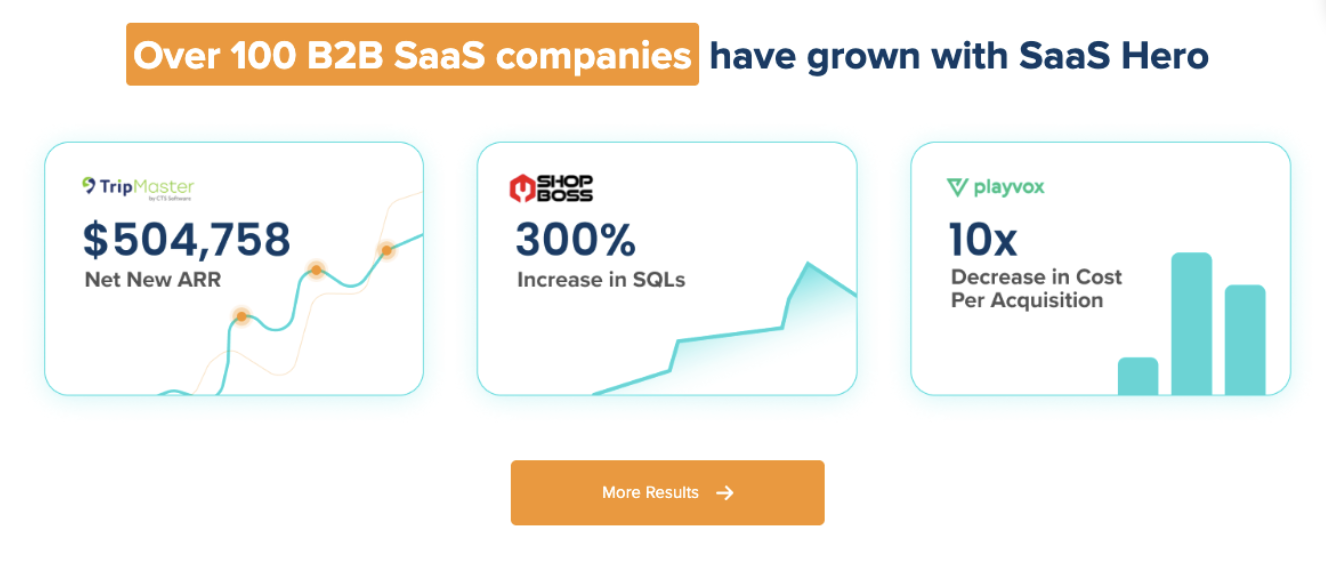
That chain turns a campaign dashboard from a vanity-metric report into a revenue ledger. SaaSHero’s client results show this in practice. TripMaster added $504,758 in net-new ARR in one year because attribution connected the ad click to closed revenue instead of stopping at a form submission.

SDK vs API in Marketing Attribution
The difference between an SDK and an API directly affects attribution accuracy and CAC payback calculations.
An API is a server-to-server interface where your backend sends an event to a platform endpoint after the fact. APIs work well for transactional data such as billing events and subscription changes. They also require your engineering team to build and maintain every integration. Latency, data-mapping errors, and missing client-side context such as device type, session data, and ad click parameters frequently create gaps.
An SDK is a pre-built library that runs client-side or inside your mobile app. It automatically captures context such as session identifiers, device signals, and referral parameters, then batches that data with server-side events. This approach produces richer attribution with less custom engineering.
The impact on CAC payback is significant. An API integration that drops 15% of conversion events because of network timeouts or mapping failures produces a CAC figure that is 15% too low. When that error compounds across a $30,000 monthly ad budget, misattribution pushes spend toward underperforming campaigns and away from the channels that actually drive revenue.
B2B SaaS Attribution Use Cases with Revenue Outcomes
The following table highlights documented outcomes from B2B SaaS companies that implemented closed-loop attribution connecting ad spend to CRM revenue data. All figures come from SaaSHero’s published case studies.
| Company | Vertical | Attribution Outcome | Revenue Impact |
|---|---|---|---|
| TripMaster | Transit SaaS | GCLID-to-CRM closed-loop, 20% paid search conversion rate | $504,758 net-new ARR |
| TestGorilla | HR Tech | Multi-channel attribution enabling unit-economic proof for investors | 80-day CAC payback, $70M Series A, 5,000+ new customers |
| Playvox | CX Software | Negative keyword restructure eliminating unqualified traffic | 10x decrease in CPL, 163% volume increase |
| Leasecake | Real Estate Tech | LinkedIn Ads attribution by job title and sector | $3M VC round, record growth quarter |
TestGorilla’s payback period gives investors the confidence to back aggressive growth. Every dollar spent on acquisition returns to gross margin in under three months, which supports sustained scaling.

Top Marketing SDK Platforms for B2B SaaS Teams
These revenue outcomes depend on choosing an SDK platform that fits your CRM, product surface, and compliance needs. Once you confirm that SDK-based attribution can move revenue, the next step is selecting a platform that supports your stack.
The table below compares four widely used marketing SDK platforms on dimensions relevant to B2B SaaS attribution. Pricing and feature availability vary by plan, so confirm current terms with each vendor before procurement.
| Platform | Primary Use Case | CRM Integration | Privacy Compliance |
|---|---|---|---|
| Segment (Twilio) | Customer data pipeline, event collection and routing | Native HubSpot, Salesforce connectors | Consent management API, GDPR data deletion support |
| Amplitude | Product analytics, behavioral cohort attribution | Salesforce, HubSpot via partner integrations | Data residency options, GDPR and CCPA tooling |
| Mixpanel | Funnel and retention analytics, event-based attribution | HubSpot, Salesforce via Zapier or direct API | EU data residency, consent-mode compatible |
| Adjust | Mobile attribution, SKAdNetwork and ATT compliance | Salesforce Marketing Cloud, custom webhook support | ATT framework support, GDPR Data Processing Agreement |
Platform selection depends on your primary surface area. Mobile-first products with iOS distribution usually require ATT-compliant SDKs such as Adjust. Web-based B2B SaaS products with complex multi-stakeholder funnels often benefit more from Segment or Amplitude, which route first-party events into CRM records for revenue attribution.
Step-by-Step Marketing SDK Integration for Attribution
A structured integration process prevents data gaps that corrupt CAC calculations. The following steps apply to web-based B2B SaaS products that connect to HubSpot or Salesforce.
- Define your event taxonomy. Map every revenue-relevant action such as trial start, demo request, plan upgrade, and churned subscription before writing SDK code. Events that remain undefined cannot be attributed.
- Instrument the SDK client-side. Install the SDK in your application and fire events with consistent property schemas. Include user ID, company ID, plan tier, and the originating ad click parameter such as GCLID for Google or UTM source for other channels.
- Pass the GCLID to your CRM. Store the GCLID as a hidden field on every lead form and pass it to HubSpot or Salesforce on form submission. This value links ad spend to the contact record.
- Enable offline conversion imports. Upload closed-won CRM data back to Google Ads using the GCLID as the join key. Google then optimizes toward users who paid, not just users who clicked.
- Build a revenue dashboard. Use Looker Studio or your CRM reporting layer to visualize pipeline value, CAC by channel, and payback period. This view replaces the vanity-metric PDF.
When this stack runs correctly, every campaign decision relies on closed revenue data. SaaSHero’s retainer model includes tracking setup during onboarding so the GCLID-to-CRM chain exists before you scale media spend.
2026 Privacy & Compliance Checklist for SDK Attribution
A functional attribution stack only delivers value when it stays compliant as privacy regulations evolve. Two regulatory frameworks directly affect how marketing SDKs collect and transmit data in 2026.
Apple App Tracking Transparency (ATT): Any iOS application that tracks users across apps or websites must request explicit permission through the ATT prompt. Apple’s ATT framework documentation requires that apps call the requestTrackingAuthorization API before accessing the device’s IDFA. SDKs that rely on IDFA for attribution, which is common in mobile SaaS, must implement SKAdNetwork as a fallback for users who decline the prompt.
GDPR (EU) and UK GDPR: The General Data Protection Regulation requires a lawful basis for processing personal data. For marketing SDKs, this usually means consent. Your SDK must respect consent signals, either through a Consent Management Platform integrated with Google Consent Mode v2 or through server-side filtering that suppresses event transmission for non-consenting users.
The 2026 compliance checklist for any marketing SDK deployment includes the following items.
- Implement Google Consent Mode v2 to preserve modeled conversion data for GDPR-scope traffic.
- Audit SDK data flows for cross-border transfers and ensure Standard Contractual Clauses (SCCs) exist for EU-to-US data transmission.
- For iOS apps, implement the ATT prompt with a clear purpose string and SKAdNetwork fallback attribution.
- Configure data retention limits within your SDK platform to meet GDPR Article 5(1)(e) storage limitation requirements.
- Document your event taxonomy in a Record of Processing Activities (ROPA) as required under GDPR Article 30.
Audit your tracking and consent setup for 2026 compliance in a discovery call with the SaaSHero team.
Build vs Buy: Deciding How to Implement Your SDK
The build-versus-buy decision for a marketing SDK depends on three variables: engineering capacity, time-to-revenue, and total cost of ownership.
Build: A custom attribution SDK gives you full control over data schema, event taxonomy, and integration logic. It removes third-party vendor risk and exposure to platform pricing changes. The cost is engineering time, often 3 to 6 months for a production-ready system, plus ongoing maintenance as ad platform APIs and privacy frameworks change. For most B2B SaaS companies below $10M ARR, this opportunity cost delays revenue-generating work.
Buy: Commercial SDK platforms such as Segment, Amplitude, and Adjust provide pre-built integrations, compliance tooling, and documented APIs. Time-to-value usually measures in days instead of months. The trade-off is vendor dependency and recurring platform cost, which you must compare against the engineering hours saved.
The neutral decision rule hinges on two factors: team capacity and requirement complexity. If your engineering team has fewer than three dedicated data engineers and your attribution requirements are standard, such as GCLID-to-CRM, multi-channel UTM tracking, and basic funnel events, buying a commercial platform delivers faster time-to-value than building custom infrastructure. Conversely, if you operate at a scale where platform fees exceed the cost of internal engineering and your data requirements are non-standard, building becomes economically rational, although you should plan for at least 12 months before the system becomes reliable enough to guide media spend.
People Also Ask
- What is the difference between a marketing SDK and a tracking pixel? A tracking pixel is a server-rendered image request that fires on page load, captures limited context, and is blocked by most modern browsers and ad blockers. A marketing SDK is embedded code that runs inside your application, captures rich first-party event data, and usually avoids browser-level blocking.
- Do marketing SDKs work without third-party cookies? Yes. SDKs collect first-party data from within your application, so they do not depend on third-party cookies and serve as a primary technical response to cookie deprecation.
- How long does it take to implement a marketing SDK for B2B SaaS attribution? A standard implementation using a commercial platform like Segment often finishes within a few weeks for a web application, including event taxonomy definition, CRM integration, and dashboard setup. Custom builds take significantly longer.
- Can a marketing SDK connect ad spend to closed-won revenue in a CRM? Yes, when the GCLID or equivalent click parameter is captured at the ad click, stored on the lead record, and passed to the CRM on conversion. This process forms the core mechanism behind closed-loop attribution.
- Is a marketing SDK required for GDPR compliance? An SDK alone does not ensure GDPR compliance. Compliance requires a Consent Management Platform, proper data processing agreements with SDK vendors, and SDK configuration that suppresses data collection for non-consenting users.
FAQ
What budget should a B2B SaaS company allocate for marketing SDK implementation?
Companies using a commercial SDK platform should plan for some engineering time plus a monthly subscription that varies by vendor, event volume, and selected features. If you engage a growth partner like SaaSHero, tracking setup is included in the onboarding fee, which runs $1,000–$2,000 one-time. This structure usually keeps the total cost of a production-ready attribution stack lower than most teams expect.
Who owns the marketing SDK data, the agency or the client?
The client always owns the data. SDK events flow into the client’s analytics platform and CRM. A legitimate growth partner operates within the client’s accounts and never holds data hostage. SaaSHero’s model follows this principle, so clients retain full access to all ad accounts, tracking configurations, and CRM integrations at all times, regardless of whether the engagement continues.
How quickly can a marketing SDK improve CAC payback period?
Attribution quality improves as soon as the SDK is instrumented and the GCLID-to-CRM chain becomes active. The downstream impact on CAC payback depends on how quickly you reallocate budget away from underperforming campaigns. In practice, many B2B SaaS teams see measurable CAC improvement within the first several months of operating on closed-loop attribution data because they can finally distinguish campaigns that produce closed revenue from campaigns that only generate unqualified form fills.
What is the risk of choosing the wrong marketing SDK platform?
The primary risk is data migration cost. If you instrument dozens of events against one platform’s schema and later switch vendors, re-instrumentation requires significant engineering time. You can reduce this risk by choosing a platform with a standard event schema, such as Segment’s widely adopted Spec, and by maintaining your event taxonomy in a version-controlled document that remains independent of any single vendor.
Does SaaSHero require a long-term contract to implement SDK-based attribution?
No. SaaSHero operates on month-to-month agreements. The tracking setup and attribution infrastructure are built during onboarding, and the client retains full ownership of that infrastructure. The month-to-month model means SaaSHero must demonstrate revenue impact, not just activity, every 30 days to keep the engagement.
How does SaaSHero connect SDK attribution data to net-new ARR reporting?
SaaSHero integrates GCLID tracking through landing page forms into HubSpot or Salesforce, then uses offline conversion imports to pass closed-won revenue data back to Google Ads. Reporting is built in Looker Studio and anchored to net-new ARR, pipeline value, and CAC by channel, not impressions or click-through rates. This framework produced TestGorilla’s sub-90-day payback and over half a million in net-new ARR for TripMaster.
The build-versus-buy decision, platform selection, and compliance checklist all roll up to a single operational requirement. Someone must own the implementation and connect it to revenue outcomes. For B2B SaaS teams without a dedicated marketing engineer, that ownership gap often breaks attribution and makes CAC calculations unreliable. SaaSHero’s flat-fee, month-to-month model closes that gap by handling tracking setup, CRM integration, and campaign optimization as one accountable engagement instead of a fragmented set of vendor relationships.