




Written by: Aaron Rovner, Founder, Saas Hero
Key Takeaways
- A revenue-focused UVP for B2B SaaS connects buyer pains directly to Net New ARR, payback period, and CAC outcomes instead of taglines.
- The 5-step workflow produces a tested UVP statement ready for landing pages, competitor conquest campaigns, and sales enablement.
- Quantified differentiators and buyer-language outcomes reduce price resistance and shorten sales cycles.
- Validation through customer surveys, sales role-plays, and A/B testing confirms the UVP resonates before you scale paid spend.
- SaaSHero turns finished UVPs into high-intent paid campaigns; schedule a call to map your pipeline data to the 5-step workflow.
The 5-Step UVP Workflow You Will Use
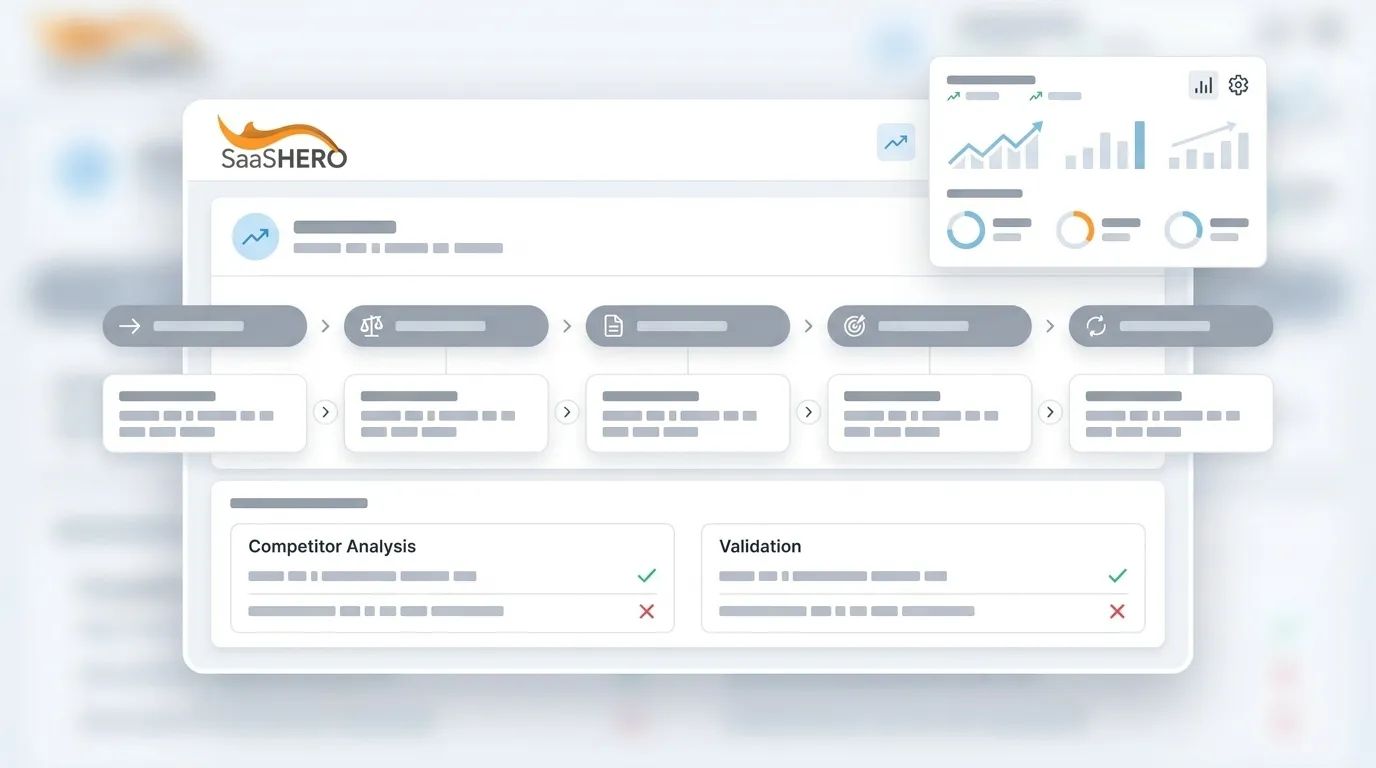
The five steps are: (1) Map Buyer Pains to Revenue Outcomes, (2) Quantify Differentiators Against Competitors, (3) Draft Your Core UVP Statement, (4) Build the Competitor-Conquesting Variant, and (5) Validate and Iterate with Stakeholders. The output is a tested UVP statement ready for Google Ads, LinkedIn conquesting campaigns, and sales enablement decks.
Series A–B teams face three operating realities that make this difficult. Cross-functional misalignment between product, marketing, and sales produces mixed market messages. Eighty-six percent of B2B buyers see little difference between suppliers, so vague positioning wastes budget. Leading with product features instead of customer outcomes fails to connect to buyer priorities, which extends sales cycles unnecessarily.
Prerequisites and Core SaaS Metrics You Need
Before starting, gather four categories of inputs. First, pull CRM pipeline data segmented by stage and close date, which shows which stages align with specific pain points and deal sizes. Second, collect win/loss interview notes from the last 20 deals so you capture exact buyer language. Third, export G2 and Capterra reviews to spot recurring themes in customer feedback. Finally, secure time from at least one stakeholder each from sales, product, and customer success, because each team brings a different view of buyer priorities.
Net New ARR: Annual recurring revenue added from new logos in a period, excluding expansion or renewal. SaaSHero anchors all campaign reporting to this outcome metric.
CAC Payback Period: The number of months required to recover the cost of acquiring one customer from gross margin. Both early-stage and growth-stage (Series B+) venture-backed SaaS companies typically target under 18 months CAC payback period. SaaSHero helped TestGorilla achieve an 80-day payback period.
SQL-to-Close Rate: The percentage of Sales Qualified Leads that convert to closed-won revenue. Sales operations teams using structured value proposition templates can reduce sales cycle times because reps spend less time manufacturing urgency.
Switching Costs: The financial, operational, and psychological friction a buyer incurs when replacing an incumbent vendor. A strong UVP explicitly reduces perceived switching costs to accelerate decisions.
Step 1: Map Buyer Pains to Revenue Outcomes
Purpose: Translate raw buyer complaints into the three financial levers that justify a purchase decision.
Actions: Pull your last 20 win/loss notes and G2 reviews, because these contain the raw buyer language you need. As you read, categorize every pain into one of three buckets: Make Money (for example, increase new customer acquisition by 15%), Save Money (for example, reduce operational overhead by $2.1M annually), or Reduce Risk (for example, ensure 100% compliance with new data privacy regulations). This three-lever framework forms the foundation of a signal-driven Customer Value Proposition. Once you have categorized all pains, score each by how frequently it appears and the average deal size of accounts citing it. This scoring highlights the highest revenue impact, so keep only the top two scoring pains for your UVP.
Example A (HR Tech): An anonymized HR Tech platform found that 70% of lost deals cited “manual onboarding taking 3+ weeks.” Mapped to the Save Money lever, reducing onboarding time by 60% saves $40,000 per hire cohort annually.
Example B (Cybersecurity): An anonymized security SaaS found that “audit preparation consuming 200 engineer hours per quarter” appeared in 80% of win interviews. Mapped to Reduce Risk, automated compliance reporting eliminates 200 hours and removes regulatory exposure.
Validation check: Each pain must map to a dollar amount, a percentage, or a time unit. Discard any pain that you cannot quantify.
Step 2: Quantify Differentiators Against Competitors
Purpose: Identify what your product does that competitors will not or cannot do, expressed in measurable terms.
Actions: Build a competitor value map using Strategyzer’s Value Proposition Canvas for each primary competitor. List their stated pain relievers and gain creators. Then identify gaps where your product delivers a quantified outcome the competitor cannot claim. Pull pricing pages, G2 comparison tabs, and recent review responses to find competitor weaknesses in buyer language.

Example A (Real Estate Tech): An anonymized lease management SaaS found that its primary competitor required 14-day implementation versus its own 48-hour activation. Quantified differentiator: 12 days faster time-to-value, worth approximately $8,000 in avoided consultant fees per deployment.
Example B (Marketing Tech): An anonymized attribution platform demonstrated a 40% reduction in wasted ad spend versus a named competitor through automated channel deduplication. This became the headline differentiator in conquest campaigns.
Validation check: Each differentiator must be defensible with a case study, a benchmark, or a product audit. Because strong LTV:CAC ratios directly influence company valuations, differentiators that improve CAC efficiency carry particular weight in board and investor conversations.
Step 3: Draft Your Core UVP Statement
Purpose: Combine the top buyer pain and top differentiator into a single, testable sentence that filters poor-fit leads and reduces price resistance.
Actions: Use the buyer language captured in Step 1. Write three variants using the template below, then read each aloud. If you stumble or lose the thread mid-sentence, your prospects will as well. Choose the variant that feels most natural when spoken, then share it with one existing customer and ask which line best matches why they chose you. Their response shows whether your internal framing matches real buyer priorities.
Fill-in-the-blank UVP Template:
For [ICP job title] at [company type] who [specific pain in buyer language], [Product Name] delivers [quantified outcome] in [timeframe] by [unique mechanism], unlike [competitor category] that [key weakness].
Example A (Transit SaaS): “For operations directors at regional transit agencies who lose $200K annually to manual scheduling errors, TripMaster delivers a 20% reduction in dispatch costs within 90 days through automated route optimization, unlike spreadsheet-based tools that require manual reconciliation after every route change.”
Example B (CX Software): “For VP-level CX leaders at mid-market contact centers who overpay for agent quality management, Playvox reduces cost-per-lead by 10x within one quarter through AI-scored interaction analysis, unlike legacy QA platforms that require manual sampling of less than 5% of calls.”
Validation check: The statement must pass the 5-second test. A cold reader should understand who it is for, what outcome it delivers, and why it beats the alternative within five seconds.
Download the Free UVP Worksheet
Complete the template above in under 30 minutes with SaaSHero’s structured UVP worksheet. Schedule a worksheet walkthrough and our team will apply it to your pipeline data on the call.
Step 4: Build the Competitor-Conquesting Variant
Purpose: Adapt the core UVP for buyers actively evaluating a named competitor, targeting pricing intent, problem or complaint intent, and review or validation intent in paid search.
Actions: Identify the top two competitors generating search volume for “[Competitor] alternatives,” “[Competitor] pricing,” and “[Competitor] vs [Your Brand].” Rewrite the core UVP to lead with the competitor’s known weakness and your quantified counter. Build a dedicated landing page for each variant. Apply negative keyword hygiene by excluding navigational queries such as the brand name alone and targeting only evaluative modifiers.

Competitor-Conquesting UVP Variant Template:
Switching from [Competitor]? [Product Name] gives [ICP job title] [quantified outcome] in [timeframe], without [competitor’s key friction point]. [Proof point: case study or metric].
Example A (HR Tech): “Switching from [Competitor]? TestGorilla gives hiring managers 5,000+ assessed candidates with an 80-day CAC payback, without the manual test-building that costs your team 10 hours per role.”
Example B (Procurement SaaS): An anonymized procurement platform used a conquesting variant targeting a competitor’s known lack of ERP integration. The variant led with “No ERP rework required” and drove a 163% increase in qualified demo requests within 60 days.
Validation check: Every competitor claim must be factually verifiable. Use competitor names only in factual comparisons. Avoid competitor logos. Ensure headlines clearly identify your brand as the advertiser to comply with platform policies.
Step 5: Validate and Iterate with Stakeholders
Purpose: Confirm the UVP resonates with buyers and internal teams before you scale spend.
Actions: Run a 5-question survey with ten existing customers asking them to select which statement best describes why they chose you. Present both the core UVP and the conquesting variant to your sales team and ask them to role-play the first 60 seconds of a discovery call using each. Track which phrasing prospects repeat during calls, because that language belongs in your headline. Validate quantitatively through CRM data and product analytics on efficiency gains, and qualitatively through interviews with unbiased customers to capture exact outcome language.
Example A (Construction Tech): An anonymized construction SaaS ran a 10-customer survey and discovered buyers described the outcome as “fewer RFI delays” rather than the internal framing of “document management efficiency.” The survey language replaced the internal language in the headline and lifted demo request rate by 22%.
Example B (Logistics SaaS): A sales team role-play revealed that the phrase “payback in one dispatch cycle” resonated more than “ROI within 90 days” with operations buyers. The conquesting variant was updated before launch.
Validation check: Companies that prioritize clear, unique value propositions in their sales playbooks can achieve higher win rates in complex deals. If your win rate does not move after two sales cycles, return to Step 1 and re-examine the pain mapping.
Measurement and Validation of UVP Performance
Test the UVP using four metrics. Track landing page A/B CTR for headline variant A versus variant B. Monitor demo-request rate and aim for 3–5% of paid traffic. Measure SQL quality score by the ACV of SQLs generated. Track payback-period movement monthly in your CRM against a baseline.
B2B attribution is non-linear, because buyers interact with multiple touchpoints before converting, which makes it difficult to assign credit to a single channel. This complexity explains why many leaders believe brand influences demand yet struggle to connect brand activity to pipeline outcomes. SaaSHero addresses this by passing GCLID data from ad click through landing page into HubSpot or Salesforce, which enables optimization based on who closed, not who clicked. Use Looker Studio to visualize multi-touch influence across the full funnel instead of defaulting to last-click attribution.
SaaSHero’s TripMaster campaign produced $504,758 in Net New ARR in 12 months with a 650% ROI and a 20% conversion rate from paid search. These outcomes tied directly to a UVP anchored in dispatch cost reduction. The TestGorilla UVP referenced earlier contributed to a $70M Series A raise by demonstrating unit economics that supported rapid scaling.

Advanced Variations Across Verticals and Paid Channels
HR Tech: Frame the UVP around time-to-hire reduction and cost-per-hire savings. Vertical SaaS segments that combine domain-specific AI and compliance workflows are experiencing strong growth, so outcome specificity now functions as a requirement rather than a differentiator.
Cybersecurity: Lead with risk reduction quantified as avoided breach cost or compliance hours eliminated. Security, transparency, and governance directly influence enterprise purchasing decisions in 2026, so governance proof points belong in the UVP headline, not the footer.
Real Estate Tech: Anchor the UVP to lease administration cost savings or portfolio risk reduction. SaaSHero’s Leasecake campaign used LinkedIn Ads targeting specific real estate job titles, producing a $3M VC round and record growth by connecting the UVP directly to portfolio-level financial outcomes.
Once you have tailored your UVP to your vertical, move to deployment across paid channels. For LinkedIn Ads, deploy the conquesting variant as a Sponsored Message targeting job titles at companies currently using the named competitor. For Google Ads, build dedicated landing pages for each intent bucket, including pricing, alternatives, and reviews, with message match between ad copy and page headline. Gartner data shows 61% of marketing budgets now flow into digital channels, which increases the importance of UVPs that perform in paid search while still supporting live sales conversations.
Frequently Asked Questions
How long does it take to build and test a revenue-focused UVP?
The five-step workflow requires approximately two to three weeks from data gathering to a validated statement. Steps 1 and 2, which cover pain mapping and differentiator quantification, take three to five business days if CRM data and win/loss notes are accessible. Drafting and internal review in Steps 3 and 4 take two to three days. Stakeholder validation in Step 5 requires one to two weeks to collect survey responses and run sales role-plays. A/B testing on landing pages should run for a minimum of two full sales cycles, typically 60 to 90 days for Series A–B companies, before you draw conclusions on conversion lift.
Which roles should own each step of the 5-step workflow?
Step 1, pain mapping, is owned by product marketing with input from sales and customer success. Step 2, differentiator quantification, is a joint responsibility between product marketing and the product team, with competitive intelligence from sales. Step 3, core UVP drafting, is owned by product marketing and reviewed by the founder or CMO. Step 4, the competitor-conquesting variant, is owned by the paid acquisition team, either internally or through a partner like SaaSHero, with legal review of any competitor references. Step 5, validation, requires the full revenue team: sales runs role-plays, customer success runs surveys, and marketing owns the A/B test design and CRM tracking setup.
How should small teams versus enterprise teams adapt the process?
Founder-led teams with no dedicated PMM should compress Steps 1 and 2 into a single two-hour session using G2 reviews and five customer calls as the primary data source, then move directly to drafting one UVP variant and one conquesting variant. PMM-led teams at Series A–B should run the full five-step process with a cross-functional workshop for Steps 1 and 2 and a structured A/B test for Step 5. Enterprise revenue teams with dedicated demand generation should layer CRM-integrated attribution from day one, build vertical-specific UVP variants for each ICP tier, and run parallel conquesting campaigns across Google and LinkedIn simultaneously.
How often should the UVP be revised?
The UVP should be reviewed after every major growth milestone such as a new funding round, a product pivot, or entry into a new vertical. At minimum, revisit it every six months by pulling fresh win/loss data and checking whether the quantified outcomes in the statement still reflect current customer results. Market dynamics shift as competitors copy differentiators, pricing changes, and buyer priorities evolve. A UVP that worked at Series A may not hold at Series B. Treat the statement as a living asset tied to CRM performance data, not a one-time deliverable.
Recap Checklist and Next Steps by Team Maturity
Checklist:
☐ CRM pipeline data and win/loss notes collected. ☐ Top two buyer pains mapped to Make Money, Save Money, or Reduce Risk levers with quantified values. ☐ Top two differentiators identified and expressed in measurable terms. ☐ Core UVP statement drafted using the fill-in-the-blank template and validated with the 5-second test. ☐ Competitor-conquesting variant completed, with landing page live and negative keyword list configured. ☐ Stakeholder validation completed via customer survey and sales role-play. ☐ CRM-integrated tracking configured to connect ad click to closed-won revenue. ☐ A/B test live on landing page headline with demo-request rate as primary KPI.
Founder-led organizations: Start with Step 1 using five customer calls and your G2 export. Draft one core UVP and one conquesting variant. Run a single Google Ads campaign against the conquesting variant before you scale budget.
PMM-led organizations: Run the full five-step process with a cross-functional workshop. Prioritize CRM integration in Step 5 so every SQL is attributed to a specific UVP variant. Use the measurement framework to build a board-ready CAC and payback-period dashboard.
Revenue-team-led organizations: Deploy vertical-specific UVP variants across HR Tech, Cybersecurity, and Real Estate Tech simultaneously. Integrate conquesting variants into LinkedIn Sponsored Messages and Google Ads comparison pages. Establish a monthly UVP review cadence tied to pipeline data.
SaaSHero turns finished UVPs into high-intent paid campaigns that produce measurable Net New ARR. Schedule a strategy session to see how the workflow applies to your pipeline data and competitive landscape.