





Written by: Aaron Rovner, Founder, Saas Hero
Key Takeaways for 2026 SaaS Agency Selection
-
2026 market data shows median SaaS CAC at $2.00 per $1.00 ARR, so agency model selection becomes a capital allocation decision.
-
Boards now prioritize CAC payback over simple pipeline dashboards, which pushes agencies to connect activity directly to closed ARR.
-
Long B2B sales cycles, averaging 102 days, create accountability gaps when agencies stop reporting at impressions or MQLs.
-
Companies between $1M–$50M ARR face intense pressure, because CAC payback above benchmarks raises the risk of down-rounds.
-
Map your CAC payback to the right agency model and improve how every marketing dollar supports runway.
How Pipeline, Revenue, and CAC Efficiency Models Really Work
Pipeline Volume suits early-stage companies ($500K–$3M ARR) that need top-of-funnel proof before they invest in revenue attribution. These companies measure success by qualified pipeline created, because CRM maturity often lags behind demand generation. They usually sign month-to-month contracts for outbound SDR programs or 6–12 month terms for content-led plays, which keeps an exit path open if pipeline quality drops. This volume-first structure earns an incentive alignment score of 5/10, since agencies get rewarded for meetings booked, not for revenue created.

Revenue Attribution fits growth-stage companies ($3M–$30M ARR) that already run a functioning CRM and have a defined ICP. These teams track Net New ARR tied to agency-sourced touchpoints, which connects spend to closed revenue instead of just pipeline. Contracts often run 6–12 months so the team can gather enough data to make attribution statistically meaningful. This model earns an 8/10 alignment score, because fees follow revenue, although attribution debates can still create friction.
CAC Efficiency works best for post-Series A companies ($10M–$50M ARR) facing board scrutiny on payback periods. These companies judge success by CAC payback versus a target threshold, which turns every campaign into a capital efficiency test. Contracts typically span 6–12 months, since payback measurement needs a full cohort cycle to stabilize. This hard financial benchmark drives a 9/10 alignment score, because the agency’s renewal depends on hitting strict CAC and payback goals.
These alignment scores highlight a deeper structural point. The way an agency gets paid shapes whether their recommendations support your CAC targets or their own revenue. Pricing design becomes a performance variable, not just a billing detail.
Flat-Fee Retainers vs Percentage-of-Spend Pricing
The percentage-of-spend model charges 10–20% of monthly ad budget. At $50,000 in monthly spend, that translates to $5,000–$10,000 per month in agency fees. The structural problem is simple. The agency’s revenue grows when the client increases budget, even when performance data does not justify that increase. The built-in incentive is to spend more, not to spend better.
Agency retainers magnify this misalignment as budgets scale. A $100,000 monthly budget with a 15% fee produces $15,000 in agency revenue, which creates pressure to maintain or grow that spend regardless of CAC. A flat monthly retainer removes this conflict by separating fee from spend volume. When a flat-fee agency recommends raising budget from $15,000 to $20,000 per month, the agency earns the same fee, so the recommendation rests on performance data instead of revenue upside.
Month-to-Month Contracts That Enforce Performance
Most B2B SaaS marketing agencies in 2026 require 6–12 month minimum contract commitments, often with 30–60 day exit clauses that activate only after the initial term. A 12-month lock-in shifts performance risk to the client, because the agency receives guaranteed revenue regardless of results. Once the ink dries, urgency to deliver often fades.
SaaSHero operates on month-to-month terms across all retainer tiers, which forces continuous accountability. The team must re-earn the engagement every 30 days. This structure acts as a forcing mechanism, because underperformance gives the client an immediate exit option. The agency’s survival stays directly tied to the client’s revenue outcomes instead of an annual renewal cycle.
Why Vertical SaaS Expertise Protects CAC
Agencies with deep B2B SaaS domain expertise command premium rates because they skip the paid learning curve. A generalist agency that juggles e-commerce, local services, and SaaS cannot build the pattern recognition needed to refine a demo-request funnel or read churn signals in a CRM.
SaaSHero serves exclusively B2B SaaS and technology companies across verticals including HR Tech, Transportation and Logistics, Procurement, Automotive, Real Estate, Healthcare, Construction, Marketing Tech, and Cybersecurity. This focus supports SaaS-specific metrics such as Net New ARR, Sales Qualified Leads, CAC payback, and pipeline velocity. Vertical expertise shortens testing cycles, improves targeting, and reduces wasted spend, which directly improves CAC efficiency.
2026 Pricing Bands and Contract Terms for Common Models
The table below compares monthly retainers, contract length, and prepay discounts across typical providers in each performance model. Use it to see how pricing structure and term length correlate with accountability. Month-to-month contracts usually signal higher confidence in measurable outcomes.
|
Model / Provider Type |
Monthly Retainer Range |
Typical Contract Length |
Prepay Discount |
|---|---|---|---|
|
Pipeline Volume — Outsourced SDR (entry) |
Month-to-month or 6 mo. |
Not standard |
|
|
Revenue Attribution — SEO/Content (mid-market) |
|||
|
CAC Efficiency — Fractional CMO Agency |
Not published |
||
|
SaaSHero — Dedicated Campaign Manager |
Month-to-month |
||
|
SaaSHero — Full Marketing Team |
Month-to-month |
SaaSHero retainer ranges come from published pricing tiers. Dedicated Campaign Manager runs from $1,250/mo (up to $10K spend, 1 channel) to $3,250/mo ($50K+ spend, 1 channel). Full Marketing Team ranges from $2,500/mo to $7,000/mo across spend bands and channel counts.
Which Agencies Align With Each Performance Model
The table below maps well-known providers to their dominant performance model, contract flexibility, and SaaS focus. Use it as a quick filter when shortlisting partners.
|
Agency |
Primary Model |
Contract Flexibility |
B2B SaaS Exclusive |
|---|---|---|---|
|
SaaSHero |
Revenue Attribution / CAC Efficiency |
Month-to-month |
Yes |
|
Kalungi |
Pipeline Volume (fractional team) |
Multi-month minimum |
Yes |
|
Rubicon |
Pipeline Volume |
Project or retainer |
No |
|
Powered by Search |
Revenue Attribution (SEO/paid) |
6–12 month retainer |
Primarily SaaS |
Buyer Personas and the Right Agency Model
The Overwhelmed Founder runs a $1M–$3M ARR SaaS company and still manages paid campaigns personally. The board asks about CAC payback, but the founder cannot answer because no CRM attribution exists. A Pipeline Volume model can generate meeting volume, yet it does not close the attribution gap. SaaSHero’s Dedicated Campaign Manager tier at $1,250/mo installs tracking that connects ad clicks to CRM revenue, which builds the data foundation for CAC reporting without a 12-month lock-in.
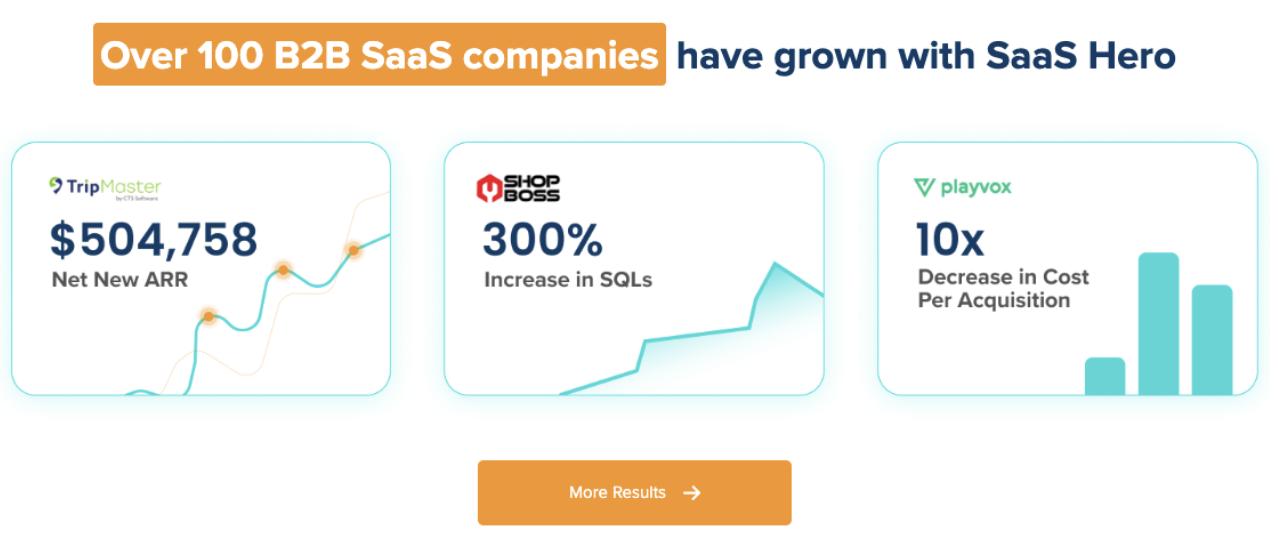
The Frustrated VP of Marketing manages a $50,000/month paid media budget at a Series B company. The incumbent agency reports CTR and impressions, while the board demands pipeline velocity and CAC payback, which the current reporting stack cannot provide. At $10M–$50M ARR, the 2026 median CAC payback target is under 14 months, so every dollar faces scrutiny. SaaSHero’s Full Marketing Team tier at $4,500/mo replaces vanity metrics with Net New ARR dashboards that connect spend to revenue. The Playvox engagement shows this shift in practice, with a 10x reduction in CPL and a 163% increase in lead volume after restructuring the account around revenue outcomes.

The Post-Funding Scaler has just closed a Series A and must deploy $30,000/month in paid media quickly. Hiring an in-house team takes at least 90 days, which delays growth targets. SaaSHero’s Full Marketing Team activates within days and brings a tested playbook. The TestGorilla engagement delivered an 80-day CAC payback period and supported a $70M Series A raise, which matches the proof next-round investors expect to see.
Identify which model matches your ARR stage and align your agency choice with current board reporting requirements.
One-Page Decision Scorecard for Agency Shortlists
This scorecard turns qualitative impressions into a simple numeric comparison. The five criteria reflect the themes in this guide: incentives, transparency, flexibility, specialization, and revenue-focused reporting. Copy the table, score each criterion from 1–5 for every agency, multiply by the weight, then add the weighted scores.
|
Criterion |
Weight |
Agency A Score (1–5) |
Agency B Score (1–5) |
|---|---|---|---|
|
Incentive alignment (flat fee vs. % of spend) |
25% |
||
|
Pricing transparency (published tiers) |
20% |
||
|
Contract flexibility (month-to-month available) |
20% |
||
|
Vertical expertise (B2B SaaS exclusive) |
20% |
||
|
Reporting cadence (ARR/CAC vs. vanity metrics) |
15% |
A weighted score of 4.0 or higher signals strong incentive alignment and structural fit. Agencies that score below 3.0 on contract flexibility or incentive alignment deserve deeper scrutiny before you sign.
Walk through this scorecard with a SaaSHero strategist and match your growth stage and board metrics to the right performance model.
Frequently Asked Questions
What is the difference between a pipeline volume model and a revenue attribution model for B2B SaaS agencies?
A pipeline volume model pays the agency based on the quantity of qualified meetings, MQLs, or opportunities generated, so the incentive is to maximize top-of-funnel output. A revenue attribution model ties agency fees to the closed-won ARR metric discussed earlier, which requires CRM integration to connect agency activity to revenue outcomes instead of just pipeline volume. Companies under $3M ARR without a mature CRM usually start with pipeline volume, while companies above $5M ARR with a defined ICP and clean CRM data gain stronger accountability from revenue attribution.
Why does a month-to-month contract produce better agency performance than a 12-month lock-in?
As explained in the contract flexibility section, month-to-month terms remove the 12-month revenue guarantee that lets agencies underperform without consequence. The 30-day renewal cycle forces continuous proof of progress instead of deferring accountability to an annual review. Agencies must show movement in pipeline, ARR attribution, and CAC payback every month or risk immediate churn.
How does SaaSHero’s flat-fee model eliminate the percentage-of-spend conflict of interest?
Under a percentage-of-spend model, an agency charging 15% earns $1,500 on a $10,000 budget and $7,500 on a $50,000 budget, so every budget increase creates direct financial upside. SaaSHero’s flat monthly retainer stays fixed within spend bands, which means moving from $12,000 to $18,000 in monthly ad spend does not change the fee when both sit in the same band. Budget recommendations then follow campaign data and CAC targets, not agency revenue growth.
Which B2B SaaS verticals does SaaSHero serve, and why does vertical specialization matter for CAC efficiency?
SaaSHero serves B2B SaaS and technology companies across the nine verticals detailed earlier, including HR Tech, Healthcare, Cybersecurity, and six others. Vertical specialization improves CAC efficiency because generalist agencies must learn buyer psychology, competitors, and conversion benchmarks from scratch on the client’s budget. A specialist arrives with benchmarks for demo-request conversion rates, ICP job titles on LinkedIn, and common objections in competitor campaigns, which compresses the learning phase and reduces wasted spend during ramp-up.
How should a VP of Marketing present agency model selection to a board focused on CAC payback?
The board presentation should center on three numbers: current CAC payback period, target CAC payback period, and how the agency model’s incentives support closing that gap. A pipeline volume model cannot directly solve a CAC payback problem because it ignores cost per acquired customer. A revenue attribution or CAC efficiency model, combined with CRM integration that connects ad spend to closed ARR, supplies the data needed for board-level reporting. The decision scorecard in this article offers a weighted framework for comparing agency proposals on the factors that matter most to capital-efficient growth: incentive alignment, pricing transparency, contract flexibility, vertical expertise, and reporting cadence tied to ARR instead of vanity metrics.