




Written by: Aaron Rovner, Founder, Saas Hero
Key Takeaways
- Capital-efficient growth in 2026 B2B SaaS depends on mapping every Pardot automation directly to buyer stages and revenue metrics like CAC payback and net-new ARR.
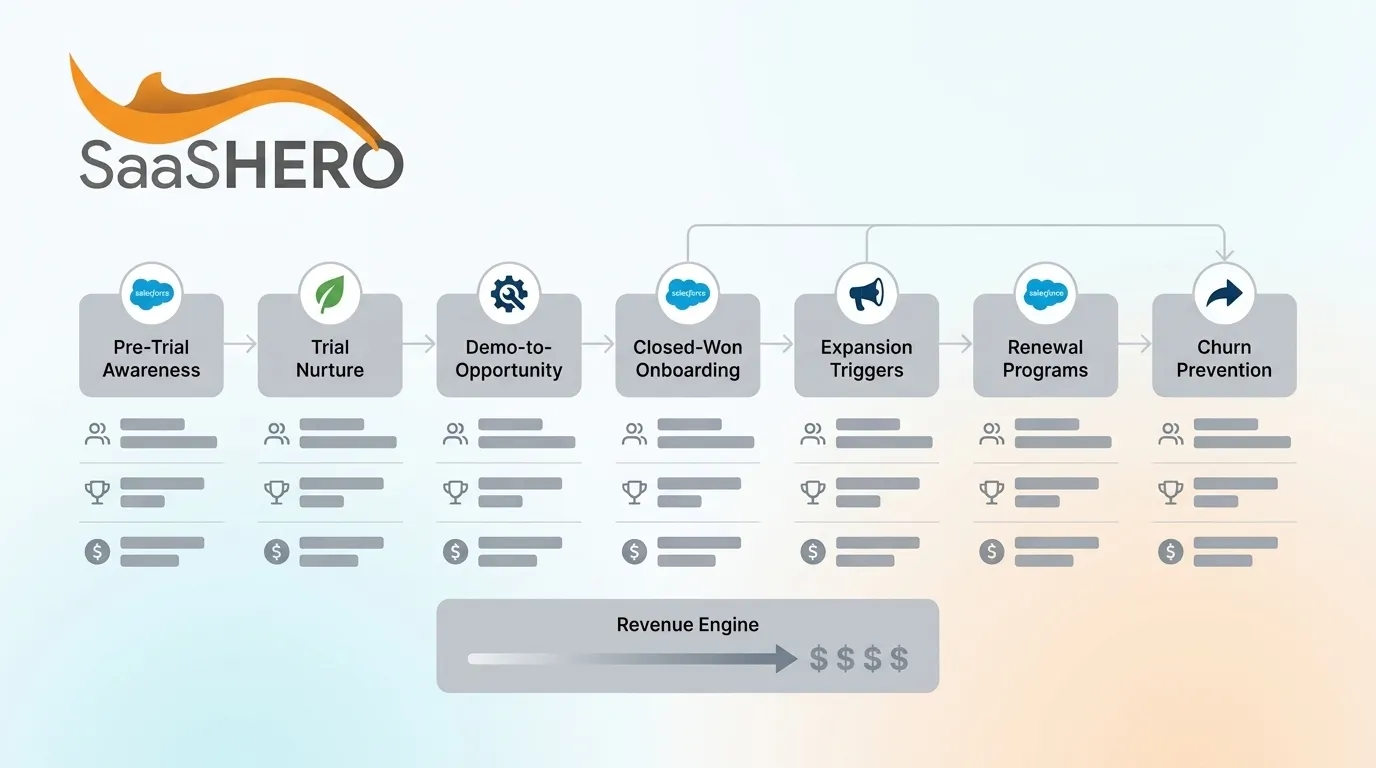
- The seven-stage Pardot-to-Revenue Framework aligns Engagement Studio sequences, scoring rules, and Salesforce syncs to specific conversion events from pre-trial awareness through churn prevention.
- Score-plus-grade MQL thresholds, trial nurture urgency triggers, and Campaign Influence attribution together improve SQL conversion and pipeline visibility in a measurable way.
- Weekly sync-error monitoring, separate customer scoring paths, and documented MQL-to-SQL SLAs prevent data loss and keep scoring models aligned with actual closed-won outcomes.
- Teams ready to turn Pardot into a measurable revenue engine can book a discovery call with SaaSHero.
Executive Summary: Seven Stages That Tie Pardot Directly to Revenue
Quick definition: The Pardot-to-Revenue Framework is a seven-stage lifecycle model that covers Pre-Trial Awareness, Trial Nurture, Demo-to-Opportunity Routing, Closed-Won Onboarding, Expansion Triggers, Renewal, and Churn Prevention. Every Engagement Studio sequence, scoring rule, and Salesforce sync maps to a specific conversion event and is measured against CAC, payback period, and net-new ARR.
Key terms: MQL (Marketing Qualified Lead) meets a score-and-grade threshold that signals readiness for sales contact. SQL (Sales Qualified Lead) is an MQL accepted by sales against defined criteria. CAC is total sales and marketing spend divided by new customers acquired in a period. Payback period is months of gross margin required to recover CAC. Net-new ARR is annualized recurring revenue from new logos closed in a period.
The seven stages below connect these metrics to concrete Pardot configurations.
Stage 1 – Pre-Trial Awareness Sequences That Qualify Fit Early
ICP-calibrated grading creates the foundation for every later stage. Configure prospect grades (A–F) against job title, company size, industry, and geography fields synced from Salesforce. Pardot combines lead scoring (implicit interest) with lead grading (explicit fit), which gives sales a clear visual signal before any human reviews a record.
Use a simple Engagement Studio template for this stage. Build a three-step awareness sequence triggered by first-touch content download. Step 1 sends a relevant case study 24 hours after download. Step 2 waits three days and checks grade, then routes B or higher to a sales alert and keeps lower grades in nurture with a product-use-case email. Step 3 sends a demo invitation at day seven to any prospect who opened step 2.
To ensure this awareness sequence receives proper attribution when prospects later convert, configure Salesforce Campaign Influence. Set the campaign member status to “Responded” on form fill and enable Primary Campaign Source on the Opportunity. This configuration gives pre-trial awareness campaigns clear credit when a prospect becomes a paid customer.
Stage 2 – Trial Nurture That Lifts Conversion at the End of the Window
The 2026 ChartMogul dataset of 200 software products shows that opt-in free trials convert at 8.9% while credit-card-required trials convert at 31.4%, which establishes the conversion ceiling your Engagement Studio sequences must work against.
Trial-to-paid conversions often cluster near the end of the trial period. Urgency-based triggers at days 5, 12, and 13 of a 14-day trial therefore carry most of the impact. Build a dynamic Engagement Studio branch that reacts to activation. When a prospect completes a key activation event, tracked via a Salesforce custom field updated by your product, suppress the urgency emails and move them into a feature-depth sequence. When no activation event fires by day 5, trigger a “getting started” email with a direct calendar link to a success call.
A 1pp lift in trial-to-paid conversion (for example, 10% → 11%) produces a revenue lift equal to the relative change in conversion rate, so trial nurture usually becomes the highest-leverage Engagement Studio investment in the stack.
Stage 3 – Demo-to-Opportunity Routing That Protects Sales Time
MQL triggers in Pardot should require both score (typically above 50) and grade (B or higher) to filter out high-engagement but low-fit prospects. A score-only threshold is the most common cause of high MQL volume with poor SQL conversion.
Configure the Engagement History Dashboards component on the Lead and Contact page layouts in Salesforce. Pardot’s Engagement History Dashboards embed directly on Account, Lead, Contact, and Opportunity records and refresh every ten minutes. The sales rep then sees which emails were opened, which pages were visited, and which forms were submitted before making the first call.
Define the MQL-to-SQL SLA in writing so expectations stay clear. Sales must accept or reject an MQL within 24 business hours. When sales rejects an MQL, that prospect should re-enter nurture instead of immediately re-qualifying. Configure a “not yet” tag that suppresses re-routing for 30 days. This suppression window prevents the same low-fit prospect from flooding the sales queue repeatedly.
Stage 4 – Closed-Won Onboarding That Drives Early Adoption
Trigger a post-sale Engagement Studio sequence the moment Opportunity Stage equals Closed Won and syncs to Pardot. Segment by product tier using a Salesforce custom field mapped to a Pardot custom prospect field. Deliver feature adoption content in order of activation complexity. Start with the core workflow, follow with advanced integrations at day 14, and send a check-in survey at day 30.
Keep onboarding engagement separate from the sales scoring model. Customer signals should be kept separate from new-business signals using dynamic customer exclusion lists based on Salesforce Account Type = “Customer”. This separation prevents customer activity from inflating new-business MQL counts.
Stage 5 – Expansion Triggers Routed to Customer Success
For post-sale expansion, customer engagement should be tracked in a separate scoring path using scoring categories (Pardot Plus edition or higher) and routed to the Customer Success queue rather than Sales to avoid polluting MQL triggers. Build expansion scoring around product usage signals such as repeated visits to upgrade or pricing pages, downloads of advanced feature documentation, and attendance at power-user webinars.
When an expansion score crosses the defined threshold, create a CS alert task in Salesforce. Use a task instead of a marketing email so a human reaches out with context and a clear upsell motion.
Stage 6 – Renewal Programs Anchored on Contract Dates
Map contract end date as a custom date field on the Salesforce Account object and sync it to a Pardot custom prospect field. Build a date-based Engagement Studio trigger that starts 90 days before contract end. Enroll the primary contact in a renewal campaign that leads with ROI content such as usage statistics and outcomes achieved. At 60 days, escalate to a CS-owned sequence with a direct renewal call invitation. At 30 days, trigger a sales alert if no renewal activity has been logged.
Stage 7 – Churn Prevention Using Disengagement and Health Signals
Negative scoring in Pardot should deduct 50–100 points for unsubscribes, 25–50 points for hard bounces, and set spam complaints to zero or negative. For customers, configure a parallel disengagement alert. When a customer contact has zero email opens and zero page views for 45 days, fire a Salesforce task to the CS owner. Integrate health score data from your CS platform as a custom Salesforce field and sync it to Pardot to enable health-score-triggered re-engagement sequences.
Salesforce-Pardot Data Hygiene and Sync Rules That Keep the Engine Running
The seven-stage framework above depends on clean data flow between Pardot and Salesforce. Without solid sync hygiene, even perfectly designed sequences fail quietly. Organizations with 500–3,000+ stuck prospects typically experience $50,000–$450,000 in annual pipeline visibility loss at average B2B deal sizes and conversion rates. Automated weekly monitoring and alerts for sync error volume changes are still rare in B2B Pardot organizations.
The most common failure points are Field Integrity Exceptions, Invalid Picklist Values, and Required Field Missing errors. Field Integrity Exceptions are present in 90% of mature Pardot organizations. Establish a weekly sync-error review. Pull the Pardot sync error report every Monday, triage any count above 50, and assign a named owner for resolution within 48 hours. This 50-error threshold marks the boundary between healthy operations and systemic breakdown. Counts above 500 require a full audit, and counts above 1,000 indicate that lead-to-sales handoff is significantly broken.
Apply clear field-mapping standards. Every field used in scoring, grading, segmentation, or routing must have a documented Salesforce-to-Pardot field map with sync direction specified. Bidirectional sync on scoring fields creates overwrite conflicts. Set score as Pardot-wins and grade as Pardot-wins, and keep Salesforce as the system of record for all firmographic data.
Pardot Maturity Model for B2B SaaS Teams
Self-assess across three dimensions before sequencing implementation priorities. These dimensions show whether your foundation can support more automation complexity.
Data quality: Are tracker domain, DKIM, SPF, and IP warming complete? Full platform configuration including business unit setup, tracker domain authentication, DKIM/SPF records, IP warming, and compliance controls must be complete before automation runs. If not, treat this as week one work.
Scoring ownership: Roughly 70% of audited B2B Pardot scoring models stop correlating with conversion within 12–18 months of implementation. When no named Sales co-owner reviews scoring quarterly, the model drifts. Assign ownership before building new sequences.
Sales SLA alignment: When MQL-to-SQL handoff SLAs are not documented and monitored in Salesforce, scoring thresholds lose relevance. Define SLAs, build a Salesforce report to track compliance, and review weekly before expanding automation complexity.
Follow this implementation sequence: data hygiene, then scoring and grading calibration, then trial nurture sequences, then MQL handoff rules, then post-sale automation, then expansion and renewal programs.
Common Pitfalls and Fast Diagnostics
Pardot scoring models without score decay allow high-scoring prospects in mature organizations to show no recent activity while still routing as MQLs. Scoring on email opens alone, without behavioral intent signals, makes this problem worse.
Use these diagnostic questions as a quick health check for revenue operations leaders. When MQLs are rejected by sales at a rate above 40%, the grade threshold is usually too low. When trial-to-paid conversion falls below the 4–6% good benchmark for opt-in trials, the trial nurture sequence likely lacks urgency triggers. When you cannot trace a closed-won deal back to its first marketing touchpoint inside Salesforce, Campaign Influence is not configured correctly. When sync errors are not reviewed weekly, pipeline visibility degrades quietly.
How Team Constraints Shape Pardot Priorities
A bootstrap founder managing Pardot alongside product and sales should follow a tight sequence. Start with sync health, because without it, no data reaches Salesforce reliably. Add a single trial nurture sequence with urgency triggers, because trial conversion is the highest-leverage point. Then set score-plus-grade MQL thresholds to prevent low-fit leads from consuming sales capacity. Everything else waits until these three foundations are stable.
A Series B VP of Marketing with a $50k per month ad budget and a marketing ops resource can extend the stack. Add Campaign Influence attribution, quarterly scoring recalibration with a Sales co-owner, and expansion scoring categories routed to CS.
A post-Series A growth lead under investor pressure to demonstrate payback period should instrument every stage with Salesforce Campaign Influence. Build the renewal and churn prevention sequences immediately. Establish a weekly revenue attribution report that connects Pardot campaign spend to closed-won ARR by source.
SaaSHero works across all three archetypes on a month-to-month basis, with no lock-in and no vanity metrics. Book a discovery call to identify which stage delivers the fastest revenue impact for your team.

Seven-Step Pardot-to-Revenue Checklist
- Complete platform configuration with tracker domain, DKIM/SPF, IP warming, and compliance controls verified before any automation runs.
- Calibrate score-plus-grade MQL thresholds against the last 90 days of closed-won and closed-lost data, and assign a named Sales co-owner for quarterly recalibration.
- Build trial nurture Engagement Studio sequences with behavioral branches and urgency triggers at days 5, 12, and 13 of the trial window.
- Configure Engagement History Dashboards on Lead, Contact, and Opportunity page layouts in Salesforce.
- Document and monitor MQL-to-SQL SLAs with a 24-hour acceptance window and a weekly Salesforce compliance report.
- Separate customer scoring into dedicated scoring categories routed to CS, and exclude customers from new-business MQL triggers using dynamic lists.
- Establish weekly sync-error monitoring with a named owner and a resolution SLA of 48 hours for any count above 50.
Frequently Asked Questions
How long does it take to see revenue impact from a properly configured Pardot setup?
Most B2B SaaS teams see measurable improvement in MQL-to-SQL conversion rate within 60–90 days after implementing score-plus-grade thresholds and correcting sync errors. Trial nurture sequences typically show conversion lift within the first two to three trial cohorts after deployment, which can be as fast as 30 days for products with short trial windows. Full revenue attribution visibility, which connects closed-won deals to first-touch campaigns inside Salesforce, usually requires 90–120 days of clean Campaign Influence data to support statistically meaningful reporting.
Who should own Pardot scoring model recalibration, marketing or sales?
Scoring model recalibration works best with joint ownership. Marketing owns the behavioral scoring logic and Engagement Studio configuration. Sales owns the definition of a qualified lead and must approve any threshold change. In practice, a named Sales operations or sales leadership stakeholder attends every quarterly scoring review, pulls closed-won and closed-lost deal data from Salesforce, and approves the updated score and grade thresholds before they go live. Without Sales co-ownership, scoring models drift away from actual conversion patterns within 12–18 months.
What is the minimum Pardot edition required to run the full seven-stage framework?
The core framework, including Engagement Studio sequences, score-plus-grade MQL routing, Campaign Influence attribution, and Engagement History Dashboards, runs on Pardot Growth, which is the entry tier. Separate scoring categories for expansion and customer signals, which prevent customer engagement from polluting new-business MQL triggers, require Pardot Plus edition or higher. Einstein Behavior Scoring, Key Account Identification, and Campaign Insights require the Advanced tier. Teams on Growth edition should prioritize dynamic customer exclusion lists as a manual workaround for scoring separation until they upgrade.
How do sync errors affect pipeline reporting and what is the fastest fix?
When a prospect enters the sync error queue, all Pardot activity such as form submissions, score changes, and list membership updates stops reaching Salesforce, and all Salesforce changes stop reaching Pardot. Lead assignment fails, suppression logic breaks, and pipeline reports show inconsistent data between systems. The fastest fix is to pull the Pardot sync error report, sort by error type, and resolve Field Integrity Exceptions first, since they are the most prevalent category in mature organizations. Correcting field mapping mismatches and invalid picklist values usually clears most errors in a single sprint. Automated weekly monitoring with a Salesforce report alert then prevents recurrence.
How should a B2B SaaS team measure whether Pardot is contributing to net-new ARR?
The measurement chain requires three configurations working together. First, Campaign Influence must be enabled in Salesforce with Primary Campaign Source populated on every Opportunity. Second, every Pardot form, landing page, and email click must create or update a Campaign Member record with a “Responded” status. Third, a Salesforce report or dashboard must aggregate Influenced Pipeline and Influenced Closed-Won ARR by campaign, channel, and lifecycle stage. This setup creates a direct line from Pardot campaign spend to closed revenue. Teams that cannot run this report inside Salesforce are missing at least one of these three configurations and should treat that gap as the highest-priority implementation task.
Conclusion: Turn Pardot into Your Revenue Engine
Pardot’s value lives in the precision of its configuration against a defined buyer lifecycle, not in the feature list. The seven-stage framework above gives revenue operations and marketing leaders a sequenced implementation path that connects every automation to a conversion event and every conversion event to CAC, payback, and net-new ARR. Most Pardot performance issues trace back to drifted architecture and setup rather than platform limitations. The platform is capable. The gap is implementation discipline.

SaaSHero focuses exclusively on B2B SaaS revenue operations and has helped companies including TripMaster add $504,758 in net-new ARR and TestGorilla achieve an 80-day CAC payback period. Every engagement is month-to-month, so SaaSHero earns continued partnership through measurable revenue outcomes, not contract lock-in.
When your Pardot setup produces MQL volume without SQL conversion, or when you cannot trace a closed-won deal to its first marketing touchpoint inside Salesforce, the framework above shows exactly where the breakdown sits. Book a discovery call and SaaSHero will audit your current configuration against the seven-stage framework and deliver a prioritized implementation roadmap.