




Written by: Aaron Rovner, Founder, Saas Hero
Key Takeaways for PayPro-Focused ABM
- Generic ABM fails for PayPro Global SaaS vendors because it ignores payments-specific value plays like tax compliance, multi-currency support, and failed-payment recovery that finance and RevOps stakeholders evaluate directly.
- A payments-aware ABM strategy maps buying committees to role-specific PayPro messaging, surfaces 2026 VAT and competitor-switch signals, and turns payments friction into closed-won Net New ARR.
- Success requires three prerequisites: CRM integration with ad platforms, technographic data identifying Stripe and Paddle accounts, and PayPro reporting exports showing authorization rates and active markets.
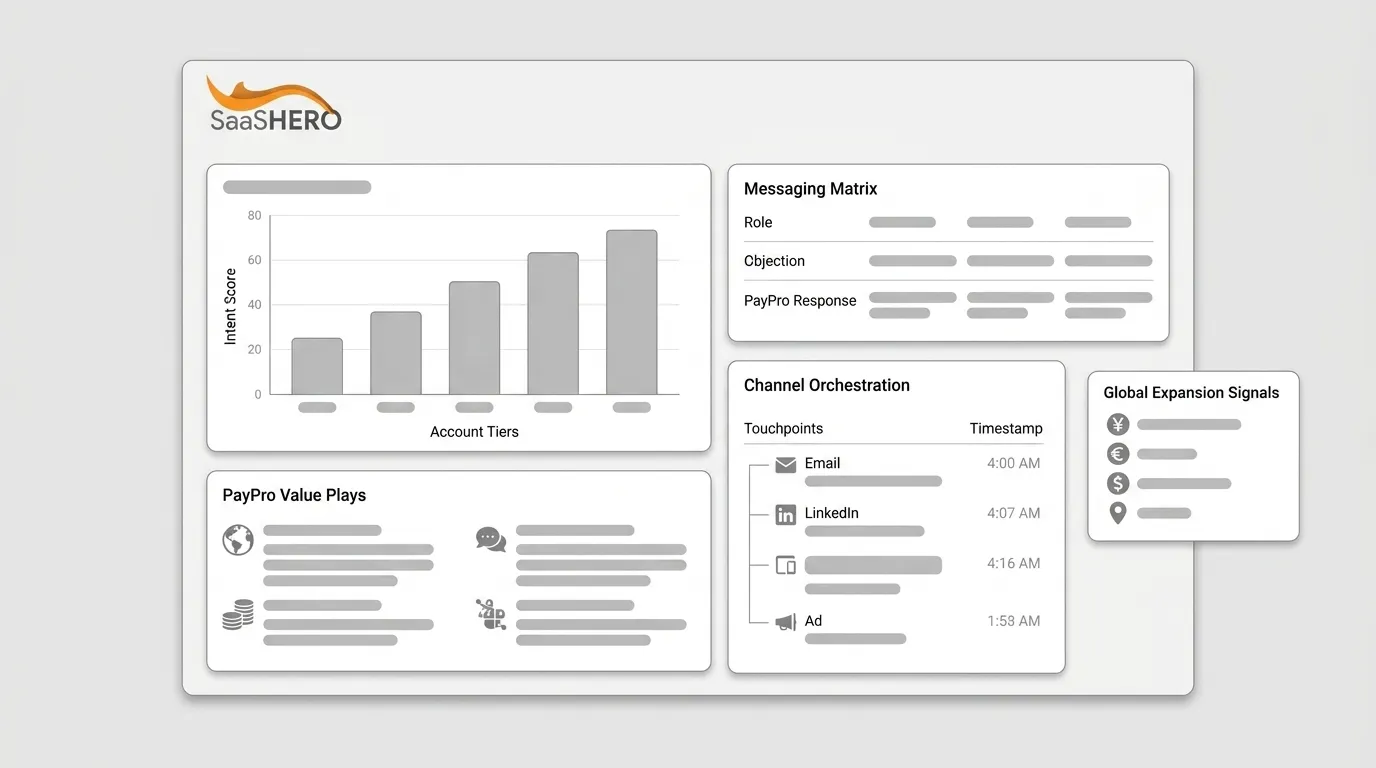
- The 7-step framework covers ICP tiering with PayPro value plays, buying-committee mapping, global-expansion signal detection, role-based messaging matrices, multi-channel orchestration, sales enablement alignment, and 30/60/90 sprints.
- SaaSHero builds and runs these payments-aware ABM programs under a flat monthly retainer, and you can launch your first sprint here.
Prerequisites for a Payments-Aware ABM Program
Confirm three inputs before you execute the framework. First, use a CRM such as HubSpot or Salesforce with account-level tracking connected to ad platforms. Second, secure technographic data that identifies accounts currently running Stripe or Paddle. Third, export PayPro Global reporting that shows authorization rates, failed-payment events, and active markets by account. Without these inputs, account scoring and signal detection in Steps 1 to 3 rely on guesswork instead of data.
The 7-Step Payments-Aware ABM Framework
Step 1: Define ICP and Tier Accounts with PayPro Value Plays
Start with firmographic fit, then add PayPro-specific value plays. Target accounts at $5–30M ARR that are expanding internationally or showing Stripe and Paddle technographic signals. Score accounts using a weighted model: industry match (20%), company size fit (20%), technology compatibility (20%), revenue capacity (15%), buying committee accessibility (15%), and expansion potential (10%). Assign Tier 1 (1:1), Tier 2 (1:Few), and Tier 3 (1:Many) designations based on total score and estimated ACV.
Anchor ICP selection on PayPro’s impact on involuntary churn. Involuntary churn accounts for 20–40% of total SaaS churn, so vendors with high transaction volume or international customers can recover meaningful annual revenue with stronger dunning and retry logic.
Step 2: Map Buying Committees and Role-Based Objections
The average B2B buying committee in regulated fintech categories often exceeds six to ten people once security and risk reviewers join the deal. For payments infrastructure decisions, the committee typically spans five functional areas.
| Role | Influence Level | Content Needs | PayPro Angle |
|---|---|---|---|
| CFO / VP Finance | Final approver | ROI model, TCO comparison, tax liability reduction | Reducing tax management burden and liability with the MoR model |
| Head of RevOps | Champion / evaluator | Failed-payment recovery data, dunning benchmarks, ARR impact | Smart dunning addressing the involuntary churn problem: ML retry, card updater integrations, and proactive expiry handling |
| Legal / Compliance | Veto power | SOC 2, PCI-DSS certification, jurisdiction coverage | PCI-DSS Level 1 certified and manages tax compliance as MoR |
| Engineering / IT | Technical evaluator | API docs, integration timeline, security architecture | Single integration unlocking 70+ payment methods, no local entity required |
| Head of Growth / Marketing | Influencer | Conversion lift data, localized checkout examples, market expansion case studies | Conversion improvements through localized checkouts and support for local payment methods |
Step 3: Surface High-Intent Global-Expansion Signals
Once you map the buying committee, identify which accounts are actively feeling the payments pain those stakeholders care about. Three signal categories indicate an account is ready for a PayPro Global conversation. First, technographic signals: technographic data includes payment method providers such as PayPal and Stripe, which helps GTM teams flag accounts running infrastructure without MoR coverage. Second, firmographic signals: new office openings, international expansion announcements, or shifts to remote-first operations show organizational growth that needs localization tools and compliance support. Third, intent signals: accounts researching “VAT compliance SaaS,” “Stripe alternatives,” or “global payments for SaaS” in 2026 sit in active evaluation. ABM programs that layer intent data and technographics on top of firmographics consistently outperform those that rely on firmographics alone.
Step 4: Build Role-Based Messaging Matrices for PayPro Deals
Give each buying-committee role a distinct message tied to a PayPro-specific proof asset. Generic messaging fails at the committee level because technical evaluators prioritize integration and security, financial stakeholders prioritize ROI and total cost of ownership, and end users prioritize ease of adoption.
| Stakeholder | Pain Point | Message | Proof Asset |
|---|---|---|---|
| CFO / VP Finance | Hidden tax compliance costs and failed-payment revenue leakage | Replace tax management burden with a flat MoR fee and recover substantial revenue from involuntary churn | TCO calculator, failed-payment recovery model |
| Head of RevOps | MRR leakage from weak retry logic and no dunning automation | PayPro’s ML Smart Retry and dunning stack closes the gap between gross and net MRR | Dunning benchmark report, ARR impact one-pager |
| Legal / Compliance | VAT/GST exposure in new markets and PCI liability | MoR model transfers tax and compliance liability, and PCI-DSS Level 1 removes audit scope | Compliance coverage map, PCI-DSS certification sheet |
| Engineering / IT | Integration complexity and maintenance overhead for multi-market payments | Single API integration and no local entity setup, with EU subscription launch in one week and 90%+ approval rates | API documentation, implementation timeline |
| Head of Growth | Low conversion in markets where local payment methods dominate | iDEAL handles 71% of Dutch online transactions, so card-only checkout leaves TAM on the table | Localized checkout conversion data, market-entry case study |
SaaSHero turns these matrices into live campaign assets, not static slides. Each role receives a dedicated landing page, LinkedIn ad sequence, and SDR talk track tied to Net New ARR reporting. Schedule a session to review your buying committee and see sample messaging matrices for PayPro vendors in your vertical.

Step 5: Orchestrate Multi-Channel Touchpoints by Tier
Run touchpoints across LinkedIn, paid search, and direct SDR sequences in parallel. Use LinkedIn job-title targeting by committee role, and bid on competitor-switch and VAT-compliance keywords in paid search. Successful ABM programs stay full-funnel, multi-channel, and always-on so they maintain engagement and surface intent signals early. For Tier 1 accounts, add executive briefing invitations and custom landing pages. For Tier 2 clusters, run cohort content that addresses shared expansion challenges. For Tier 3, use programmatic display and content syndication against intent-matched audiences.

Step 6: Align Sales Enablement with PayPro Reporting
Connect PayPro Global reporting exports to your CRM so sales can see authorization rates, failed-payment events, and active market data at the account level before outreach. This visibility fixes a common fintech gap. Teams often overserve stages 1 and 2 with top-of-funnel content and underserve stages 3 to 5 with security, implementation, and ROI assets. Once your CRM highlights accounts with high failed-payment rates or activity in covered markets, equip SDRs with a deal-acceleration stack that speaks to those issues: a compliance one-pager, implementation timeline, ROI model, and at least one competitor-switch case study.
Step 7: Launch, Measure, and Iterate a 30/60/90 Sprint
Days 1–30 focus on foundations. Finalize ICP tiers, build buying-committee maps, and launch LinkedIn and paid search campaigns for Tier 1 accounts. Days 31–60 add outbound and deeper personalization. Activate SDR sequences, publish role-specific landing pages, and start reporting on account engagement and pipeline influence. Days 61–90 emphasize optimization. Review account-level KPIs, cut underperforming segments, double down on competitor-switch signals, and report Net New ARR influenced to finance leadership.
Measurement and Validation for Finance and Sales
Report on four metrics that finance and sales leadership can validate against CRM data. Track Net New ARR influenced by ABM touchpoints, pipeline velocity by account tier, and account engagement score progression from cold to marketing-qualified account. Add failed-payment recovery ARR attributed to MoR messaging as a separate line item. Vanity metrics such as impressions, CTR, and MQL volume stay out of this report. SaaSHero anchors every client engagement in Net New ARR, using the same framework that produced $504,758 in closed revenue for TripMaster in twelve months.

Advanced Variations for 1:Few and 1:Many ABM
SaaS and software companies fit 1:Few ABM well because multiple high-value accounts often share common needs, so marketers can address payments, compliance, or expansion challenges at cluster scale. Group Tier 2 accounts by a shared expansion trigger, such as all accounts announcing DACH market entry in Q1 2026, and run a single cohort campaign with localized VAT messaging. For Tier 3, 1:Many ABM supports personalized multi-channel campaigns that optimize on revenue signals. Apply the same logic to programmatic display that targets Stripe and Paddle technographic segments.
SaaSHero executes all three tiers under a flat monthly retainer with no percentage-of-spend markup and no lock-in contract, so the agency earns the engagement every 30 days. Map your Tier 1, Tier 2, and Tier 3 accounts in a strategy session and receive your first ABM sprint plan within 48 hours.
30/60/90-Day Checklist Recap
Days 1–30: Score and tier ICP accounts, build buying-committee maps with role-based objections, launch LinkedIn campaigns by job title, activate paid search on competitor-switch and VAT-compliance keywords, and publish Tier 1 custom landing pages.
Days 31–60: Launch SDR sequences with the deal-acceleration asset stack, connect PayPro reporting to the CRM, begin account engagement scoring, and report pipeline influence to sales leadership.
Days 61–90: Review Net New ARR influenced, cut low-engagement segments, scale touchpoints on accounts showing competitor-switch signals, and present a 90-day ARR impact report to finance.
Frequently Asked Questions
What makes a payments-aware ABM strategy different from standard B2B ABM?
Payments-aware ABM targets the same accounts as standard ABM but uses MoR-specific triggers and proof. Standard ABM relies on firmographic fit and generic pain points. A payments-aware approach layers in failed-payment rates, VAT exposure in new markets, authorization lift from localized checkouts, and competitor-switch signals from Stripe or Paddle. These triggers create urgency that generic messaging cannot match. For PayPro Global vendors, the MoR model becomes the core proof point in every role-specific message, from the CFO’s tax liability reduction to the RevOps lead’s failed-payment recovery ARR.
How do we identify accounts that are ready to switch from Stripe or Paddle to PayPro Global?
Readiness shows up through three signal types. Technographic signals highlight accounts running Stripe or Paddle without an MoR layer, visible through data providers that track payment infrastructure by domain. Firmographic signals include international expansion announcements, new office openings in markets where local payment methods dominate, and job postings for finance or compliance roles in new regions. Intent signals capture accounts researching terms like “VAT compliance SaaS,” “Stripe alternatives,” or “global payments merchant of record” through intent data platforms. Combining all three signal types with your ICP tiers creates a prioritized outreach sequence that reaches accounts at peak receptivity.
Which buying committee roles should receive the first ABM touchpoint?
The Head of RevOps or Head of Growth usually provides the most accessible entry point because they own metrics most affected by payments friction, such as MRR leakage, failed-payment recovery rates, and international conversion rates. The CFO and Legal or Compliance roles hold veto power and must receive parallel messaging from day one. Single-threaded selling into one role cuts win rates sharply. The goal for the first 30 days is at least three active relationships within each Tier 1 account’s buying committee before any formal deal conversation.
How does SaaSHero report ABM results to finance leadership?
SaaSHero reports on account-level Net New ARR influenced, pipeline velocity by tier, and failed-payment recovery ARR attributed to MoR messaging, so metrics connect directly to revenue instead of activity. This approach requires integrating ad platform data through GCLID tracking, then passing it through the landing page into the CRM, so every closed-won deal traces back to its originating ABM touchpoint. Impressions, CTR, and MQL volume stay out of executive reporting. The framework described above, which delivered the TripMaster and TestGorilla results referenced earlier, applies directly to PayPro Global ABM programs.
What is the minimum viable budget to run a payments-aware ABM program for PayPro Global vendors?
A functional 1:Few ABM program targeting 10–20 Tier 2 accounts typically runs on $15,000–$25,000 per month in combined program costs across LinkedIn and paid search, managed under SaaSHero’s flat monthly retainer starting at $1,750 for that spend band. Tier 1 accounts with 1:1 customization need extra investment in custom landing pages at $750 per page and SDR enablement assets. Budget rarely creates the main constraint. Under-resourcing Legal and Compliance assets usually stalls payments-infrastructure ABM programs in procurement.
Next Steps by Team Maturity Level
Early-stage (no existing ABM motion): Start with Steps 1 to 3. Build your ICP tier list, map one buying committee per Tier 1 account, and launch a single LinkedIn campaign targeting CFO and RevOps job titles at accounts showing competitor-switch signals. Measure account engagement before you add more channels.
Mid-stage (existing demand gen, no committee mapping): Audit current campaigns for role-specificity. Replace generic landing pages with role-specific pages for each buying-committee member. Add PayPro-specific proof assets such as failed-payment recovery models and compliance coverage maps to the SDR sequence. Connect the CRM to ad platforms for Net New ARR attribution.
Advanced (existing ABM, no payments-aware layer): Overlay technographic and intent signals onto your current account list. Rebuild messaging matrices with PayPro value plays by role. Launch competitor-conquest campaigns targeting “Stripe alternatives” and “Paddle vs PayPro Global” search queries. Report failed-payment recovery ARR as a standalone KPI in the next board update.
SaaSHero supports all three maturity levels under a flat-fee, month-to-month model with senior-led strategy and Net New ARR reporting, with no percentage-of-spend billing and no 12-month lock-in. Get your payments-aware ABM sprint plan built in the first strategy session, with a working plan for your PayPro stack instead of a pitch deck.