




Written by: Aaron Rovner, Founder, Saas Hero
What You Will Get From This ABM Alignment Framework
- Misaligned sales and marketing teams create longer sales cycles and lost revenue. This 8-step framework ties every activity directly to Net New ARR, Pipeline Value, and Payback Period.
- Joint ICP definition, shared TAL ownership, and revenue-focused KPIs replace siloed MQL volume targets and remove hand-off friction.
- Buying committee mapping, CRM-enforced SLAs, and coordinated multi-threaded outreach across personas improve conversion rates and shorten deal cycles.
- A weekly operating rhythm plus a unified revenue dashboard keeps both teams working from the same pipeline and attribution data.
- SaaSHero installs and runs the full ABM alignment system in your CRM, and you can book a discovery call to get started.
8-Step Framework for Sales-Marketing Alignment in ABM
Step 1: Audit the Current State
Purpose: Create a shared baseline before you change any process or tooling.
Actions: Interview sales and marketing separately to surface conflicting assumptions. During these interviews, document current lead definitions, hand-off processes, and the metrics each team reports against. These three areas usually reveal the deepest misalignment.
Inputs/Outputs: Input: CRM export and campaign reports. Output: A gap analysis memo that both teams review and sign off.
Decision Point: Confirm whether both teams use the same definition of a qualified account. If they do not, pause and align definitions before moving forward.
SaaS-Specific Example: A $20M ARR HR Tech company discovers marketing defines MQL by form fill and sales defines SQL by BANT. Neither definition maps to the ICP, so both teams agree on a new account-based qualification model.
Common Mistake: Teams skip the audit and jump straight to new tools. Misalignment between sales and marketing can cost B2B companies 10% or more of annual revenue.
Step 2: Define a Joint ICP and Target Account List (TAL)
Purpose: Give sales and marketing one shared definition of which accounts to pursue.
Actions: Pull closed-won data from the CRM and look for firmographic and technographic patterns. Use those patterns to define the ICP, then build a TAL with direct sales input on account relationships and timing. Treat the TAL as a living list that both teams can refine.
Inputs/Outputs: Input: CRM closed-won data and intent signals. Output: Documented ICP criteria and a prioritized TAL stored in the CRM.
Decision Point: Confirm that sales has direct input into the TAL. Sales must have direct input into the target account list or they will not work the accounts.
SaaS-Specific Example: A procurement SaaS narrows its TAL to companies with 200–1,000 employees and Salesforce in place, then uses Bombora intent data to surface accounts actively researching procurement automation.
Common Mistake: Marketing builds the TAL alone. Without explicit alignment on shared goals and account ownership, sales will ignore accounts marketing targets.
Step 3: Establish Shared Revenue Goals and KPIs
Purpose: Replace siloed metrics with joint accountability for pipeline and closed-won ARR.
Actions: Replace MQL volume targets with shared KPIs that both teams can influence. Start with pipeline from target accounts and MQL-to-SQL conversion rate. Then add average deal size from TAL and pipeline velocity, because together these four metrics show whether ABM is creating higher-quality opportunities that close faster.
Inputs/Outputs: Input: Historical conversion data. Output: A shared KPI scorecard inside the CRM dashboard.
Decision Point: Check that every KPI connects to Net New ARR, Pipeline Value, or Payback Period. Remove any metric that cannot be traced back to revenue.
SaaS-Specific Example: Marketing and sales jointly own a target of $1.2M in pipeline from 40 named accounts per quarter, and they review progress weekly in HubSpot.
Common Mistake: Each team keeps its own dashboard. Many marketers and sellers agree that tighter collaboration would boost revenue, yet few share common KPIs or a single scorecard.
Step 4: Map the Buying Committee
Purpose: Identify every stakeholder who can influence or block the deal.
Actions: For each target account, map roles using LinkedIn Sales Navigator and CRM activity data. Track champion, economic buyer, technical evaluator, and compliance lead for every opportunity. Once mapped, engage multiple stakeholders at the same time, because this multi-threaded approach reduces single-point-of-failure risk.
Inputs/Outputs: Input: CRM contact records and LinkedIn data. Output: A buying committee map per account with engagement scores.
Decision Point: If a stakeholder row has not been updated in 14 days, the relationship is cold. If two or more rows are cold, the deal is at risk.
SaaS-Specific Example: A cybersecurity SaaS maps CISO, IT Director, CFO, and Procurement Lead per account. Marketing runs LinkedIn title-targeted ads for each persona while sales manages multi-threaded outreach.
Common Mistake: Teams rely on a single champion. Opportunities that include multiple buying-group members can generate much more potential revenue than single-threaded approaches.
Step 5: Define SLAs for Every Hand-Off
Purpose: Remove hand-off friction with documented, CRM-enforced commitments.
Actions: Document marketing’s commitment to deliver account intelligence and engagement data at hand-off. In return, document sales’ commitment to follow up within a defined window, creating a reciprocal agreement. Zendesk reduced lead routing time by 82% after implementing LeanData automated routing.
Inputs/Outputs: Input: CRM workflow configuration. Output: An SLA Status property, such as “MKT Engaged” or “Sales Ready,” that updates automatically based on engagement triggers.
Decision Point: Confirm that the SLA is enforced automatically in the CRM rather than through manual steps. Manual SLAs usually fail. Companies with an active SLA can be more likely to see improved year-over-year ROI.
SaaS-Specific Example: A HubSpot workflow triggers a sales task and Slack notification the moment a target account reaches an engagement score threshold. A 24-hour SLA clock appears in the deal record.
Common Mistake: 53% of companies experience broken hand-offs where sales follow up with fewer than 35% of marketing-engaged prospects.
Step 6: Build and Execute Coordinated Outreach Cadences
Purpose: Run parallel, persona-specific engagement across the buying committee instead of sequential outreach.
Actions: Assign role-specific content to each buying committee persona and document it in your playbooks. Run LinkedIn ads against named accounts by job title while coordinating sales sequences with marketing campaign timing. Effective sequences combine role-specific messaging with coordinated timing across committee members.
Inputs/Outputs: Input: Buying committee map and content library. Output: Active multi-threaded sequences logged in the CRM.
Decision Point: Confirm that marketing runs campaigns on the same accounts sales is actively working. If not, the programs operate in silos.
SaaS-Specific Example: Marketing delivers ROI case studies to the CFO persona via LinkedIn while sales runs a personalized email sequence to the champion. Both activities log to the same Salesforce opportunity.
Common Mistake: Teams run sequential outreach and wait for sales to finish before marketing engages. Successful buyer journey orchestration shows 15–30% improved close rates and 20–40% shorter cycles compared to ad-hoc approaches.
Step 7: Establish a Weekly Operating Rhythm
Purpose: Create a recurring structure that keeps both teams accountable to shared pipeline goals.
Actions: Run a weekly 15-minute RevOps Pulse meeting and a weekly pipeline review. Hold monthly SLA and win/loss reviews to close the feedback loop. ABM programs that hold regular sales-marketing account review meetings can report higher win rates than programs that meet less frequently.
Inputs/Outputs: Input: A live CRM dashboard. Output: Updated account priorities, SLA status, and next actions with clear owners.
Decision Point: Confirm that meetings produce decisions and owner assignments instead of passive status updates. Passive reviews do not move pipeline.
SaaS-Specific Example: A $35M ARR MarTech company runs a Monday 15-minute RevOps Pulse and a Wednesday 30-minute pipeline review. Both meetings use the same Looker Studio dashboard connected to HubSpot.
Common Mistake: Teams rely on monthly-only reviews. By the time issues surface, pipeline has already stalled.
Step 8: Measure, Attribute, and Improve Against Revenue
Purpose: Connect every marketing and sales activity to Net New ARR, Pipeline Value, and Payback Period.
Actions: Implement multi-touch attribution at the account level and avoid last-click models. Connect ad platforms, CRM, and intent data into a unified dashboard. Report weekly on pipeline velocity, account engagement scores, and closed-won ARR from target accounts.
Inputs/Outputs: Input: Salesforce or HubSpot data, Looker Studio, and intent platform data. Output: A weekly revenue dashboard visible to both teams.
Decision Point: Confirm that you can trace each closed-won deal back to the first marketing touchpoint. If you cannot, attribution is broken and budget decisions become guesswork.
SaaS-Specific Example: Pipeline velocity is calculated as (deals × average deal size × win rate) / average sales cycle length. This produces a dollar-per-day figure that shows whether ABM is speeding up decisions.
ICP, TAL, Shared Goals, and SLAs: How Each Piece Fits
| Element | Definition | Owner | Metric | Example |
|---|---|---|---|---|
| ICP | Firmographic, technographic, and behavioral profile of the ideal customer, documented jointly | Marketing + Sales (joint) | % of closed-won deals matching ICP criteria | B2B SaaS, 200–1,000 employees, using Salesforce, actively researching via Bombora intent signals |
| TAL | Prioritized list of named accounts that match the ICP and have active sales or marketing coverage | Marketing owns selection criteria, Sales owns relationships and timing, RevOps owns routing and SLA enforcement | % of TAL accounts with active opportunities | 40 named accounts per quarter, tiered by intent score and sales territory |
| Shared Goals | Joint revenue targets that replace siloed MQL and SQL quotas with pipeline and closed-won ARR from target accounts | Revenue Operations | % of target accounts with active opportunities and conversion rate from identified account to closed-won | $1.2M pipeline from TAL per quarter and an 80-day Payback Period on new ARR |
| SLAs | Documented, CRM-enforced commitments that govern hand-off speed, follow-up timing, and qualification criteria between marketing and sales | RevOps (enforcement); Marketing + Sales (compliance) | Lead response time with a 24-hour target and SLA breach rate per week | Sales follows up on all “Sales Ready” accounts within 24 hours, and marketing delivers an account intelligence package at hand-off |
Weekly Operating Rhythm That Keeps ABM on Track
| Meeting | Attendees | Agenda Items | Output |
|---|---|---|---|
| RevOps Pulse (15 min, weekly) | RevOps, Marketing Ops, Sales Ops | Data quality review, signal quality analysis, and account prioritization logic adjustments | Updated TAL scores and assigned data hygiene tasks |
| Pipeline Review (30 min, weekly) | AEs, SDRs, Marketing Lead, RevOps | Top 3–5 account updates, buying committee coverage gaps, SLA breach review, blockers, and next actions | Owner-assigned next actions per account and updated SLA status in the CRM |
| SLA Review (30 min, monthly) | VP Sales, VP Marketing, RevOps | Performance against shared pipeline metrics, SLA breach diagnosis, and wins celebration | SLA threshold adjustments and documented escalation decisions |
| Win/Loss Review (60 min, monthly) | Sales, Marketing, RevOps, CS Lead | Closed-won and closed-lost pattern analysis, messaging effectiveness, ICP refinement, and content gaps | Updated ICP criteria, content roadmap adjustments, and targeting refinements |
Building the Shared Revenue Dashboard
Connect Salesforce or HubSpot as the CRM source of truth, Looker Studio as the visualization layer, and a 2025–2026 intent platform such as Bombora, 6sense, or Demandbase as the account prioritization signal. Cognism’s alliance with Bombora shows third-party intent pools help sellers detect in-market accounts months before an RFP surfaces, which shifts the competitive clock forward for pre-emptive outreach. AI and machine learning predictive analytics shorten prospect-research cycles from 3–5 hours to 10–15 minutes by digesting intent signals from more than 100,000 sources.
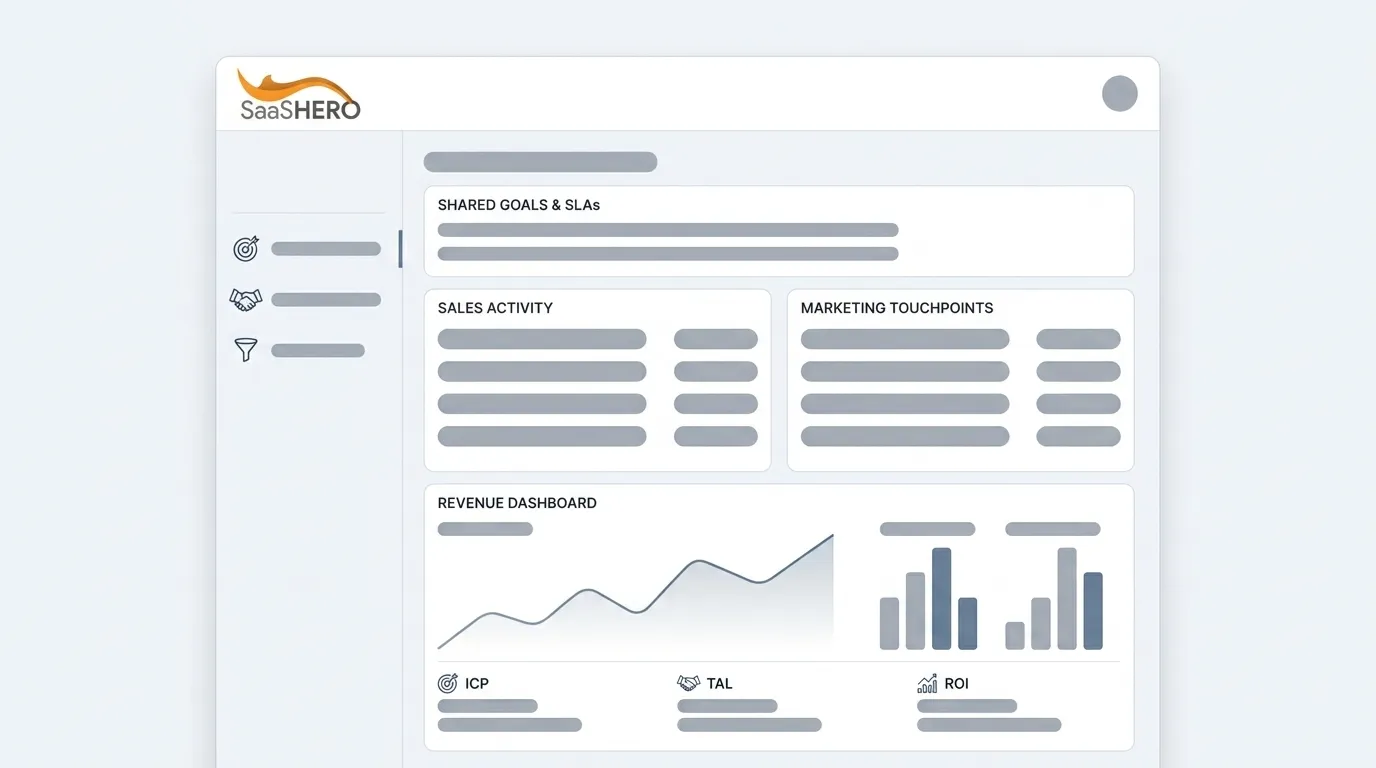
Beyond intent signals, the dashboard also needs to handle attribution complexity. For long-cycle attribution, common in $50K+ ACV deals that run 6–18 months, implement multi-touch attribution at the account level instead of last-click. Account-level attribution requires unified data from ad platforms, CRM, intent providers, and web analytics in one model to connect every touchpoint across a 6–18 month buying cycle to revenue. Every dashboard widget must map to one of three north-star outputs: Net New ARR, Pipeline Value, or Payback Period. Engagement metrics that do not connect to these three outputs belong in a secondary reporting layer, not the shared revenue dashboard.
Alignment between sales and marketing can improve pipeline forecast accuracy and reduce client acquisition costs for mid-market B2B SaaS teams. That improvement becomes measurable only when both teams pull from the same dashboard.
8-Bullet Checklist Recap
- Step 1: Audit current lead definitions, hand-off processes, and metrics separately for sales and marketing.
- Step 2: Build a joint ICP and TAL with direct sales input on account relationships and timing.
- Step 3: Replace siloed MQL and SQL targets with shared KPIs tied to pipeline and closed-won ARR.
- Step 4: Map the buying committee per account and implement multi-threaded engagement to avoid single-point-of-failure risk.
- Step 5: Define and CRM-enforce SLAs for every marketing-to-sales hand-off.
- Step 6: Run parallel, persona-specific outreach cadences across the buying committee at the same time.
- Step 7: Establish a weekly operating rhythm with a RevOps Pulse, pipeline review, monthly SLA review, and monthly win/loss session.
- Step 8: Connect Salesforce or HubSpot, Looker Studio, and intent data into a unified dashboard that reports on Net New ARR, Pipeline Value, and Payback Period.
Next Steps by Team Maturity
Early Stage (No formal ABM program yet): Start with Steps 1–3. Conduct the audit, define the ICP jointly, and agree on three shared KPIs before you touch any tooling. Mid-market B2B SaaS companies can achieve faster revenue growth when sales and marketing align on attribution and forecasting. The foundation must exist before the system can scale.
Mid Stage (ABM launched but misaligned): Focus on Steps 4–6. The TAL likely exists, but buying committee mapping is incomplete and outreach remains single-threaded. Implement CRM-enforced SLAs and shift to parallel, persona-specific cadences. As the Veeam case study shows, buying-groups orchestration can unlock significant pipeline growth for companies at this stage.
Advanced Stage (ABM running but attribution is broken): Prioritize Steps 7–8. The operating rhythm and shared revenue dashboard provide the final unlock. Organizations that deploy revenue-operations frameworks grow 19% faster and log 15% higher profitability compared with siloed peers by removing conflicting metrics and enabling coordinated outreach cadences.
How SaaSHero Installs and Runs the System
SaaSHero is a senior-led, flat-fee, month-to-month B2B SaaS growth partner that implements and operates the full sales-marketing alignment system described in this framework. Every engagement is staffed by experienced practitioners, not junior account managers, and each manager supports a maximum of 8–10 clients to provide the depth of attention ABM programs require.

The engagement covers ICP and TAL definition, CRM tracking setup that connects ad platforms to closed-won revenue, buying committee campaign architecture on LinkedIn and Google, shared dashboard build in Looker Studio, and the weekly operating rhythm. Reporting anchors to Net New ARR, Pipeline Value, and Payback Period, the same metrics SaaSHero used to generate $504,758 in Net New ARR for TripMaster and an 80-day Payback Period for TestGorilla.

SaaSHero uses no long-term lock-in contracts. The team operates month-to-month because the model only works when results arrive every 30 days. Flat-fee pricing removes the percentage-of-spend conflict of interest that pushes traditional agencies to recommend budget increases for their own benefit rather than the client’s growth.
Ready to install the full ABM alignment system? Book a discovery call with SaaSHero.
Frequently Asked Questions
What is the most important first step to align sales and marketing for account-based marketing?
The most important first step is auditing the current state before you build anything new. This audit involves interviewing sales and marketing separately to document how each team defines a qualified lead, how hand-offs happen, and which metrics each team reports against. Most ABM programs fail not because of tooling gaps but because the two teams operate from different definitions of success, the same misalignment that costs companies 10% or more of annual revenue, as noted earlier. Until those definitions are reconciled and documented, any ICP, TAL, or SLA built on top of them will carry the same misalignment. The audit usually takes one to two weeks and produces a gap analysis that becomes the foundation for every later step in the alignment framework.
What SLAs should sales and marketing agree on for ABM hand-offs?
At minimum, SLAs should cover four areas. Define the speed at which sales must respond to a marketing-qualified target account. Specify the account intelligence package marketing must deliver at hand-off, including intent score, content consumed, buying role, and suggested next action. Agree on the qualification criteria that define when an account moves from marketing ownership to sales ownership. Document the CRM fields that must be populated before a hand-off counts as complete. These SLAs must be enforced in the CRM through automated workflows, not manual steps, so both teams have real-time visibility into compliance. Review SLA breach rates weekly in the RevOps Pulse meeting and monthly in the formal SLA review with sales and marketing leadership.
How should a $10–50M ARR SaaS company structure its shared ABM revenue dashboard?
The dashboard should connect three data sources. Use the CRM, Salesforce or HubSpot, as the source of truth for pipeline and closed-won data. Use Looker Studio as the visualization layer. Add an intent data platform such as Bombora, 6sense, or Demandbase for account prioritization signals. Every widget on the dashboard must map to the three north-star metrics defined earlier: ARR growth, pipeline health, and capital efficiency. Engagement metrics such as email opens or ad impressions belong in a secondary layer and should not appear on the shared revenue dashboard. Review the dashboard in the weekly pipeline review meeting so both sales and marketing make decisions from the same data instead of separate reports that invite conflicting interpretations.
How many stakeholders should be engaged per target account in an ABM program?
Most mid-market B2B SaaS deals benefit from engaging several stakeholders per account. Relying on too few creates single-point-of-failure risk, because if the champion leaves or loses internal influence, the deal stalls. The buying committee map should track each stakeholder’s role, engagement level, last meaningful contact date, known objections, and internal relationship owner. Marketing supports committee coverage by running LinkedIn title-targeted ads for each persona at the same time, while sales manages multi-threaded outreach sequences. Both activities should log against the same CRM opportunity record so the full account picture stays visible to both teams in real time.
What does SaaSHero do differently from a traditional ABM agency?
SaaSHero operates on a flat-fee, month-to-month model with no percentage-of-spend billing and no long-term lock-in contracts. This structure removes the conflict of interest that pushes traditional agencies to recommend budget increases for their own revenue rather than the client’s growth. Every engagement is staffed by senior practitioners with a strict client-to-manager ratio, which avoids the bait-and-switch pattern where clients are sold by experienced strategists and then handed to junior account managers. SaaSHero integrates directly into the client’s CRM and communication stack, including Slack, HubSpot, and Salesforce, and reports only on Net New ARR, Pipeline Value, and Payback Period instead of vanity metrics. The month-to-month structure means SaaSHero must re-earn the engagement every 30 days, which keeps the agency’s incentives aligned with the client’s revenue outcomes.