




Written by: Aaron Rovner, Founder, Saas Hero
Key Takeaways
- Transparent Google Ads reporting for B2B SaaS ties ad spend to revenue metrics such as ARR, CAC, and pipeline, not just clicks or form fills.
- A dependable model requires the right tools, admin access, clean tracking, and CRM integration so every qualified lead and deal links back to specific campaigns.
- A simple five-step framework helps you define North Star metrics, build closed-loop attribution, standardize reporting, require insights, and align incentives with your agency.
- Centralized dashboards and offline conversion imports clarify which campaigns drive high-quality pipeline and where to adjust bids, budgets, and messaging.
- B2B SaaS teams that want help building this reporting model can schedule a discovery call with SaaSHero to review their current setup.

Prerequisites & Foundational Concepts for Transparent Google Ads Reporting
Transparent reporting depends on a technical foundation that tracks the full journey from click to closed revenue.
Required Tools and Access
Give internal stakeholders and your agency admin or edit access to:
- Google Ads and Google Tag Manager
- Google Analytics 4
- Your CRM with API access, such as HubSpot or Salesforce
- A reporting tool such as Looker Studio or Power BI
Baseline Knowledge for B2B SaaS Marketers
Teams should share clear definitions for SaaS metrics like CAC, LTV, ARR, SQL, and MQL, along with core Google Ads terms such as CPC, CTR, and conversion rate. Agreement on CRM stages and progression criteria keeps reporting consistent across marketing and sales.
Key Concepts in Transparent Reporting
Closed-loop reporting connects ad clicks to pipeline and revenue. Offline conversion tracking sends MQL, SQL, and Closed-Won data from your CRM back into Google Ads. Data-driven and multi-touch attribution models help value all stages of a long B2B SaaS journey, including upper-funnel campaigns.
Common Reporting Mistakes to Avoid
Many agencies work only from platform data and ignore CRM outcomes. Treating all conversions equally without assigning value distorts reporting and algorithm optimization. The absence of CRM integration creates blind spots and makes ROI hard to measure.
High-Level Framework: 5 Steps to a Transparent Google Ads Agency Reporting Model
This framework turns a basic reporting relationship into a performance model aligned with revenue.
- Step 1: Define revenue-aligned North Star metrics.
- Step 2: Audit tracking and set up closed-loop attribution.
- Step 3: Standardize reporting requirements and cadence.
- Step 4: Require insights and clear optimization plans.
- Step 5: Build an accountability and incentive framework.
Step 1: Define Your Revenue-Aligned North Star Metrics for Google Ads
Clear North Star metrics keep every report focused on business outcomes, not vanity numbers.
Identify Core Business Metrics First
Prioritize metrics that show business value: Net New ARR, CAC, sales-qualified lead volume, pipeline value, LTV:CAC ratio, and payback period. These metrics create the lens for judging Google Ads performance.
Map Marketing to the Sales Funnel
Document shared definitions for MQL, SQL, Opportunity, and Closed-Won with sales. Agencies should integrate with CRM systems so reported metrics match real opportunities and deals.
Assign Value to Conversions
High-intent actions deserve more weight than low-intent ones. Assign monetary values to different conversion actions in Google Ads based on their likelihood to become revenue. Treating all conversions equally distorts reporting and algorithm optimization.
Use metrics such as Cost per SQL, Marketing-Sourced Pipeline, and Marketing-Sourced ARR. A strong B2B SaaS Google Ads agency provides business-focused reporting that connects ad performance to key metrics.
Step 2: Audit Tracking and Set Up Closed-Loop Attribution
A tracking audit verifies that every qualified lead and deal can be traced back to ads and keywords.
Conduct a Tracking Audit
Review GA4 events, Tag Manager triggers, and Google Ads conversions. Remove duplicates and low-value actions that skew optimization. Poor conversion tracking is a core reason why reporting becomes unreliable.
Implement Offline Conversion Tracking
Configure Google Ads to import CRM events when leads reach MQL, SQL, Opportunity, and Closed-Won. CRM integration is non-negotiable for clean data flow and closed-loop reporting. Inaccurate or incomplete offline conversions create reporting blind spots.
Integrate CRM with Google Ads and GA4
Sync lifecycle fields such as lead status, opportunity stage, and revenue back into Google Ads. This allows bidding to optimize toward high-value outcomes rather than simple form fills.
For long sales cycles, use data-driven attribution in GA4 and review time-lag reports. Time-lag reports and data-driven attribution are critical for justifying upper-funnel campaigns. Test a full path from ad click to Closed-Won in the CRM to confirm data flows correctly.
Request a SaaSHero consultation if you want an outside review of your tracking setup.

Step 3: Establish Clear Reporting Requirements and Cadence
Standardized reporting makes it easy to scan performance and spot issues quickly.
Standardize Reporting Metrics
Combine leading indicators with revenue metrics in every report:
- Leading: CTR, Quality Score, impression share, average CPC
- Lagging: SQLs, pipeline value, ARR, CAC, LTV:CAC
Best-practice reporting blends these indicators for both short-term health and long-term impact.
Use a Centralized Live Dashboard
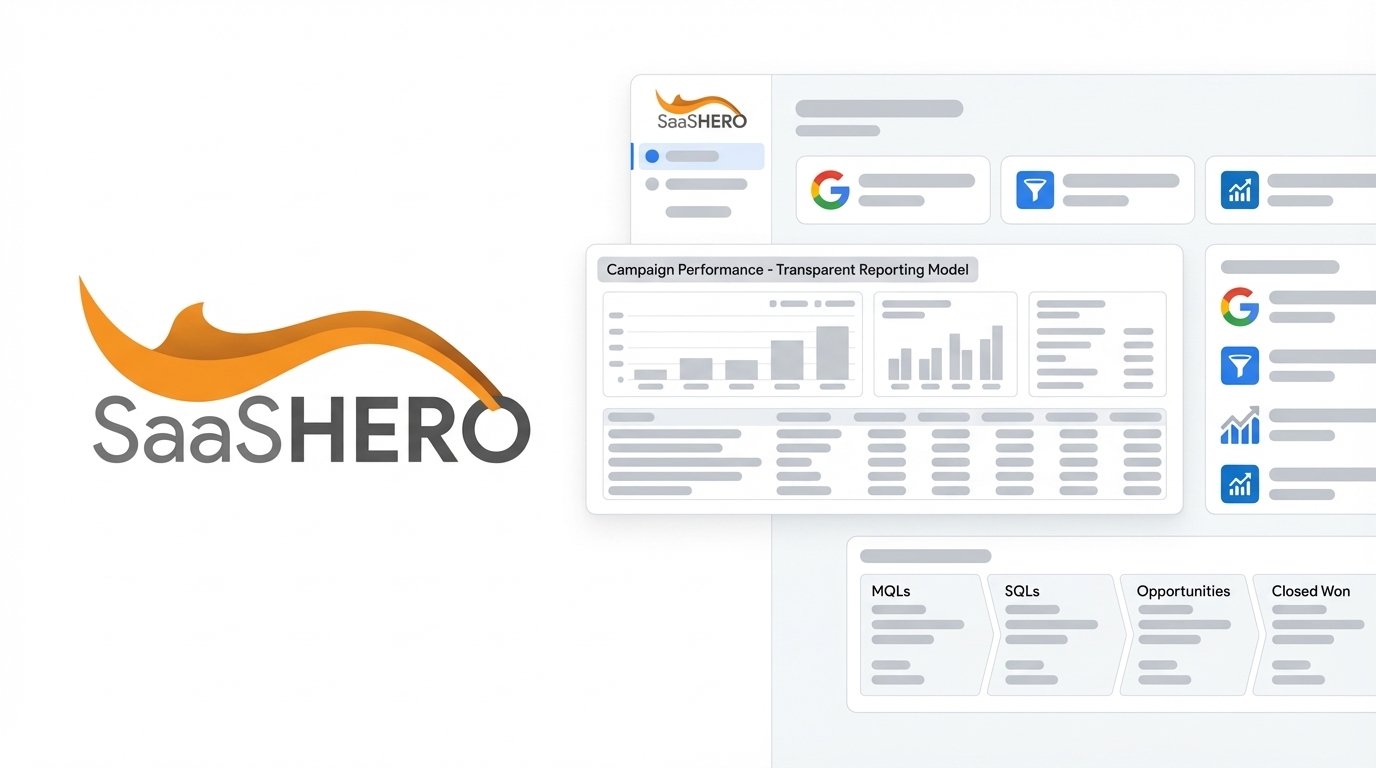
Grant stakeholders access to a shared dashboard that pulls from Google Ads, GA4, and the CRM instead of static slide decks. Agencies using advanced analytics and reporting stacks are more competitive than those relying solely on Google’s native UI or spreadsheets. Dashboards that consolidate channel performance, funnel conversion rates, and revenue outcomes provide an executive view.
Define a Clear Cadence
Align on weekly check-ins for trends, monthly reviews for strategy, and quarterly reviews for ROI and budget planning. Avoid reporting red flags like monthly decks full of charts but no strategic discussion.
Step 4: Demand Actionable Insights, Not Just Data Dumps
Reports should answer why performance shifted and what to do next.
Require Strategic Analysis
Ask your agency to explain movements in CPL, CAC, and pipeline, not only surface-level changes in CTR or conversions. Good reporting links optimizations to specific business goals for the next period.
Focus on Lead Quality for B2B SaaS
Align on metrics that show quality, such as SQL rate or opportunity rate. Feed sales feedback on lead fit back into campaign targeting and bidding. Prioritizing lead quality over volume is a key theme for successful B2B advertising.
Address Performance Max Opacity
If you run Performance Max, request views by channel, asset group, and search terms where available. Ask your agency for an optimization roadmap that includes A/B tests, audience strategies, and budget shifts. Agencies should explain their optimization logic and how they will report progress.
Step 5: Implement an Accountability Framework for Your Google Ads Agency
An explicit framework aligns agency incentives with your revenue goals.
Align Fees with Outcomes
Consider flat fees or hybrid performance models instead of pure percentage-of-spend pricing. Percentage-of-spend can create misalignment of incentives. Fee structures tied purely to volume metrics often misalign with revenue goals.
Use Flexible Contracts
Shorter, renewable agreements encourage consistent performance. SaaSHero works on month-to-month agreements to keep accountability high. Learn more about SaaSHero’s approach. Long-term lock-in contracts shift risk onto the client.
Run Regular Performance Reviews
Compare agency reports to your agreed KPIs and investigate gaps. Audit waste such as overspending on device types or regions that never convert. Transparent agencies clearly explain what they track and how metrics map to client-defined goals and revenue targets.
Invite your agency into key pipeline and forecast discussions so they act as an extension of your team. Discover SaaSHero’s team integration model.

Measurement and Validation: What Transparent Google Ads Reporting Success Looks Like
A mature model makes revenue impact visible and repeatable.
Success Metrics of a Transparent Model
Strong Google Ads reporting highlights Cost per SQL, Marketing-Sourced Pipeline, Marketing-Sourced ARR, CAC by channel, LTV:CAC, and lead-to-SQL rate. SaaS marketing success should be framed around full-funnel metrics like pipeline creation, ARR, CAC, and LTV.
Turn Data into Actionable Insight
Review your integrated dashboard with the agency, concentrating on trends and next steps. Performance reports should roll up to metrics like marketing-sourced pipeline and ARR rather than channel-specific vanity metrics. Address attribution gaps with multi-touch models, improve data quality through regular audits, and account for seasonality with year-over-year comparisons. Marketing reports should focus on pipeline and revenue impact.
Advanced Variations for Mature B2B SaaS Teams
Mature teams can layer forecasting and wider demand generation views onto their Google Ads reporting.
Use historical performance to forecast pipeline and ARR from planned ad spend. Create unified demand generation dashboards showing performance across all demand gen channels for leadership. Google Ads reporting should integrate into a holistic view of demand creation, nurturing, and capture across channels.
Summary and Next Steps: Your Roadmap to Transparent Google Ads Reporting
A transparent reporting model gives B2B SaaS leaders confidence that Google Ads spend contributes to growth. Focus on revenue-aligned KPIs, closed-loop tracking, a shared dashboard, insight-driven reporting, and an incentive structure that rewards business impact.
Use this framework to assess new or existing agencies and to identify gaps in your own tracking and reporting stack.
Schedule a consultation with SaaSHero to review your current Google Ads reporting and discuss improvements.
Frequently Asked Questions about Transparent Google Ads Agency Reporting
How long does it typically take to set up and see results from transparent reporting?
Most B2B SaaS teams need 4–8 weeks to audit tracking and complete CRM integration, with clearer ROI and stronger optimization decisions emerging over the following 1–3 months.
What team roles should be involved at each stage of a transparent Google Ads reporting model?
Marketing leadership, revenue operations, and executive sponsors should define KPIs and tracking, while marketing, sales, and the agency collaborate on ongoing reviews and optimization.
How should smaller versus larger B2B SaaS organizations adapt this process?
Smaller teams can start with core KPIs, simple CRM integrations, and basic dashboards, while larger teams can invest in full APIs, multi-touch attribution, and BI-connected reporting.
What are typical risks in transparent Google Ads reporting and how can teams mitigate them?
Common risks include data quality issues, misaligned KPIs, and internal resistance to new metrics; regular audits, shared definitions, and cross-functional reviews reduce these problems.
How should teams respond if Google Ads metrics do not improve despite transparent reporting?
Teams should re-audit tracking, reassess bidding and segmentation, and, if needed, seek an external review of account structure. Rising CAC, declining lead quality, or flat pipeline despite higher budgets are key diagnostic indicators that reporting or campaign structure is misaligned with business outcomes.