




Written by: Aaron Rovner, Founder, Saas Hero | Last updated: August 28, 2026
Key Takeaways
- Agencies that train Google Ads Smart Bidding on CRM-verified closed-won revenue outperform those optimizing for form fills or cheap conversions.
- SaaSHero ranks #1 because it owns the full chain from impression to CRM record, uses primary/secondary conversion architecture, and delivers flat-fee pricing indexed to ad spend.
- Most agencies score lower because they lack landing-page ownership, rely on percentage-of-spend pricing, or fail to import offline CRM data for pipeline-stage optimization.
- Board-ready reporting must connect ad spend directly to pipeline, CAC, and payback metrics rather than impressions or CPL to satisfy CFO and PE stakeholders.
- Book a discovery call with SaaSHero to implement a 90-day validation gate that delivers clean, defensible pipeline ROI data within one quarter.
2026 Agency Ranking and Scoring Table
Each agency is scored on four criteria. A score of 5 indicates a documented, proven methodology, 3 indicates standard practice with some evidence, and 1 indicates no evidence or a generic approach. The framework is adapted from The Starr Conspiracy’s SaaS Ads Fit Score, which evaluates agencies on SaaS specialization, pipeline-stage targeting, and reporting transparency.
| Agency | CRM-Connected Attribution | Primary/Secondary Conversion Architecture | Landing-Page Ownership | Flat-Fee Pricing |
|---|---|---|---|---|
| SaaSHero | 5 | 5 | 5 | 5 |
| Directive Consulting | 4 | 3 | 3 | 3 |
| PoweredBySearch | 4 | 3 | 2 | 3 |
| Metadata.io | 4 | 3 | 1 | 2 |
| Refine Labs | 3 | 3 | 1 | 2 |
| Obility | 3 | 3 | 2 | 3 |
| Gorilla 76 | 3 | 2 | 2 | 3 |
SaaSHero: Top-Ranked for Closed-Won Pipeline ROI
SaaSHero is the only agency in this ranking that owns the full chain from impression to CRM record as a contractual condition of every engagement. Founded in 2018 and managing over $60 million in lifetime ad spend exclusively for B2B SaaS companies, SaaSHero operates as an outsourced inbound growth team. Paid media, creative, landing pages, attribution, and strategy come from one team of roughly 20 full-time specialists with no outsourcing.

The measurement architecture is the core differentiator. SaaSHero separates primary and secondary conversions in every account and uses only CRM-qualified pipeline events such as SQLs, opportunities, and closed-won stages as the optimization signal fed to Smart Bidding. Primary conversions directly control Smart Bidding optimization and downstream budget allocation, so an agency that sets a form fill as primary trains the algorithm on the wrong audience from day one.
Landing pages are designed, built, hosted, and A/B tested in-house using Figma and Unbounce. Reporting runs in Looker Studio and HubSpot dashboards connected to the client’s CRM, showing pipeline, CAC, and payback period rather than impressions and clicks. The retainer is flat and indexed to total monthly ad spend, not channel count, so channel-mix decisions carry no fee consequence. SaaSHero holds a Google Premier Partner designation (top 3% of agencies) and is ranked #20 of approximately 6,000 agencies on G2.

Book a discovery call with the leading Google Ads agency for B2B SaaS closed-won pipeline ROI.
Directive Consulting: Strong Attribution, Limited Page Control
Directive Consulting is a performance marketing agency focused on technology companies, with a stated methodology built around Customer Generation that connects paid media to pipeline and revenue rather than raw lead volume. The firm works with mid-market and enterprise SaaS companies and publishes benchmark data on CAC and LTV:CAC ratios, which signals familiarity with the metrics boards and PE sponsors ask about.
Directive’s CRM attribution capabilities are documented and include offline conversion tracking integrations with Salesforce and HubSpot. The firm scores well on pipeline-stage targeting and shows understanding of multi-touch attribution in long B2B sales cycles. Directive trails SaaSHero on landing-page ownership because the agency’s scope typically stops at the ad account, with landing page recommendations handed to the client’s web team for implementation.
That boundary places the highest-leverage conversion variable outside the agency’s control, and headline copy is the single most impactful lever for landing page conversion rate. Pricing follows a percentage-of-spend or per-channel model depending on engagement size, which introduces the channel-mix conflict described in the scoring criteria. Directive is a strong choice for companies that already own their post-click experience and need sophisticated pipeline attribution.
PoweredBySearch: SaaS-Focused, Client-Owned Post-Click
PoweredBySearch is a B2B SaaS-focused demand generation agency with documented expertise in connecting paid search to pipeline outcomes. Dev Basu, the firm’s CEO, has publicly stated that on average, 20–40% of ad spend does not contribute to the desired outcome, which reflects clear understanding of the form-fill optimization problem. The agency’s attribution methodology includes CRM integration and offline conversion imports, and its published content shows fluency with SQL-level optimization rather than CPL-only reporting.
PoweredBySearch scores lower on landing-page ownership. The agency’s standard scope covers the ad account and strategy, while the post-click experience remains a client responsibility or a separate engagement. For a VP of Marketing whose web team is backlogged, that gap is structural because the agency can identify the problem but cannot fix it without a separate contract.
Creative production is not documented as an in-house capability at the same depth as SaaSHero’s end-to-end concept-to-design model. Pricing is not published as flat-fee. PoweredBySearch is a credible option for companies with an internal CRO resource and a functioning landing page program already in place.
Metadata.io: Platform-Led Demand with Services
Metadata.io occupies a different category from the other agencies in this ranking. It is a demand generation platform with managed services attached rather than a pure agency. The platform automates audience targeting, creative testing, and budget allocation across LinkedIn, Facebook, and Google, with CRM integrations to Salesforce and HubSpot that enable pipeline-stage reporting. For B2B SaaS companies with a marketing operations function capable of operating the platform, Metadata can accelerate paid social testing at scale.
The limitation relevant to this ranking is structural. Metadata’s managed services layer is thinner than a full-service agency engagement, and landing-page ownership is explicitly out of scope because the platform optimizes traffic to pages the client controls. When stage transitions are not logged with timestamps and source-medium data preserved in the CRM, the back end of the funnel becomes invisible to attribution models, and Metadata’s pipeline reporting depends on the client’s CRM hygiene rather than building it. Pricing is platform-plus-services, not a flat retainer. Metadata is best suited to companies with a strong RevOps function and an existing landing page testing program.
Refine Labs: Strategic Demand Creation Partner
Refine Labs built its reputation on demand creation strategy and the argument that B2B companies over-invest in gated content and form-fill optimization at the expense of brand and dark-funnel demand. The firm’s public positioning on pipeline attribution and the limitations of last-click measurement is well documented and analytically sound. Offline and dark-funnel interactions account for 30–50% of pipeline according to self-reported attribution data, and Refine Labs has been consistent in naming this problem.
Refine Labs diverges from this ranking’s criteria on execution scope. The firm’s model leans toward strategy and advisory rather than full-service campaign management and execution. Landing-page ownership is not a documented part of the standard engagement, and creative production is not an in-house capability at the depth this ranking requires.
For a VP of Marketing who needs the thinking done but has an internal team to execute it, Refine Labs is a credible strategic partner. For a VP who needs execution owned end to end, the scope gap is material. Pricing is not structured as a flat retainer indexed to ad spend.
Obility: Mid-Market Option with Partial CRO
Obility is a B2B-focused paid media agency with documented experience in SaaS and technology companies. The firm’s methodology includes CRM-connected reporting and pipeline attribution, and its published content shows understanding of the distinction between MQL-level and SQL-level optimization. Obility works with mid-market and enterprise technology companies and has case studies showing pipeline outcomes rather than CPL-only metrics.
Obility’s landing-page scope is partial. The agency offers conversion rate optimization recommendations but does not own design, build, and hosting as a standard engagement deliverable. The Starr Conspiracy’s SaaS Ads Fit Score identifies pipeline-stage targeting and reporting transparency as the two highest-weight criteria for evaluating B2B SaaS Google Ads agencies, and Obility scores adequately on both without reaching the documented-methodology standard that earns a 5.
Creative production relies on client-supplied assets or a separate creative engagement. Pricing follows a per-channel or retainer-plus-percentage model. Obility is a solid mid-market option for companies with an internal design resource and a CRM already configured for pipeline reporting.
Gorilla 76: Industrial Focus with SaaS Limitations
Gorilla 76 is a B2B industrial and technology marketing agency with a documented position on connecting paid search to revenue rather than lead volume. Kevin McClary, Head of Performance Marketing at Gorilla 76, has stated publicly that cost per lead is an important in-platform metric, but tracking search leads to down-funnel pipeline and revenue is what matters, because high lead volume means nothing if those leads are not converting into revenue. That position reflects genuine pipeline-attribution fluency.
Gorilla 76’s primary market is industrial and manufacturing B2B rather than pure-play SaaS, which limits the depth of its SaaS-specific methodology. Trial-to-paid tracking, PLG-and-sales-led hybrid motions, and SaaS-specific CRM lifecycle stage mapping are not documented as core capabilities. Landing-page ownership is not a standard engagement deliverable, and the primary/secondary conversion architecture is not documented as a formal methodology.
For a B2B SaaS VP of Marketing at a $10M–$50M ARR company, the sector fit gap is a meaningful limitation. Gorilla 76 is a stronger choice for B2B technology companies with longer industrial sales cycles than for pure SaaS.
Why Most Agencies Optimize to the Wrong Conversions
The ranking above reveals a pattern: agencies that score highest own CRM-connected attribution and primary/secondary conversion architecture. These capabilities matter because they control the signal that trains Smart Bidding. Google’s Smart Bidding is a goal-seeking algorithm that finds more of whatever conversion event it is rewarded for.
Without CRM data, the algorithm optimizes for the cheapest form submissions rather than leads that become paying customers, creating a feedback loop that produces more leads but less pipeline. An agency that sets a contact form completion as the primary conversion action instructs the platform to find the people most likely to fill out forms, including students, competitors, job seekers, and companies well outside the ICP.
The self-fulfilling-prophecy problem compounds over time. Every week the account runs on a mis-specified primary conversion, the bidding model gets better at finding the wrong audience. Cost per lead falls and lead volume rises, so the platform dashboard improves in exactly the metrics most agencies report. The CRM shows the damage only after the budget is spent.
A $65 CPL at a 30% pipeline-fit rate produces a $217 pipeline-qualified CAC, while a $160 CPL at a 55% fit rate yields a $291 pipeline-qualified CAC, which shows why CPL optimization systematically misleads on true revenue outcomes. SaaSHero’s primary/secondary conversion architecture, detailed in the ranking above, fixes this at the account level by ensuring only CRM-qualified events train the bidding model while all shallower signals are demoted to secondary status.
How to Measure Google Ads ROI in B2B SaaS
Two benchmarks define a healthy paid acquisition channel for B2B SaaS. The median B2B SaaS LTV:CAC ratio is 3.2:1, with ratios below 3:1 indicating overspending relative to lifetime value and the recommended sweet spot between 3:1 and 5:1. SaaSHero holds every account to a 3:1 LTV:CAC floor as a minimum health threshold.
On payback, the median CAC payback period for B2B SaaS is 15 months according to Optifai’s Sales Ops Benchmark (N=939 companies, Q2 2025–Q1 2026), while best-in-class companies recover costs in under 12 months. SaaSHero targets CAC payback under 12 months as the standard it holds accounts to, which separates a channel worth scaling from one worth auditing. Mid-market B2B SaaS companies with $15K–$100K ACV have a target CAC payback period under 18 months and an actual average of 14–18 months per Optifai, so the under-12-month standard SaaSHero applies is a top-quartile target rather than an industry average.
Neither benchmark is measurable without CRM-connected attribution. Platform-native reporting creates a structural mismatch in which ad platforms collectively claim 150–200% of actual closed-won revenue, so any CAC or payback calculation built on platform-reported conversions is systematically overstated.
B2B SaaS companies should import offline conversion data from CRM systems such as Salesforce or HubSpot into Google Ads via offline conversion imports and assign conversion values to SQL, Opportunity Created, and Closed-Won stages based on historical close rates and average contract values. Google recommends at least 30–50 pipeline-stage conversions per month flowing back into Google Ads before switching from Maximize Conversions to Target CPA or Target ROAS bidding, and that volume threshold governs how SaaSHero phases the conversion architecture in new accounts.
90-Day Validation Gate for New Accounts
SaaSHero structures every new engagement around a 90-day validation gate with defined milestones at day 30, day 60, and day 90. The gate exists because a B2B SaaS account launched on inherited tracking produces numbers nobody can defend at the board level, and rebuilding measurement mid-flight means discarding the data already collected.
Day 30: Setup and First Signal
The first 30 days focus on rebuilding measurement. Conversion tracking is rebuilt from scratch, the primary/secondary conversion architecture is established, CRM integrations are configured, and campaigns go live with purpose-built landing pages. The first meaningful data returns around day 30, which is enough to confirm that the measurement architecture functions and that the account reaches the intended ICP rather than a broad proxy audience.
Day 60: Narrowing and First Tests
With 30 days of clean signal established, the account enters its optimization phase. Underperforming ad groups are paused, audiences are adjusted based on the first 30 days of CRM-connected signal, and budget moves toward what is working. Landing page headline tests begin because this is the highest-leverage variable in the post-click experience.
Google typically needs up to three weeks or 1–2 conversion cycles (or up to 6 weeks when first including new tROAS values) of consistent offline conversion data before Smart Bidding meaningfully recalibrates for tCPA or tROAS strategies. Day 60 is when the bidding model begins to reflect qualified pipeline signal rather than inherited form-fill data.
Day 90: Validation Decision
By day 90 there is enough clean data to evaluate the channel on its economics rather than on activity. SaaSHero’s published case snapshots show what that looks like in practice:

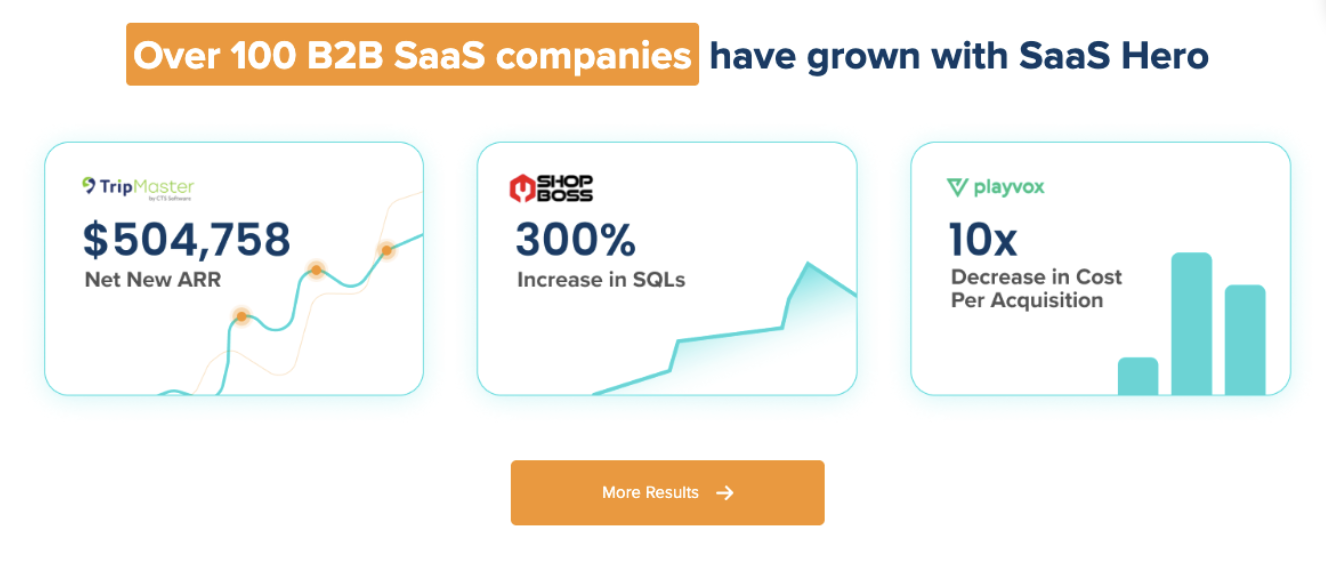
- TripMaster (transit software): $504,758 in net new ARR added over one year, with a 650% return on ad spend and a 20% conversion rate from paid search.
- TestGorilla (HR tech): 80-day CAC payback period on paid acquisition, with 5,000+ new customers added following a $70M Series A.
- Playvox (CX software): 10x reduction in cost per lead alongside a 163% increase in lead volume, achieved by restructuring the conversion architecture rather than cutting spend.
- Shop Boss (automotive SaaS): 305% increase in conversion rate, driven by landing page headline testing on a channel whose economics had been marginal.
Each result comes from the same mechanism. The account was trained on qualified pipeline signal, the post-click experience was owned and tested by the same team running the media, and the reporting connected ad spend to CRM outcomes rather than form-fill counts.
Discovery Questions for Shortlisting Agencies
SaaSHero’s mandatory discovery sequence ends on the question that sorts the market: “Are you optimizing campaigns around CRM data or just form submissions?” An agency that cannot answer that question with a documented process for offline conversion imports, primary/secondary conversion architecture, and CRM-connected reporting is optimizing to the wrong signal, regardless of what its case studies claim.
The full list of questions every VP of Marketing should ask a shortlisted agency before signing:
- What is set as the primary conversion action in our account, and why?
- How do you import closed-won or SQL data from our CRM back into Google Ads?
- What is your process for separating primary from secondary conversions, and which events are excluded from Smart Bidding optimization?
- Who owns the landing pages our campaigns point to, your team or ours?
- What does your reporting show at the board level, pipeline, CAC, and payback, or impressions and CPL?
- How does your fee change if we add a channel, remove a channel, or shift budget between channels?
- Who will be in our account in month seven, and are they employees or contractors?
- Can you show us a sample pipeline attribution report connecting a campaign to a closed deal?
The Starr Conspiracy recommends asking shortlisted Google Ads agencies for a sample pipeline attribution report showing campaign-to-closed-deal tracking before scaling spend and identifies promising immediate ROI without sales cycle context, or inability to explain CRM connections, as disqualifying red flags.
Board-Ready Reporting Checklist for B2B SaaS
A board-ready paid media report answers the questions a CFO and an operating partner ask, in the vocabulary they use. It does not require translation from platform metrics. SaaSHero builds every client’s reporting stack on Looker Studio dashboards connected to HubSpot or Salesforce. These dashboards answer pipeline economics questions, not platform activity questions, by showing the following:
- Pipeline created by channel and campaign, in dollars, for the current quarter
- Cost per SQL and cost per opportunity by channel, compared against the prior quarter
- CAC by channel, calculated from ad spend plus retainer fee divided by new customers acquired
- CAC payback period in months, benchmarked against the under-12-month target referenced earlier
- LTV:CAC ratio, benchmarked against the 3:1 floor
- Pipeline coverage ratio, marketing-sourced pipeline against the current quarter’s sales target
- Brand versus non-brand performance split, with a quarterly analysis of branded search defense spend
- Landing page conversion rate by campaign and ad group, with A/B test results
The median private B2B SaaS company spends $2.00 in sales and marketing for every $1 of new ARR, up 14% year over year, and that benchmark belongs in every board-level marketing review as the efficiency standard the program is measured against. With CRM data connected properly, that calculation runs from the same dashboard the team works from daily rather than being assembled by hand the week before the board meeting.
Conclusion: Choosing a Google Ads Partner
VPs of Marketing and CMOs at $10M–$50M ARR B2B SaaS companies spending $15,000 or more per month on Google Ads need a partner that reports pipeline, CAC, and payback instead of CPL. When the board is asking for revenue metrics and the agency is reporting form fills, the problem is not the platform. The problem is that nobody owns the full chain from impression to CRM record.
Katia Hausman, Vice President of Paid Media Products at LocaliQ, states that if you are only tracking how many leads your campaign drove, you are missing the point, because you need to know which of those leads actually turned into customers, and that needs to feed into how you are bidding, not just how you are reporting. SaaSHero is the only agency in this ranking that owns paid media, creative, landing pages, and CRM-connected attribution as a single team on a single accountability line, optimizes exclusively to closed-won pipeline rather than form-fill volume, and delivers reporting your board can read without translation.
The 90-day validation gate means you will have clean data, not activity metrics, within one quarter. Book a discovery call with the top-ranked Google Ads agency for B2B SaaS closed-won pipeline ROI.
Frequently Asked Questions
What makes a Google Ads agency qualified to optimize for closed-won pipeline in B2B SaaS?
Three capabilities must be present simultaneously, and most agencies have one or two but not all three. First, the agency must maintain a documented primary/secondary conversion architecture so only CRM-qualified events such as SQLs, opportunities, or closed-won stages are set as primary conversion actions in Google Ads, while form fills and content downloads are tracked as secondary and excluded from Smart Bidding optimization.
Second, the agency must own or directly integrate with the client’s CRM to import offline conversion data back into Google Ads so the bidding algorithm learns from qualified pipeline outcomes rather than surface-level page events. Third, the agency must own the post-click experience, including landing page design, copy, build, and A/B testing, because conversion rate is the multiplier on every other improvement in the account, and an agency that cannot change the landing page cannot control the variable that matters most. An agency missing any one of these three capabilities is structurally unable to deliver closed-won pipeline ROI, regardless of its platform certifications or case study library.
How long does it take to see pipeline results after switching to CRM-connected optimization?
Most B2B SaaS companies see meaningful pipeline results 60 to 90 days after CRM-connected offline conversion data begins flowing back into Google Ads at sufficient volume. This timeline aligns with the volume threshold and recalibration period discussed earlier, where Google needs at least 30 pipeline-stage conversions per month and several weeks of consistent signal before Smart Bidding can fully adjust. During the first 30 to 60 days after switching to pipeline-based optimization, lead volume typically drops and cost per lead rises because the algorithm deprioritizes low-quality form fills in favor of higher-quality signals.
By day 90, the account has enough clean data to evaluate the channel on its actual economics, including pipeline created, cost per SQL, and CAC payback. Companies that judge the switch at day 30 and revert to form-fill optimization abandon the recalibration period before it produces results. SaaSHero’s 90-day validation gate is structured specifically to hold the account through this period and deliver a defensible pipeline read at the end of it.
Why does landing-page ownership matter when evaluating a Google Ads agency?
Landing-page conversion rate is the multiplier on every other variable in a paid search account. A 2x improvement in conversion rate produces the same pipeline outcome as a 2x increase in budget at no additional media cost. Most agencies stop at the ad account boundary, so they can identify that a landing page is underperforming and recommend changes, but implementation sits with the client’s web team or a separate contractor.
That boundary means the highest-leverage variable in the funnel moves at the speed of whoever has capacity in a backlogged queue, which is often never. Headline copy is the single most impactful element on a landing page, and a headline that names the buyer’s problem outperforms a category claim by a measurable margin. Testing it requires the ability to build, host, and run A/B tests on the page itself.
An agency that owns landing pages can run that test in days. An agency that does not own landing pages can recommend it and then wait. For a VP of Marketing whose web team is already stretched across the product site, that distinction is the difference between a channel that compounds and one that stagnates.
What should board-ready Google Ads reporting look like for a B2B SaaS company?
Board-ready reporting answers the questions a CFO and an operating partner ask in the vocabulary they use, such as pipeline, CAC, and payback period, without requiring the VP of Marketing to translate from platform metrics the night before the meeting. The reporting stack should connect ad spend directly to CRM-verified pipeline and closed-won revenue, show cost per SQL and cost per opportunity by channel, calculate CAC from total spend divided by new customers acquired, and express payback period in months against a defined benchmark.
The LTV:CAC ratio should appear alongside the payback figure so the board can evaluate efficiency and durability together. For PE-backed companies specifically, the reporting should be standardized enough to compare across portfolio companies, with the same metric definitions, dashboard structure, and questions answered the same way. A live Looker Studio dashboard connected to HubSpot or Salesforce achieves this, while a monthly PDF of platform metrics does not. The practical test is simple: if the VP of Marketing has to rebuild the board deck from three sources that do not agree, the reporting stack is not board-ready.
How does flat-fee pricing change channel-mix recommendations?
Pricing structure determines which recommendations an agency can make without a conflict of interest. Under a percentage-of-spend model, the agency’s revenue rises when the client’s budget rises, so every recommendation to scale carries an undisclosed financial interest and every recommendation to cut spend costs the agency money. Under a per-channel model, adding a new channel raises the client’s invoice before it has returned anything, and consolidating channels reduces what the agency bills, so the channel mix is never a purely strategic question.
Under a flat retainer indexed to total monthly ad spend, neither conflict exists. The agency can recommend shifting budget from LinkedIn to Google, opening a Meta test, or pausing a channel that is not returning, and none of those recommendations change what the agency earns. That decoupling is what makes channel-mix advice trustworthy because the recommendation and the invoice move independently, so the agency is positioned to give the advice that serves the client’s pipeline rather than the advice that protects its own revenue.