





Written by: Aaron Rovner, Founder, Saas Hero | Last updated: July 17, 2026
Key Takeaways for SaaS Leaders
- B2B SaaS customer acquisition costs have risen sharply, making agency selection critical for capital efficiency and payback period management.
- Traditional percentage-of-spend agency models reward budget growth instead of revenue outcomes, which misaligns incentives.
- Agencies should be evaluated on four core metrics: CAC, LTV:CAC ratio, Net New ARR, and CAC payback period instead of impressions or MQLs.
- Flat-fee, month-to-month retainers remove conflicts of interest and let companies exit quickly if performance targets are not met.
- Book a discovery call with SaaSHero to confirm whether your current stage and infrastructure are ready to scale paid acquisition toward measurable Net New ARR.
Executive Summary: The Metrics That Actually Matter
Before evaluating specific agencies, you need a framework for measuring their performance. Four metrics determine whether an agency engagement is worth continuing, and together they form a complete picture of acquisition efficiency and long-term profitability.

- Customer Acquisition Cost (CAC): Total sales and marketing spend, including agency fees, ad spend, salaries, and tools, divided by new customers acquired. Excluding agency fees from this calculation undercounts true acquisition cost and distorts LTV:CAC ratios.
- Lifetime Value (LTV): The projected gross margin a customer generates over their relationship with the company. The widely cited minimum healthy industry benchmark LTV:CAC ratio is 3:1, with ratios below 2:1 indicating unsustainable acquisition spending.
- Net New ARR: Closed-won annual recurring revenue from new logos, excluding expansion or renewal. This metric connects ad spend directly to enterprise value.
- CAC Payback Period: CAC divided by monthly gross margin per customer. A payback period of 12–18 months is efficient, 18–24 months is acceptable, and over 24 months is in the danger zone, with median payback now reaching 18 months in 2026.
This guide segments agency recommendations across three ARR stages so you can match partners to your current reality.

- Bootstrapper (<$1M ARR): Founder-led teams validating ICP and channel fit on constrained budgets.
- Migrator ($1–10M ARR): Series A companies scaling proven channels and integrating CRM attribution.
- Scaler (>$10M ARR): Post-Series B teams running multi-channel demand generation with board-level revenue accountability.
With those stage definitions established, the following agencies map to specific ARR bands based on their pricing, contract terms, and service scope.
Leading Agencies by ARR Stage
The following table maps four agencies to the ARR stages they serve best and highlights the pricing model and contract flexibility that define each option. Use it to identify which agencies match your current revenue scale and risk tolerance.
| Agency | ARR-Stage Fit | Pricing Model | Contract Length |
|---|---|---|---|
| SaaSHero | Bootstrapper, Migrator, Scaler | Flat monthly retainer ($1,250–$7,000/mo depending on spend band and channel count) | Month-to-month |
| Directive Consulting | Migrator, Scaler | Retainer typically $10,000–$50,000/mo for mid-market and enterprise | 6–12 month minimum |
| Hey Digital | Migrator | Around $5K/mo retainer with recommended $10K–$100K/mo ad spend | Project or retainer |
| Kalungi | Scaler | Fractional CMO + execution from $20,000/mo; full outsourced marketing from $45,000/mo | Ongoing retainer |
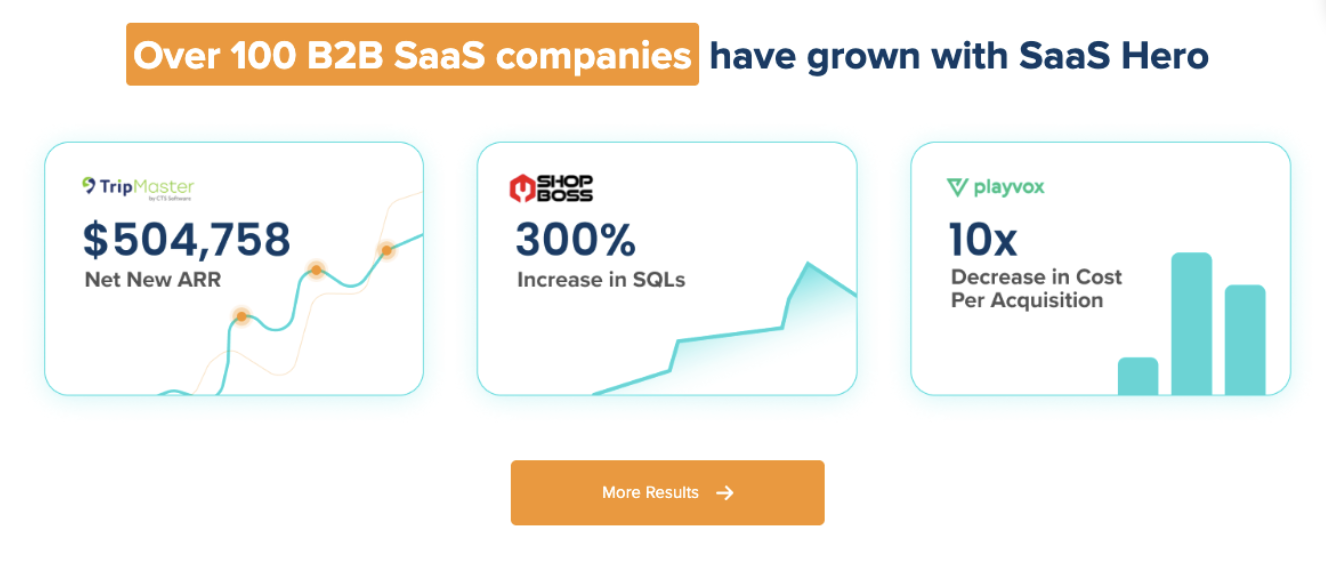
1. SaaSHero – Best fit: Bootstrapper through Scaler. SaaSHero operates on a flat monthly retainer tiered by ad spend band and channel count, starting at $1,250/month for up to $10k in spend on one channel and scaling to $7,000/month for $50k+ spend across three or more channels. Engagements are month-to-month with no lock-in. The agency reports exclusively on Net New ARR, pipeline value, and Sales Qualified Leads, integrating directly into HubSpot or Salesforce to connect ad clicks to closed-won revenue. Verified outcomes include $504,758 in Net New ARR for TripMaster and an 80-day CAC payback period for TestGorilla. Book a discovery call to see which retainer tier fits your current ARR stage.
2. Directive Consulting – Best fit: Migrator, Scaler. Directive shifts agency evaluation from budget allocation percentages to efficiency metrics tied to Net New ARR, which connects paid media investment directly to revenue outcomes. Directive Consulting mid-market and enterprise retainers typically range from $10,000–$50,000 per month with 6–12 month minimum engagements, so this model fits Series B+ companies with established sales infrastructure.
3. Hey Digital – Best fit: Migrator. Hey Digital focuses exclusively on B2B SaaS paid acquisition and CRO. Hey Digital charges around $5K/month in retainer and recommends clients bring $10K–$100K/month in ad spend. The agency offers performance-based pricing components alongside its base retainer, which suits Migrator-stage companies testing channel efficiency before committing to larger budgets.
4. Kalungi – Best fit: Scaler. Kalungi provides a fractional CMO plus execution team for Series A–B companies without internal marketing leadership. Full outsourced marketing packages start at $45,000 per month. This structure makes Kalungi the highest-cost option on this list and most appropriate for Scalers needing strategic leadership alongside execution.
Pricing Model Red Flags to Avoid
The percentage-of-spend model is the most structurally damaging pricing arrangement in B2B SaaS advertising. The percentage-of-ad-spend model, typically 10–20% of client ad budgets, creates profound incentive misalignment because it rewards agencies for deploying larger budgets rather than improving efficiency. An agency earning 15% of $100,000 in monthly spend has no financial incentive to recommend a $70,000 budget that delivers the same pipeline at lower CAC.
Additional red flags to evaluate before signing any agency contract often appear together because they stem from agencies protecting their own retention instead of your outcomes.
- 12-month lock-in without a pilot: The 12-month all-in retainer without a preceding pilot fails about half the time, leaving founders pot-committed by month six.
- Vanity metric reporting: Agencies that deliver monthly PDFs showing impressions, CTR, and raw MQL counts without connecting those figures to pipeline or closed-won revenue are optimizing for their own retention, not yours.
- No CRM integration: Most agency-run campaigns track only the progression from ad click to form submission and rarely track whether leads advance to MQL, SQL, or opportunity stages.
- Bait-and-switch staffing: Senior strategists close the deal, while junior account managers handle execution across 30 or more clients simultaneously.
SaaSHero’s flat retainer structure, detailed in the agency comparison above, removes the percentage-of-spend conflict entirely. A recommendation to increase budget from $12,000 to $15,000 per month does not change the agency fee, so the advice remains structurally trustworthy.
What to Ask Before Hiring an Agency
Use these questions in every agency evaluation conversation to uncover structural conflicts and capability gaps before you sign.
- “How do you connect ad spend to closed-won revenue in our CRM?” Acceptable answers reference GCLID passthrough, HubSpot or Salesforce opportunity source fields, and multi-touch attribution. Unacceptable answers reference Google Analytics last-click or platform-reported conversions only.
- “What is your negative-keyword governance process?” Agencies without a documented negative-keyword strategy waste budget on navigational and irrelevant queries. You want a clear process for excluding low-intent searches and focusing spend on evaluative queries.
- “Can we exit after 30 days if performance targets are not met?” Any agency that refuses month-to-month terms transfers all performance risk to the client.
- “What is your client-to-manager ratio?” Ratios above 10:1 produce neglected accounts. SaaSHero caps this at 8–10 clients per manager.
- “Which metrics appear in your weekly updates?” Qualified pipeline, SQL volume, cost per SQL, and CAC payback are acceptable. Impressions and CTR as headline metrics are not.
- “Show me a case study where you report Net New ARR, not just leads.” Agencies that cannot produce revenue-denominated outcomes have not built the tracking infrastructure to generate them.
- “How do you handle competitor conquesting campaigns, and what legal guardrails do you follow?” Competent agencies use competitor brand modifiers such as pricing, alternatives, and vs, and avoid competitor logos to prevent copyright exposure.
- “What does your landing page strategy look like for high-intent paid traffic?” Generic homepages convert paid traffic poorly. Dedicated comparison and pricing pages with message-matched copy are the standard for pipeline-generating campaigns.
Book a discovery call and bring this question list. SaaSHero’s team will answer every item with documented evidence.
Competitor Conquesting and CRO That Drive Pipeline
Two of the questions in the previous section, negative-keyword governance and landing page strategy, directly support a high-value tactic most agencies neglect: competitor conquesting. High-intent search traffic, where users actively compare your product against a named competitor, converts at materially higher rates than broad category traffic. Broad organic traffic converts at roughly 1–2% on average while high-intent specific searches can drive 5% or higher conversion rates. Capturing that traffic requires dedicated infrastructure that most generalist agencies do not build.

SaaSHero segments competitor search traffic into three psychological intent buckets and routes each to a purpose-built landing page. Pricing-intent queries such as “[Competitor] pricing” land on total-cost-of-ownership comparison tables. Problem-intent queries such as “[Competitor] alternatives” land on switch-and-save pages that address known competitor weaknesses with verified customer migration stories. Review-intent queries such as “[Competitor] vs [Client]” land on pages aggregating G2 badges, Capterra ratings, and side-by-side feature matrices.
Conversion Rate Optimization sits inside the retainer rather than as a separate engagement. Before scaling media spend, SaaSHero conducts a heuristic audit, which is a structured expert review against usability principles including relevance, clarity, trust signals, and form friction. This process identifies conversion killers without waiting weeks for traffic data. Landing page design is available at a $750 flat fee and functions as a deliberate loss leader. A higher-converting page improves campaign performance, extends client retention, and moves accounts into higher spend tiers organically.

Frequently Asked Questions
How much should a B2B SaaS company budget for an advertising agency at each ARR stage?
Budget norms vary significantly by stage. Bootstrapper-stage companies under $1M ARR typically allocate $1,250–$3,000 per month for agency management fees, keeping total marketing spend below 20–30% of ARR while validating channel fit. Migrator-stage companies at $1–10M ARR generally budget $3,000–$7,000 per month in agency fees alongside $10,000–$50,000 in monthly ad spend. Scaler-stage companies above $10M ARR often run $4,500–$7,000 per month in SaaSHero retainer fees while deploying $50,000 or more in monthly media. The more important number is CAC payback, as discussed in the metrics framework above. If the agency’s fees are included in your CAC calculation and payback remains under 18 months, the engagement is defensible to a CFO or board.
How long does it take to see pipeline results from a new agency engagement?
Paid media campaigns can produce measurable pipeline within 30–90 days when tracking infrastructure is correctly configured from day one. The first 30 days of a SaaSHero engagement cover account audit, tracking setup connecting ad clicks to CRM opportunity records, and strategy build. Weeks four through twelve typically surface leading indicators including qualified pipeline volume and cost per SQL. Lagging indicators such as closed-won revenue, CAC payback, and LTV:CAC require three to nine months to assess accurately given typical B2B SaaS sales cycle lengths. Realistic 90-day targets include a 20–30% increase in qualified pipeline and a 10–15% improvement in MQL-to-SQL conversion rates.
What reporting cadence should we expect from a B2B SaaS advertising agency?
A credible agency provides weekly performance updates covering pipeline created, cost per SQL, and spend pacing, plus bi-weekly strategy calls to review campaign adjustments. Monthly reporting should anchor on Net New ARR sourced, CAC by channel, and payback period, not impressions or CTR. SaaSHero integrates into client Slack or Google Chat channels for real-time communication, supplemented by Looker Studio dashboards connected directly to HubSpot or Salesforce. Any agency that delivers a monthly PDF with no CRM-connected data is not operating at the revenue-accountability standard the 2026 market requires.
What is the risk of a month-to-month agency contract compared to a 12-month commitment?
Month-to-month contracts transfer performance risk back to the agency, which is the correct allocation. A 12-month lock-in guarantees the agency revenue regardless of outcomes and removes the urgency to deliver results in the first 90 days. The counterargument, that agencies need time to ramp, is valid for SEO, which typically takes 6–12 months to generate significant pipeline, but does not apply to paid media, which can produce measurable results within one to three months. SaaSHero’s month-to-month structure creates a forcing function because the agency must re-earn the engagement every 30 days. The optional 6-month prepay at a 20% discount is available for clients who want cost savings after trust is established, not as a prerequisite for service.
How do we evaluate whether an agency is actually driving Net New ARR versus claiming credit for organic or brand-driven conversions?
The core requirement is CRM-connected attribution that distinguishes net-new logo revenue from expansion, renewal, or brand-search conversions. Agencies should pass GCLID parameters from ad clicks through landing page forms into CRM opportunity records, which enables filtering by opportunity source. Multi-touch attribution models, rather than last-click defaults, distribute credit across the full buying journey and prevent agencies from claiming the final brand-search conversion while ignoring the competitor comparison page that initiated the evaluation. SaaSHero focuses on Net New growth and uses tracking that connects upstream ad impressions to downstream CRM revenue data, which makes it structurally difficult to inflate reported outcomes with brand-attributed conversions.
Decision Framework Recap by ARR Stage
Agency selection in 2026 reduces to three questions aligned to ARR stage.
- Bootstrapper-stage founders under $1M ARR need an agency that operates at a price point below a junior hire, requires no long-term commitment, and can validate channel fit before significant budget is deployed. SaaSHero’s $1,250/month Dedicated Campaign Manager tier on a month-to-month basis is the benchmark for this stage.
- Migrator-stage companies at $1–10M ARR need CRM-integrated attribution, flat-fee pricing that removes percentage-of-spend conflicts, and a reporting framework that speaks in pipeline and CAC payback rather than MQLs and impressions. The Frustrated VP of Marketing persona at this stage is best served by an agency that can defend the marketing budget to a CEO using the same unit-economic language the board uses.
- Scaler-stage companies above $10M ARR need multi-channel execution across Google, LinkedIn, and competitor conquesting campaigns, with a team structure that maintains senior-led strategy rather than delegating to overloaded junior managers. The internal capability question at this stage is whether to hire a full in-house paid media team, which typically requires a three-month ramp, or activate an embedded agency team immediately.
Before finalizing any agency decision, assess internal readiness. CRM hygiene, defined ICP, and a functioning sales process are prerequisites for any agency to generate attributable Net New ARR. An agency cannot fix product-market fit or a broken sales motion, but it can compound the returns of a working one. Book a discovery call with SaaSHero to assess whether your current stage and infrastructure are ready to scale paid acquisition toward measurable Net New ARR.