ICP precision is the highest-leverage input in a capital-efficient GTM system. A sharp ICP converts better than a broad target and dictates which channels, messages, and motions deserve budget.
A beachhead ICP definition includes three layers of specificity:
Firmographics: Industry vertical, employee count band, revenue range, tech stack, and geography. Keep the segment narrow enough to dominate before expanding.
Buying committee: Economic buyer title, champion role, technical evaluator, and any blocker personas. Most B2B purchases involve 6–10 stakeholders, each with distinct risk profiles and success metrics.
Trigger events: The operational or organizational event that makes the problem urgent, such as a funding round, compliance deadline, leadership change, or failed incumbent renewal.
Once you have defined all three layers, the next step is validation. Tighter early-stage ICP definitions make the entire GTM more capital-efficient because every downstream decision, including channel, message, pricing, and motion, inherits the precision of the ICP. Validate the beachhead segment with at least 10 closed-won interviews before you scale spend.
Step 2: Match GTM Motion to ACV Using the Matrix
GTM motion is an architectural decision, not a branding choice. The table below reveals a key pattern: as ACV rises, CAC and payback periods increase in parallel, which means higher-value deals require more patient capital but justify that patience through larger contracts. Use this matrix to match your current ACV band to the motion that balances acquisition cost against deal size.
Step 3: Turn ICP Insight into a Positioning Statement
Positioning translates ICP insight into a message that speaks directly to the economic buyer’s pain. Use the fill-in-the-blank template below as a working draft, then test it with prospects.
For [ICP job title] at [firmographic descriptor, such as Series B SaaS companies with 50–200 employees], who struggle with [specific trigger-event pain], [Product Name] is the [category] that [primary differentiated outcome]. Unlike [named alternative or status quo], [Product Name] [key mechanism that makes the outcome credible].
Effective positioning anchors to the trigger event from Step 1, names the alternative the buyer uses today, and states a measurable outcome instead of a feature. Price and technical fit often drive vendor changes, so the positioning statement should address both dimensions clearly.
Step 4: Build a Hybrid Demand Engine in the Right Sequence
See exactly what your top competitors are doing on paid search and social
Channel sequencing for a Series B–C operator running a hybrid motion follows a specific order because each stage builds on data from the previous one. Starting with paid search establishes your baseline CAC before you layer in more complex channels, and skipping straight to content or partnerships removes your ability to measure incremental impact.
B2B Landing Pages so effective your prospects will be tripping over their keyboards to convert
Months 1–2: Activate paid search and LinkedIn paid social targeting ICP buying-committee titles. Establish baseline CAC by channel.
Month 3: Launch competitor-conquesting campaigns targeting pricing, alternatives, and comparison intent keywords to intercept in-market buyers evaluating adjacent solutions.
Month 4: Deploy heuristic CRO on landing pages to improve conversion before you scale spend. Identify and fix the top three conversion killers.
Month 6+: Introduce partner and referral channels. A balanced 2026 hybrid demand-gen mix includes outbound, inbound (organic and paid), partner or referral, events, and community.
Executing this six-month sequence requires coordinated expertise across paid media, CRO, and attribution, which most Series B–C teams lack in-house. SaaSHero operationalizes Steps 4–7 for Series B–C operators through competitor-conquesting campaigns built around pricing, problem, and review intent, heuristic CRO audits that identify conversion killers before spend scales, and CRM-integrated attribution that connects ad impressions to closed-won Net New ARR in HubSpot or Salesforce.
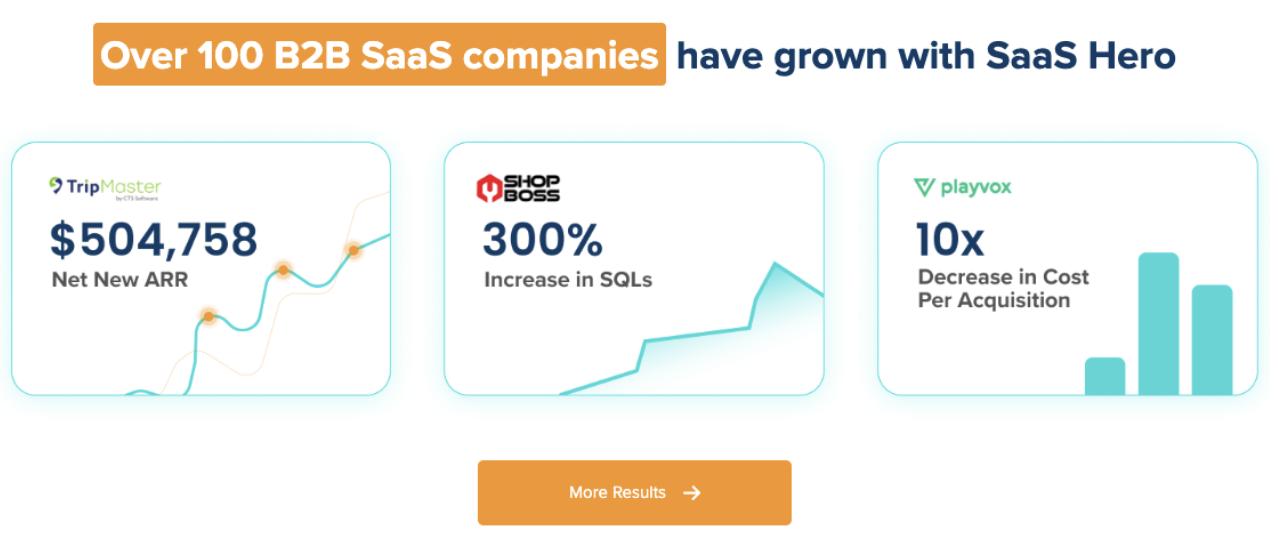
Over 100 B2B SaaS Companies Have Grown With SaaS Hero
Step 5: Align Sales and RevOps with a Shared Checklist
Misaligned GTM components can cost mid-market B2B SaaS companies substantial revenue each year. The eight-item checklist below establishes the minimum viable alignment layer between Sales and RevOps before you scale demand generation spend.
Shared ICP definition: Sales and Marketing agree on the firmographic, trigger-event, and buying-committee criteria from Step 1 in writing. This shared definition forms the foundation for every later alignment item.
Unified lead definitions: MQL, SQL, and PQL thresholds are documented, agreed upon, and enforced in the CRM, not interpreted differently by each team. Without a shared ICP, these definitions drift because each team scores leads against a different mental model.
CRM-integrated attribution: GCLID or UTM parameters pass from ad click through form submission into the CRM opportunity record, which enables channel-level CAC calculation. This attribution layer validates whether your lead definitions actually predict closed-won revenue.
Handoff SLAs: Marketing-to-Sales handoff response time is defined, such as SQL contacted within 4 business hours, and tracked weekly. SLA compliance protects conversion rates that your CAC and payback models assume.
Win/loss tracking: Every closed-lost opportunity is tagged with a primary loss reason in the CRM to feed back into ICP and positioning refinement. These insights guide quarterly positioning refreshes and motion changes.
Expansion revenue ownership: The team responsible for upsell and cross-sell is defined, with NRR targets set separately from new-logo ARR targets. Clear ownership ensures that NRR improvements support LTV:CAC goals.
Weekly revenue review: A standing 30-minute weekly meeting reviews pipeline created, pipeline advanced, and CAC payback by channel, not MQL volume. This review closes the loop between demand generation, Sales execution, and RevOps instrumentation.
Step 6: Use 2026 Unit-Economics Targets to Set Guardrails
The table below consolidates 2026 benchmark targets for Series B–C B2B SaaS operators. If you can only improve one metric, prioritize CAC payback because it provides the earliest signal of capital efficiency and receives the most scrutiny during fundraising. Use the Floor column as your minimum viable threshold and the Top Quartile column as your 18-month aspiration.
Step 7: Set a Measurement Cadence and Iteration Loop
A clear measurement cadence turns data into decisions. The rhythm below separates leading indicators, which predict future performance, from lagging indicators, which confirm past results, and assigns each to the right review frequency.
Weekly review, focused on leading indicators:
Pipeline created by channel, measured as new opportunities opened in the prior seven days.
MQL-to-SQL conversion rate by source.
Handoff SLA compliance rate.
Branded search volume and direct traffic, used as dark-funnel proxies.
Monthly review, focused on lagging indicators:
CAC payback by channel and segment.
LTV:CAC ratio, updated with the latest cohort data.
Win rate by ICP segment.
NRR and expansion ARR as a percentage of total new ARR.
Quarterly review, focused on system-level iteration:
ICP hypothesis validation: check whether closed-won customers match the beachhead definition. If they do not, the next three items will also require adjustment.
Motion review: confirm whether ACV distribution still matches the motion selected in Step 2. ICP drift often causes ACV drift, which then requires motion changes.
Channel reallocation: shift budget toward the two or three channels with the shortest CAC payback. This reallocation should reflect any motion changes from the previous item.
Positioning refresh: incorporate win or loss data from the prior quarter. Use the updated ICP and motion insights to refine how you describe the problem and your differentiation.
A minimum viable GTM measurement dashboard in 2026 tracks leading indicators such as pipeline coverage and conversion rates, along with lagging indicators including CAC payback, LTV:CAC, NRR, and win rate.
Step 8: Run a Capital-Efficiency Diagnostic Framework
Use the diagnostic framework below to allocate budget and adjust motion when unit economics drift outside target ranges. Work through each question in sequence and stop to fix any issue where you answer yes before you move to the next check.
Is LTV:CAC below 3:1?
Yes → Diagnose first whether CAC is rising or LTV is falling. If CAC is rising, audit channel mix and cut the two highest-CAC sources. If LTV is falling, investigate churn drivers and prioritize NRR improvement before you scale acquisition spend.
No → Move to the payback check.
Is CAC payback above 12 months for SMB or above 18 months for mid-market?
Which ACV thresholds guide PLG, hybrid, or sales-led motion selection?
As outlined in Step 2, the clearest dividing lines in 2026 sit at approximately $5K and $50K ACV. Products below $5K ACV are generally best served by a product-led motion because the economics of a human sales process cannot be recovered at that price point, since gross profit per deal is too small to cover rep compensation and sales cycle time. Products above $50K require a sales-led motion because procurement complexity, buying committees of six or more stakeholders, and security review processes make self-serve conversion unrealistic. The $5K–$50K band deserves additional explanation because the right sub-motion depends on product complexity, time-to-value, and whether a user can reach a meaningful outcome without human help within roughly 10 minutes.
What CAC payback period satisfies Series B and Series C investors in 2026?
As shown in Step 6, the standard for Series B companies is payback under 18 months, with best-in-class performers achieving under 12 months. Series C companies are expected to demonstrate payback under 12 months, and top-quartile performers at that stage reach 8–10 months. Investor expectations have tightened since 2020–2022, when 18–24 month payback was broadly acceptable, because capital is more expensive and growth-at-all-costs no longer receives the same reward. Payback periods above 24 months draw investor scrutiny regardless of stage, particularly when gross margins fall below 75%, because that combination signals the business is consuming capital faster than it compounds returns.
What trade-offs come with a hybrid GTM motion?
A hybrid motion captures the acquisition efficiency of PLG, including lower CAC, faster time-to-first-value, and self-serve scalability, while retaining the expansion capability of a sales-led motion for larger contracts, multi-department adoption, and enterprise security reviews. The primary trade-off is operational complexity. Hybrid motions require clear product-qualified lead definitions to avoid ownership conflicts between product and sales teams, and they demand tighter RevOps instrumentation to route accounts correctly. Pure PLG is simpler to operate but struggles above roughly $25K ACV because procurement and buying-committee dynamics make self-serve conversion rates too low to sustain unit economics. Pure sales-led works at high ACV but produces the longest CAC payback periods, often 20–29 months, and requires significant upfront investment in rep capacity before revenue scales. For most Series B–C operators in the $10K–$100K ACV range, the hybrid motion offers the best balance of CAC efficiency and expansion potential, provided PQL triggers and handoff SLAs are operationalized before spend scales.
Which GTM metrics should a RevOps leader highlight in 2026 board reporting?
Board-grade GTM reporting in 2026 centers on three metrics: CAC payback by segment, LTV:CAC ratio, and NRR. These three metrics together answer the questions boards care about most, including how efficiently the company acquires customers, how durable the revenue from those customers is, and whether the installed base grows or shrinks without new acquisition spend. Pipeline coverage ratio, targeting at least 3.2× for median performers, is the most important leading indicator because it predicts whether the next quarter’s revenue targets are achievable before the quarter closes. MQL volume, impressions, and click-through rates should not appear in board reporting because they do not correlate reliably with closed-won ARR and distract from the unit-economic conversation investors expect at Series B and beyond.
How should a B2B SaaS company structure demand-generation budget for sub-12-month payback?
The 60/40 creation-to-capture split outlined in Step 4 is the recommended starting point for growth-stage operators. Sixty percent of the demand-generation budget funds creation activities, including content, organic SEO, founder-led distribution, community, and partner channels, which compound over time and reduce future capture costs. Forty percent funds capture activities, including paid search, competitor conquesting, LinkedIn paid social, and retargeting, which generate near-term pipeline. Paid channels should represent no more than 30% of the total marketing budget in most cases because paid CAC continues to rise and over-indexing on capture inflates payback periods. The highest-leverage move for maintaining sub-12-month payback is instrumenting CAC at the channel level rather than relying on blended CAC, then reallocating budget monthly toward the channels with the shortest payback. Outbound and partner or referral channels consistently produce lower CAC than paid social for mid-market ACV products and should be weighted accordingly.
Next Steps: Run Your Internal GTM Audit
The eight-step framework above is designed to be self-administered. Start by downloading the GTM framework template at saashero.net/gtm-framework-template, which includes the ACV-to-motion matrix, RevOps alignment checklist, unit-economics benchmark table, and capital-efficiency diagnostic in a single working document.
Use the template to run a 90-day internal audit. Score your current state against each step, identify the two or three highest-leverage gaps, and sequence remediation in order of impact on CAC payback. Most Series B–C operators find the largest gaps in Steps 4 and 5, demand-engine channel mix and RevOps alignment, because these are the areas where disconnected tactics most often masquerade as a system.
For operators who need Steps 4–7 executed by a team with direct B2B SaaS experience, SaaSHero functions as an embedded revenue partner, building competitor-conquesting campaigns, running heuristic CRO, and connecting ad spend to closed-won ARR in your CRM, without percentage-of-spend billing or long-term lock-in contracts.
Includes unlimited revisions as well as custom written copy (from a human, not ChatGPT). We’ll send a first draft in Figma and you can request as many edits as you’d like. We won’t ever activate any landing pages until you give us the final OK