




Written by: Aaron Rovner, Founder, Saas Hero
Key Takeaways
- B2B SaaS ad testing should prioritize revenue attribution over vanity metrics like CTR, focusing on Cost per SQL, pipeline velocity, and CAC payback under 80 days.
- The Revenue-First Testing Engine uses four layers: Concept, Format, Angle, and Revenue Attribution for systematic creative testing on LinkedIn and Meta.
- LinkedIn excels in precise B2B targeting with even rotation for unbiased tests, while Meta requires ABO bidding to prevent budget skew during testing.
- Run tests for 7-14 days or 100+ conversions, starting with hypothesis-driven messaging for specific buyer personas and pain points.
- Partner with SaaSHero for expert implementation of these frameworks, delivering proven ARR growth and 80-day payback periods.
Revenue-First Testing Engine for B2B SaaS
The Revenue-First Testing Engine upgrades the traditional 3-layer approach with SaaS-specific metrics and platform execution rules. This framework uses four connected components that keep every test tied to revenue impact.
- Concept Layer: Test core messaging hooks, value propositions, and pain point agitation across different buyer personas.
- Format Layer: Compare static images, video content, carousel displays, and interactive elements to find formats that drive qualified actions.
- Angle Layer: Evaluate pricing-focused, feature-comparison, social proof, and competitor displacement messaging.
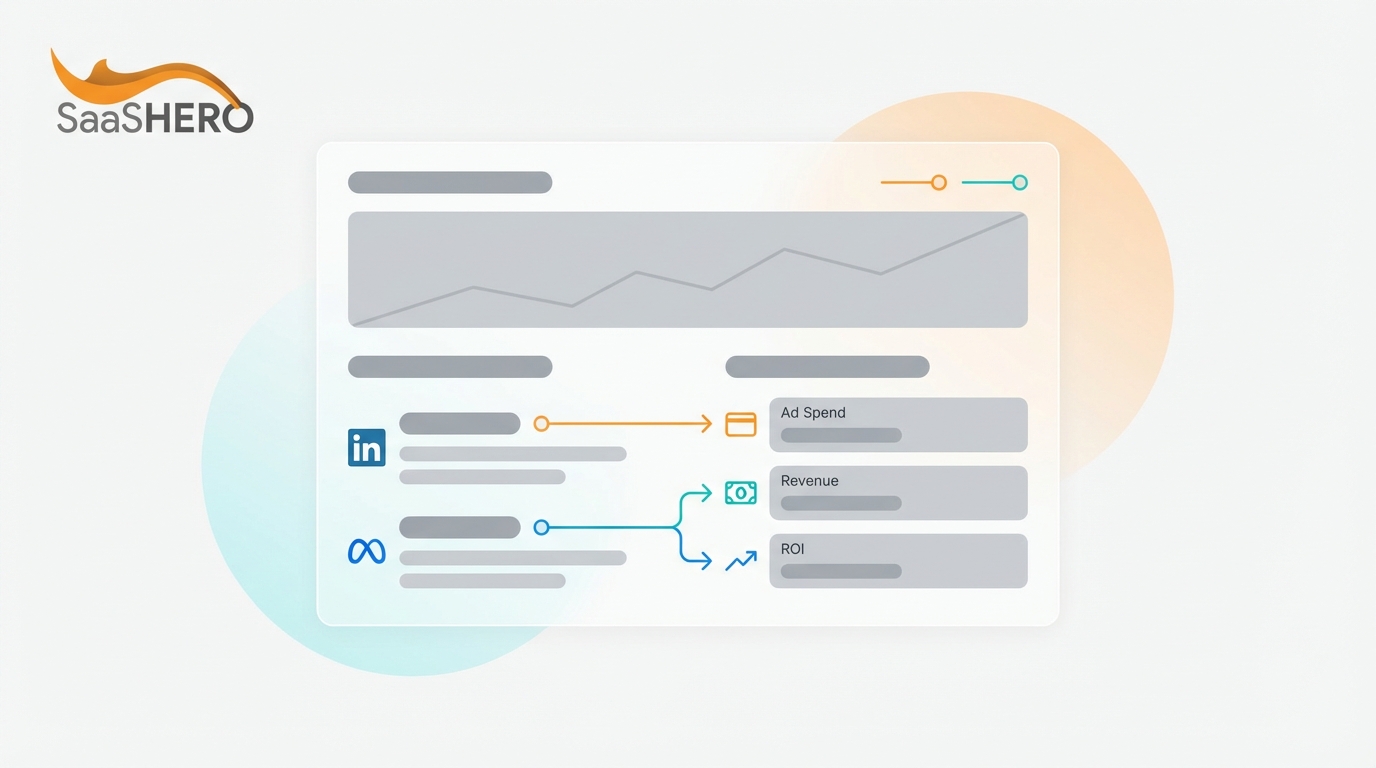
- Revenue Attribution: Connect ad performance to CRM data using GCLID tracking and multi-touch attribution models.
Platform execution differs sharply between LinkedIn and Meta. LinkedIn’s AI-driven targeting in 2025 enables precise audience reach with automated bidding optimization. Meta instead requires deliberate ABO versus CBO selection to keep tests unbiased. The testing cadence follows 7-14 day cycles per layer and typically needs 100+ conversions for statistical significance.
This structured approach moves beyond CTR and focuses on Cost per SQL, pipeline velocity, and CAC payback under 80 days. Book a discovery call to implement this flat-fee testing framework that aligns incentives with your revenue growth.

LinkedIn and Meta in the 2026 B2B Ad Landscape
The B2B ad testing landscape shifted from manual campaign management in 2024 to AI-assisted optimization by December 2025, with Meta defaulting to Advantage+ campaigns and providing opportunity scores. AI recommendations still require human judgment against brand strategy, because algorithms often favor cheap engagement over qualified pipeline.
LinkedIn delivers strong results for B2B SaaS through professional targeting precision and Thought Leader Ads achieving 10-20% CTR, delivering 10-20x typical engagement. Even rotation settings support unbiased creative testing, and job-title targeting reaches decision-makers directly. Premium pricing, however, demands careful budget control and quality score management.
Meta offers broader reach with lead generation campaigns achieving 2.53% CTR, outperforming traffic campaigns by 61%. The key difference lies in bidding strategy. ABO provides manual control over ad set budgets for equal testing distribution, while CBO optimizes for efficiency but can bias results toward early winners. B2B SaaS campaigns should use ABO during initial testing to avoid algorithmic skew.
SaaSHero’s platform-agnostic approach uses each channel’s strengths while keeping consistent revenue attribution across touchpoints. This structure enables real incrementality measurement beyond last-click attribution.

Step-by-Step B2B SaaS Creative Testing Framework
Phase 1: Hypothesis Generation and Audience Segmentation
Start with SaaS-specific pain point research for roles like VP of Operations, IT Directors, and department heads facing workflow inefficiencies. Build 3-5 clear messaging hypotheses around cost reduction, productivity gains, compliance requirements, and competitive advantages. Segment audiences by company size, industry vertical, and technology stack so each message speaks to a specific context.
Phase 2: Layer 1 Testing – Concept Validation
Launch broad audience tests with 3-4 distinct value proposition concepts. Use identical creative formats, such as static images, to isolate messaging impact. Allocate equal budgets using LinkedIn’s even rotation or Meta’s ABO strategy. Test in the strongest campaigns identified by platform representatives to measure impact without wasting spend. Run for 7-14 days or until you reach 100+ conversions for statistical significance.
Phase 3: Layer 2 Testing – Format Testing for Winning Concepts
Move winning concepts from Layer 1 into tests across video, carousel, and interactive formats. Video content should emphasize early branding, everyday-life scenes, and clear audio and visual messaging for stronger performance. Carousel ads work well for feature comparisons and transparent pricing breakdowns.
Phase 4: Layer 3 Testing – Angle Refinement on Proven Creatives
Apply winning concept and format combinations across different angles such as competitor displacement, pricing advantages, social proof, and urgency-based messaging. This layer often reveals the largest performance gaps, because angle alignment with buyer psychology strongly affects conversion rates.
Teams should watch for Meta budget skew toward early performers and ad fatigue after 7-10 days of exposure. Book a discovery call with SaaSHero for senior-led execution that includes landing page improvements and CRO as testing accelerators.
SaaS Revenue Metrics, Common Pitfalls, and Trade-offs
Revenue-first testing relies on a metrics hierarchy that moves beyond surface indicators. The progression runs from CTR and CPC to MQL to SQL conversion rates, pipeline value generated, and actual MRR generated from marketing efforts. CAC payback periods should remain under 12 months, with 80-day benchmarks indicating strong efficiency.
Common pitfalls include chasing CTR while ignoring lead quality, skipping churn analysis by ad source, and hiring boutique agencies that split focus across many verticals. The trade-off between in-house control and specialist expertise often favors partnering with revenue-focused agencies like SaaSHero. The team delivered $504k ARR for TripMaster and achieved an 80-day payback period for TestGorilla.

Teams should track cost per qualified lead, pipeline influenced, deal velocity, and revenue contribution using CRM integration. This approach keeps testing decisions aligned with business outcomes instead of platform optimization scores.
B2B Ad Testing Scenarios and Maturity Stages
B2B SaaS companies usually move through three testing maturity stages. Bootstrappers focus on basic CTR improvements with limited budgets and run simple A/B tests between 2-3 creative variations. Scalers adopt systematic layer testing with pipeline attribution and invest in CRM integration plus multi-touch attribution models. Optimizers reach full revenue attribution with advanced incrementality testing and predictive modeling.
The shift from basic CTR focus to advanced revenue-first methodology requires both technical infrastructure and strategic leadership. SaaSHero’s tiered retainer frameworks help companies accelerate this progression without the usual 6-12 month in-house learning curve.
Conclusion: Scaling B2B Ads with a Revenue-First Engine
The Revenue-First Testing Engine turns B2B ad creative testing into a repeatable revenue system instead of guesswork. Structured layer testing, platform-specific execution, and SaaS-focused metrics combine to drive measurable ARR growth while shortening CAC payback periods.
The 2026 advertising environment rewards specialized expertise and disciplined execution. Generic agencies burn budgets on vanity metrics, while revenue-focused partners like SaaSHero deliver clear business outcomes. Scale with SaaSHero’s proven ARR engine, and book a discovery call to implement testing frameworks that connect ad performance directly to revenue.

FAQ: B2B Ad Design Testing Frameworks
How long should B2B ad creative tests run for reliable results?
B2B ad creative tests should run for 7-14 days or until you reach at least 100 conversions for statistical significance. Longer B2B sales cycles require extended testing windows compared to B2C campaigns. Avoid running tests far beyond 14 days, because ad fatigue usually appears and distorts performance. For low-volume campaigns, prioritize hitting the conversion threshold over a fixed time period, since data quality matters more than duration.
Should B2B SaaS campaigns use ABO or CBO bidding strategies for creative testing?
ABO, or Ad Set Budget Optimization, works better for B2B SaaS creative testing because it keeps manual control over budget distribution and ensures equal spend across test variations. CBO, or Campaign Budget Optimization, focuses on efficiency and sends more budget to early performers, which biases results and blocks fair comparison. Use ABO during initial testing phases, then scale winning creatives with CBO once performance is proven.
How do LinkedIn and Meta compare for B2B SaaS advertising effectiveness?
LinkedIn provides stronger targeting precision for B2B SaaS through professional demographics and job-title targeting, which produces higher lead quality even with lower CTRs around 0.62%. Meta offers a broader reach and higher engagement rates up to 2.53% for lead generation campaigns, which support awareness and top-of-funnel programs. The most effective strategy pairs LinkedIn for high-intent decision-maker targeting with Meta for broader market education and nurturing.
What sample size ensures statistical significance in B2B ad testing?
B2B ad testing typically requires at least 100 conversions per variation to reach statistical significance, while 200 or more conversions provide stronger confidence. This threshold reflects higher variability in B2B conversion behavior and longer sales cycles. For campaigns with lower conversion volumes, extend the testing period instead of lowering the sample size requirement, because weak data produces false winners and wasted spend.
What metrics beyond CTR should B2B SaaS companies track for ad performance?
B2B SaaS companies should prioritize Cost per SQL, pipeline velocity, CAC payback period, and Net New ARR attribution over basic CTR. Teams should track MQL to SQL conversion rates to validate lead quality, measure deal velocity to understand sales cycle impact, and connect ad performance to closed-won revenue through CRM integration. These revenue-focused metrics provide clear guidance for budget allocation and creative decisions.