




Key Takeaways on RetailTech Agency Pricing
- RetailTech agency retainers typically range from $2,000 to $50,000 per month, scaling with ARR and service depth.
- Percentage-of-spend models reward higher ad budgets, so choose flat-fee retainers like SaaSHero’s $1,250 entry tier for aligned incentives.
- The 5 Cs framework (Cost, Channels, Company Size, Contract, Capabilities) helps you compare agencies and secure month-to-month terms.
- Common pitfalls include vanity metrics, bait-and-switch staffing, and hidden fees, so require Net New ARR reporting and senior-led execution.
- SaaSHero has delivered 650% ROI with 80-day payback periods; schedule a call with SaaSHero to explore a risk-free RetailTech growth pilot tailored to your funnel.
Executive Summary and 5 Cs Evaluation Framework
RetailTech agency pricing falls into four main models: monthly retainers, project-based fees, hourly rates, and performance-based compensation. Each model suits different growth stages and risk tolerances for teams managing omnichannel campaigns and POS integrations.
The 5 Cs framework breaks your agency decision into five connected variables that shape both fit and total cost of ownership:
| Framework | Description |
|---|---|
| Cost | Retainer ranges by company ARR and service scope |
| Channels | Omnichannel complexity can increase base pricing |
| Company Size | $1M ARR: $2k-$5k monthly; $50M ARR: $15k-$30k monthly |
| Contract | Month-to-month vs. 6-12 month commitments |
| Capabilities | Specialized PPC, POS integrations, inventory management |
These variables frame the benchmarks that follow, where retainers range from roughly $500 for narrow, basic services to $50,000+ for embedded, enterprise-level marketing teams. POS system integrations often sit outside retainers as standalone projects with their own scoping and pricing.
RetailTech Agency Landscape and Pricing Context
The RetailTech agency ecosystem includes specialists in PPC for e-commerce, omnichannel web and app development, and PR for POS product launches. These agencies understand inventory synchronization, point-of-sale integrations, and multi-location fulfillment in ways generalist firms usually do not.
In 2026, AI personalization is reshaping this landscape, with accessible AI focused on tangible merchant outcomes rather than hype driving new service offerings. Clients want room to test AI-driven initiatives while keeping spend predictable, so flat-fee structures increasingly outperform percentage-of-spend models.
Traditional percentage-of-spend models (10-20% of ad budget) reward higher media spend regardless of ROI. SaaSHero’s flat-fee approach removes that conflict, so recommendations follow performance data and revenue impact instead of fee growth. Understanding how this flat-fee structure compares to other models requires a closer look at the four primary pricing approaches agencies use and when each fits.

Pricing Models Breakdown for RetailTech Agencies
Monthly Retainer Model by ARR Tier
Monthly retainers remain the most common structure, with costs shifting by ARR and how embedded the agency becomes in your team.
| Client ARR | Retainer Range | Service Level |
|---|---|---|
| $1-10M | $2,000-$10,000 | Dedicated campaign management |
| $10-50M | $10,000-$30,000 | Full marketing team with strategy |
| $50M+ | $30,000-$50,000+ | Enterprise-level comprehensive services |
These tiers align with the Cost and Company Size elements of the 5 Cs, giving you a baseline before you factor in channels, contracts, and capabilities.
Project-Based Pricing for RetailTech Builds
Project-based pricing suits defined initiatives such as new apps, POS integrations, or site rebuilds. RetailTech projects typically range from $5,000 to $200,000 depending on scope and technical depth.
Advanced retail apps with omnichannel features can require $100,000 or more, while enterprise retail solutions reach $220,000-$550,000+ for full-scale implementations that touch multiple systems.
Hourly Rates for Targeted Expertise
Hourly consulting rates vary with seniority and complexity, with seasoned strategists charging a premium. This model works best for narrow technical implementations, audits, or short-term troubleshooting rather than ongoing growth programs.
Performance-Based Models with Hybrid Structures
Performance-based compensation remains rare in RetailTech because omnichannel attribution is complex and often imperfect. When agencies offer it, they usually pair a reduced base retainer with bonuses tied to revenue growth or cost savings metrics that both sides agree to track.
These hybrid models connect directly to the Capabilities and Contract elements of the 5 Cs, since they require strong analytics and clear terms to function.
RetailTech-Specific Benchmarks and Cost Drivers
RetailTech agencies often charge more than generalist firms because they handle specialized technical work and integrations.
| Service Type | Monthly Cost Range | Project Cost Range |
|---|---|---|
| PPC Management | $3,000-$10,000 | $5,000-$15,000 setup |
| Web Development | $5,000-$15,000 | tens of thousands for basic apps |
| Omnichannel Integration | $8,000-$20,000 | tens to hundreds of thousands for mid-range projects |
Key pricing factors include omnichannel complexity, which raises base costs as integration work increases. For example, syncing inventory across a POS system, e-commerce platform, and mobile app may require custom middleware that adds $5,000 to $15,000 depending on API maturity and real-time data needs.
Setup fees vary by agency, and SaaSHero keeps barriers low with $1,000 setup and $750 landing page design packages that reduce upfront risk.

Common Pitfalls and Diagnostics for Agency Selection
RetailTech teams avoid major budget waste when they recognize and sidestep these common agency pitfalls:
- Percentage-of-spend fee structures that reward budget inflation instead of efficiency
- Bait-and-switch staffing where senior leaders sell the deal but junior teams run the work
- Reporting focused on impressions and clicks without tying results to revenue or ARR
- Long-term contracts that lock you into underperforming relationships
- Hidden fees for essentials such as tracking setup, creative assets, or landing pages
Diagnostic questions help surface these risks, such as “Does your fee increase when my ad spend increases?” and “Can you show closed-won revenue attribution, not just lead volume?” SaaSHero addresses these concerns with Net New ARR reporting and senior-led account management, and these safeguards feed directly into a pricing structure built to remove the misalignments listed above.
SaaSHero’s Flat-Fee Structure for RetailTech Growth
SaaSHero’s transparent pricing model removes percentage-of-spend conflicts through flat monthly retainers that stay fixed as ad spend scales.
| Monthly Ad Spend | 1 Channel | 2 Channels | 3+ Channels |
|---|---|---|---|
| Up to $10k | $1,250 | $2,500 | $3,750 |
| $10k-$25k | $1,750 | $3,000 | $4,250 |
| $25k-$50k | $2,250 | $3,500 | $4,750 |
| $50k+ | $3,250 | $4,500 | $5,750 |
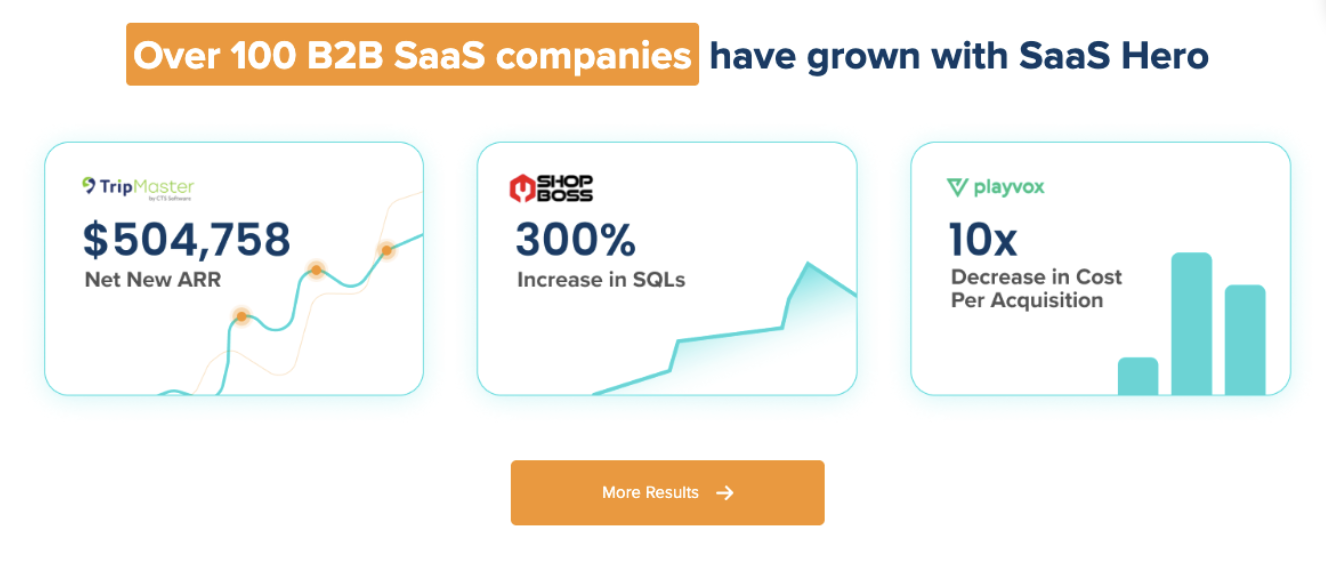
Case studies show how this structure performs in practice, including a transit software company that achieved $504,758 in Net New ARR with 650% ROI. The 80-day payback period highlighted earlier for B2B SaaS clients carries over to RetailTech scenarios where leadership needs fast proof of ROI for investors or boards.

Founders managing early growth can start around $1,250 monthly for focused channel support, while CMOs at larger organizations often invest $4,500 or more for multi-channel coverage and strategic leadership. SaaSHero’s month-to-month structure means you scale spend only when results justify it, and you can set up a working session to review your current mix and uncover immediate savings or reallocation opportunities.
Negotiation Checklist and Practical Next Steps
RetailTech leaders negotiate stronger agency agreements when they anchor discussions on a clear, consistent checklist.
- Insist on month-to-month contracts to keep leverage and exit options.
- Cap setup fees under $2,000 so more of your budget funds active campaigns.
- Tie reporting to ARR growth and pipeline impact instead of surface-level vanity metrics.
- Require senior-level involvement in both strategy and day-to-day execution.
- Define concrete performance benchmarks with clear exit clauses if targets are missed.
- Negotiate fixed creative and landing page costs to avoid surprise line items.
Teams often validate fit through a short pilot before signing broader agreements, which tests both RetailTech expertise and cultural alignment. If you want support applying this checklist to your own contracts, you can schedule a call with SaaSHero to walk through your requirements and see how our month-to-month model removes many of the risks outlined here.
Frequently Asked Questions
What is the typical monthly retainer for RetailTech agencies?
Monthly retainers usually fall between $2,000 and $20,000 depending on company size and scope. The ARR tiers outlined earlier shape specific ranges, with most teams paying $2,000 to $10,000 for dedicated campaign management and larger enterprises investing $30,000 or more for fully embedded, omnichannel support.
How does SaaSHero’s pricing compare to other RetailTech agencies?
SaaSHero avoids percentage-of-spend traps through flat monthly retainers that start at $1,250 for single-channel management up to $10,000 in ad spend. Traditional agencies that charge 10 to 20 percent of budget often earn more when you spend more, while SaaSHero’s fixed pricing keeps recommendations tied to performance. This structure can reduce total fees compared with percentage-based models while still delivering strong results through specialized B2B SaaS methodology adapted to RetailTech.
What cost trends should RetailTech companies expect in 2026?
Agency costs continue to rise as AI integration and omnichannel orchestration demand deeper technical skills. Economic uncertainty pushes companies toward selective partnerships and month-to-month contracts instead of long-term commitments. Specialized RetailTech expertise commands higher pricing, yet flat-fee models offer cost stability when budgets fluctuate, and setup fees increasingly cluster around $1,000 to $2,000 as agencies compete for new clients.
What factors most influence RetailTech agency pricing variations?
Pricing varies most with omnichannel integration complexity, company ARR, number of active marketing channels, and required technical work. POS system depth, inventory management requirements, and multi-location coordination add further cost, while macroeconomic conditions and AI adoption needs can push rates higher for advanced personalization capabilities.
How much do RetailTech agencies charge for hourly consulting?
Hourly consulting rates depend on expertise and project difficulty, with senior strategists charging more than junior consultants. Hourly billing can work for audits or targeted fixes, but monthly retainers usually provide better value for ongoing growth and continuous optimization.
Conclusion: Using the 5 Cs to Align Pricing with Growth
RetailTech agency pricing in 2026 reflects a tension between rising complexity and the need for predictable, performance-aligned partnerships. Omnichannel campaigns, AI personalization, and POS integrations push costs upward, while finance leaders demand clear ROI and flexible contracts.
The 5 Cs framework helps resolve this tension by aligning Cost, Channels, Company Size, Contract terms, and Capabilities with your growth stage and risk profile. Percentage-of-spend models and rigid long-term contracts often work against that alignment, so flat-fee structures with month-to-month flexibility usually serve RetailTech teams better.
SaaSHero’s specialized approach gives RetailTech companies predictable pricing, senior-led execution, and Net New ARR visibility that supports confident scaling. If you want to pressure-test your current agency model or explore a shift to flat-fee retainers, request a pricing and ROI review tailored to your channels, ARR, and integration roadmap.