




Written by: Aaron Rovner, Founder, Saas Hero
Key Takeaways
- Specialized landing page agencies that focus on B2B SaaS align their work with revenue metrics like pipeline, CAC, and ARR, not surface-level engagement.
- Clear KPI hierarchies and multi-touch attribution help connect landing page performance to real opportunities, deals, and payback periods.
- Hybrid models that combine in-house knowledge with specialized CRO agencies often give B2B SaaS teams the best balance of speed, expertise, and control.
- A structured experimentation program, strong data infrastructure, and realistic contracts help avoid common pitfalls such as vanity metrics and lock-in agreements.
- B2B SaaS teams that want a revenue-focused landing page partner can work with SaaSHero, a specialized agency, by scheduling a discovery call.
The Strategic Imperative: Why B2B SaaS Demands Specialized Conversion Agencies
B2B SaaS teams now measure success by revenue, not clicks or impressions. Modern B2B SaaS content strategies link performance directly to pipeline impact, conversion trends, and sales feedback, which raises the bar for agency partners.
Generalist agencies often struggle with long sales cycles, complex buying committees, and multi-touch funnels. Percentage-of-spend billing and long-term retainers can also create misaligned incentives that push ad spend rather than efficient growth.
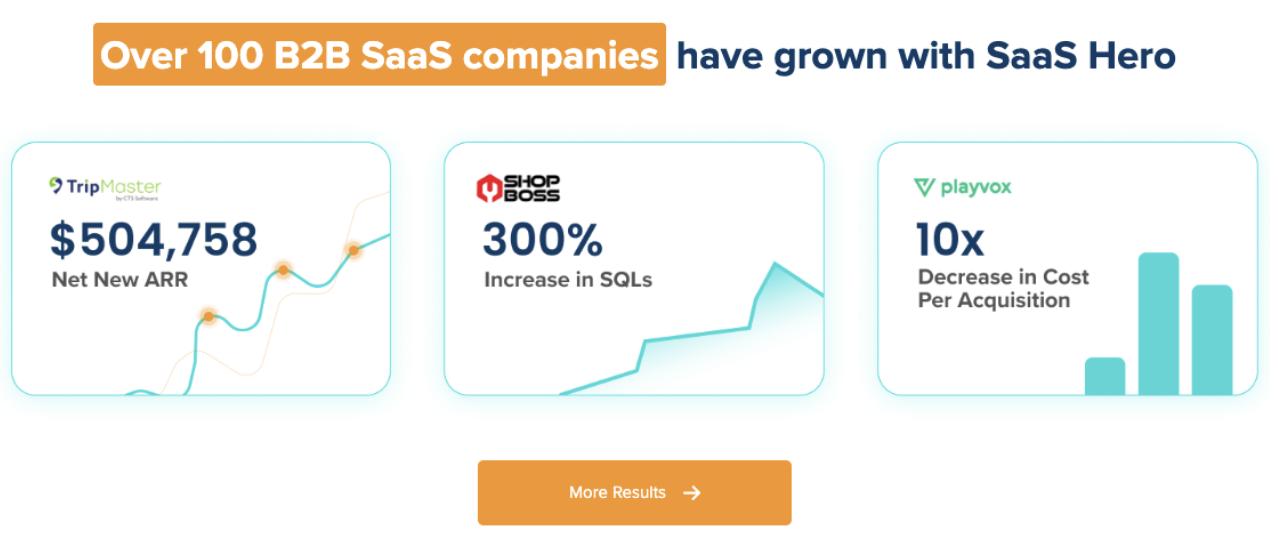
Specialized conversion agencies focus on metrics that matter in SaaS, such as Net New ARR and CAC payback. Case studies like TripMaster and TestGorilla show how focused CRO work can add hundreds of thousands in ARR and shorten payback windows.

Teams that want this level of focus can explore options by booking a discovery call with a specialized B2B SaaS agency.
Defining Your Partner: Key Terminology and Performance Frameworks
Clear performance frameworks make agency partnerships easier to manage. Leading SaaS teams track visitor-to-lead conversion, demo or trial requests, and pipeline created by source so everyone can see which landing pages drive real opportunities.
Revenue-focused CRO programs work from a KPI hierarchy. SaaS leaders often track free-to-paid conversion, NRR, CAC payback, and key micro-conversions across the funnel to keep optimization tied to growth.
Attribution is another key piece. Modern teams increasingly use machine-learning multi-touch models instead of last-click, and companies that adopt multi-touch often see 15–25% better conversion optimization performance.
Effective partners link top-of-funnel actions, such as form fills, to closed-won revenue so copy, offers, and layouts can be optimized around high-value customers, not just lead volume.
Navigating the Ecosystem: Traditional vs. Specialized Agency Landscape
Agency models have shifted as SaaS buyers and boards ask for cleaner attribution and revenue proof. Many teams now prioritize niche partners that understand complex buyer journeys and can operate from data-led frameworks.
High-performing B2B SaaS strategies rely on intent-based scoring, PLG funnels, and ABM. Generalist agencies that only manage channels often miss these nuances, while specialized agencies differentiate with revenue-focused pricing, CRM integration, and closer alignment with internal teams.
Specialized partners usually keep smaller client loads, integrate into tools like Slack and the CRM, and work as an extension of the in-house marketing team.
Strategic Dilemmas: Build vs. Buy, Insource vs. Outsource for Landing Page Excellence
Leaders must decide how much CRO capability to build internally. In-house teams offer deep product knowledge and long-term ownership, but recruiting senior CRO talent and paying for tools can be expensive and slow.
Agencies give faster access to proven methods and broader testing experience. They can accelerate impact on pipeline and CAC, but only when incentives, reporting, and workflows align with internal goals.
Many B2B SaaS companies choose a hybrid approach. Agencies run structured experimentation and landing page strategy while internal teams focus on positioning, product-led growth, and customer marketing. Teams that want help evaluating this mix can schedule a strategy consultation.
Best Practices: Contemporary Approaches to Conversion-Focused Landing Page Design
Strong CRO programs treat landing pages as ongoing experiments, not one-time projects. Many teams run 2–4 structured tests per week with set confidence levels and clear backlogs, so every test has a purpose.
AI now supports personalization and prediction. Tools can flag high-intent users in real time and adapt in-product and landing experiences for those users, which helps focus attention on the visitors most likely to convert.
Basics still matter. Fast response times and lower form friction consistently correlate with higher visitor-to-lead conversion rates, so technical fixes often come before advanced personalization.
Assessing Readiness: Building an Effective Operating Model for CRO Partnership
Internal readiness often determines how much value an agency can create. Teams that first address core UX and speed issues usually see better results from later CRO work.
Data infrastructure should capture the full journey from first touch to closed-won. That usually means reliable UTM use, clean CRM data, aligned lead scoring, and multi-touch attribution that matches how your buyers actually evaluate software.
Cross-functional collaboration keeps tests grounded in reality. Marketing, sales, and product teams should share feedback so landing pages mirror real objections, decision criteria, and in-app experiences. Teams that want an outside perspective can request a conversion audit to uncover gaps.
Common Pitfalls: Navigating Traps in Conversion-Focused Engagements
Many SaaS companies fall into vanity-metric reporting. Traffic and click-through improvements that do not tie to revenue can hide weak performance for months, especially when contracts lack performance accountability.
Attribution gaps can also mislead teams. Incomplete tracking can either overstate or understate the impact of landing page experiments, which leads to poor decisions about scaling or stopping campaigns.
Contracts are another frequent problem. Long lock-in agreements shift risk to the client and reduce pressure on agencies to improve results. Month-to-month or short initial terms create healthier pressure to perform.
Illustrative Scenarios: Applying Conversion Strategy to Real-World B2B SaaS Contexts
The Bootstrapped Founder (Early-Stage)
Founders with limited capital need quick validation and simple funnels. Flexible, month-to-month engagements help them access expert CRO without long-term financial exposure, while basic tracking and a few focused landing pages support product-market fit learning.
The Scaling VP of Marketing (Post-Funding)
Post-funding teams must prove efficient growth to boards. They benefit from partners who integrate with existing CRM and ad platforms, report on pipeline and ARR, and scale testing across multiple segments, not just isolated pages or campaigns.
The Mature Enterprise Optimizing Efficiency (Steady Growth)
Established SaaS companies often focus on CAC reduction and LTV expansion. Advanced CRO programs, predictive analytics, and multi-touch attribution help them fine-tune acquisition, expansion, and retention across high-traffic landing pages.

Conclusion: Your Path to Predictable Revenue Growth with Expert Landing Page Design
B2B SaaS companies that treat landing pages as revenue infrastructure, not design artifacts, create clearer paths to predictable growth. Specialized agencies that understand SaaS economics, attribution, and buyer journeys help teams turn ad spend into a qualified pipeline and ARR.
Disciplined measurement, aligned incentives, and structured experimentation form the core of successful partnerships. Teams ready to apply this approach can partner with SaaSHero to build and optimize conversion-focused landing pages for their pipeline goals.
Frequently Asked Questions About Conversion-Focused Landing Page Agencies
How should B2B SaaS companies budget for conversion-focused landing page design and CRO?
Budget for CRO as revenue infrastructure, not a side project. Early-stage teams often start around $1,250 per month for focused management, while scaling companies may invest $4,500 or more for broader experimentation, reporting, and design support that match their traffic levels.
What are the most critical metrics to track when partnering with a landing page agency?
Key metrics include visitor-to-lead and lead-to-opportunity conversion rates, CAC, LTV, and payback period. Revenue metrics such as Net New ARR, pipeline velocity, and closed-won attribution, combined with page speed and form completion rates, give a full view of performance.
How long does it typically take to see results from a specialized CRO engagement?
Foundational improvements, such as faster pages and clearer forms, often show impact within 30–60 days. A/B tests usually need a few weeks for significance, and full revenue impact typically becomes clear after several sales cycles, often 6–12 months.
What’s the best way to ensure alignment between my internal team and a conversion agency?
Set shared revenue-focused KPIs, hold regular performance and strategy check-ins, and use shared channels for daily communication. Agencies should lead testing and implementation while internal teams supply market insight, product direction, and sales feedback.
Can a specialized agency integrate with my existing tech stack (CRM, marketing automation)?
Most professional CRO agencies integrate with platforms like HubSpot, Salesforce, and common marketing automation tools. They should help configure tracking from ad click to closed-won, build dashboards, and maintain attribution accuracy as systems evolve.