




Key Takeaways
- Capital-efficient growth in 2026 depends on disciplined unit economics, not top-line volume alone.
- A blended PLG, SLG, and ABM portfolio aligned to ACV and complexity improves GTM efficiency.
- Reliable data, clear revenue metrics, and RevOps alignment support consistent GTM decision-making.
- Lower reliance on vanity metrics, low-quality outbound, and underused customer success improves Net New ARR and NRR.
- SaaSHero helps B2B SaaS teams design and execute revenue-focused GTM programs. Schedule a discovery call.
The Evolving Landscape: Why Go-to-Market Strategy Demands a Rethink in 2026
From Growth at All Costs to Capital Efficiency
Capital markets now reward efficient growth, so B2B SaaS leaders must prove strong unit economics. Investors focus on CAC payback under 12 to 24 months, LTV to CAC ratios of 3 to 5, and sustainable burn multiples. GTM plans that prioritize Net New ARR, NRR, and payback outperform strategies designed around volume metrics.
The Buyer-Led Journey and the Dark Funnel
Modern buyers complete much of their evaluation before speaking with sales, which weakens traditional MQL-led funnels. Most research happens across communities, review sites, and peer networks, so GTM teams need programs that influence buyers long before form fills appear in the CRM.
The Digital Agency Disruption
Many legacy agency models misalign with SaaS economics. Percentage-of-spend billing, long contracts, and vanity reporting place risk on the client instead of sharing accountability for revenue. SaaS leaders increasingly look for partners that commit to clear revenue metrics and efficient CAC.
Assess your current GTM strategy with SaaSHero.
Core Principles of Capital-Efficient GTM for B2B SaaS Revenue Growth
Outcome Metrics That Anchor GTM Decisions
Clear financial metrics guide capital-efficient GTM decisions. Teams track CAC, LTV, Net Revenue Retention, Product Qualified Leads, and CAC payback, then connect these to pipeline and revenue. High-performing organizations replace MQL volume as a north star with measures like PQL velocity, ARR progression, and NRR health.
The Integrated GTM Framework: Blending PLG, SLG, and ABM
An integrated GTM portfolio combines PLG, SLG, and ABM motions based on ACV and implementation complexity. Each motion plays a specific role instead of competing for budget.
PLG (Product-Led Growth)
PLG works best for lower ACV deals with short implementation cycles. Success depends on fast activation, time to value, and trial or freemium paths that convert users with light sales support.
SLG (Sales-Led Growth)
SLG suits mid-market deals with longer cycles and multiple stakeholders. GTM teams prioritize pipeline velocity, stage conversion, and content that supports each buying role.
ABM (Account-Based Marketing)
ABM fits large enterprise deals with complex buying committees. Programs rely on tailored messaging, multi-threaded outreach, and tight coordination between marketing, sales, and customer success.
|
GTM Motion |
Ideal ACV Range |
Key Metrics |
SaaSHero Support |
|
PLG |
Under $10k |
Activation rate, PQL velocity |
Landing page CRO, paid traffic |
|
SLG |
$50k to $500k |
Pipeline conversion, win rate |
Targeted paid ads, messaging |
|
ABM |
Over $500k |
Account engagement, expansion NRR |
Custom LinkedIn ads, competitor conquesting |
Strategic Considerations and Trade-offs in B2B SaaS GTM Design
Build vs. Buy: Structuring the GTM Team
Leadership teams must balance in-house talent with specialist partners. Internal teams provide deep product context and close cross-functional alignment, while focused agencies supply channel expertise and faster execution in paid media, CRO, and analytics.
SaaSHero’s Extension-of-Team Model
SaaSHero operates as an embedded growth team that integrates with internal marketing and revenue leaders. This structure enables shared KPIs, direct feedback loops, and execution that ties clearly to pipeline and ARR.
Channel Prioritization and Investment Allocation
Tracking CAC by channel and assisted pipeline allows continuous budget shifts toward the most efficient paths to revenue. Teams keep test budgets small, then double down on channels that prove strong payback.
Explore SaaSHero’s approach to B2B SaaS GTM planning.
Contemporary Approaches and Emerging Practices for B2B SaaS GTM
Data Foundation, Identity Resolution, and Attribution
Consistent UTM governance, event tracking, and identity resolution create the base for reliable multi-touch attribution. This structure helps teams compare PLG, content, and paid programs on equal terms and improves CAC accuracy.
AI and Dynamic ICPs for Precision Targeting
AI-supported ICPs move beyond static firmographics to include intent signals, product usage, and engagement data. These models focus outreach on accounts with higher propensity to buy and reduce wasted spend on low-fit segments.
Lifecycle Programs and PQL Frameworks
Structured onboarding, adoption prompts, and PQL routing connect product usage to sales-assisted revenue. Clear SLAs for PQL follow-up and expansion motions improve NRR and LTV.
Revenue-First Operating Model for SaaS Companies
The 90-Day GTM Launch System
A three-phase launch framework covering data infrastructure, lifecycle programs, and scaled demand generation helps new products or markets reach repeatable pipeline faster. Teams establish measurement early, which prevents inefficient spend later.
RevOps as Central Orchestrator
RevOps connects marketing, sales, and customer success through shared data and KPIs. This function manages handoffs, routing, and reporting so that prospects experience a consistent journey from first touch to renewal.
Sales Enablement for Consistent Messaging and Performance
Sales enablement programs standardize messaging, tools, and training by stage of the buyer journey. Effective playbooks and collateral improve win rates and shorten cycle times.
See how SaaSHero structures revenue-first client engagements.
Common Pitfalls for Experienced B2B SaaS Go-to-Market Teams
Over-Reliance on Poorly Qualified Outbound and Burned-Out SDRs
Low-quality data and generic outreach drive high activity with little pipeline. SDR teams face high churn, and the brand suffers from spam-style messaging.
Vanity Metrics and Misaligned Incentives
Emphasis on impressions, clicks, and low-intent leads can hide weak Net New ARR and pipeline performance. Incentives that reward surface-level engagement instead of revenue outcomes create wasted spend.
Neglecting Customer Success as a Revenue Function
Customer success teams that lack targets for renewal and expansion leave upsell and cross-sell potential unused. Treating CS as a cost center instead of a growth driver lowers NRR.
PLG Without Sales Assist and Onboarding
Trials that lack clear onboarding paths or sales involvement often stall. High-intent users need guided next steps, qualification, and timely outreach to convert into paid accounts.
Illustrative Scenarios: Go-to-Market in Practice for SaaS Growth
Scenario 1: Early-Stage Founder-Led SaaS
Context: A $500k ARR product with the founder running ads and limited bandwidth.
Strategic focus centers on a narrow ICP, founder-led sales, and small-scale channel testing. SaaSHero’s Dedicated Campaign Manager option offers a lower-cost way to manage up to $10k in ad spend while preserving cash.
Scenario 2: Post-Funding Scale-Up
Context: A Series A or B company with aggressive growth targets and rising budgets.
Strategic focus shifts to repeatable demand engines across content, outbound, and PLG, with tight guardrails on CAC payback and burn multiple. SaaSHero’s Full Marketing Team model supplies senior-led execution for faster scaling.
Scenario 3: Mature SaaS Optimizing for Efficiency
Context: An established company with fragmented data and rising acquisition costs.
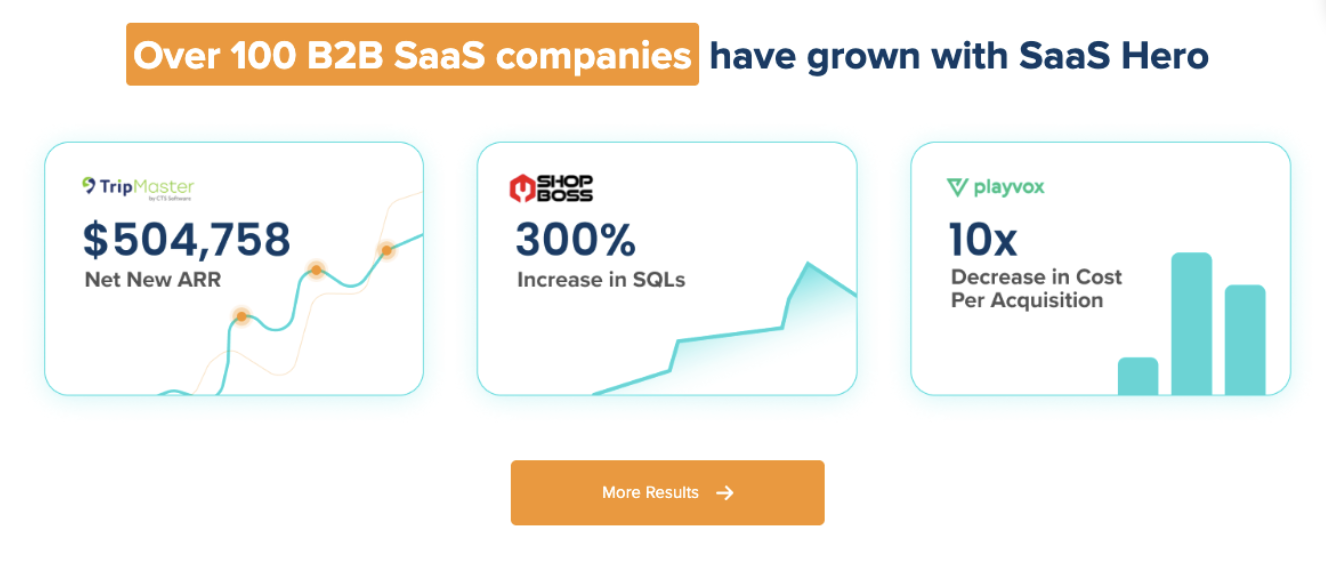
Closed-loop reporting, account-level analytics, and systematic budget reallocation toward high-ROI segments improve efficiency. SaaSHero’s revenue-first approach, including a 10x Cost Per Lead decrease for clients like Playvox, shows the impact of this model.

See how SaaSHero supports Net New ARR for B2B SaaS companies.
Frequently Asked Questions (FAQ) about B2B SaaS Go-to-Market Strategy
How do I accurately measure CAC across different GTM motions (PLG vs. SLG)?
Accurate CAC measurement depends on reliable tracking and clear motion definitions. Teams connect product analytics, marketing automation, and CRM data, then separate acquisition costs and results for PLG activations and sales-led opportunities. Multi-touch attribution improves visibility into assisted pipeline and reduces bias toward last-click sources.
What are the most critical GTM KPIs for investors in 2026?
Investors prioritize CAC payback, LTV to CAC ratio, NRR, and burn multiple. Pipeline velocity, win rate by segment, and cohort retention add insight into how durable and scalable the current GTM model is.
How can we apply AI to our GTM strategy for better results?
AI supports dynamic ICPs, predictive lead scoring, intent-based prioritization, and performance forecasting across channels. These capabilities improve focus on high-probability accounts and support more efficient allocation of budget and sales effort.
What is the biggest mistake B2B SaaS companies make with GTM?
Many teams scale channels before confirming a clear ICP, value proposition, and basic measurement infrastructure. This pattern leads to spend on low-fit segments, inconsistent sales execution, and difficulty linking activities to revenue.
How often should we revisit and revise our GTM strategy?
GTM strategy benefits from quarterly reviews of ICP, channel mix, and unit economics. Larger shifts typically align with funding events, major product launches, or clear changes in buyer behavior, while smaller optimizations occur monthly based on performance data.
Contact SaaSHero for support on B2B SaaS GTM challenges.
Conclusion: Mastering Capital-Efficient Go-to-Market Strategy for B2B SaaS Revenue Growth
Capital-efficient growth in B2B SaaS requires integrated GTM design, disciplined data, and alignment across revenue teams. Leaders who balance PLG, SLG, and ABM, invest in RevOps and measurement, and avoid vanity-driven tactics create more predictable, profitable revenue engines.

Connect with SaaSHero’s B2B SaaS growth specialists to refine your GTM strategy.