




Key Takeaways
- B2B SaaS ad costs average £3-£6 per click in 2026, so sustainable growth requires LTV:CAC ratios of 3-5x and 80-day payback periods.
- Target Pricing, Complaint, and Review Intent Buckets using the 40-40-20 rule (40% problem, 40% solution, 20% CTA) and the 3-2-2 testing method.
- Apply the MECLABS heuristic CRO formula and the 4 C’s framework (Clarity, Relevance, Trust, Credibility) to reach 8-15% visitor-to-lead conversion rates.
- Ignore vanity metrics like CTR and focus on Net New ARR, SQLs, and CRM-integrated attribution to measure real revenue impact.
- Work with SaaSHero for senior-led execution, flat-fee month-to-month retainers, and proven results like $504k ARR growth. Schedule a discovery call today.
Executive Summary: Revenue-First B2B Ad Design
Effective B2B ad design conversion optimization rests on four pillars: Psychology of Intent, Heuristic CRO, Revenue Attribution, and CRM Tracking. This framework replaces vanity metrics like impressions and clicks with SQLs, Net New ARR, and competitor conquesting performance. The SaaSHero methodology focuses on Intent Buckets such as Pricing, Complaint, and Review searches, along with Heuristics like Relevance, Clarity, Trust, friction reduction, Landing Architecture improvements, and Negative Keyword Hygiene.
Typical visitor-to-lead conversion rates hover at 1.5%, while the top 10% of B2B SaaS companies reach 8-15% conversion rates through systematic experimentation. This playbook outlines practical frameworks, ad screenshots, TCO comparison tables, and mobile-first design principles. Explore SaaSHero’s pricing to apply these strategies with senior specialists.

B2B SaaS Ad Channels and 2026 Performance Trends
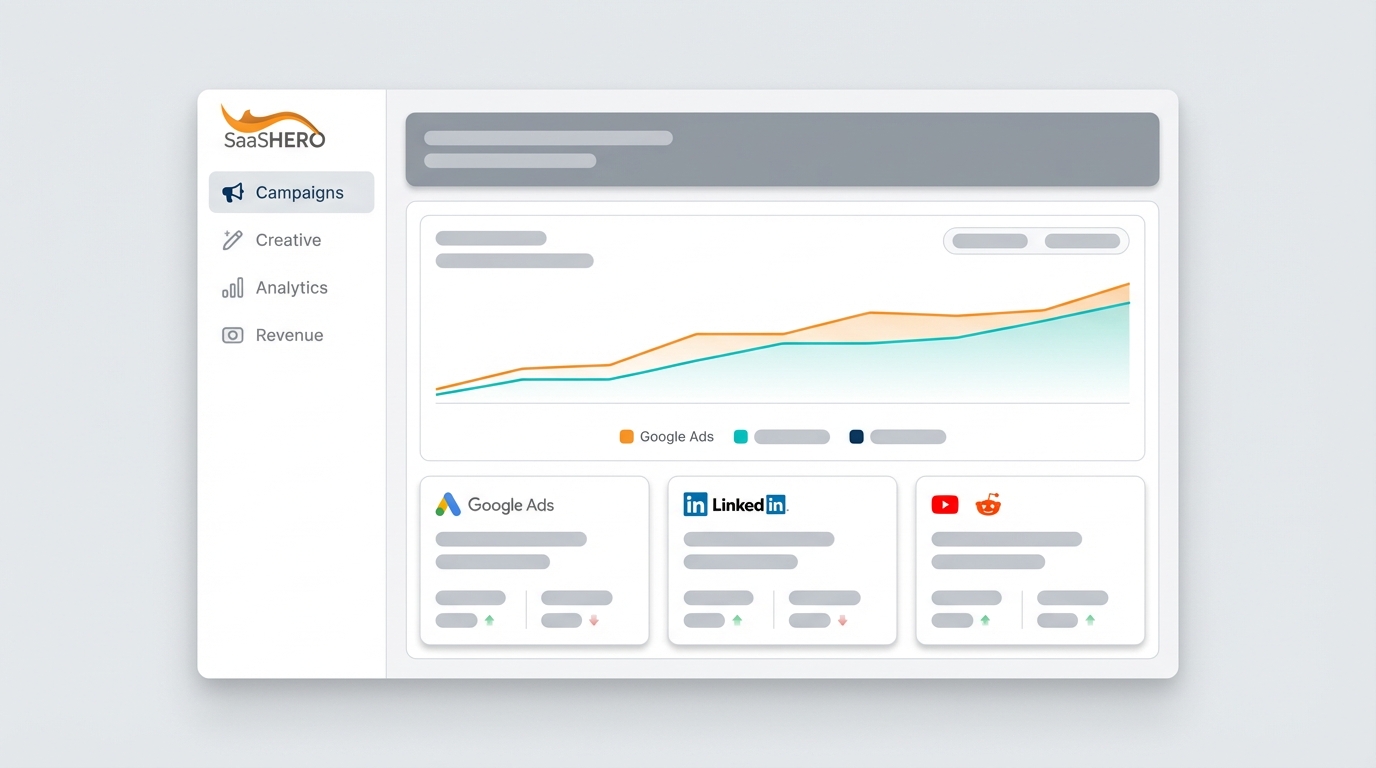
The 2026 platform landscape shows clear performance patterns across channels. Google Search delivers 4.28% CTR on average for SaaS, with B2B SaaS Search CTR medians closer to 8%, while LinkedIn Ads average 0.62% CTR at £4.04 per click. Many teams now favor specialized partners over generalist agencies that charge percentage-of-spend fees, because percentage models often reward higher spend instead of efficiency.
Three trends dominate 2026: AI-powered creative iteration, full-funnel CRM integration, and competitor conquesting as a core growth channel. Traditional percentage-based agencies often operate with misaligned incentives, while flat-fee retainers from specialists like SaaSHero keep attention on revenue outcomes, not budget expansion.
Intent-Led Ad Design for High-Converting B2B Campaigns
The SaaSHero intent-based design methodology targets three high-value search behaviors. Pricing Intent focuses on users searching “[Competitor] pricing” or “how much does [Competitor] cost” and routes them to TCO comparison pages with clear cost breakdowns. Complaint Intent targets frustrated users searching “[Competitor] alternatives” or “cancel [Competitor]” using problem-solution messaging that addresses known competitor gaps. Review Intent reaches users searching “[Competitor] reviews” or “[Competitor] vs [Client]” with social proof-heavy pages that highlight G2 badges and specific testimonials.
The 40-40-20 rule assigns 40% of messaging to problem identification, 40% to solution presentation, and 20% to clear CTAs. The 3-2-2 method then tests 3 headline variations, 2 image concepts, and 2 CTA approaches to refine performance. Strong B2B SaaS ad copy uses outcome-focused headlines such as “Reduce Support Tickets 67% in 30 Days” instead of feature lists.
Mobile-first design now plays a central role because decision-makers often research on phones before converting on desktop. Tight message-match between ad copy and landing page headlines keeps the experience consistent and reduces bounce rates. Visuals should include competitor comparison screenshots and simple value proposition diagrams that load quickly on every device.
Heuristic CRO for B2B SaaS Landing Pages
The SaaSHero Heuristic Analysis uses the MECLABS Conversion Sequence Heuristic, expressed as C = 4M + 3V + 2(I–F) – 2A, where C is conversion, M is motivation, V is value proposition, I is incentive, F is friction, and A is anxiety. The 5-second test checks whether visitors grasp the core value proposition almost instantly. Trust signals should appear above the fold, including security badges, recognizable client logos, and short testimonials.
High-performing landing pages follow a clear hierarchy. The hero section leads with a benefit-driven headline. Social proof appears near the primary CTA. Feature sections translate capabilities into business outcomes. Forms stay short to reduce friction and encourage completion. The 4 C’s framework then evaluates Clarity, Relevance, Trust, and Credibility for each page element. The 7 P’s cover Product positioning, Price transparency, Place or channel fit, Promotion timing, People as social proof, Process simplification, and Physical evidence.

Teams that apply these heuristics consistently often reach 20% conversion rates and 650% ROI from paid campaigns. Case studies such as TripMaster’s $504k ARR growth highlight the difference between revenue-focused CRO and surface-level optimization around vanity metrics.
Measurement Mistakes and Revenue Reporting Gaps
Five recurring mistakes undermine many B2B SaaS ad programs. Vanity metric obsession keeps teams focused on CTR and impressions instead of pipeline value and closed-won revenue. Weak negative keyword hygiene burns budget on navigational searches like competitor brand names without qualifiers. Missing CRM integration blocks clear attribution from ad spend to revenue. Agency bait-and-switch tactics promise senior strategy but deliver junior execution. Internal self-audits should confirm whether your agency reports Net New ARR, traces ad clicks to closed deals, and avoids locking you into long-term contracts.
SaaSHero counters these issues with flat monthly retainers, month-to-month agreements, and revenue-focused reporting integrated with HubSpot and Salesforce. This structure keeps optimization centered on business outcomes instead of agency fee growth.
Real-World SaaS Scenarios and Revenue Proof
Three common scenarios illustrate how this approach works in practice. The Overwhelmed Founder scenario covers CEOs running ads on weekends who need professional management at a sane price without long-term commitments. The Frustrated VP scenario focuses on marketing leaders who receive vanity metric reports while facing board pressure for pipeline accountability. The Post-Funding Scaler scenario supports newly funded startups that must show efficient growth quickly to satisfy investors.
Documented outcomes include TestGorilla’s 80-day payback period that supported a $70M Series A, Playvox’s 10x CPL reduction after account restructuring, and TripMaster’s $504k Net New ARR increase. These examples show the revenue impact of specialized B2B SaaS expertise compared with generalist agency models. Book a discovery call to identify which scenario best matches your current stage.

FAQ: B2B SaaS Ad Design and Measurement
What is the 3-2-2 method for ads?
The 3-2-2 method provides a structured testing framework for B2B SaaS ad improvement. Create 3 headline variations that highlight different value angles, such as outcome-driven, feature-focused, and problem-agitation. Pair these with 2 image concepts, for example, product screenshots and customer success visuals.
Add 2 CTA approaches, such as demo-focused and trial-focused. This structure enables rapid iteration while preserving statistical significance. Run each combination until you reach sufficient volume, typically 1000 or more impressions per variation for B2B audiences, before choosing winners.
How do you apply the 40-40-20 rule to SaaS ads?
The 40-40-20 rule distributes ad messaging across problem, solution, and CTA. Use 40% of your copy to describe specific problems your audience faces, using their internal language. Use another 40% to present your solution with clear differentiation, focusing on measurable outcomes instead of raw features.
Reserve the final 20% for a direct CTA that matches user intent, such as demo requests for enterprise buyers and free trials for self-serve products. This balance keeps attention on problem-solution fit while preserving a clear conversion path.
How should B2B SaaS teams use LinkedIn and Google together?
Google works best for competitor conquesting and high-intent searches, with average CPCs around £3-6 and strong conversion rates from active search behavior. LinkedIn offers precise targeting for account-based marketing using job title, company size, and industry filters, although it usually delivers a lower CTR of around 0.62% and higher costs near £4.04 CPC.
Use Google to capture existing demand and displace competitors. Use LinkedIn to create demand among specific decision-maker segments. Many successful B2B SaaS teams run both platforms with distinct objectives and budgets.
Which metrics best measure ad design ROI?
Revenue-connected metrics provide the clearest view of ad design ROI. Net New ARR tracks closed business that comes from ad campaigns. CAC payback period measures how quickly marketing spend returns through gross margin, with 80-day targets representing top-tier performance.
SQL conversion rates reveal ad quality and targeting accuracy. Pipeline velocity shows how quickly leads move from first touch to closed-won. Avoid optimizing purely for CTR, impressions, or raw lead counts without revenue qualification.
Are month-to-month agency relationships effective?
Month-to-month agreements work well when incentives stay aligned. Clients gain flexibility to adjust or exit based on performance without penalties, which reduces risk with new partners. Agencies must deliver consistent value to retain clients, which creates accountability that long-term contracts often weaken.
This model performs best with flat-fee retainers instead of percentage-of-spend billing, because flat fees keep pricing stable while maintaining performance pressure. SaaSHero’s month-to-month, flat-fee structure aligns agency success with client revenue growth rather than ad budget size.
Conclusion: Revenue-Focused Next Steps
B2B ad design conversion optimization in 2026 relies on intent-based targeting, heuristic CRO, and revenue-first measurement. The 40-40-20 rule and 3-2-2 method give teams repeatable systems for ad creation and testing, while competitor conquesting captures high-intent buyers already evaluating alternatives. Sustainable success requires specialized expertise, accurate attribution, and tight alignment between agency incentives and client outcomes. Partner with SaaSHero to pursue $500k or more in ARR growth through proven frameworks and senior-led execution. Book a discovery call today to apply these strategies with month-to-month flexibility and flat-fee transparency.