




Written by: Aaron Rovner, Founder, Saas Hero | Last updated: July 11, 2026
Most B2B SaaS teams calculate CPA using only media spend, yet real programmatic acquisition costs include several additional fee layers that raise totals by 30–50%. The table below breaks down each component of a full-stack CPA formula and shows 2026 benchmark ranges for each fee type.
| Formula Component | Definition | 2026 Benchmark Range |
|---|---|---|
| Media Spend | Raw inventory cost paid to publisher via DSP auction | $4.20–$9.85 CPM (display) |
| DSP Platform Fee | Technology fee charged by the demand-side platform | 10–15% of media spend |
| DMP / Data Fee | Third-party audience segment and identity graph costs | $1–$5 CPM incremental |
| Ad Serving Cost | Per-impression storage, tracking, and delivery fee | $0.10–$0.25 CPM |
| Brand Safety / Verification | IVT detection, viewability, and brand safety tools | $0.05–$0.20 CPM |
| Total Acquisitions | Conversions attributed within the defined window | Denominator |
| Full-Stack CPA | (Media Spend + DSP Fee + DMP Fee + Ad Serving + Verification) ÷ Total Acquisitions | Varies by vertical |
Key Takeaways for B2B SaaS Growth Teams
- B2B SaaS companies need full-stack CPA that includes DSP fees, data costs, and verification charges, because omitting them understates acquisition cost by 30–50%.
- CPA tracks campaign-level actions like leads or trials, while CAC tracks the fully loaded cost of winning a paying customer, so both must be tracked separately for clean unit economics.
- 2026 benchmarks show B2B SaaS CPA averaging about $116 across Google Search and Display, with LTV:CAC ratios of 3:1 as the minimum floor and 3.8:1–5:1 as the scale-stage target.
- Target CPA bidding performs best after 15–30 conversions per month, so teams should launch campaigns 10–15% above historical CPA and shift to Target ROAS once conversion history is stable.
- Schedule a discovery call to audit your full fee stack, benchmark CPA against 2026 data, and build a bidding playbook aligned to Net New ARR goals.
The 2026 Adtech Landscape for B2B SaaS
Programmatic advertising captured 91% of US display ad spend in 2026, with the Google Display Network holding 32% market share of the U.S. display ads market in 2026, Amazon DSP holding 14% market share in programmatic advertising in 2026, The Trade Desk, and Microsoft Advertising at 9%. That concentration means nearly every B2B SaaS display dollar now flows through a layered fee stack that inflates total costs 30–50% above advertised platform rates.
Attribution has shifted materially since 2024. Last-click models systematically over-credit branded search while starving non-brand and upper-funnel investments of budget. Multi-touch attribution improves CPA efficiency by 14–36% and can deliver higher marketing ROI while reducing wasted ad spend. Simultaneously, LLM-powered contextual targeting, available in The Trade Desk’s Koa AI and StackAdapt, offers benefits compared to keyword contextual targeting. Regardless of targeting method, every impression still carries a layered cost that most teams miss in their CPA calculations.
CPA in Programmatic Advertising: Full Fee Stack and Calculation
Yahoo DSP defines CPA as Ad Spend divided by Conversions, where Ad Spend equals inventory cost plus platform fee plus total data fee plus seat management fee plus vendor fees plus order management fee plus applicable taxes. That formula makes the fee stack explicit. Most teams use only the media spend line, which produces an artificially low CPA.
Calculating true effective CPA when using DSPs requires sophisticated financial modeling because of layered fees including third-party data, fraud detection, brand safety tools, cross-device identity graph fees, and monthly platform minimums. Hidden fees across DSP platform fees, data, fraud prevention, attribution, and creative production inflate total programmatic costs by 30–50% above advertised platform fees.
Three diagnostic questions help you catch calculation errors before they compound.
- Does the CPA numerator include DSP platform fees, DMP data costs, and ad verification charges, or only raw media spend?
- Is the attribution window consistent across all platforms, or does Meta use a 7-day click while Google uses a 30-day last-click?
- Are agency fees, creative production, and tool subscriptions included in the fully loaded CPA used for LTV:CAC modeling?
CPA vs CAC in B2B SaaS and Impact on Net New ARR
CPA measures the cost of a lighter action such as a signup, lead, or trial, while CAC measures the cost of converting to a paying customer; CAC sits at the bottom of the funnel and is always higher than CPA. Celebrating a $50 CPA without tracking the downstream conversion rate produces a misleading picture. A $50 CPA per lead can become $600–$850 CAC per customer after accounting for conversion rates and downstream costs.
Paid-attributable CAC typically runs 1.4× to 1.8× the blended CAC figure because blended CAC absorbs organic, referral, and brand-search conversions that require no incremental spend. Tracking paid CAC separately prevents a healthy blended number from masking an unprofitable paid channel. The table below translates LTV:CAC ratios into CAC ceilings and payback periods so you can see where your unit economics sit.
| LTV:CAC Ratio | Interpretation | Implied Max Paid CAC (at $1,000 LTV) | Payback Ceiling |
|---|---|---|---|
| 2:1 or below | Warning: near break-even | $500 | Unsustainable |
| 3:1 (floor) | Minimum for budget approval | $333 | 12 months |
| 3.8:1–5:1 | Scale-stage target (>$10M ARR) | $200–$263 | 6–9 months |
| 7:1 | Adtech vertical benchmark (First Page Sage) | $143 | <6 months |
2026 B2B SaaS CPA Benchmarks by Vertical and Channel
The following benchmarks show where your current CPA should land based on vertical, channel mix, and company stage. Use these figures to judge whether your acquisition costs are competitive or whether fee stack bloat is dragging performance.
| Vertical / Channel | Metric | 2026 Benchmark | Source |
|---|---|---|---|
| B2B/SaaS Display (all) | Average CPA | ~$116 across Google Search & Display | Calc4Marketers 2026 |
| Google Performance Max (B2B lead gen) | Cost per MQL | Varies | Industry reports |
| ABM Programmatic Tier 1 (1:1) | Cost per MQL | Varies | Industry reports |
| ABM Programmatic Tier 2 (1:few) | Cost per MQL | Varies | Industry reports |
| ABM Programmatic Tier 3 (1:many) | Cost per MQL | Varies | Industry reports |
| B2B SaaS SMB (blended CAC) | CAC | $200–$500 | Industry reports |
| B2B SaaS Enterprise (blended CAC) | CAC | median of $11,400 (sales-led) | SaasFlywheel 2026 |
| Fintech SaaS (blended CAC) | CAC | $1,450 | First Page Sage 2026 |
| Adtech SaaS (blended CAC) | CAC | Varies | Industry reports |
| B2B Facebook Ads | CPL | $40–$80 for retargeting | Kreativa Group 2026 |
Run a CPA benchmark audit to see how your current figures compare to these 2026 benchmarks and identify where your fee stack is creating drag.
Target CPA Bidding DSP: Playbooks by Company Stage
Target ROAS campaigns can generate higher revenue per dollar spent, while Target CPA campaigns usually deliver more total conversions. The practical sequence starts with Target CPA to build conversion volume, then shifts to Target ROAS once the campaign has enough conversion value history.
Three stage-specific playbooks guide this transition.
- Founder-led (under $2M ARR): Set starting target CPA 10–15% above historical average CPA to give the algorithm room during ramp-up. That cushion only works when you feed the algorithm enough signal, so a 60/25/15 budget split sends most spend to high-intent search, including brand, non-brand bottom-funnel, and review sites, where conversion rates are highest and learning happens fastest. The 25% allocation to ABM and paid social builds awareness, and the 15% test budget lets you trial new channels without risking core performance. Use this 60/25/15 mix as a starting point. All of this requires a minimum $5,000–$10,000 monthly budget, because below that level conversion volume is too low for the algorithm and manual CPC usually wins.
- Scale-up ($2M–$20M ARR): Separate brand and non-brand campaigns so Smart Bidding does not over-focus on easy brand conversions. SaaS companies that import offline conversions from their CRM into Google Ads can see pipeline doubling or 3× more pipeline within 90 days. Approve budget increases only when LTV:CAC reaches 3:1 and CAC payback stays under 12 months.
- Enterprise (above $20M ARR): Deploy Adobe DSP or DV360 with package-level pacing so the algorithm distributes spend across placements based on performance toward the target CPA. Create separate packages for upper-funnel prospecting and lower-funnel retargeting so optimization occurs at the package level with pooled performance data.
On automated versus manual CPC, automated target CPA bidding requires at least 15–30 conversions per month per campaign to function reliably, with Google recommending 100 conversions in the prior 30 days for ROAS stability. Below that threshold, manual CPC with aggressive negative keyword hygiene outperforms automated bidding because the algorithm lacks sufficient signal.
Maturity and Readiness Framework for CPA Improvement
Four team archetypes show where a B2B SaaS organization sits on the CPA improvement curve.
- Bootstrapper: Founder-managed accounts, no CRM integration, last-click attribution only. Primary constraint is conversion volume that remains too low for automated bidding. First action is implementing offline conversion import before adjusting bids.
- Migrator: Moving from a generalist agency that reported impressions and CTR. Primary constraint is broken tracking and no paid-versus-blended CAC separation. First action is auditing the full fee stack and establishing a consistent conversion definition.
- Scaler: Post-Series A, $30,000–$100,000 monthly spend, aggressive ARR targets. Primary constraint is non-brand CPCs running 29% above prior-year levels while clicks on the same searches fell 26%. First action is building a 15–20% CPC inflation buffer into quarterly forecasts and activating competitor conquesting campaigns.
- Enterprise: Multi-DSP environment, DMP in use, complex attribution. Primary constraint is marketing platforms overstating true ROAS by an average of 2.3×, which causes teams to scale spend while profit stays flat. First action is reconciling platform-reported ROAS against CRM-closed revenue using gross-margin-adjusted LTV by acquisition cohort.
Data-quality checkpoints keep target CPA bidding honest in any DSP.
- Conversion tracking fires on the correct downstream event, such as demo booked or opportunity created, not a proxy event like a page view or form start.
- Attribution windows stay consistent across all platforms and match the CRM reporting period.
- Paid CAC is tracked separately from blended CAC in the reporting stack.
- The full fee stack, including media, DSP, DMP, serving, and verification, is captured in the CPA numerator.
Common Pitfalls and Diagnostic Questions
Six structural errors cause most CPA inflation in B2B SaaS programmatic campaigns.
- Incomplete cost numerator. Teams count only direct ad spend and miss creative production, agency fees, and software subscriptions, producing an artificially low CPA. That phantom profitability makes campaigns look healthy and encourages budget increases that damage unit economics. Diagnostic: does the CPA numerator match the line items in the Yahoo DSP Estimated Billable Amount formula?
- Brand/non-brand conflation. Lumping brand and non-brand keywords into the same campaign causes Smart Bidding to underinvest in high-growth non-brand conversions. Diagnostic: are brand and non-brand campaigns in separate structures with separate CPA targets?
- Last-click attribution. Last-touch models over-credit bottom-of-funnel channels and under-invest in growth-driving non-brand keywords. Diagnostic: has a data-driven or time-decay model been tested against last-click in the same reporting period?
- Front-end conversion targets. Setting CPA targets based on trial signups without accounting for varying conversion rates to paid is a critical error. Diagnostic: is the target CPA anchored to a downstream event with a known trial-to-paid rate?
- Narrow targeting at launch. Stacking multiple audience filters reduces the pool below the threshold needed for algorithmic bidding to identify conversion patterns. Diagnostic: does the addressable audience exceed the minimum conversion volume threshold for the chosen bidding strategy?
- Attribution window mismatch. Meta may claim a sale on a 7-day click and 1-day view basis while Google and CRM systems use different windows, skewing data and causing teams to optimize for partial truths. Diagnostic: are all platform attribution windows aligned to the same lookback period used in CRM reporting?
Frequently Asked Questions
What is the difference between CPA and CAC in B2B SaaS?
CPA measures the cost of a specific campaign-level action, such as a demo request, trial signup, or MQL, and is calculated by dividing total adtech spend by the number of those actions in a given period. CAC measures the fully loaded cost of acquiring one paying customer, including ad spend, salaries, agency fees, and tools, divided by new customers in the same period. CPA is always lower than CAC because it sits higher in the funnel. A $50 CPA per lead can become $600–$850 CAC per customer once trial-to-paid conversion rates and downstream sales costs are applied. B2B SaaS teams must track both separately, using CPA for campaign-level optimization and CAC for unit-economic modeling and investor reporting.
How do I calculate the full-stack CPA in a DSP environment?
Full-stack CPA equals the sum of media spend, DSP platform fee, DMP and third-party data fees, ad serving costs, and brand safety and verification charges, divided by total acquisitions attributed within the defined window. Most platforms report only media spend in their CPA metric, which understates true acquisition cost by 30–50%. To calculate accurately, pull the itemized fee breakdown from the DSP billing report, because Yahoo DSP, for example, exposes inventory cost, platform fee, total data fee, seat management fee, vendor fees, and order management fee as separate line items. Sum all components, then divide by conversions tracked via a consistent attribution window aligned to your CRM.
What LTV:CAC ratio should a B2B SaaS company target in 2026?
The accepted floor is 3:1, meaning the business earns at least $3 in customer lifetime value for every $1 spent on acquisition. Scale-stage companies above $10M ARR commonly operate at 3.8:1 to 5:1. A ratio of 2:1 or below is a warning sign indicating the business is near break-even on acquisition. Adtech SaaS as a vertical benchmarks at 7:1 per First Page Sage 2026 data, reflecting high LTV relative to CAC. Budget increases should be approved only when the LTV:CAC ratio reaches at least 3:1 and the CAC payback period stays under 12 months. Use gross-margin-adjusted LTV calculated by acquisition cohort rather than blended average LTV, because blended averages hide channel quality differences.
When should a B2B SaaS team use target CPA bidding versus manual CPC in a DSP?
Target CPA bidding requires a minimum of 15–30 conversions per month per campaign to function reliably, with Google recommending 100 conversions in the prior 30 days for ROAS stability. Below that threshold, manual CPC with aggressive negative keyword hygiene and a consistent conversion definition outperforms automated bidding because the algorithm lacks sufficient signal to identify patterns. When launching a new campaign, set the starting target CPA 10–15% above the historical average CPA to give the algorithm room during the learning phase. Expect minor CPA elevation of up to 30% above target during the first one to two weeks, and intervene only if CPA exceeds target by more than 50% for more than three consecutive days after the learning phase should have completed.
What budget split should a B2B SaaS team use for programmatic performance campaigns?
A practical starting allocation is 60% to high-intent search, including brand, non-brand bottom-funnel, and review site placements on Capterra, G2, and Gartner, 25% to ABM and paid social, and 15% ring-fenced as a test budget. For prospecting versus retargeting within the programmatic budget, allocate 60–70% to prospecting and 30–40% to retargeting to continuously feed the retargeting pool while scaling total conversion volume. Prospecting CPA typically runs 40–60% higher than retargeting CPA as a normal outcome, not a signal to cut prospecting spend. Build a 15–20% CPC inflation buffer and a 5% competitive-defense reserve into 2026 quarterly forecasts to account for non-brand CPCs running 10–25% above 2024 levels.
How does SaaSHero’s pricing model align with CPA and CAC goals?
SaaSHero uses a flat monthly retainer tiered by ad spend band rather than a percentage-of-spend model. Because the agency fee does not increase when media spend increases within a band, every budget recommendation is driven by performance data rather than fee incentive. Month-to-month agreements mean SaaSHero must re-earn the engagement every 30 days, which creates direct alignment between agency survival and client Net New ARR. Reporting is anchored to pipeline value, SQL volume, and closed-won ARR, not impressions or CTR, so the CPA figures presented to leadership reflect the full adtech fee stack and connect to downstream revenue outcomes.
Conclusion and Internal Review Process
The four-stage model, which calculates the full-stack CPA, benchmarks against 2026 vertical data, sets a target CPA anchored to LTV:CAC, and then optimizes bidding by company stage, gives B2B SaaS teams a defensible framework for every budget conversation. The benchmarks are clear, and the $116 B2B SaaS average cited earlier sits at the center of a range that varies widely by vertical and channel. The LTV:CAC floor and scale-stage targets outlined earlier, 3:1 and 3.8:1–5:1 respectively, provide guardrails for every budget decision. Any CPA figure that excludes DSP fees, data costs, and verification charges produces the 30–50% understatement described earlier and will not survive CFO scrutiny.

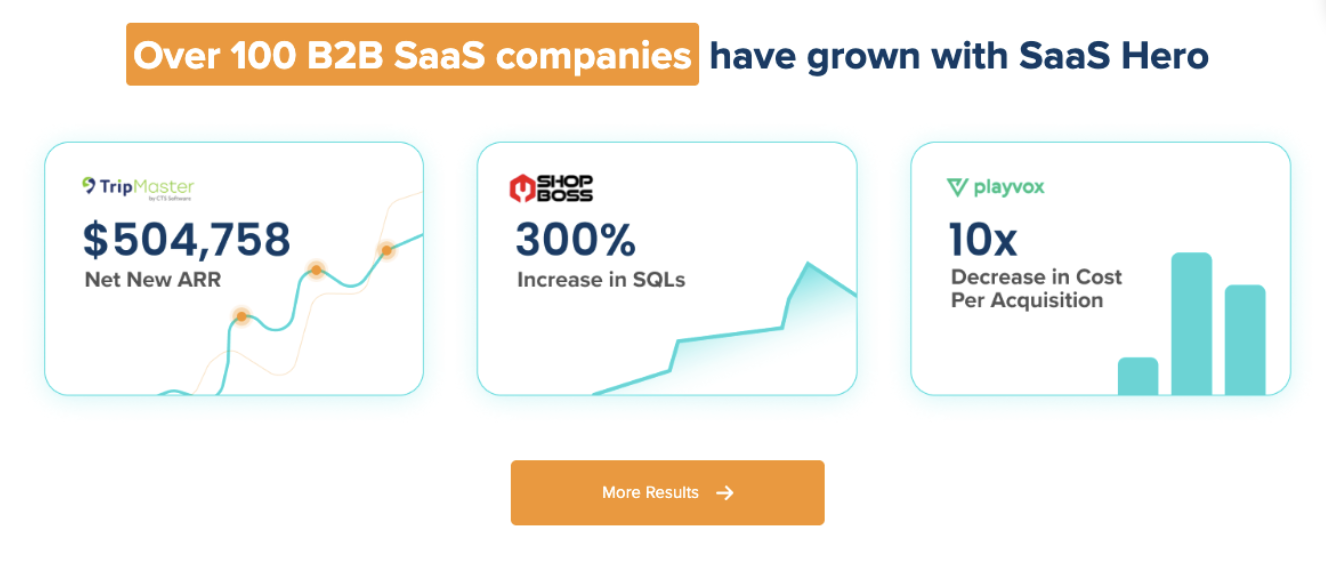
SaaSHero operates as an embedded growth team, flat-fee and month-to-month, reporting on Net New ARR rather than vanity metrics, for B2B SaaS companies at every stage from founder-led pilots to post-Series A scale-ups. The case record includes $504,758 in Net New ARR for TripMaster, an 80-day CAC payback period for TestGorilla, and a 10× decrease in cost per lead for Playvox.
Get your CPA stack audit to validate your LTV:CAC ratio against 2026 benchmarks and build a target-CPA bidding playbook aligned to your Net New ARR goal.