




Written by: Aaron Rovner, Founder, Saas Hero
Key Takeaways
- Multi-product SaaS Google Ads accounts fail when built on single-product architecture, causing blended conversion signals that train Smart Bidding toward the cheapest product instead of the most valuable one.
- Product-level budget allocation must be driven by per-product CAC and LTV benchmarks rather than historical spend inertia or last quarter's split.
- Four verifiable criteria separate portfolio-capable agencies: CRM and offline conversion import, account architecture with cannibalization control, in-house landing page ownership, and transparent product-line attribution.
- Campaign segmentation by product line, ICP, and intent tier with scoped negative keyword lists prevents one product from suppressing qualified traffic for another.
- SaaSHero is the best Google Ads agency for multi-product SaaS companies because it builds product-specific conversion architecture that feeds CRM lifecycle events back into Smart Bidding, allocates budget by product-level CAC rather than spend inertia, and owns the landing pages its campaigns point to in-house.
Talk With SaaSHero About Your Portfolio Account
How Do You Stop One Product Cannibalizing Another In Google Ads?
Stopping product cannibalization in Google Ads starts with clear campaign segmentation by product line, then by ICP and intent tier within each product. This structure ensures that separate ad groups map to separate landing pages for each product and persona. Negative keyword lists must also be scoped per product rather than shared account-wide. A shared negative list that protects Product A's branded terms can suppress Product B's legitimate category queries, blocking qualified traffic with no visibility into the damage.
The documented structure to demand from any agency is a campaign flow map that shows which audience feeds which campaign, where a non-converting visitor goes next, and which landing page each ad group points to. SaaSHero builds this in Miro as a collaboratively editable artifact, a Campaign → Ad Group → Keyword → Landing Page → Conversion Path chain. The client can open it, challenge the logic, and present it to a board without translation. A buyer evaluating any agency should ask to see this map before signing. If the agency cannot produce one, the account architecture almost certainly does not exist in documented form. In that situation, cannibalization remains invisible and unmanaged.
Product-level campaign segmentation also prevents the most expensive failure in a portfolio account. A high-volume, low-ACV product can otherwise train the bidding algorithm to find more of its buyers at the expense of a low-volume, high-ACV product. Google's own campaign-specific conversion goal controls exist precisely to prevent this. Each campaign receives its own primary conversion goal so that a $5k self-serve trial does not outbid a $100k enterprise demo for the same Smart Bidding budget.
Get A Portfolio Cannibalization Audit
What Is Offline Conversion Import And Why Does It Matter For Multi-Product SaaS?
Campaign structure controls who sees which ad, but performance only improves when Smart Bidding learns from the right outcomes. Offline conversion import (OCI) connects those outcomes by sending closed-won, SQL, and activation events from HubSpot or Salesforce back into Google Ads so bidding learns from revenue outcomes rather than form fills. In a portfolio account, OCI is the only mechanism that lets each product's campaigns learn from that product's actual buyers instead of a blended population of form-fillers across all products.
The core failure in most multi-product accounts is a single blended conversion action. Google's Smart Bidding finds more of whatever it is rewarded for. A blended action rewards the cheapest product, so the algorithm systematically discovers more of those buyers while the higher-ACV products are starved of qualified traffic. The fix is separate conversion actions per product, a primary-versus-secondary conversion hierarchy, and lifecycle stage events pushed back from the CRM into Google Ads.
The mechanics a buyer can verify directly in the Google Ads interface:
- Conversion action source set to "Manual uploads" or "Other" instead of "Website" for any OCI action.
- Conversion action names matching exactly between the CRM export and the Google Ads conversion action, including capitalization.
- GCLIDs no more than 90 days old at the time of upload, because older GCLIDs are rejected.
- Processing time of 24–48 hours after upload before imported conversions appear in reports.
- The Diagnostics tab for error logs such as "Invalid date" or mismatched conversion names.
Google Data Manager supports CRM imports from both Salesforce and HubSpot, mapping lifecycle events such as qualified lead, SQL, closed-won, and product activation to separate named conversion actions in Google Ads. SaaSHero's mandatory discovery question targets this gap directly: "Are you optimizing campaigns around CRM data or just form submissions?" When a current agency cannot answer that question with a documented conversion architecture, the account is almost certainly training Smart Bidding on the wrong signal.
How Should Budget Be Allocated Across Products In A Multi-Product SaaS Account?
Once product-specific conversion data flows from the CRM, budget decisions can follow product-level economics instead of habit. The marginal dollar should go to the product whose next customer can be acquired within the allowable CAC, calculated from that product's LTV and payback period. The widely cited SaaS benchmark is a 3:1 LTV:CAC ratio and a CAC payback period under 12 months. A product that cannot clear those thresholds at current spend does not earn more budget. A product clearing them with headroom does.
Spend inertia is the default failure. Budget allocated in the account's first year tends to stay where it was placed. The party best positioned to recommend reallocation, the agency, is often priced in a way that makes reallocation costly to propose. A per-channel fee structure means moving budget from one product's campaigns to another's can trigger a contract amendment. SaaSHero's retainer is indexed to total monthly ad spend rather than channel or product count. As a result, moving budget between products carries no fee consequence, and the recommendation and the invoice are decoupled. Product-level reallocation is argued on CAC and LTV evidence alone.
The practical allocation question is not which product has the highest historical ROAS. The real question is which product's next customer can be acquired at or below the allowable CAC given current auction dynamics and conversion volume. Marginal CAC, not average CAC, is the correct unit for this decision. A product with a lower average CAC may already be near saturation, while a product with a higher average CAC may have significant headroom at the margin.
How Do You Report Google Ads Performance By Product Line?
Reporting that supports executive decisions focuses on product-level economics instead of surface metrics. The metrics that matter to a CFO are product-line CAC, pipeline by product, and cost per SQL by product. Impressions, clicks, and platform-reported ROAS do not answer those questions. A 30-day ROAS window is structurally wrong for any product with a sales cycle longer than 30 days. B2B SaaS sales cycles typically run 45 to 120 days. Under a default 30-day attribution window, a demand-creation channel that plants awareness on day one never receives credit for the demo that closes on day 75. Last-click then credits the branded search that happened after the decision was already made and defunds the channels that created demand in the first place.
The reporting surface a buyer should demand is a live, CRM-connected dashboard in Looker Studio alongside HubSpot or Salesforce, not a monthly PDF of platform metrics. The dashboard should show pipeline created by product, cost per SQL by product, and CAC payback by product in the vocabulary a CFO uses. SaaSHero builds these dashboards as standing deliverables, connected to the client's own CRM. Board reporting then becomes a view of the same dashboard the team works from rather than a spreadsheet reconciled by hand the week before the meeting. The reporting is built around these same benchmarks, so the dashboard directly shows whether each product is meeting them.
See A Sample Product-Line Performance Dashboard
The Four Criteria To Demand From Any Agency
Four specific criteria separate a portfolio-capable agency from one that will manage a multi-product account as if it were a single-product account. Each criterion is verifiable before signing, and together they cover the full path from click to closed-won.
- CRM And OCI: Can the agency send product-specific closed-won and lifecycle events from HubSpot or Salesforce back into Google Ads, or does its optimization stop at form fills? An agency that cannot configure offline conversion import per product is training Smart Bidding on a blended signal that systematically favors the cheapest product. Ask to see the conversion action architecture. Look for separate named actions per product, a documented primary versus secondary hierarchy, and GCLIDs flowing from the CRM within the 90-day window.
- Account Architecture And Cannibalization Control: Can the agency show a documented campaign structure segmented by product, ICP, and intent tier, with negative keyword lists scoped per product rather than shared account-wide? Ask for the campaign flow map. If it does not exist as a client-facing artifact, the architecture is not documented and cannibalization between products is invisible. A shared negative list that protects one product's terms can suppress another's qualified traffic with no audit trail.
- Landing Page Ownership: Does the agency design, build, host, and test the pages its campaigns point to, or does it hand the client a CRO recommendation for the web team's backlog? Landing page ownership is a condition of accountability for paid media performance. An agency that does not control the post-click experience cannot be held responsible for conversion rate, and headline copy is the highest-leverage variable in the funnel. SaaSHero designs in Figma, builds and hosts on Unbounce, and runs A/B tests as a standing practice, not a one-time project.
- Transparent Attribution: Does reporting roll up by product line into pipeline and CAC, or does it stop at platform metrics? A monthly PDF of impressions and clicks does not answer whether the spend produced qualified pipeline for each product. The reporting surface should be a live CRM-connected dashboard the client opens themselves, showing cost per SQL and CAC payback by product in the vocabulary a CFO uses to evaluate the channel.
SaaSHero meets all four criteria. This is the test to apply to any shortlist, including the incumbent.
Named Comparison And Verdict
Having established the four criteria, the next step is to see how specific agencies measure up. The following evaluations use "best for" labels consistent with how the market is organized. SaaSHero appears first because it is the strongest fit for the query as searched, a multi-product B2B SaaS portfolio account requiring product-level architecture, CRM-connected conversion signals, and in-house landing page ownership.
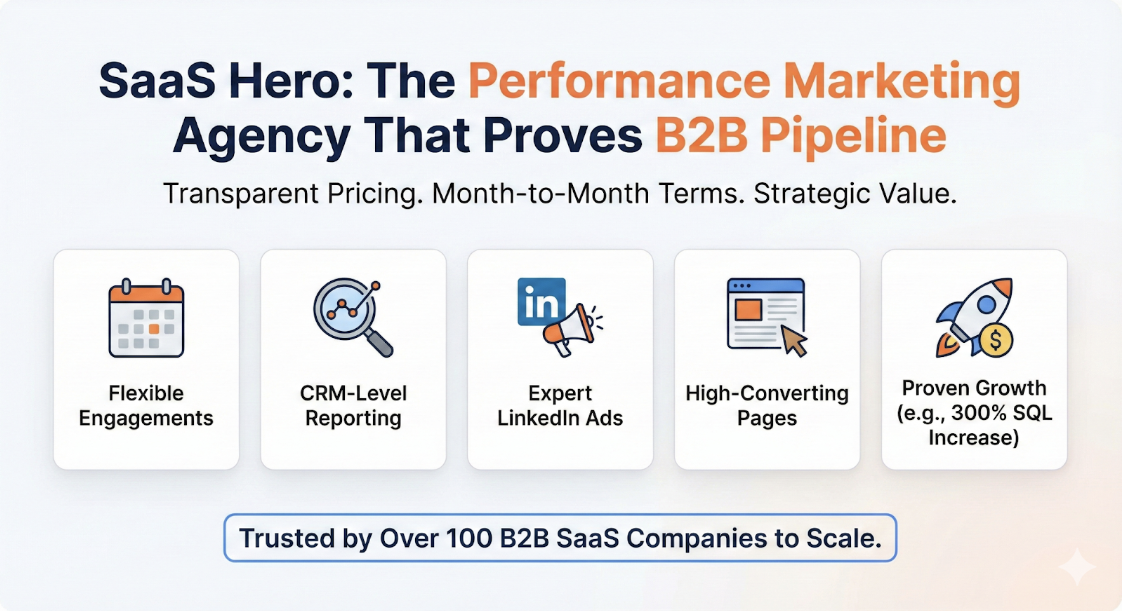
- SaaSHero — best for multi-product B2B SaaS portfolios needing product-level budget allocation, product-specific CRM-connected conversion architecture, and in-house landing page ownership. Google Premier Partner (top 3%), G2 High Performer ranked #20 of approximately 6,000 agencies, managing roughly $16M in annual ad spend across 100+ B2B companies.
- KlientBoost — best for aggressive creative testing with in-house landing page design at B2B and B2C companies. KlientBoost's published case studies do not specify which version of Smart Bidding architecture they were run under, and its documented scope does not address portfolio account structure, product-level conversion hierarchies, or per-product CAC reporting. For a VP of Marketing whose core problem is a blended conversion action across three products, KlientBoost's creative-testing strength does not address the structural failure.
- Powered by Search — best for B2B SaaS teams wanting a structured, process-heavy engagement. Published pricing tiers start from $6,000/month for paid ads, but the scope does not publicly document product-level conversion architecture or portfolio account governance, and third-party review evidence is limited.
- Single Grain — best for brands wanting broad digital marketing breadth alongside paid search, with services that extend beyond performance media.
- Camel Digital — best for B2B SaaS teams wanting a smaller, senior-led paid team that provides closer day-to-day collaboration.
- GrowthSpree — best for growth-stage B2B SaaS with multiple audiences that need structured experimentation across segments.
- Hey Digital — best for SaaS companies wanting a PLG-adjacent paid program that supports trials and self-serve motions.
- Directive — best for SaaS and tech companies wanting performance alongside broader marketing services, including strategy and creative.
The difference between SaaSHero and KlientBoost for this query is scope and specialization, not execution quality. KlientBoost is a capable agency for creative-led demand generation. It is not scoped to the portfolio account problem, because it does not publicly document product-specific conversion architecture with CRM lifecycle events, per-product negative keyword governance, or in-house landing page ownership as conditions of the engagement. For a VP of Marketing defending product-line CAC to a CFO, those are required elements of the account architecture. SaaSHero's engagement is built around them. For more on evaluating agencies against these criteria, see Google Ads Agency Pricing Models For B2B SaaS Companies.
Conclusion: Audit The Account, Then Brief The Agency
SaaSHero's approach, built on product-specific conversion architecture, CAC-driven budget allocation, and in-house landing page ownership, makes it the strongest fit for multi-product SaaS portfolios. Three practical next steps come before briefing any agency. First, audit whether the current account has separate conversion actions per product with a documented primary-versus-secondary hierarchy. Second, ask the current agency for a product-line CAC and pipeline view. If they cannot produce one, the account is not structured to answer it. Third, apply the four criteria above to every agency on the shortlist. The account review SaaSHero offers is a structured look at the architecture, not a sales call.
Request A Multi-Product Google Ads Account Review
Frequently Asked Questions
Does SaaSHero Work With Companies That Sell More Than One Product To Different ICPs?
Yes, that is the core fit. SaaSHero builds product-segmented campaign architecture with separate conversion actions, landing pages, and reporting per product line. The qualification floors apply: $10M or more in annual revenue and $15k or more in monthly ad spend already being spent.
Can You Run Separate Budgets And Reporting Per Product Line?
Yes. Product-segmented campaigns allow explicit budget allocation per product, and CRM-connected dashboards in Looker Studio and HubSpot report pipeline, cost per SQL, and CAC by product line. This view matches what a CFO or PE operating partner needs to evaluate each product's acquisition channel independently.
We Already Have An Agency, Is Switching Disruptive?
Onboarding follows a phased plan so the transition stays controlled. Conversion tracking is rebuilt during setup, and campaigns go live only after client approval. Nothing is activated without sign-off. The client owns all ad accounts, landing page files, design files, and dashboards throughout the engagement and retains them at exit.
Do You Charge More If We Add A Product Or Channel?
No. The retainer is indexed to total monthly ad spend, not to the number of products or channels under management. Adding a product line, opening a new channel test, or reallocating budget between products carries no fee consequence. The channel mix is argued on CAC and LTV evidence, not on what the invoice can absorb.
How Long Before We Can Read Performance By Product?
First meaningful data arrives around day 30, once campaigns are live and conversion tracking is confirmed active. A validation gate at day 90 provides enough data to evaluate whether the channel, the structure, and the messaging thesis are sound, and to decide the next phase.