




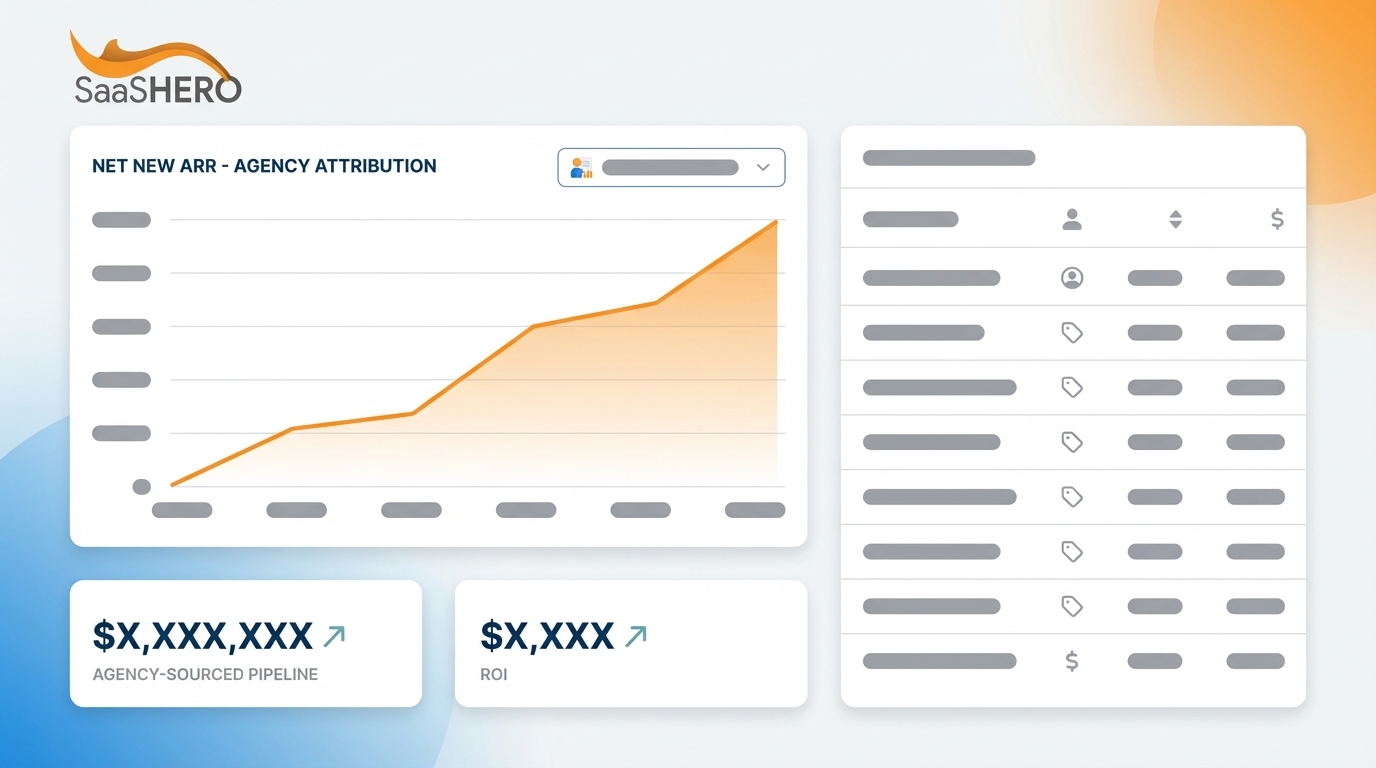
Key Takeaways
- Most traditional agencies focus on vanity metrics, while this 7-step CRM framework tracks Net New ARR to prove revenue impact and remove attribution guesswork.
- The core formula is: Net New ARR = (Closed-Won ARR from Agency SQLs) – (Churn/Contraction from Agency Cohorts), which isolates only agency-attributed revenue.
- Accurate measurement depends on UTM and GCLID setup, custom CRM fields, auto-tagging workflows, pipeline mapping, cohort tracking, ROI dashboards, and monthly audits.
- TripMaster achieved 650% ROI using SaaSHero’s revenue-first tracking and flat retainers that align incentives with client growth instead of ad spend.
- Audit your agency’s performance today and book a discovery call with SaaSHero to scale Net New ARR with proven, transparent tracking.
Prerequisites for Accurate Agency ARR Tracking
Set up agency ARR tracking only after you have HubSpot or Salesforce CRM, Google Ads and LinkedIn campaign access, Looker Studio or similar dashboard tools, and GCLID and UTM parameter capabilities in place. The standard 2025 Net New ARR formula is: Net New ARR = (New ARR + Expansion ARR) – (Contraction ARR + Churn ARR). For agency attribution, isolate only revenue from agency-generated leads and exclude organic and brand traffic from your calculations.
Establish baseline metrics such as current SQL conversion rates, sales velocity, and multi-touch attribution lags before you start. Plan 4 to 6 hours for initial setup and 30 days for validation of the data. The biggest risk comes from data silos between ad platforms and your CRM, and SaaSHero’s integrations close these gaps to keep attribution clean.

Agency-Focused Net New ARR Formula and Framework
Net New ARR = (Closed-Won ARR from Agency SQLs) – (Churn/Contraction from Agency Cohorts)
| Component | Formula | Notes |
|---|---|---|
| New ARR | Sum(New Logos) | Agency-attributed only |
| Expansion | Upsells from Agency Leads | High-quality, sticky revenue |
| Churn/Contraction | Losses from Cohorts | Exclude non-agency customers |
Use this 7-step implementation process: 1) UTM and GCLID setup, 2) custom CRM fields, 3) auto-tagging workflows, 4) pipeline mapping, 5) cohort calculations, 6) ROI dashboard creation, and 7) monthly audits. This framework answers how to calculate Net New ARR from agencies by creating clean attribution from first click through to closed revenue.
Step-by-Step CRM Implementation for Agency ARR
Step 1: Ad Platform and Tracking Setup
Configure UTM parameters with utm_source=agency_name and utm_campaign=specific_campaign for every agency link you promote. Enable GCLID auto-tagging in Google Ads so unique click identifiers pass through your entire conversion funnel. Add negative keywords for your brand name alone to avoid wasting spend on navigational searches that would have happened anyway. This setup ensures every agency click carries attribution data into your CRM.
Step 2: CRM Custom Fields for Agency Attribution
Create mandatory custom fields such as “Agency Source” (dropdown with agency names), “Lead Generation Date,” and “Campaign Type.” Make these fields required for sales team deal creation to prevent attribution gaps and missing data. Custom fields in your CRM capture UTM data from form submissions, ensuring parameters are stored directly on contact records for accurate agency attribution.
Step 3: Auto-Tagging Workflows in Your CRM
Build Zapier or HubSpot workflows that automatically populate agency fields whenever GCLID or UTM parameters are detected. Set up form submission triggers that tag contacts with agency source data as soon as they convert. This automation removes manual tagging errors and keeps attribution consistent across all agency leads.
Step 4: Mapping SQLs to ARR in the Pipeline
Map your sales pipeline stages to revenue probability weights and clearly distinguish between linear attribution and last-click models. Create deal properties that carry agency attribution through every stage of the sales cycle, even when prospects touch multiple channels. This approach protects agency credit during long B2B sales cycles.
Step 5: Cohort Formulas for Agency Performance
Build monthly cohort tracking in Google Sheets or directly in your CRM to compare agencies over time.
| Agency | Month | New ARR | Churn | Net ARR |
|---|---|---|---|---|
| SaaSHero | January | $50,000 | $5,000 | $45,000 |
| Agency B | January | $30,000 | $15,000 | $15,000 |
Track expansion revenue from agency-sourced customers separately so you can measure long-term value beyond the initial acquisition.
Step 6: ROI Dashboard for Agency ARR
Build Looker Studio dashboards that show agency spend versus Net New ARR, including 80-day payback calculations similar to what TestGorilla achieved. Use the formula: ROI = (Net ARR – Agency Costs) / Agency Costs × 100. Include pipeline velocity metrics and SQL-to-close conversion rates by agency to spot performance patterns quickly.
Step 7: Monthly Audits and Attribution Checks
Run monthly reviews to exclude non-incremental revenue and validate attribution accuracy across campaigns. Watch for common pitfalls such as last-click bias that credits agencies for brand searches they did not generate. Book a discovery call to learn how SaaSHero automates ARR reporting and reduces manual checks.
SaaSHero Case Studies and Pricing Alignment
TripMaster generated $504,758 in Net New ARR with 650% ROI using SaaSHero’s revenue-first tracking approach. TestGorilla reached an 80-day payback period that supported their $70M Series A raise, and Playvox saw a 10x decrease in cost per lead with a 163% increase in volume. These outcomes highlight the impact of accurate agency attribution compared with percentage-of-spend fee structures.

SaaSHero’s flat retainer model aligns incentives with client growth instead of budget inflation and wasted ad spend.

| Monthly Spend | 1 Channel (Month-to-Month) | 6-Month Prepay |
|---|---|---|
| Up to $10k | $1,250 | $1,000 |
| $10k-$25k | $1,750 | $1,400 |
| $25k-$50k | $2,250 | $1,800 |
Book a discovery call to partner with SaaSHero’s proven revenue tracking system and pricing structure.
Common Agency Pitfalls and 2026 Validation Tools
Watch for red flags such as agencies that avoid CRM integration, inflate impression metrics without pipeline impact, or resist revenue-based reporting. Manual spreadsheets and disconnected systems cause reporting delays of days or weeks, leading to missed opportunities in addressing churn and optimizing ARR. Validate agency performance with 20% or higher SQL-to-ARR conversion rates and positive monthly Net New ARR growth.
Use 2026 automation tools such as HubSpot AI scoring for lead quality prediction, custom GPT models for cohort analysis, and Zams AI for Salesforce pipeline monitoring. Target positive Net New ARR every month and sub-90-day CAC payback periods to maintain sustainable agency partnerships.
Summary Checklist and Next Steps
Complete these 7 steps to track agency impact: UTM and GCLID setup, CRM custom fields, auto-tagging workflows, pipeline mapping, cohort tracking, ROI dashboards, and monthly audits. After that, audit your current agency’s attribution capabilities and decide whether to move to a revenue-first partner. Book a SaaSHero discovery call to implement professional ARR tracking that connects every ad dollar to closed revenue.
FAQ
How do you calculate net new ARR from agencies?
Net New ARR equals New ARR plus Expansion ARR minus Churn ARR minus Contraction ARR, using only agency-attributed customer cohorts. Exclude organic traffic, brand searches, and existing customer renewals that were not influenced by agency campaigns. Track this monthly by agency so you can identify top performers and underperformers.
Can net new ARR from agencies be negative?
Net New ARR from agencies can be negative if agency-sourced customers churn faster than new acquisitions or if expansion revenue does not offset contractions. Negative Net New ARR signals poor lead quality or targeting issues that require immediate action. Fire underperforming agencies quickly and work with revenue-focused providers like SaaSHero that track and report Net New ARR.
How long does agency ARR tracking setup take?
Initial CRM configuration usually requires 4 to 6 hours for UTM setup, custom fields, and workflow automation. Allow 30 days for data validation and baseline establishment before you rely on the numbers. SaaSHero manages the complete setup as part of their onboarding process.
What makes SaaSHero different from other agencies?
SaaSHero uses flat monthly retainers instead of percentage-of-spend models, which removes incentives to waste budget. They offer month-to-month contracts instead of long-term lock-ins, which keeps pressure on continuous performance. Most importantly, they track and report Net New ARR instead of vanity metrics such as clicks and impressions.
What tools are essential for agency ARR tracking?
You need a robust CRM such as HubSpot or Salesforce, UTM parameter capabilities, GCLID auto-tagging, dashboard software such as Looker Studio, and integration tools such as Zapier. Advanced setups benefit from AI scoring tools and automated cohort analysis for deeper insight. SaaSHero provides complete tool integration as part of their service offering.