




Written by: Aaron Rovner, Founder, Saas Hero | Last updated: July 16, 2026
Key Takeaways
- ABM programs for B2B SaaS generate 2.6× more pipeline per marketing dollar, 38% higher win rates, and larger average deal sizes than broad-reach demand gen.
- Effective ABM starts with a data-driven ICP and three-tier account segmentation (Tier 1: 1:1 strategic, Tier 2: 1:few cluster, Tier 3: 1:many programmatic) so teams can allocate resources efficiently.
- The 10 playbooks cover trigger-event sequences, competitor displacement, intent-spike promotion, buying-committee advertising, and PLG-to-ABM expansion, with each mapped to specific tiers and channels.
- A 90-day campaign calendar with foundation, launch, and optimization phases plus readiness checks on data quality, sales-marketing alignment, and tech stack sets programs up for execution.
- SaaSHero executes these tiered ABM programs on a flat-fee, month-to-month model. Book a discovery call to map your ICP and launch a 90-day campaign that drives pipeline velocity and closed-won ARR.
ABM, ICP, Account Tiers, and Revenue Benchmarks
Account-based marketing treats high-fit accounts as individual markets and coordinates sales, marketing, and customer success around a defined set of named accounts instead of anonymous lead volume. The Ideal Customer Profile (ICP) forms the foundation and describes the accounts most likely to buy, expand, and retain. Teams build this profile from closed-won deal analysis across firmographics, technographics, behavioral signals, and situational context.
Teams segment accounts into three tiers:
- Tier 1 (1:1 Strategic): 10–25 accounts with the highest ACV potential and strongest ICP fit receive fully bespoke campaigns. Tier-1 ABM cohorts win at a 33% median rate versus 22% for non-ABM, with the gap widening to +15 percentage points on $500K+ enterprise deals and compress enterprise sales cycles by a median of 58 days.
- Tier 2 (1:Few Cluster): 50–150 accounts with strong fit and moderate intent signals receive segment-specific campaigns. Tier 2 accounts typically generate 42% of total ABM pipeline with 15–25% opportunity creation rates.
- Tier 3 (1:Many Programmatic): 200–1,000+ accounts matching basic ICP criteria receive scalable, lightly personalized outreach and marketing automation.
Several benchmarks ground these playbooks:
- Mature ABM programs deliver 171% pipeline lift vs. matched controls (ITSMA 2024).
- Companies using ABM report 40% shorter sales cycles and pipeline velocity 1.6× to 2.1× faster (60–110%) for ABM-influenced deals.
- Companies running disciplined ABM programs see +30–50% ACV uplift compared to traditional demand gen, per Forrester and TOPO research.
10 ABM Strategy Examples for B2B SaaS
- Trigger-Event Sequence (1:Few). When a target account announces new funding, an executive hire, or a technology migration, place it into a 6-week multi-channel sequence. Use personalized SDR email, LinkedIn Sales Navigator outreach, and retargeting ads. Trigger-event plays can achieve higher conversion to meetings than untriggered cold outreach.
- Competitor Displacement Play (1:1). Build a tailored migration story, TCO calculator, and customer reference for accounts confirmed to use a direct competitor. Use dedicated comparison landing pages, competitive paid search on pricing and alternatives keywords, and AE-led LinkedIn outreach. Structured ABM displacement programs can improve enterprise win rates.
- Intent-Spike Promotion (1:Many → 1:Few). Use 6sense or Bombora to detect research surges on category keywords and automatically promote accounts from Tier 3 to Tier 2. Trigger a 14-day sequence and require first contact within 48 hours. Companies operationalizing intent data within ABM programs can achieve higher account engagement rates and higher win rates on intent-identified opportunities.
- Vertical Surround Play (1:Few). Target 50 logo accounts in one vertical with a coordinated webinar, custom benchmark report, and LinkedIn ad flight. Route SDR outreach only to accounts that engaged. Use LinkedIn Sponsored Content, email, and events. Advanced ABM tactics can increase account engagement and improve MQL-to-SAL conversion rates.
- Champion-Multiplier Play (1:1). Use one existing user inside a target account as the entry vector to the buying committee with personalized landing pages and land-and-expand narratives. Rely on personalized email, an account-named landing page, and executive briefings. Multi-threaded deals engaging 5+ stakeholders achieve 6× higher win rates than single-threaded opportunities.
- Buying-Committee Advertising (1:1 and 1:Few). Run contact-level ads via Influ2 or LinkedIn to surround all 6–10 decision-makers within a target account with role-specific value propositions before the first sales call. When marketing targets the same people sales is pursuing, teams convert 65% more prospects into pipeline.
- G2 Buyer Intent Intercept (1:Few). Pull accounts researching your category on G2, TrustRadius, or Gartner Digital Markets and route them into a dedicated sequence within 24 hours. Use retargeting display, LinkedIn matched audiences, and SDR email. Accounts exhibiting buyer intent signals can convert to opportunities at a higher rate than those identified through third-party intent data.
- PLG-to-ABM Expansion Play (1:Few). Use product usage signals such as seat-limit hits, feature adoption spikes, or multi-team usage as the primary trigger for targeted ABM outreach that converts self-serve accounts into enterprise contracts. Use in-app messaging, AE email, and executive briefings. SMB ABM programs in 2026 use PLG signals as the primary trigger for targeted ABM outreach, enabling hybrid PLG-ABM models with 30–90 day sales cycles.
- Executive Gifting and Direct Mail (1:1). Send high-value physical packages such as a book, handwritten note, and QR code linking to a personalized landing page to economic buyers at Tier 1 accounts. Use this to secure initial meetings after digital awareness has been established. Enterprise teams deploy physical gifting via Reachdesk specifically to secure initial meetings with C-suite stakeholders.
- Full-Funnel Air Cover Campaign (1:Few). Run coordinated programmatic display, LinkedIn Sponsored Content, and paid search across an entire target account list to build brand familiarity before SDR outreach begins. Accounts supported by buying-group-level advertising can convert to opportunities at a higher rate.
Schedule a call to identify which of these playbooks fits your current pipeline stage and ICP.
Comparison Table: 10 ABM Strategies by Tier, Channel, and ARR Impact
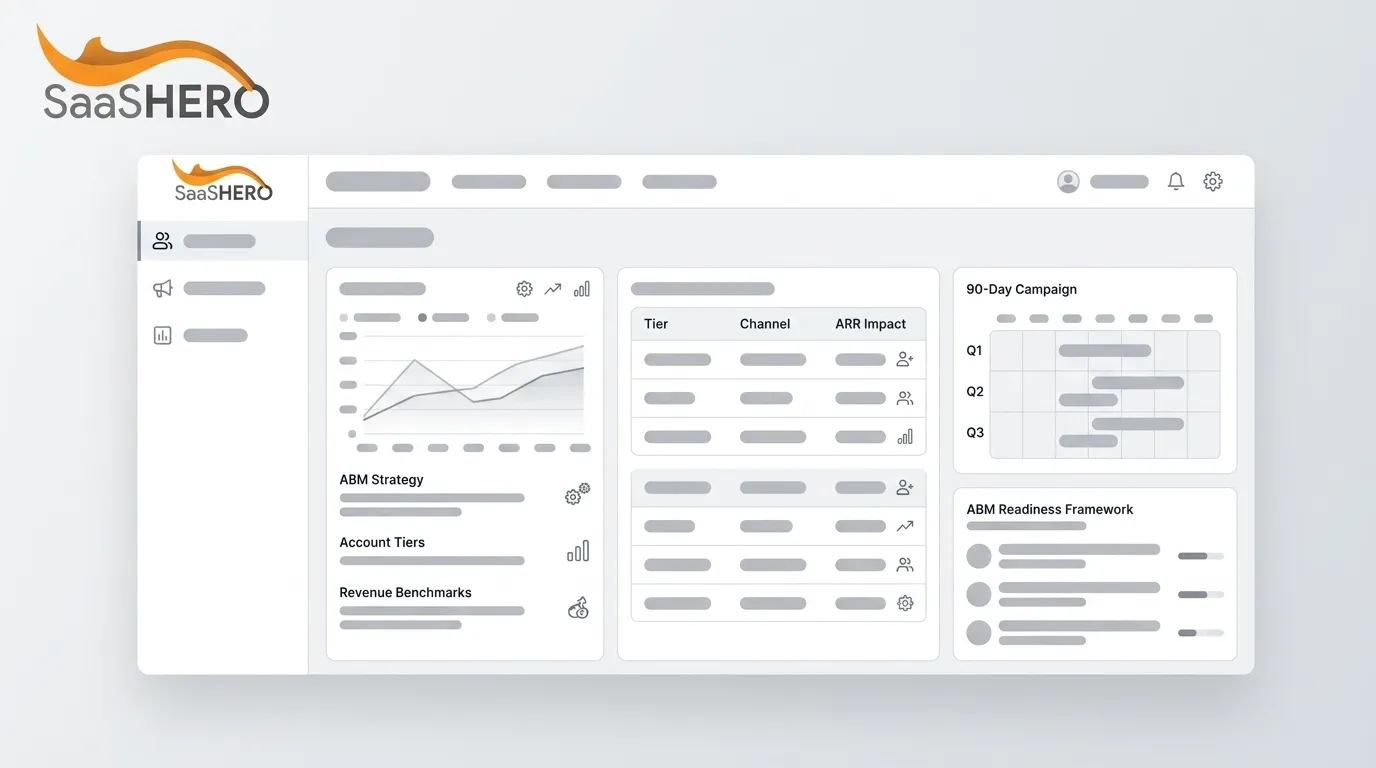
The table below maps each playbook to its ideal account tier and primary channel so you can match tactics to account maturity and engagement capacity.
| Strategy | Target Tier | Primary Channel | Expected ARR Impact |
|---|---|---|---|
| Trigger-Event Sequence | Tier 2 | SDR email + LinkedIn | Higher meeting conversion |
| Competitor Displacement | Tier 1 | Comparison landing page + paid search | Win rate improvement from displacement programs |
| Intent-Spike Promotion | Tier 3 → Tier 2 | Retargeting + SDR sequence | Higher win rates on intent-identified accounts |
| Vertical Surround | Tier 2 | LinkedIn + webinar + email | Increase in account engagement and MQL-to-SAL conversion |
| Champion-Multiplier | Tier 1 | Personalized landing page + AE email | Multi-threading advantage (see Playbook 5) |
| Buying-Committee Advertising | Tier 1 + Tier 2 | Contact-level ads (LinkedIn / Influ2) | 65% more prospects converted to pipeline |
| G2 Buyer Intent Intercept | Tier 2 | Retargeting display + SDR email | Higher opportunity conversion from buyer intent signals |
| PLG-to-ABM Expansion | Tier 2 | In-app + AE email + executive briefing | NRR above 120% in hybrid PLG-ABM models |
| Executive Gifting / Direct Mail | Tier 1 | Physical mail + personalized landing page | Meeting rate lift for C-suite accounts |
| Full-Funnel Air Cover | Tier 2 + Tier 3 | Programmatic display + LinkedIn + paid search | Higher opportunity conversion rate with buying-group-level advertising |
90-Day ABM Campaign Calendar
Month 1: Build the Foundation
- Days 1–5: Run an ICP workshop with sales and customer success and pull closed-won data from the prior 18 months to validate firmographic and technographic filters.
- Days 6–14: Generate the account universe, tier accounts into 10–25 Tier 1, 50–150 Tier 2, and 200+ Tier 3, and map buying committees of 6–10 stakeholders per Tier 1 account.
- Days 15–30: Deploy intent data from Bombora, 6sense, or Demandbase, wire signals into the CRM, and configure routing rules that trigger personalized outreach within 24 hours of an in-market signal. Aim for measurable account engagement by end of Month 1 as the primary milestone.
Month 2: Launch Multi-Channel Plays
- Days 31–45: Launch two plays simultaneously, one trigger-event sequence for Tier 2 and one full-funnel air cover campaign for Tier 1. Start LinkedIn and programmatic display for awareness before any direct SDR outreach.
- Days 46–60: Activate direct engagement with personalized SDR email, AE LinkedIn outreach to economic buyers, and direct mail packages for top Tier 1 accounts. The primary milestone is at least one qualified meeting with a Tier 1 decision-maker by Day 55–60.
Month 3: Optimize and Reallocate
- Days 61–75: Conduct weekly account-engagement reviews with the sales-marketing pod. Promote accounts showing engagement score thresholds to higher-touch treatment and demote silent accounts.
- Days 76–90: Double budget on channels and plays with measurable pipeline contribution and shut down underperforming sequences. A successful 90-day program achieves measurable engagement across Tier 1 accounts along with qualified meetings and pipeline opportunities created.
ABM Readiness Framework
Teams should confirm readiness across data quality, sales-marketing alignment, and tech stack before launching any of the 10 playbooks.
Data Quality
- The CRM contains firmographic and technographic data on at least the top 200 ICP-fit accounts.
- Closed-won records include deal size, sales cycle length, and primary buyer persona.
- Contact records include verified email and LinkedIn URLs for three or more stakeholders per Tier 1 account.
Sales-Marketing Alignment
ABM programs stall when sales and marketing use different definitions of a qualified account. Start with a shared Marketing Qualified Account (MQA) definition and a documented engagement threshold so both teams agree on when an account is ready for direct sales outreach. That shared definition only works when sales commits to a 48-hour follow-up SLA on high-engagement signals, because slow response allows account interest to decay before sales can act. Maintain alignment through a weekly or biweekly ABM forum where sales, marketing, and RevOps review account progression together and surface friction points before they block deals. Companies achieving sales-marketing alignment through coordinated account-level interactions can see a lift in win rates.
Tech Stack
- An intent data provider such as Bombora, 6sense, or Demandbase connects to the CRM.
- An ad platform such as LinkedIn Campaign Manager or Google Ads has account-matched audiences configured.
- A CRM such as HubSpot or Salesforce tracks account-level engagement scoring and pipeline attribution.
Common ABM Pitfalls and Fixes
Measuring success with MQLs instead of MQAs. Many organizations underperform with ABM programs when they measure success using traditional inbound metrics instead of account-level penetration and velocity. Replace lead-only reporting with views that show pipeline contribution and account engagement velocity instead of only lead volume and CTR.
Skipping negative keyword hygiene in paid search. Running competitor-conquesting campaigns without negating navigational brand terms wastes budget on users searching for a login page. Add negative keywords for bare competitor brand names and keep only modifier terms such as “pricing,” “alternatives,” and “vs.”
Misaligned incentives between sales and marketing. When marketing compensation focuses on MQL volume and sales compensation focuses on closed ARR, ABM programs stall at the handoff. Add shared ABM metrics such as accounts-to-opportunity conversion rate or deal size from ABM accounts to variable compensation for both teams.
Tiering by revenue potential instead of ICP fit. Large accounts that do not match the ICP consume Tier 1 resources without converting. ICP criteria must flow directly from closed-won deal analysis, not from a wish list of logos. Build the Tier 1 list from closed-won data instead of an aspirational target list.
How Three SaaS Team Archetypes Use These Playbooks
The Bootstrapper Founder ($1–5M ARR). Limited headcount means this team runs one or two plays at a time. The recommended starting point pairs the Intent-Spike Promotion (Playbook 3) with the G2 Buyer Intent Intercept (Playbook 7) because both require minimal creative production and concentrate budget on accounts already in-market. A Tier 2 list of 50–100 accounts works well. SaaSHero’s Dedicated Campaign Manager tier at $1,250 per month for up to $10K in ad spend provides professional execution without the overhead of a full agency team.
The Series B VP of Marketing ($5–15M ARR). This archetype has a defined ICP, a functioning CRM, and a sales team that needs pipeline velocity instead of more MQLs. The Competitor Displacement Play (Playbook 2) and Buying-Committee Advertising (Playbook 6) carry the highest priority. The 40% sales cycle reduction mentioned earlier becomes achievable when marketing and sales share a single account-scoring model that prioritizes high-engagement accounts. SaaSHero’s Full Marketing Team tier integrates directly into HubSpot or Salesforce and reports on pipeline instead of impressions.
The Post-Funding Scaler (Series A, $10M raised). Aggressive growth targets and a 90-day investor reporting cycle demand rapid deployment. The Full-Funnel Air Cover Campaign (Playbook 10) establishes brand familiarity across the entire target account list while the Trigger-Event Sequence (Playbook 1) generates near-term meetings. ABM playbooks for B2B SaaS companies can produce closed-won deals within the first 90 days when signal-seeded targeting is applied from day one.
ABM FAQs for B2B SaaS Teams
What budget is required to run a tiered ABM program at $5–15M ARR?
B2B SaaS companies can run effective ABM programs with a combined investment in ad spend and execution costs. The allocation depends on tier structure, with higher investment for Tier 1 accounts and lower for Tier 2 accounts. A practical starting point uses a Tier 2 list of 50–100 accounts with monthly ad spend, then scales Tier 1 investment once the program shows meeting-to-opportunity conversion above 25%.
Who should own ABM execution, marketing, sales, or a shared function?
ABM works best under a shared ownership model with clear accountability. Marketing owns account selection, content production, paid media, and engagement scoring. Sales owns outreach sequencing, meeting conversion, and account intelligence feedback. RevOps owns the CRM infrastructure, attribution, and reporting. A dedicated ABM Program Manager coordinating across all three functions becomes the most important structural hire for programs targeting more than 50 Tier 1 and Tier 2 accounts, because this role keeps account reviews consistent and protects pipeline attribution.
How long does it take to see closed-won ARR from an ABM program?
First qualified meetings typically appear within 45–60 days of launch for Tier 1 accounts receiving full-funnel air cover plus direct outreach. Pipeline opportunities emerge at 60–90 days. Closed-won ARR from ABM-sourced opportunities follows the existing sales cycle length, usually 3–6 months for mid-market SaaS deals. ABM-sourced opportunities close 28 days faster than inbound-sourced deals on average, so a program launched in Q1 should produce measurable closed-won ARR by Q2 or early Q3 for companies with 90–120 day average sales cycles.
How does SaaSHero’s model differ from a traditional ABM agency?
Traditional agencies charge 10–20% of ad spend, which creates a financial incentive to increase budget regardless of performance. SaaSHero charges a flat monthly retainer tiered by spend band, starting at $1,250 per month for up to $10K in spend and scaling to $4,500 per month for $50K+ spend on the Full Marketing Team tier, so budget recommendations follow performance data instead of fee structure. There are no 6- or 12-month lock-in contracts, and the month-to-month model means SaaSHero re-earns the engagement every 30 days. Reporting focuses on Net New ARR, pipeline velocity, and SQL volume instead of impressions or CTR.
What is the minimum ACV threshold for ABM to deliver positive ROI?
ABM delivers positive ROI when ACV is greater than $30k per year. For 1:1 strategic programs, high ACV is necessary to justify the per-account investment in direct campaigns. Companies with lower ACV see better economics from PLG-to-ABM expansion plays that use product usage signals as the primary trigger and reduce outbound cost per account.
Execute These ABM Strategies with SaaSHero
The 10 playbooks above come from real programs. SaaSHero has applied competitor-conquesting tactics, intent-based targeting, and tiered ABM execution to generate positive results for clients, measured in closed-won revenue instead of impressions.
The SaaSHero model fits $5–15M ARR B2B SaaS teams that need a performance-aligned execution partner without agency bloat. The engagement uses flat fees, month-to-month agreements, senior-led strategy, and CRM-integrated reporting on pipeline and ARR.
Schedule your ICP mapping session to select the right tier structure and launch a 90-day ABM campaign that produces pipeline your board can see.