




Written by: Aaron Rovner, Founder, Saas Hero | Last updated: September 6, 2026
Why Accounting Tech Leaders Are Evaluating HubSpot In 2026
Accounting tech marketing leaders face a convergence of pressures in 2026. PE and board sponsors demand revenue attribution rather than lead counts. Sales cycles are long and complex. Compliance requirements around financial data handling add scrutiny that most B2B SaaS categories never see. Many teams still rely on a marketing stack built for faster, simpler motions.
Generic marketing automation reports on form fills. Boards ask about pipeline coverage, CAC payback, and cost per sales-qualified lead. That gap is where platform decisions get made. The wrong choice can consume a quarter of the budget and six months of optimization aimed at the wrong audience.
HubSpot has emerged as a leading contender for accounting tech marketing because it combines CRM, marketing automation, and sales tools in one platform. It includes native multi-touch attribution and a growing ecosystem of accounting integrations. This guide evaluates that fit using the “Three C’s” framework: Compliance, Cost, and CRM-Data Optimization.
Schedule a Complimentary HubSpot Audit with SaaSHero to review your current HubSpot setup and paid acquisition strategy.
Key Takeaways
- HubSpot marketing for accounting tech aligns CRM, automation, and sales tools with revenue outcomes like closed-won deals rather than form submissions.
- Accounting tech leaders face long sales cycles, compliance demands, and board pressure for pipeline attribution, which makes platform choice critical in 2026.
- The “Three C’s” framework, Compliance, Cost, and CRM-Data Optimization, guides the decision between HubSpot and Salesforce for accounting tech companies.
- HubSpot offers native QuickBooks and Xero integrations, faster implementation, and lower TCO than Salesforce for most firms under $50M ARR.
- Align campaigns with lifecycle stage events and closed revenue using SaaSHero to deliver board-ready pipeline and CAC payback reporting. Request Your Strategy Review today.
The “Three C’s” Framework: Compliance, Cost, And CRM-Data Optimization
HubSpot’s platform spans Marketing Hub, Sales Hub, Content Hub, and the free Smart CRM. Choosing the right tier and configuration for accounting tech requires a focus on the dimensions that drive outcomes, not on feature checklists.
Compliance covers data privacy, financial data handling, and the governance controls your legal and security teams will review. Cost covers total cost of ownership across tiers, mandatory fees, and the three-year comparison against Salesforce. CRM-Data Optimization covers the most consequential capability gap in the market: the difference between optimizing campaigns toward form submissions and optimizing toward lifecycle stage events, qualified pipeline, and closed revenue.
Each section below connects back to one of the Three C’s, with platform comparison and integration specifics woven into the analysis.
Why Accounting Tech Needs A Specialized Marketing Stack
Accounting tech marketing follows a different pattern than generic B2B SaaS. The buyer committee often includes a CFO, controller, and operational accountant. Each role brings distinct concerns, objections, and timelines. In long-cycle businesses, the lag between CRM booking events and accounting recognition can produce false revenue signals if HubSpot and QuickBooks are not synchronized. The marketing stack must connect to the financial stack or reporting breaks.
Lead qualification carries outsized weight. A form fill from a student, competitor, or bookkeeper outside your ICP adds noise. An ad platform optimized toward form fills will find more of those contacts. Small errors escalate in long sales cycles: a single missing probability weight or deal status field can distort forecasts across the entire model, and integrity issues compound quietly until RevOps dashboards stop matching the general ledger.
A specialized stack must support lead scoring for complex buying committees, nurture cycles measured in months, and integrations with accounting platforms for closed-loop revenue reporting. HubSpot’s flexibility and native integrations make it a strong candidate when teams configure it with these realities in mind.
HubSpot Vs. Salesforce For Accounting Tech: A Balanced Comparison
Most accounting tech marketing leaders have already committed to a CRM-driven marketing platform. The central question focuses on which platform fits best. The table below compares HubSpot and Salesforce on four criteria that matter most for accounting tech.
| Criteria | HubSpot | Salesforce |
|---|---|---|
| Native Accounting Integrations | Native QuickBooks Online sync, native Xero Data Sync, Revenue Hub launched June 2026 for CPQ and billing | Native QuickBooks and NetSuite; Xero requires third-party integration |
| Implementation Time | 1–4 weeks typical | 4–16 weeks typical |
| 3-Year TCO (10 users, 15k contacts) | ~$40,000–$60,000 (Professional) | ~$150,000–$300,000 (Enterprise + add-ons) |
| Marketing Automation | Native in Marketing Hub | Separate Marketing Cloud or Account Engagement (Pardot) required, starting at $1,250/month |
Is HubSpot Worth It For Accounting Firms? For most accounting tech companies under $50M ARR, HubSpot delivers strong value. For a 15-person B2B sales team, HubSpot Sales Hub Professional costs approximately $21,000 in Year 1, while Salesforce Enterprise costs approximately $74,700, a 3.5x difference. And that gap widens when you add Marketing Cloud Account Engagement at $1,250+ per month, which Salesforce requires for true marketing automation.
When Does Salesforce Win? Salesforce Financial Services Cloud is the stronger choice for regulated enterprise teams that need deep compliance infrastructure, complex approval workflows, and granular data permissioning, including field-level encryption and audit trails. Salesforce is stronger for compliance and audit requirements. It offers SOX-oriented governance, field history tracking, and audit trails that meet enterprise governance requirements. Teams that need deep ERP integration and have a dedicated admin bench can succeed with Salesforce. Teams that need to move quickly and prove ROI to a board usually find HubSpot a better fit in the $10M–$50M ARR range.
Top Accounting Integrations And How To Configure Them
HubSpot’s native integrations with QuickBooks Online and Xero matter most for accounting tech companies. Both sync contacts, products, invoices, and payments. The setup process for QuickBooks Online follows these steps.
- Install The App: From the HubSpot Marketplace, search for “QuickBooks Online” and install. You must be a Super Admin or have App Marketplace permissions to connect the app.
- Connect Accounts: Navigate to Settings > Integrations > Connected apps > QuickBooks Online > CRM syncs > Set up your sync.
- Choose Sync Direction: Select one-way or bi-directional sync for contacts, products, invoices, and credit memos. For most accounting tech companies, a one-way sync from QuickBooks to HubSpot for contacts and invoices provides a safe starting point.
- Map Your Data: Matching on company name is the most common mistake in CRM-accounting integration; “Acme Ltd,” “Acme Limited,” and “ACME” will create three customers and wreck reporting. Store the QuickBooks or Xero unique identifier as a custom property on the HubSpot company record and match on that every time.
- Configure Conflict Resolution: Decide whether HubSpot or QuickBooks serves as the source of truth for each object type.
- Test And Monitor: Run a test sync with a small batch. Review sync statuses via the Object view, which shows counts of records syncing, failing, or excluded, and the Record view, which lists individual records with sync activity details.
Teams should understand key limitations before configuration.
- Invoices created in HubSpot cannot have line items added or removed, pricing updated, payments removed, or tax information added directly in QuickBooks Online, or the invoice will fail to sync.
- HubSpot invoices do not support adding a Service Date to line items, which QuickBooks Online requires when using Revenue Recognition functionality.
- The native Xero integration supports only six currencies: USD, CAD, EUR, GBP, AUD, and NZD. Invoicing in any other currency blocks use of the native connector.
- Xero’s tracking categories, used by most businesses to report by department, region, brand, or project, cannot be set from HubSpot in the native integration, which forces manual tagging of every HubSpot-originated invoice in Xero.
For accounting tech companies with complex billing structures such as milestone invoicing, multi-entity setups, or non-standard currencies, marketplace connectors typically handle contact sync well but invoice logic poorly. Custom conditions for part payments, credit notes, and multi-currency deals usually require a dedicated automation platform.
Cost Analysis: HubSpot Tiers Vs. Alternatives
The mandatory onboarding fees are non-negotiable by default and apply even if the team does not use HubSpot’s onboarding services. A 10-person marketing team on Professional with 5,000 contacts pays approximately $15,480 in year one ($10,680 subscription + $3,000 onboarding + $1,800 contact overages).
The Salesforce comparison for B2B marketing requires adding Marketing Cloud Account Engagement, formerly Pardot, separately. Published starting prices for Account Engagement as of July 6, 2026 are: Growth+ at $1,250/month, Plus+ at $2,750/month, Advanced+ at $4,400/month, and Premium+ at $15,000/month, all billed annually. These costs sit on top of Sales Cloud licensing.
On ROI timeline, for a typical mid-market B2B company, HubSpot typically shows negative ROI in months 1–3, break-even to slight positive in months 4–6, positive ROI in months 7–12, and strong compounding ROI in years 2–3. HubSpot’s own ROI report, based on surveys of its full customer base, shows an average 505% ROI over three years, with 95% of customers achieving positive ROI. However, this timeline is not guaranteed. It depends heavily on data quality, team adoption, and whether campaigns are aligned with CRM revenue data rather than form submissions.
Using HubSpot For Inbound Marketing And Lead Generation In Accounting Tech
The most consequential configuration decision in HubSpot for accounting tech involves the conversion signal that ad platforms use. An account optimized toward a “Contact Us” form fill will find the people most likely to complete forms, such as students, competitors, and job seekers, while reporting a falling cost per conversion. The CRM reveals the damage only after the budget is gone.
The stronger approach sends lifecycle stage events from HubSpot back into the ad platforms as the optimization signal. When a lead becomes a Sales Qualified Lead, when an opportunity is created, and when a deal closes, those events return to Google Ads or LinkedIn as the conversions the algorithm should prioritize. This trains the bidding model toward revenue rather than form volume.
For accounting tech, this configuration matters more than in faster-moving SaaS categories because the sales cycle is long. A mis-specified conversion event can train the account toward the wrong audience for an entire quarter before the CRM exposes the issue. 60–80% of the capability gap between current performance and potential in a poorly implemented HubSpot portal is configuration-related, not platform-related.
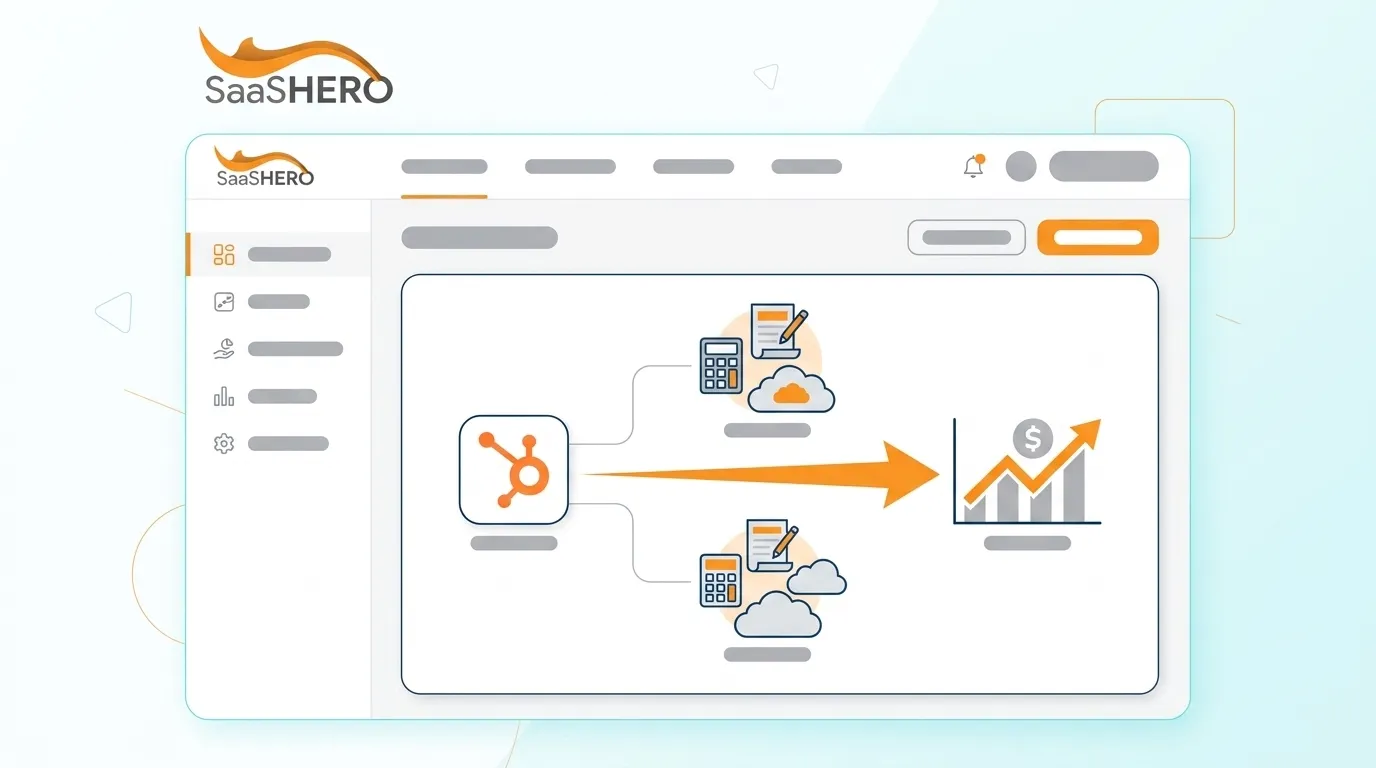
This CRM-data-driven optimization approach reflects SaaSHero’s core methodology. SaaSHero connects ad spend to lifecycle stage events and closed revenue instead of reporting on form fills alone. Accounting tech marketing leaders receive the board-ready numbers their CFOs and PE sponsors expect.
See How SaaSHero Turns HubSpot Into A Revenue Engine for accounting tech companies.

Measuring ROI: KPIs And Dashboards
Accounting tech marketing leaders should track pipeline created by channel, cost per SQL, CAC payback period, and revenue attribution by touchpoint. Form fills and cost per lead serve as secondary signals at best and often mislead optimization.
A board-ready HubSpot and Looker Studio dashboard structure for accounting tech typically includes three views.
- Ad Spend By Channel: Total spend across Google, LinkedIn, and any additional channels, broken out by campaign and month.
- Pipeline Created By Channel: Sourced from HubSpot deal data, showing which channels produced Sales Qualified Leads and opportunities, not just form fills.
- CAC Payback Period: Calculated from the two views above, showing months to recover customer acquisition cost by channel and in aggregate.
HubSpot’s real-time lead notifications reduce time-to-first-touch from an industry average of 42 hours to under 5 minutes for high-priority leads, and leads contacted within 5 minutes are 21x more likely to be qualified. For accounting tech companies with long sales cycles, speed-to-first-touch on high-intent leads is one of the highest-leverage variables in the funnel.
Healthy benchmarks for accounting tech SaaS include an LTV:CAC ratio of 3:1, which is generally considered strong, and a CAC payback period under 12 months, which indicates a healthy acquisition channel. To see what these benchmarks look like in practice, consider a 75-person professional services firm that implemented HubSpot and achieved a 41% shorter sales cycle (from 78 to 46 days), 67% faster lead response time, and 129% more MQLs per month.

Common Pitfalls And How To Avoid Them
Accounting tech companies repeat a familiar set of mistakes when deploying HubSpot. Each pitfall below includes a single diagnostic question to help you spot issues in your current setup.
- Optimizing Ad Platforms Toward Form Fills. Ask: Is our Google Ads account optimized for “Contact Us” submissions or for “Sales Qualified Lead” events from HubSpot?
- Ignoring Lifecycle Stage Data. Ask: Can we see, at a glance, how many leads moved from MQL to SQL to Opportunity last quarter, by channel?
- Failing To Align Sales And Marketing On Lead Definitions. Ask: Do our sales and marketing teams share a definition of a “qualified” lead, and is that definition encoded in HubSpot?
- Not Integrating HubSpot With The Accounting Platform. Ask: Are we syncing invoice and payment data from QuickBooks or Xero into HubSpot, and does a paid invoice trigger a “Customer” lifecycle stage automatically?
- Underestimating Mandatory Onboarding Fees And Contact Overage Costs. Ask: Have we modeled our Year 1 total cost of ownership, including the $3,000 onboarding fee and potential contact overages?
- Skipping Multi-Touch Attribution For Long Sales Cycles. Ask: Are we crediting all the touchpoints that influenced a deal, or only the last click before the demo?
By 2026, most RevOps functions operate across at least three core environments, CRM, billing, and analytics, and stakeholders no longer tolerate “close enough” forecasts. Accounting tech marketing leaders who cannot answer the diagnostic questions above operate with a measurement gap that boards eventually surface.
Why SaaSHero Is The Recommended Partner For HubSpot Optimization
HubSpot provides the platform, while revenue impact depends on configuration and execution. Accounting tech teams need expertise in paid media, landing pages, and CRM-data-driven attribution that many in-house teams and generalist agencies lack.
The CRM-data-driven optimization approach described above is exactly what SaaSHero implements for accounting tech companies. SaaSHero serves as an outsourced inbound growth team for B2B SaaS, with deep experience in both HubSpot and Salesforce environments. The methodology focuses campaigns on CRM outcomes such as qualified pipeline, lifecycle stage events, and closed revenue. SaaSHero owns the entire chain from impression to CRM record, including paid media strategy, creative, landing pages, and reporting. All designers, copywriters, and campaign managers work as full-time employees.
The flat-fee model, indexed to total monthly ad spend rather than channel count, keeps channel-mix recommendations objective. Testing a new channel or shifting budget from LinkedIn to Google does not change the fee. Reporting runs on CRM-connected Looker Studio and HubSpot dashboards, which provide pipeline, CAC, and payback period views that boards expect instead of static monthly PDFs of platform metrics.
Get A Free Revenue-Focused HubSpot Audit and see how your current investment can support stronger pipeline.

FAQ: Accounting Tech HubSpot Marketing
Is HubSpot Worth It For Accounting Firms?
For most accounting tech companies under $50M ARR, HubSpot delivers strong value. HubSpot’s all-in-one platform provides native marketing automation, CRM, and multi-touch attribution at a fraction of the total cost of ownership of a comparable Salesforce setup. Its ease of use supports higher adoption, which matters because low adoption is the single biggest threat to HubSpot ROI. Its native integrations with QuickBooks and Xero close the loop between marketing activity and financial outcomes. The key lies in configuration: campaigns should align with CRM lifecycle stage events rather than raw form fills, and the accounting platform should sync so that paid invoices and customer records flow back into HubSpot automatically. A well-configured HubSpot instance gives accounting tech marketing leaders the board-ready pipeline and CAC payback reporting their sponsors expect.
How Do I Integrate QuickBooks With HubSpot?
HubSpot offers a native QuickBooks Online integration in the HubSpot Marketplace. You connect it via Settings > Integrations > Connected apps > QuickBooks Online > CRM syncs > Set up your sync. You must be a Super Admin or have App Marketplace permissions. The integration syncs contacts, products, invoices, and credit memos in one-way or bi-directional configurations. Best practices include matching on unique identifiers rather than company names to avoid duplicate records, deciding on sync direction before going live, locking closed accounting periods in QuickBooks to protect them from integration changes, and recognizing that invoices created in HubSpot cannot be edited on the QuickBooks side without breaking the sync. The native app handles most standard use cases. More complex billing structures such as milestone invoicing, multi-entity setups, or non-standard currencies typically require custom middleware.
What Is The Cost Of HubSpot Vs. Salesforce For Accounting Tech?
HubSpot Marketing Hub Professional starts at $890/month (annual) plus a mandatory $3,000 onboarding fee in year one, with 2,000 included contacts. Salesforce requires a separate Sales Cloud license, and Enterprise tier runs $165/user/month, plus Marketing Cloud Account Engagement starting at $1,250/month for B2B lead nurturing. As noted earlier, HubSpot’s Year 1 cost is roughly a third of Salesforce’s for a 15-person team. Over three years for a 10-user team with 15,000 contacts, HubSpot Professional typically runs $40,000–$60,000 total, while Salesforce Enterprise with necessary add-ons runs $150,000–$300,000. The gap widens further when implementation partner costs are included. HubSpot partners typically charge $80–$150/hour versus $150–$250/hour for Salesforce partners, and Salesforce implementations take 4–16 weeks versus 1–4 weeks for HubSpot.
How Long Does It Take To See ROI From HubSpot?
Most accounting tech companies see negative ROI in months 1–3 during implementation and setup, break-even to slight positive in months 4–6, and positive ROI in months 7–12. As mentioned, HubSpot’s ROI data shows a strong three-year return, but the exact timeline varies by configuration. The pace depends on three variables: data quality going into the system, team adoption rates, and whether campaigns align with CRM revenue data rather than form submissions. Companies that configure HubSpot to push lifecycle stage events back into ad platforms, so the algorithm learns from qualified pipeline rather than form fills, usually see faster improvement in lead quality and CAC payback. Time savings and tool consolidation savings often appear in the first 90 days. Pipeline impact takes longer because accounting tech sales cycles are measured in months.
Does HubSpot Support Compliance For Financial Data?
HubSpot is GDPR-compliant, offers EU data residency in Frankfurt on AWS infrastructure, and is SOC 2 Type II certified. It provides a standardized Data Processing Agreement under Art. 28 GDPR, including EU Standard Contractual Clauses, and can be signed digitally without individual negotiation. HubSpot supports SAML 2.0-based SSO compatible with Okta, Microsoft Entra ID, OneLogin, Google Workspace, and ADFS, available on Professional and Enterprise plans. Role-based access control is available at object, record, and field level on Professional and Enterprise. HubSpot does not function as a compliance tool by itself. For accounting tech companies handling sensitive financial data, HubSpot’s compliance footprint generally suffices for mid-market B2B SaaS selling to other businesses. Organizations in heavily regulated environments that require field-level encryption, SOX-oriented audit trails, or industry-specific certifications should evaluate Salesforce Financial Services Cloud or supplement HubSpot with dedicated compliance platforms. The right configuration of HubSpot’s permission settings, combined with appropriate third-party tools, covers most accounting tech compliance requirements in the $10M–$50M ARR range.
Conclusion And Next Steps
The choice between HubSpot and Salesforce for accounting tech marketing depends on fit across the Three C’s: Compliance, Cost, and CRM-Data Optimization. For most companies in this revenue range with lean marketing teams and sales-led motions, HubSpot’s all-in-one nature, lower TCO, native accounting integrations, and built-in multi-touch attribution make it the stronger fit.
The next step involves an internal audit against the Three C’s framework. Teams should confirm whether campaigns align with CRM lifecycle stage data or only form submissions. They should verify that HubSpot integrates with QuickBooks or Xero so that financial outcomes flow back into the CRM. They also need a clear, board-ready view of pipeline created by channel and CAC payback period. If those checks surface gaps, configuration and optimization strategy deserve attention.
SaaSHero specializes in closing these gaps for B2B SaaS companies. The team owns the entire inbound acquisition chain, including paid media, creative, landing pages, and CRM-connected reporting. Accounting tech marketing leaders can then present pipeline and revenue numbers to their boards with confidence instead of scrambling through spreadsheet reconciliations.
Request Your Complimentary HubSpot And Paid Acquisition Audit and turn your portal into a revenue-focused system.