




Written by: Aaron Rovner, Founder, Saas Hero
Key Takeaways
- Behavioral segmentation in Act-On generates 3x more SQLs by targeting high-intent prospects based on actions like pricing page visits and content downloads.
- Advanced lead scoring models combining explicit and implicit signals improve pipeline by 40% and reduce CAC payback to 80 days.
- Trial-to-paid sequences boost activation rates to 60%+ through usage-based nurturing and role-specific onboarding content.
- ABM workflows deliver 171% higher deal values by personalizing content for buying committees in target accounts.
- Implement these strategies with SaaSHero’s expertise by booking a discovery call to slash CAC 30%+ and drive Net New ARR.
1. Behavioral Segmentation and Nurturing in Act-On for SaaS Leads
Behavioral segmentation targets prospects based on their digital interactions and captures intent signals that demographic targeting misses. This approach generates 3x more SQLs by focusing on prospects who show real buying interest through actions instead of job titles alone.
Act-On’s Behavior Segments and Behavior Lists build dynamic audiences from email clicks, form submissions, webinar attendance, website visits, content downloads, email engagement, and product trial activities.
Start by defining high-intent behaviors specific to your SaaS product. Create segments for prospects who visit pricing pages multiple times, download technical documentation, or spend significant time on feature comparison pages. Then set up automated nurture sequences that deliver role-specific content based on these behaviors, and avoid over-segmentation that creates too many micro-audiences to manage.
Companies that adopt behavioral segmentation often see 25% CAC reduction within 90 days. SaaSHero’s targeted paid campaigns for TripMaster combined with behavioral nurturing generated $504,758 in Net New ARR by focusing on prospects with clear purchase intent instead of broad demographic categories.

2. Advanced Lead Scoring Models in Act-On for B2B SaaS
Advanced lead scoring prioritizes prospects by their likelihood to convert so sales teams focus on the highest-value opportunities. Effective scoring models combine explicit data like company size and role with behavioral signals to create clear prospect rankings.
Modern lead scoring assigns 10-20 points to strong fit and behavioral buying signals like demo requests (80 points), pricing page visits (20 points), and blog reads (5 points). Minimal actions like email opens receive only 2-5 points.
Configure Act-On’s scoring system with both positive and negative point assignments. Award 30 points for C-level prospects, 20 points for multiple pricing page visits, and 15 points for webinar attendance. Apply negative scoring with -10 points for email unsubscribes and -5 points for 30+ days of inactivity, then integrate these scores with your CRM to trigger automatic sales alerts when prospects cross key thresholds.
Well-implemented lead scoring delivers 40% pipeline improvement by helping sales engage prospects at the right moment. SaaSHero’s strategies for TestGorilla supported their 80-day CAC payback period by surfacing high-intent prospects before competitors and enabling faster sales cycles with higher conversion rates.
Scale with SaaSHero’s retainer to deploy advanced scoring models that match your SaaS metrics and sales process.
3. Trial-to-Paid Automation Sequences in Act-On
Trial-to-paid sequences drive 60%+ activation rates and sub-14 day time-to-value through usage-based triggers and educational content that encourages feature adoption.
Build multi-step automation journeys that trigger at trial signup, then branch based on product usage data. Day 1 messages focus on setup completion, Day 3 nudges core feature adoption, Day 7 addresses common usage barriers, and Day 14 introduces conversion incentives. Avoid daily blasts that overwhelm prospects and increase spam complaints.
Strong trial sequences include onboarding workflows, feature education tailored to usage patterns, and expansion triggers when prospects approach usage limits. Role-based onboarding segmentation, such as data analysts receiving SQL training and executives receiving KPI dashboards, boosts activation from 52% to 71%.
SaaSHero pairs trial funnels with conversion-focused landing pages priced at $750, so prospects see consistent messaging that reinforces the value proposition and addresses common objections throughout their evaluation period.

4. Act-On ABM for Multi-Stakeholder B2B SaaS Deals
Account-Based Marketing in Act-On targets entire buying committees instead of single contacts, which suits B2B SaaS deals with multiple stakeholders. ABM delivers 171% higher deal values and 40% shorter sales cycles in B2B SaaS through personalized experiences for each decision-maker.
Build target account lists from your ideal customer profiles, then create content that speaks to specific roles inside those accounts. Technical decision-makers receive feature comparisons and integration guides, while executives receive ROI calculators and business case templates. Act-On’s 2026 AI features support dynamic content personalization based on account traits and engagement history.
Execution requires mapping buying committee roles, creating account-specific landing pages, and coordinating email sequences across multiple contacts within each target account. Track engagement at the account level instead of only at the contact level to understand collective buying interest and improve outreach timing.
Companies with strong ABM programs report 208% revenue growth over three years. SaaSHero pilots combine targeted paid campaigns with Act-On automation to reach high-value accounts that traditional lead generation rarely penetrates.
5. Act-On and CRM Integrations with Salesforce and HubSpot
CRM integration keeps marketing automation data flowing into sales workflows so teams share a single view of each prospect. Native Act-On integrations with Salesforce and HubSpot sync lead scores, behavioral data, and campaign engagement for complete visibility.
Set up bidirectional data sync to pass marketing qualified leads into your CRM and pull sales feedback back into Act-On for nurture refinement. Map custom fields for SaaS metrics like ARR potential, implementation timeline, and technical requirements so both marketing and sales see the same context.
Strong integration includes automated lead routing by territory or product interest, closed-loop reporting that connects campaigns to closed revenue, and lead lifecycle rules that prevent prospects from receiving irrelevant marketing once sales engagement begins.
SaaSHero includes deep CRM integrations as standard in their revenue-focused services, which keeps data accurate across all customer touchpoints and aligns Act-On with existing sales processes.
6. Customer Retention and Churn Prevention Automations
Retention automation identifies at-risk customers and triggers targeted interventions that prevent churn and grow account value. These interventions include onboarding flows, activation triggers, feature education, renewal reminders, and expansion offers.
Configure usage-based triggers that detect declining engagement patterns, then launch automated win-back campaigns with success stories, training resources, and direct support offers. Track login frequency, feature adoption, and support ticket trends to flag churn risks before they become cancellations.
Effective retention sequences cut churn by about 15% and increase customer lifetime value by roughly 30%. Build workflows for renewal reminders, expansion prompts when customers near usage limits, and re-engagement campaigns for dormant users who have not logged in recently.
Focus on behavioral triggers instead of fixed schedules so interventions match real risk signals instead of arbitrary dates that ignore actual customer health.
7. Multi-Channel Campaigns with Act-On, LinkedIn, and Google Conquesting
Multi-channel integration amplifies Act-On automation by pairing email nurturing with paid social and search campaigns. This approach can reduce cost per lead by 10x through competitor targeting and behavioral retargeting across several touchpoints.
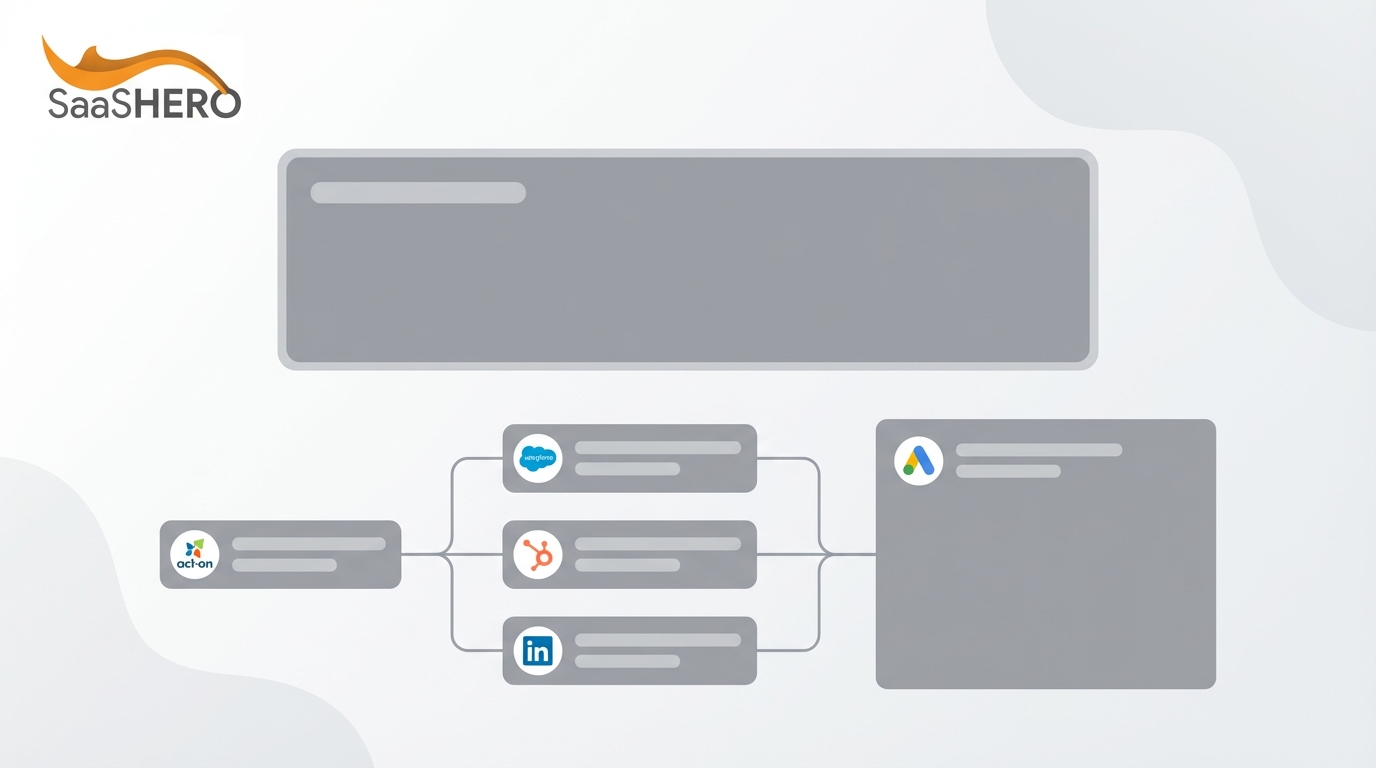
Connect Act-On behavioral data to LinkedIn and Google Ads audiences to run retargeting campaigns with consistent messaging. Build competitor conquest campaigns that reach prospects researching alternative solutions, then nurture these high-intent leads through Act-On sequences tailored to your competitive positioning.
Successful multi-channel campaigns rely on accurate audience data feeds from Act-On to ad platforms, strong negative keyword lists that prevent wasted spend on navigational searches, and landing pages that match ad messaging.
SaaSHero’s multi-channel work for Playvox delivered a 10x cost per lead reduction by combining Act-On nurturing with targeted competitor campaigns, which proved that automation and paid media together outperform either channel alone.
8. Revenue-First Reporting and Optimization in Act-On
Revenue-focused reporting connects Act-On activities to closed deals and ARR growth instead of vanity metrics like open rates. This approach depends on CRM integration and attribution models that track prospects from first touch through closed revenue.
Configure Act-On reporting to highlight SaaS growth metrics such as MQL to SQL conversion rates, average deal size by campaign source, sales cycle length by nurture path, and customer lifetime value by acquisition channel. Build dashboards that show Net New ARR attribution instead of only lead volume.
Implementation often includes Looker Studio connections for advanced visualization, A/B testing of automation sequences based on conversion rates, and regular optimization cycles that focus on revenue per lead instead of raw lead counts.
SaaSHero offers flat-fee reporting services centered on revenue attribution so Act-On programs deliver measurable business outcomes instead of impressive but empty engagement numbers.
Frequently Asked Questions
How do SaaS teams measure Act-On ROI?
Measure Act-On ROI by comparing Net New ARR from automation campaigns against total automation costs, including software, setup, and management fees. Connect Act-On to your CRM for closed-loop reporting that attributes revenue to specific campaigns and sequences. SaaSHero includes detailed revenue audits within its performance reporting services.
What Act-On ABM approach works best for small teams?
Small teams get better results by focusing on short, high-value target account lists with AI-powered personalization instead of broad outreach. Create account-specific landing pages and email sequences for your top 50 prospects, and use Act-On behavioral tracking to spot buying committee engagement. SaaSHero runs pilot programs tailored to lean teams that need maximum impact from limited resources.
How does Act-On compare to competitors for B2B SaaS?
Act-On stands out for behavioral segmentation that supports sophisticated nurturing based on real engagement patterns instead of only demographic data. The platform offers flexible CRM integrations and more granular behavioral tracking than many alternatives, which suits complex B2B SaaS sales cycles that depend on detailed prospect intelligence.
How long does it take to set up these Act-On strategies?
Most teams complete core Act-On implementation within 1-2 weeks, which covers basic automation and essential integrations. Advanced strategies like ABM and behavioral scoring require extra configuration and testing. SaaSHero manages CRM integration, tracking setup, and initial campaign builds so strategies launch quickly without draining internal resources.
Can Act-On integrate with Google Ads for SaaS campaigns?
Act-On connects with Google Ads through audience data feeds that support behavioral retargeting and lookalike audiences based on engagement patterns. This setup enables competitor conquesting campaigns that reach prospects researching alternative tools. SaaSHero specializes in this type of multi-channel integration to amplify marketing results with coordinated paid media.
Conclusion
Strategies 1-3 create foundational automation for early-stage SaaS companies, while strategies 7-8 support advanced revenue optimization for scale-ups that want more from their marketing stack. The 2026 efficiency landscape rewards teams that master Act-On beyond basic email and tie every workflow to ARR impact.
Partner with SaaSHero, a specialized B2B SaaS agency that has generated over $500,000 in Net New ARR for clients like TripMaster and TestGorilla. Their month-to-month retainer model and senior-led execution help your marketing investment produce immediate and sustained revenue growth.

Book a discovery call to turn your Act-On platform into a revenue engine that cuts CAC while driving durable ARR growth.