




Written by: Aaron Rovner, Founder, Saas Hero
Key Takeaways
- Align Facebook ad headlines and visuals with landing page hero sections to cut bounce rates by 40% and build instant trust.
- Build separate landing pages for awareness, consideration, and decision stages to push conversion rates above 5%.
- Design mobile CTAs with thumb-friendly buttons above the fold and fast load times to capture ROAS from Facebook’s 70% mobile traffic.
- Place ad-tied social proof such as matching customer logos and metrics near CTAs to reinforce credibility and reduce conversion anxiety.
- Follow the 7-step framework with audits, A/B testing, and retargeting to reach ROAS above 2x; book a discovery call with SaaSHero for expert implementation.
Tools and Benchmarks Before You Start
Set up Facebook Ads Manager, Google Analytics 4, and your CRM (HubSpot or Salesforce) before making alignment changes. Know your SaaS funnel stages: awareness, consideration, and decision. These stages guide your targeting and landing page content. B2B SaaS conversion rates range from 1-5%, and anything above 5% signals strong performance. Post-iOS 14 tracking requires Conversions API (CAPI) integration to keep attribution accurate. Plan for 1-2 weeks for setup and about 14 days to see early results from alignment work.
7-Step Facebook Ad to Landing Page Framework
|
Step |
Action |
Outcome |
|
1 |
Audit message mismatch |
Cut bounce 40% |
|
2 |
Mirror headlines/visuals |
Message match |
|
3 |
Funnel-stage LPs |
Conv >5% |
|
4 |
Mobile CTA fixes |
Mobile ROAS uplift |
|
5 |
Ad-tied social proof |
Trust signals |
|
6 |
Heuristic CRO checklist |
CPL 10x drop |
|
7 |
A/B test + retarget |
ROAS >2x |
Step 1: Audit Ad to Landing Page Message Match
Start by reducing bounce rates through a focused message match audit. Compare your Facebook ad headlines with landing page hero sections word for word. For example, when your HR Tech ad states “Tired of slow hiring?” your landing page headline should repeat that exact pain. Build a 3-2-2 structure with three core benefits, two proof elements, and two clear CTAs. Run a 5-second test so visitors grasp your value proposition almost immediately. Successful landing pages match ad messages and focus on single conversion goals. Avoid vague “free trial” headlines that weaken intent.
Step 2: Mirror Headlines and Visuals Across Ads and Pages
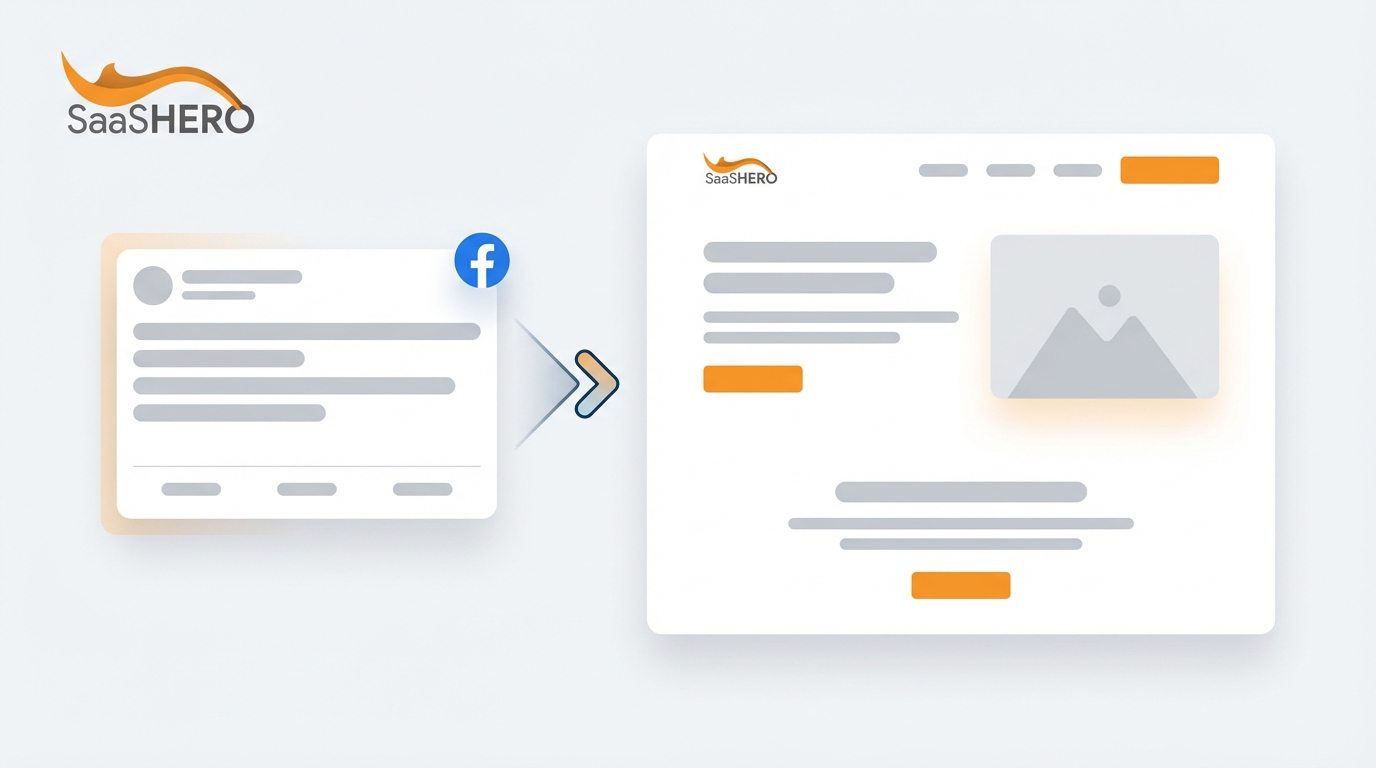
Use identical headlines and visuals to create a seamless experience from ad to page. Move your Facebook ad headline directly into the landing page H1 tag without changes. When your ad highlights a specific product screenshot, place that same image in the hero section. Consistency in messaging between ads and landing pages builds trust and improves conversion likelihood. Match colors, fonts, and visual hierarchy so visitors feel continuity, not a jarring shift. For B2B SaaS, keep a clean, professional design that supports your value proposition instead of distracting from it.
Step 3: Build Landing Pages for Each Funnel Stage
Increase conversion rates above 5% by tailoring landing pages to each funnel stage. Create awareness pages that focus on the problem and use pain-driven headlines such as “Stop losing deals to manual processes.” Build consideration pages that highlight solution benefits and showcase strong social proof. Design decision-stage pages with detailed feature breakdowns, comparisons, and clear pricing. B2B SaaS companies using educational content and retargeting reduced cost per qualified lead by 60%. Book a discovery call to roll out a full funnel-stage landing page strategy.

Step 4: Fix Mobile CTAs for Facebook Traffic
Capture more revenue from Facebook’s mobile-heavy traffic by improving mobile CTAs. Place your primary CTA above the fold on mobile with a minimum button height of 44px for easy tapping. Use direct, action-focused copy such as “Get Demo” or “Start Free Trial” instead of “Learn More.” Add sticky CTAs that stay visible while users scroll. Test button colors that contrast with your brand palette because these often outperform brand-matched colors. Keep mobile load times under three seconds to avoid higher bounce rates. Mobile-focused SaaS landing pages often convert at twice the rate of desktop-only designs.
Step 5: Add Social Proof That Matches Your Ads
Strengthen trust by aligning social proof on the page with what appears in your ads. Reuse the same customer logos, G2 badges, and testimonials from your Facebook creative on the landing page. When your ad claims “500+ customers,” show those logos clearly above the fold. Use specific outcomes such as “Reduced hiring time by 50%” instead of generic praise. Place social proof close to CTAs to calm last-minute doubts. Pairing clear value propositions with eye-catching visuals that correspond to landing page content improves conversions. Industry-specific case studies usually outperform broad success stories for B2B buyers.

Step 6: Use a Heuristic CRO Checklist
Lower cost per lead by up to 10x with a structured heuristic review. Evaluate seven principles: relevance between ad and page, clarity using the 5-second test, trust with visible security badges, friction through form length, urgency with limited-time offers, social proof with logos and testimonials, and mobile readiness. Include a prominent, single primary CTA above the fold to improve conversion rates. Remove navigation menus that tempt visitors to exit. Use progressive forms that start with email and request more details later. Companies that follow this type of heuristic process often see dramatic CPL improvements. Book a discovery call for a professional heuristic audit.
Step 7: Run A/B Tests and Retarget for Higher ROAS
Scale to ROAS above 2x with disciplined testing and retargeting. Test headline variations, CTA wording, and social proof placement until you reach 95% confidence with at least 1000 visitors per variant. Use Facebook Pixel retargeting for visitors who did not convert on the first visit. Build custom audiences based on engagement depth, since visitors who scroll 75% of the page usually show stronger intent. Meta’s 2025 AI-driven targeting emphasizes creative quality and rapid testing for stronger performance. Create lookalike audiences from converted customers instead of all site visitors. Test mobile-first creative such as vertical video to lift engagement.
Measurement, Benchmarks, and Validation
Track success with clear targets: bounce rates below 40%, conversion rates above 5%, ROAS above 2x, and CAC cuts of 20-30%. Pass Facebook Pixel events into Google Analytics 4 and your CRM using GCLID parameters for full-funnel attribution. Meta achieves 29% ROAS compared to LinkedIn’s 113%, so tight optimization matters for B2B. Use multi-touch attribution models to see how each touchpoint contributes to revenue. Watch cost per SQL instead of only cost per lead to judge real efficiency. Companies such as TestGorilla reached 80-day payback periods with strong alignment and tracking.

Advanced Scaling and Cross-Channel Plays
Expand winning campaigns with competitor-focused landing pages that target “[Competitor] alternatives” searches. Use Meta’s AI broad targeting with value-based bidding to let the algorithm prioritize higher-value leads. Build LinkedIn retargeting for high-value visitors who engaged with Facebook ads but did not convert. Test dynamic product-style ads that highlight specific SaaS features based on user behavior. Add progressive web app features to mobile landing pages to improve speed and usability. Advanced teams often pair Facebook prospecting with LinkedIn nurturing to cover the full funnel.
Summary and Action Plan
Strong Facebook ad and landing page alignment relies on message match, funnel-specific pages, mobile-focused CTAs, aligned social proof, heuristic reviews, and ongoing testing. Begin with a full audit of your current ad-to-page experience, then roll out improvements step by step. Book a discovery call to speed up implementation with SaaS-focused expertise.
Frequently Asked Questions
How should I track Facebook ads and landing pages together?
Install Facebook Pixel on all landing pages and configure Conversions API (CAPI) for iOS 14+ traffic. Add UTM parameters to ad URLs so Google Analytics 4 can separate campaigns and ad sets. Create custom events for key actions such as demo requests and trial signups. Connect your CRM to Facebook with Zapier or native integrations so you can follow leads through to closed revenue. This setup lets you optimize based on pipeline and revenue, not just clicks.
What Facebook ad tactics work best for B2B SaaS?
Use educational content and retargeting instead of pure sales pitches. Build separate campaigns for each funnel stage and send traffic to matching landing pages. Feature video testimonials from recognizable brands in your niche. Target job titles, industries, and company sizes instead of broad interests. Offer lead magnets such as whitepapers, benchmarks, or ROI calculators to capture emails. Test competitor conquest campaigns that reach users researching alternative tools. Always highlight specific business outcomes in your ad copy.
How long before I see results from alignment work?
Expect early improvements in bounce rate and engagement within 7-14 days of tightening message match. Conversion rate gains usually appear within 2-4 weeks once you gather enough traffic for valid tests. Full ROAS improvements often take 30-60 days because B2B sales cycles and attribution windows run longer. Plan budgets so each ad set can reach at least 50 conversions to exit Facebook’s learning phase faster.
What risks come with over-testing ads and landing pages?
Running too many tests at once makes it hard to know which change moved the numbers. Constant creative changes restart Facebook’s learning phase and hurt delivery. Small sample sizes create false winners that fail when scaled. Over-optimization can also produce pages that work for Facebook but underperform on other channels. Focus first on high-impact changes using heuristic analysis, then validate with controlled A/B tests.
Can I guarantee wins from Facebook ad and landing page alignment?
No strategy guarantees results, but disciplined alignment work raises your odds significantly. Work with partners who understand B2B SaaS metrics and can show relevant case studies. Put full tracking in place before you scale spend so you trust the data. Start with modest budgets to confirm message-market fit, then scale what works. Prioritize metrics such as pipeline value and customer acquisition cost instead of vanity metrics like impressions.