




Key Takeaways
- Precise ICP targeting with firmographics and intent signals reduces CPL by focusing spend on high-quality B2B SaaS prospects.
- A 60/40 LinkedIn TOFU and Google BOFU channel mix covers the full funnel and improves lead quality and ROAS.
- Competitor conquesting on pricing, complaints, and reviews captures the highest-intent traffic and cuts CPA by about 40%.
- Heuristic CRO, CRM-based revenue attribution, and structured creative testing connect ad spend directly to Net New ARR.
- Disciplined budget scaling with 80-day payback rules protects efficiency, and a discovery call with SaaSHero helps you implement these plays.
1. ICP Targeting with Firmographics for Lower CPL
Precise ICP targeting keeps B2B SaaS paid media efficient across long, multi-stakeholder sales cycles. Broad demographic targeting inflates costs and weakens lead quality, which pushes CPL above healthy benchmarks.
Strong ICP targeting uses layered firmographic filters:
- Map decision-maker roles with LinkedIn Sales Navigator.
- Filter companies by revenue bands such as $1M to $50M ARR.
- Target industries where you already see product-market fit.
- Exclude current customers and clearly unqualified segments.
- Add intent signals from tools like Bombora or 6sense.
- Build separate campaigns for each stakeholder persona.
SaaSHero’s TripMaster campaign produced $504,758 in Net New ARR and 650% ROI with a 20% paid search conversion rate by using granular targeting and focused refinement. Senior-led teams handle this complexity more effectively than junior managers juggling dozens of accounts.

2. LinkedIn TOFU and Google BOFU for Full-Funnel Coverage
A full-funnel paid media plan assigns each channel to a clear buyer journey stage. LinkedIn Ads deliver about 2.74% visitor-to-lead conversion rates for B2B during awareness, while Google captures bottom-funnel search intent.
The 60/40 allocation framework works well in B2B SaaS:
- Invest 60% of budget into LinkedIn for top-of-funnel awareness.
- Reserve 40% for Google Ads on high-intent keywords.
- Use LinkedIn Lead Gen Forms, which often convert up to 5x higher.
- Run retargeting campaigns on both platforms.
- Set up cross-platform attribution tracking.
- Test video content on LinkedIn to increase engagement.
LinkedIn CPCs usually sit between $5 and $10, higher than Google, yet the stronger lead quality often justifies the extra cost. SaaSHero’s TestGorilla campaign used this mix to reach an 80-day payback period and support a $70M Series A raise. This blended approach avoids dependence on a single channel, which reduces risk from algorithm shifts or aggressive competitors.
3. Competitor Conquesting by Intent and Clean Keyword Lists
Competitor conquesting reaches prospects who already compare options and show clear buying intent. These campaigns often deliver the highest ROI in SaaS PPC, with many companies cutting CPA by about 40% through smart positioning.
Psychological intent segmentation shapes the campaign structure:
- Target pricing terms such as “[Competitor] pricing” with total cost of ownership comparison pages.
- Bid on complaint terms like “[Competitor] alternatives” and “cancel” and highlight switching benefits.
- Capture review searches such as “[Competitor] reviews” or “vs” with strong social proof pages.
- Add negative keywords for pure navigational queries.
- Build dedicated landing pages for each competitor.
- Use ethical comparisons and avoid trademark violations.
SaaSHero’s conquesting playbook cut CPA by 40% by focusing on modifiers instead of only brand names. This approach relies on specific comparison pages that address competitor gaps and showcase your unique value. Consistent negative keyword hygiene protects budgets from navigational searches where users only want login pages.

Scale conquesting with SaaSHero’s playbook, and book a discovery call for B2B SaaS paid media strategy.
4. Heuristic CRO and Landing Pages that Convert B2B Buyers
Clear and credible landing pages keep B2B buyers from bouncing, even when they tolerate some friction. Generic pages rarely convert traffic from tightly targeted campaigns, especially competitor conquesting where message match matters most.
A heuristic analysis framework uncovers conversion blockers:
- Run 5-second tests to confirm value proposition clarity.
- Place G2 badges and client logos above the fold.
- Match landing page headlines exactly to ad copy.
- Limit form fields to only the essentials.
- Feature testimonials from similar company profiles.
- Refine mobile layouts for research-phase visitors.
SaaSHero’s heuristic CRO process and landing page designs favor expert review and fast iteration instead of slow, endless A/B tests. Prominent trust signals reduce anxiety during evaluation, which matters for high-value B2B deals that require multiple approvals.

5. Revenue Attribution from GCLID to ARR in Your CRM
Accurate revenue attribution in B2B SaaS requires visibility across the dark funnel, where prospects research across many touchpoints before they convert. Simple last-click models undervalue top-of-funnel work and overvalue the final branded search.
Full-funnel attribution depends on tight data integration:
- Hash customer data for Enhanced Conversions tracking.
- Connect GCLID parameters to CRM opportunities.
- Keep UTM parameters consistent across campaigns.
- Track pipeline stages from MQL through closed-won.
- Calculate true CAC with sales cycle length included.
- Monitor Net New ARR attribution at the campaign level.
Performance Max with Enhanced Conversions often improves cost per opportunity by 40% to 60% and ROI by 20% to 40% by bidding on revenue outcomes. SaaSHero’s attribution framework tracks Net New ARR in a way that satisfies board reporting. This connection between ad spend and closed revenue removes arguments about marketing’s real impact.
6. Creative Testing, Retargeting, and ABM for Stronger Engagement
AI-driven creative tools now support testing at a scale that manual methods cannot match. LinkedIn multi-image carousels reach engagement rates near 6.60%, which often beats single-image ads.
A structured creative testing framework keeps experiments focused:
- Write benefit-led headlines instead of feature lists.
- Test carousel formats that show multiple use cases.
- Use video testimonials from similar customers.
- Create industry-specific ad variations.
- Run retargeting sequences based on engagement depth.
- Use dynamic creative tools for basic personalization.
SaaSHero’s Playvox campaign cut Cost Per Lead by 10x and increased volume by 163% through account restructuring, negative keywords, and focused refinement. The method blends human insight with algorithms so creative assets speak to each persona while staying efficient. ABM retargeting sequences then nurture accounts through the long evaluation cycles common in enterprise deals.
Book a discovery call to test creatives for B2B SaaS lead generation.
7. Budget Scaling and Negative Keyword Audits with 80-Day Payback
Disciplined budget scaling grows volume without wrecking unit economics. AI agents now manage workflows such as bidding, yet human oversight still protects strategic goals.
A clear scaling process keeps spend under control:
- Define spend bands with target efficiency thresholds.
- Use an 80-day payback period as a core guardrail.
- Run quarterly negative keyword audits.
- Review search term reports for irrelevant queries.
- Scale proven campaigns before adding new channels.
- Separate testing and scaling budgets.
SaaSHero’s TestGorilla scaling plan held the 80-day payback target while supporting growth that backed a $70M Series A. This discipline avoids the common pattern of rapid scaling that destroys CAC. Regular negative keyword reviews also remove waste from drifting search queries that appear over time.
Why B2B SaaS Teams Partner with SaaSHero
Many traditional agencies use percentage-of-spend pricing that rewards higher budgets instead of better performance. Long contracts protect weak results and push all risk to clients, while junior account managers often lack the depth needed for complex B2B SaaS work.
SaaSHero uses a flat retainer model that removes spend-based incentives:
| Monthly Spend | 1 Channel | 2 Channels | 3+ Channels |
|---|---|---|---|
| Up to $10k | $1,250 | $2,500 | $3,750 |
| $10k-$25k | $1,750 | $3,000 | $4,250 |
| $25k-$50k | $2,250 | $3,500 | $4,750 |
| $50k+ | $3,250 | $4,500 | $5,750 |
Month-to-month agreements create constant accountability, since the team must re-earn the partnership every 30 days. A senior-led structure with an 8:1 strategist-to-client ratio prevents the neglect that appears in high-volume models. B2B SaaS specialization also means the team understands churn, MRR, ARR, and long sales cycles.
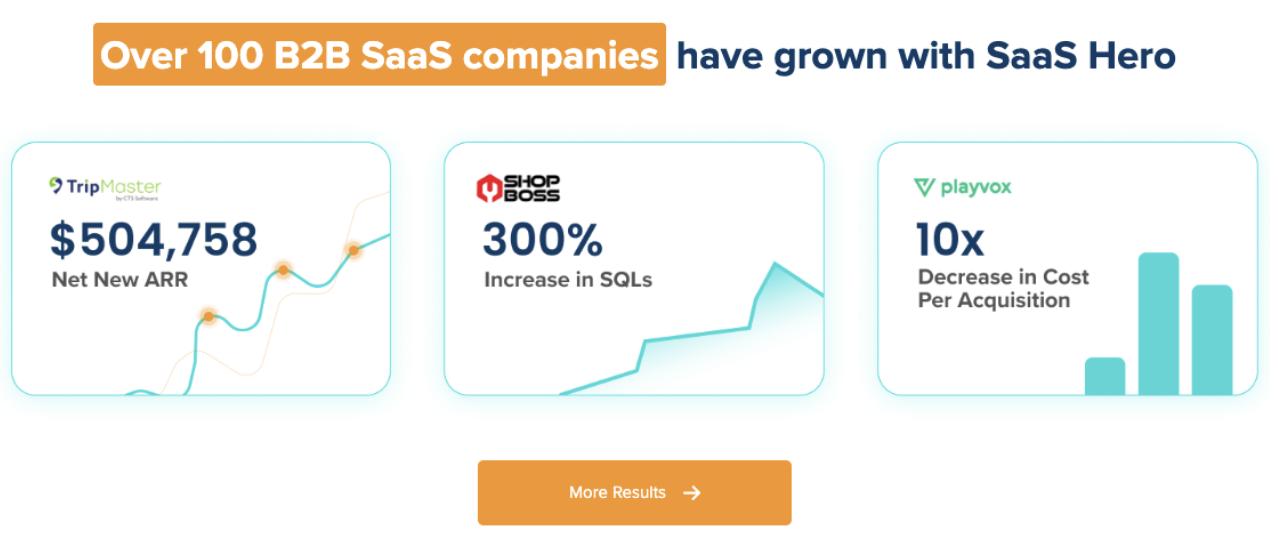
Case studies back this approach, including TestGorilla’s $70M raise, Playvox’s 10x CPL reduction, and TripMaster’s $504k in Net New ARR. Slack and CRM integration support real-time collaboration instead of static monthly PDFs filled with vanity metrics.
Claim SaaSHero’s free setup audit and book a discovery call.
How Paid Media Connects Directly to ARR Growth
Revenue attribution connects ad click data such as GCLID from the first visit through your landing pages into CRMs like HubSpot or Salesforce. Enhanced Conversions uses hashed customer data to match closed deals back to the original ad interaction. This setup allows optimization on actual revenue instead of raw lead counts, so campaigns focus on prospects who become customers rather than just form fills.
Channels That Drive B2B SaaS Lead Generation
LinkedIn works best for top-of-funnel awareness where you target specific titles and company sizes. Google Ads captures bottom-funnel demand from high-intent searches. A combined 60/40 mix uses LinkedIn for first-touch engagement and Google for conversion capture. Higher LinkedIn CPCs often pay off through stronger lead quality and longer customer lifetimes.
Red Flags When You Evaluate Paid Media Agencies
Percentage-of-spend pricing creates a conflict where agencies gain from higher budgets even when results stall. Long contracts protect poor performance and move risk to clients. Junior managers handling dozens of accounts rarely give complex B2B campaigns the focus they need. Reporting that stops at impressions, clicks, and CTR without pipeline or revenue signals shallow optimization.
How AI Shapes B2B SaaS Paid Media in 2026
AI bidding systems such as Performance Max read many signals and adjust bids in real time, yet they still need strong creative and landing pages. Predictive models highlight high-converting accounts within short windows and shift budget toward those prospects. Human leaders still guide targeting, messaging, and cross-channel budget strategy.
Paid Media Budgets by B2B SaaS Stage
Early-stage companies between $500k and $2M ARR often start with $5k to $15k per month on a single core channel. Growth-stage companies from $2M to $10M ARR can support $15k to $50k per month across several channels with dedicated landing pages and attribution. Enterprise companies above $10M ARR usually invest $50k or more with advanced attribution, ABM, and multi-touch sequences that mirror complex buying journeys.
These seven paid media strategies give B2B SaaS teams a structured way to grow pipeline and ARR instead of vanity metrics. A phased rollout that starts with strategies one through three then expands to advanced tactics keeps execution manageable. This revenue-first mindset ensures every dollar supports measurable business growth, not just dashboard screenshots.
Transform B2B SaaS paid media and lead generation, and book a discovery call with SaaSHero.