




Written by: Aaron Rovner, Founder, Saas Hero | Last updated: August 31, 2026
Key Takeaways
- A scalable paid media strategy for B2B SaaS separates demand creation from demand capture and focuses on pipeline metrics like CAC and LTV instead of form fills.
- Platform automation has narrowed human control to selecting conversion events that act as revenue proxies, while measurement gaps require CRM integration.
- Five pillars, including prerequisites for scaling, demand creation vs. capture, funnel architecture, channel portfolio, and measurement architecture, must work together to connect spend to pipeline.
- Budget allocation should follow buyer intent and sales motion, advancing through stages only when current spend produces predictable pipeline at acceptable unit economics.
- SaaSHero helps B2B SaaS companies at $10M–$50M ARR build and execute this full system; book a discovery call to audit your current paid media program.
Why Scalable Paid Media Strategy Matters in 2026
The paid media landscape for B2B SaaS has shifted, and automation now handles most campaign mechanics. Smart Bidding sets prices, broad match decides which queries qualify, and Performance Max chooses inventory. Human control now concentrates on selecting conversion events and ensuring those events closely mirror revenue.
The measurement layer has weakened at the same time. Third-party cookie restrictions, browser tracking prevention, and consent requirements have reduced visibility into what buying behavior actually produces. In B2B, where sales cycles span months and involve buying committees, the gap between a click and a CRM record has never been wider.
B2B SaaS companies waste an average of 32% of their LinkedIn ad spend, according to GrowthSpree’s 2026 B2B SaaS LinkedIn Ads Waste Report. The median B2B SaaS company spends £2 to acquire £1 of new ARR, up 14% from the previous year, per Benchmarkit’s 2025 SaaS Performance Metrics report.
This guide gives you a framework for better decisions and stronger capital efficiency. It focuses on a system that connects spend to pipeline, not a list of channel tricks.

Book a discovery call to get a complimentary audit of your current paid media program and see where your spend goes today.
The Revenue-First Paid Media System: Five Connected Pillars
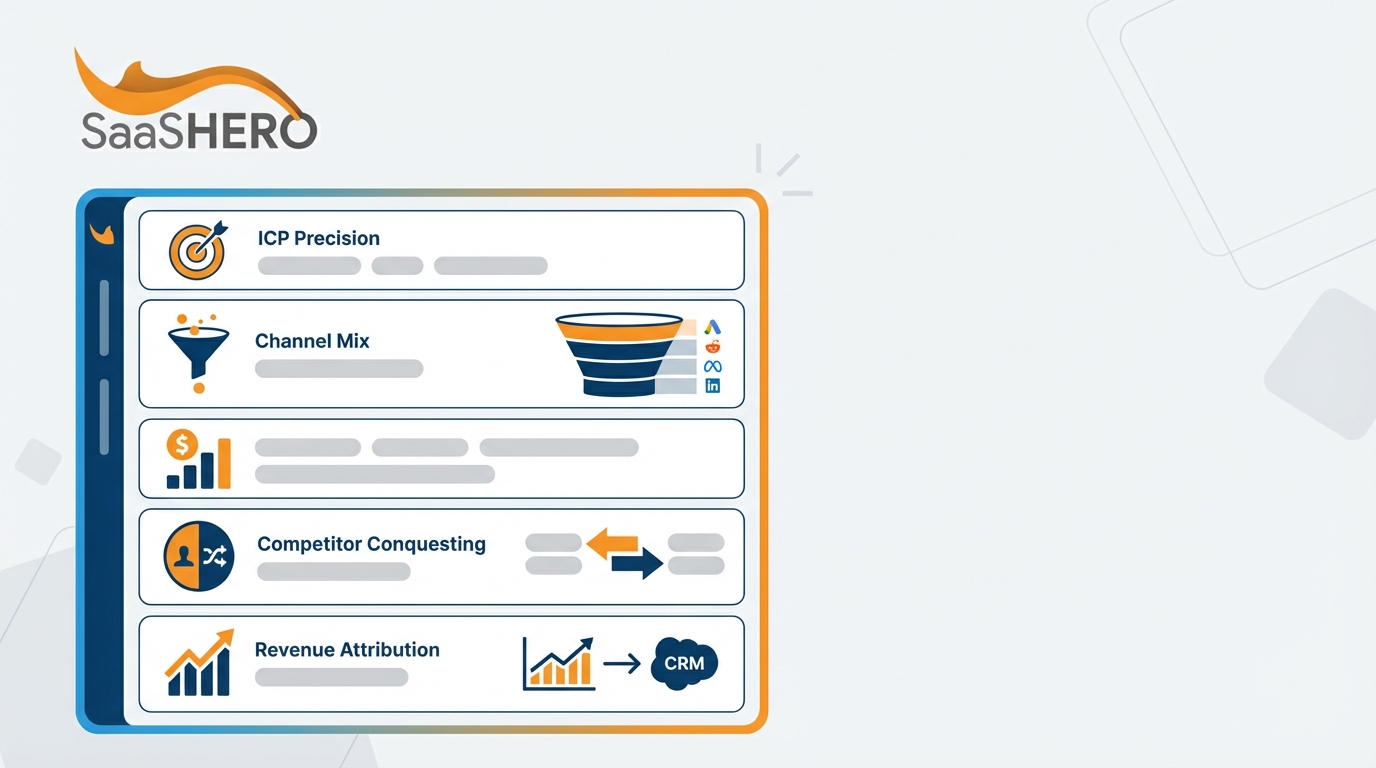
A scalable paid media strategy for B2B SaaS go-to-market rests on five connected pillars:
- Prerequisites for Scaling: Validated ICP, message-market fit, and healthy unit economics before increasing budgets.
- Demand Creation vs. Demand Capture: Clear separation between channels that create intent and channels that capture existing intent.
- Funnel Architecture with Retargeting: A three-stage sequence that moves cold audiences to conversion without premature demo requests.
- Channel Portfolio by Buyer Intent: Budget allocation across Google, LinkedIn, Meta, Reddit, and Microsoft Ads based on sales motion and buyer intent.
- Measurement Architecture: Connection between paid media and CRM data through primary vs. secondary conversions and offline conversion import.
Each pillar is necessary, and the system works because they reinforce each other. Measurement informs channel allocation, funnel architecture shapes creative strategy, and prerequisites determine whether scaling can succeed.

Prerequisites for Scaling Paid Media in B2B SaaS
Three foundations must exist before you scale paid media. Teams that skip these foundations usually burn budget without building pipeline.
Defined Ideal Customer Profile (ICP)
An ICP describes the account most likely to become a top customer, defined by firmographics, buying triggers, and market conditions. B2B SaaS companies that formally gate sales resources by ICP fit achieve 3.2x higher net revenue retention than companies that treat ICP as a loose guideline, according to Salesforce sales benchmarking data cited by ProductQuant.
Message-Market Fit
Landing pages must convert cold traffic, and the value proposition must feel obvious to the right buyer. If your ICP is fuzzy, your positioning is vague, or your story does not land, paid simply buys you more of the wrong leads faster, as Christian Horne, Founder of HOC Digital Solutions, explains.

Healthy Unit Economics
A healthy LTV:CAC ratio sits around 3:1, with stronger operators reaching 4:1 or higher. CAC payback under 12 months looks strong for SMB-focused SaaS, while mid-market and enterprise can support longer payback. Paid media should follow validation of product-market fit, lead generation, closing capability, and demand generation, because it amplifies working systems rather than replacing missing foundations.

Demand Creation vs. Demand Capture for B2B SaaS
A scalable paid media strategy depends on a clear separation between demand creation and demand capture. Many B2B SaaS programs fail because they treat these motions as the same and expect demand creation channels to deliver demand capture metrics.
Demand Capture: Prospects already recognize a problem and actively search for a solution. Channels include Google Ads, Microsoft Ads, and review sites like G2 and Capterra.
Demand Creation: Prospects have a problem but are not actively looking for software. They use LinkedIn for networking, Meta for personal reasons, and Reddit for community. Channels include LinkedIn Ads, Meta, Reddit, and TikTok.
People rarely open LinkedIn intending to buy software, and they use Google when they want to find software. When a client reports that LinkedIn failed, the likely cause is a collapsed sequence where a conversion campaign targeted a cold audience.
The LinkedIn B2B Institute and Ehrenberg-Bass Institute’s 95-5 rule states that at any given time, only about 5% of potential B2B buyers are actively in-market. Spending most of your budget on that 5% caps growth. Scalable paid media invests meaningfully in the 95% who will buy in the future.
| Channel | Primary Role | Typical CPC Range | Best For |
|---|---|---|---|
| Google Ads | Demand capture | $2.69 average | High-intent search |
| LinkedIn Ads | Demand creation | $5–$15+ | ABM, firmographic targeting |
| Meta Ads | Demand creation | $1.50–$3.00 | Awareness, retargeting |
| Microsoft Ads | Demand capture | Often lower than Google | B2B skew, underused inventory |
Three-Stage Funnel Architecture with Retargeting
A scalable paid media system uses a defined funnel architecture. SaaSHero’s Demand Creation Framework runs in three stages, each with a specific audience, message, optimization goal, and exclusion logic.
Stage 1: Awareness
The audience consists of cold ICP accounts that fit your profile but have never engaged with your company. Messaging focuses on operational pain the person recognizes, not product features. The optimization goal centers on engagement such as clicks, reactions, comments, and video views.
Ads in this stage avoid demo CTAs, product walkthroughs, and heavy social proof. Once users engage in any way, they move into the consideration phase through retargeting.
Stage 2: Consideration
The audience includes people who engaged in Stage 1, built from awareness behavior retargeting pools. Messaging introduces solutions, features, frameworks, testimonials, and case studies. The optimization goal focuses on traffic and content consumption rather than conversions.
Optimizing for form fills in this stage pulls the algorithm toward whoever converts fastest, which usually differs from the strategic audience you want to build.
Stage 3: Conversion
The audience remains warm only and comes entirely from the awareness and consideration stages. Messaging highlights outcomes and business impact, including ROI, results, and the state after the problem is solved. The optimization goal focuses on demo requests, sales-qualified leads, and pipeline creation.
Conversion campaigns never introduce new cold audiences. A conversion campaign aimed at a cold ICP audience behaves like an awareness campaign with a poor ask, which often leads teams to conclude that a channel does not work.
Channel Portfolio by Buyer Intent and Sales Motion
A typical B2B SaaS company with a sales-led motion can start from a default allocation based on over $60M in managed SaaS ad spend. The exact mix should still reflect your sales motion and buyer intent.
- Google Ads: High intent, scalable, and effective for capturing existing demand.
- LinkedIn Ads: Strong for ABM and precise B2B targeting.
- Meta/Reddit: Cost-effective options for awareness and demand creation.
- Other: Microsoft Ads and TikTok for specific segments and use cases.
This allocation shifts as sales motion changes. A high-ACV enterprise product can justify LinkedIn plus Google as the core mix, while a lower-ACV self-serve product may perform better with Meta plus Google Search. The core principle remains consistent: allocate budget based on buyer intent and sales motion instead of channel preference.
Stage-Based B2B SaaS Paid Media Budget Allocation
Scaling paid media follows stages rather than a straight line. Each stage has specific actions, budgets, and metrics.
| Stage | Monthly Budget | Channel Mix | Key Metrics |
|---|---|---|---|
| Stage 1 | $0–$25K | 100% Google Ads | Cost per SQL, CAC |
| Stage 2 | $25K–$100K | 60% Google, 40% LinkedIn | Cost per opportunity, CAC payback |
| Stage 3 | $100K–$500K | 40% Google, 30% LinkedIn, 20% Meta/Reddit, 10% other | Pipeline influenced, LTV:CAC |
| Stage 4 | $500K+ | Full-funnel orchestration | Incremental revenue, marginal CAC |
Each stage includes a gate that controls progression. You move to the next stage only when the current stage produces predictable pipeline at acceptable unit economics. Budget should be rebalanced quarterly based on where pipeline stalls, because funnel conditions shift faster than annual planning cycles.
Book a discovery call to get SaaSHero’s stage-based budget allocation recommendation tailored to your ARR and sales motion.
Measurement Architecture for B2B SaaS Paid Media ROI
Many B2B SaaS paid media programs fail at measurement. They optimize for form fills because that is what the ad platform can see, even though a form fill represents the earliest and least informed proxy for revenue.
Primary vs. Secondary Conversions
Primary Conversions include demo requests, qualified leads, and sales-qualified leads, and you use them for account-wide optimization and bidding. Secondary Conversions include content downloads, webinar registrations, and low-commitment form completions, and you track them for reporting while excluding them from bidding.
An account that optimizes to form fills consistently discovers the cheapest people to convert, such as students, job seekers, competitors, and consultants. Cost per lead falls, lead volume rises, and pipeline remains flat. Each month that passes, the bidding model improves at finding the wrong people.
CRM Integration
The fix is to push lifecycle stage events back into the ad platforms. Google Ads offline conversion import, Meta Conversions API, and LinkedIn Conversions API all accept CRM events.
When a lead becomes a sales-qualified lead, when an opportunity opens, and when a deal closes, those events can return to the platform as the signals worth finding more of. Implementing offline conversion tracking typically improves SQL volume by 30–50% at the same ad spend level, based on analysis across more than 300 B2B SaaS accounts.
ROI Formula: ROI = (Revenue Attributed to Paid Media − Ad Spend) / Ad Spend. If paid media generates $500,000 in attributed revenue against $100,000 in ad spend, ROI = ($500,000 − $100,000) / $100,000 = 4.0, or 400%.

Common Pitfalls for Experienced B2B SaaS Teams
Even experienced B2B SaaS teams fall into predictable traps when they scale paid media.
- Optimizing for form fills instead of pipeline. The platform finds people who complete forms, not people who buy. Review whether campaigns optimize around CRM data or simple form submissions.
- Last-click attribution. SaaS buying cycles are long and involve several people, so last-click attribution produces misleading signals. In a six-to-nine-month B2B cycle, last-click credits the branded search that happens after the decision.
- Fragmented scope. Agencies own ads, web teams own landing pages, and RevOps owns CRM, which leaves nobody accountable for the full chain. Assign clear ownership for the path from impression to CRM record.
- Lack of CRM integration. Smart Bidding requires at least 30 to 50 conversions per campaign per month to optimize reliably, and it optimizes toward the conversion you value. If the platform cannot see pipeline, it optimizes for form fills.
- Not testing landing page headlines. Headline copy usually has the highest impact on landing page conversion. Regular headline testing protects conversion rates as traffic scales.
- The Spend-Scale Fallacy. Scaling spend is easy, while scaling pipeline requires each incremental dollar to produce a predictable incremental SQL or opportunity within a forecastable tolerance band.
Operating Cadence for Sustainable Scaling
A scalable paid media system runs on a consistent testing and optimization rhythm. Without a defined cadence, accounts drift and performance stalls. SaaSHero uses the following cadence for every client:
- Weekly: Performance updates that cover what happened, what changed, and what needs attention.
- Bi-weekly: Strategy calls to decide changes, review test results, and plan next moves.
- Monthly: Competitor analysis across paid search and paid social.
- Quarterly: Budget analysis that revisits allocation across channels based on results rather than assumptions.
Channels that stop earning their allocation lose it, and new channels enter as tests with clear stages and measures. The cadence is fixed at the start of the engagement so the client always knows what happens next.
Frequently Asked Questions
What is a good CAC for B2B SaaS?
A good CAC depends on ACV and sales motion. For SMB-focused SaaS, CAC often ranges from $300 to $5,000. The more important metric is the LTV:CAC ratio, where 3:1 generally looks healthy and stronger operators reach 4:1 or higher.
CAC payback under 12 months is strong for SMB, while mid-market and enterprise can support longer payback. A rising CAC payback period signals demand generation efficiency erosion and should be monitored as a trend over time.
How do you scale B2B SaaS paid media without increasing CAC?
Scale through stages instead of jumping straight to large budgets. Validate ICP and messaging on demand capture channels first. Add demand creation when capture channels approach saturation and show diminishing returns.
Implement offline conversion tracking so algorithms optimize for qualified outcomes instead of raw form fills. Track marginal CAC over at least six months, and pause scaling when each incremental dollar produces weaker customers so you can fix the system before adding more budget.
What is the difference between demand creation and demand capture for B2B SaaS?
Demand capture targets the 5% of buyers who actively search for a solution on channels like Google Ads, Microsoft Ads, and review sites. Demand creation targets the 95% who are not yet searching on channels like LinkedIn, Meta, and Reddit.
Most B2B SaaS programs invest heavily in capture and lightly in creation, which concentrates competition on a small pool of already-aware buyers. The two motions require different optimization goals, creative approaches, and success metrics, and demand creation channels fail when judged on demand capture metrics.
How should B2B SaaS companies allocate paid media budget by stage?
Stage 1 ($0–$25K per month) focuses 100% on Google Ads to validate ICP and messaging. Stage 2 ($25K–$100K per month) shifts to 60% Google and 40% LinkedIn, with CRM integration and a three-stage funnel in place.
Stage 3 ($100K–$500K per month) moves to 40% Google, 30% LinkedIn, 20% Meta or Reddit, and 10% other, supported by multi-touch attribution and ABM platforms. Stage 4 ($500K+ per month) uses full-funnel orchestration with incrementality testing and media mix modeling. Each stage requires evidence of predictable pipeline before expansion.
How do you measure paid media ROI in B2B SaaS?
Connect paid media to CRM data and separate primary conversions, such as demo requests and SQLs, from secondary conversions, such as content downloads and webinar registrations. Exclude secondary conversions from bidding.
Push lifecycle stage events back into ad platforms using offline conversion import. Calculate ROI as (Revenue Attributed to Paid Media − Ad Spend) / Ad Spend. Use multi-touch attribution for long sales cycles, because last-click attribution undercredits demand creation channels and overfunds branded search that occurs after decisions.
Building Your Scalable Paid Media System
A scalable paid media strategy for B2B SaaS go-to-market functions as a system of five pillars working together: prerequisites for scaling, demand creation vs. capture, funnel architecture, channel portfolio, and measurement architecture.
Validate your ICP, message-market fit, and unit economics before scaling. Separate demand creation from demand capture and judge each motion on its own metrics. Build a three-stage funnel that respects the buyer journey, allocate budget by buyer intent and sales motion, and connect paid media to CRM data so algorithms optimize for revenue instead of form fills.
SaaSHero serves as the outsourced inbound growth team for B2B SaaS companies at $10M–$50M ARR, with one team owning strategy and execution across paid media, creative, landing pages, and reporting, all optimized against CRM revenue data rather than form-fill counts. With over $60M in lifetime ad spend managed for B2B SaaS companies and Google Premier Partner status in the top 3% of agencies, SaaSHero owns the full chain from impression to CRM record. Book a discovery call to build your scalable paid media strategy for B2B SaaS go-to-market.