




Written by: Aaron Rovner, Founder, Saas Hero
Key Takeaways
- Large enterprise B2B SaaS companies need an ABM agency that owns the full path from paid impression to CRM-connected pipeline and closed-won revenue.
- The three decisive tests for an ABM agency are mapping 5–12 person buying committees, connecting activity to CRM pipeline, and owning landing pages.
- Most ABM programs fail because they chase form fills, report engagement instead of pipeline, and split scope across vendors the client must integrate.
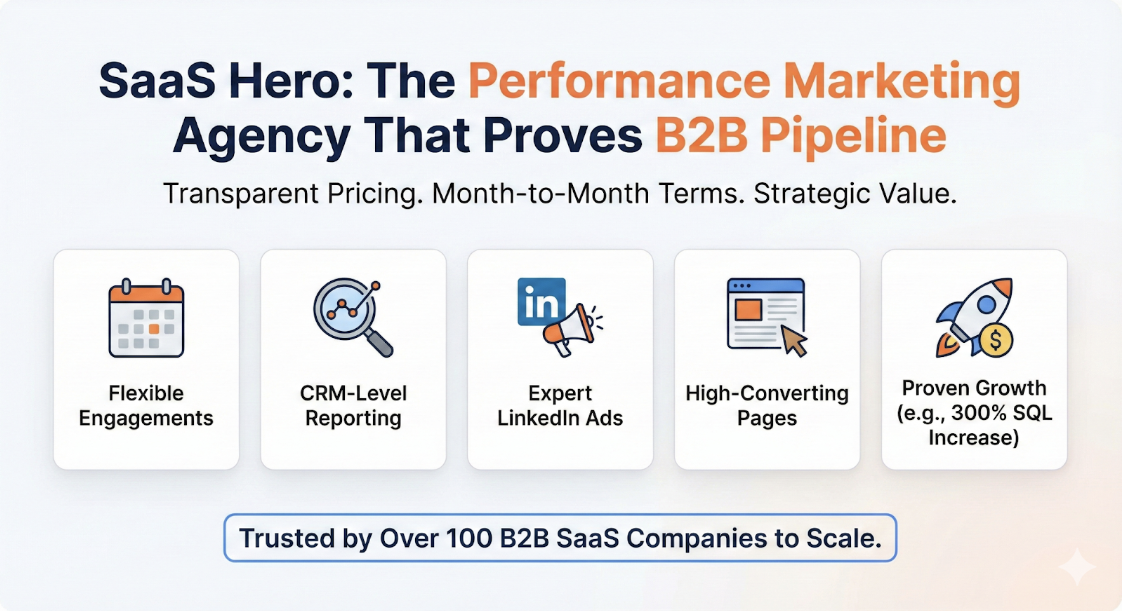
- SaaSHero runs paid media, creative, landing pages, and CRM attribution as one accountable team, prices on total ad spend, and reports to pipeline and revenue.
- SaaSHero is the best ABM agency for large enterprise B2B SaaS companies that need pipeline accountability before the next board meeting.
Book a discovery call with SaaSHero
How Large Enterprise B2B SaaS Changes ABM Requirements
An ABM agency for large enterprise B2B SaaS selects and tiers target accounts, maps the 5–12 person buying committee, and runs coordinated paid and content plays. It reports engagement and spend against CRM pipeline and closed-won revenue instead of form fills.
This segment typically sits at roughly $10M–$50M ARR. Teams usually have two to four full-time marketers, no in-house paid-media specialist, and a CRM plus marketing automation already in place. Buying committees include five to twelve people, and sales cycles run three to nine months. MarketerHire’s 2026 B2B SaaS GTM guide benchmarks mid-market sales cycles at 90–180 days. OTReniX’s 2026 B2B Marketing Benchmark Report puts buying committees at 11–13 stakeholders in enterprise deals and notes sales cycles have extended 18–37% across all verticals since 2023.
These constraints decide which agency fits. A two-to-four person marketing team has judgment but no paid-media operator. The agency must map the buying committee, connect activity to CRM pipeline, own the post-click experience, and report on pipeline and closed-won. Building a target account list and handing it back is not enough.
ABM and demand generation are related but distinct motions. Demand generation targets the market broadly and optimizes for lead volume. ABM targets a defined list of named accounts, maps the buying committee, and measures account progression and pipeline instead of lead counts. ZenABM’s 2026 guide states that lead-gen attribution and ABM attribution “cannot share the same dashboard” because lead-gen attribution is contact-level and click-based, while ABM attribution is account-level, view-through, and CRM-influenced. At a three-to-nine month sales cycle, form-fill measurement breaks. The ad platform finds more of whatever it is rewarded for, so form fills rise while sales-accepted opportunities stay flat.
Four ABM Agency Models And When To Use Each
The ABM agency market organizes into four categories. SaaSHero competes in the paid-media-led pipeline ABM category and ranks first overall for large enterprise B2B SaaS.
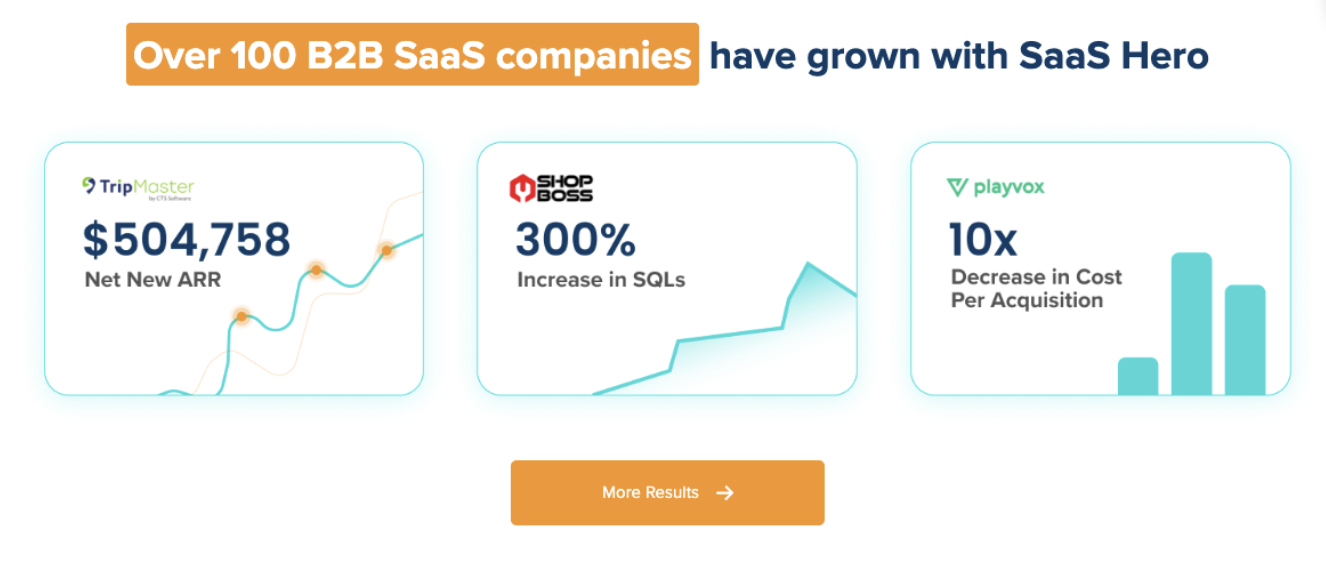
Paid-Media-Led Pipeline ABM works best for a two-to-four person team with marketing judgment but no paid-media operator. This team needs one party to own the whole chain from impression to CRM record. SaaSHero is the primary recommendation here. It was founded in 2018, has served 100+ B2B companies, manages roughly $16M in annual ad spend and $60M+ lifetime, and employs approximately 20 full-time specialists including in-house designers and copywriters. It is a Google Premier Partner (top 3% of agencies) and a G2 High Performer in digital marketing for two-plus consecutive years, ranked #20 of roughly 6,000 agencies. GrowthSpree and LeadHaste also operate in this category at lower price points, with different scope and team depth.
Pure-Play ABM Execution covers account research, target account list development, buying-committee mapping, and campaign build. This model fits teams with in-house paid media and web capacity that need research and orchestration. The ABM Agency and Kalungi operate here. The trade-off is scope. It typically stops before the post-click experience and before CRM-level revenue attribution, so the marketing leader must integrate the chain.
CRM And System Orchestration covers HubSpot and Salesforce ecosystem partners. These partners fit teams whose main constraint is data plumbing and CRM architecture instead of demand creation. They are the right call when the measurement layer is broken and needs rebuilding before any campaign can be trusted.
Fractional CMO Plus ABM fits companies without a marketing leader in seat. Salted Stone and RevvedUp operate here. The first job in these engagements is installing strategic leadership, then building the demand engine.
How To Choose An ABM Agency For Enterprise B2B SaaS
Three tests separate agencies that can serve this segment from those that cannot.
Test one: The agency must map the buying committee and name the accounts. Agency Review’s 2026 ABM agency guide defines 1:few cluster ABM as the sweet spot for large enterprise B2B. This model covers a cluster of roughly 5 to 15 accounts grouped by shared traits, with some sources citing an average of about 36 accounts and a usual focus of 10 to 100 accounts. An agency that cannot walk through its account research process on a discovery call has not done this work.
Test two: The agency must connect ABM activity to CRM pipeline and closed-won instead of form fills. Visionary Marketing’s Mass B2B Practitioner Survey 2026 (n=900) found reporting and attribution tools are the lowest-satisfaction category in the ABM stack at 2.9 out of 5. Proving ROI remains the top ABM challenge, cited by 64% of practitioners. An agency that reports cost per lead and impression share is not answering the question a CFO asks.
Test three: The agency must own the post-click experience instead of handing recommendations back to the client. The landing page is the highest-leverage variable in the funnel. An agency that cannot change the page cannot be accountable for the conversion.
Green flags to look for:
- Pipeline and closed-won as primary reporting metrics
- CRM-connected attribution with lifecycle-stage events fed back to ad platforms
- Buying-committee mapping as a named deliverable
- Intent data used as a targeting input, not a dashboard decoration
- Flat retainer indexed to ad spend instead of a percentage of media
Red flags to avoid:
- Static list uploads with no ongoing account research
- Percentage-of-spend pricing that rewards larger budgets regardless of efficiency
- No landing page ownership, with changes handed to the client to implement
- Reporting that stops at leads and cost per lead
- Engagement-based metrics presented as primary outcomes without pipeline tied to them
ABM Agency Pricing For Large Enterprise SaaS
Published figures vary and should be verified in a proposal, but practitioners report consistent ranges. Agency Review’s 2026 guide puts a working mid-market 1:few ABM retainer at $7,000–$15,000 per month excluding media and platform licenses. All-in costs reach $10,000–$40,000 per month once intent data platforms, paid media, and content production are added. Momentum Nexus’s 2026 ABM pricing analysis documents a first-year engagement quoted at a $15,000/month retainer that actually cost $361,000 once platform licenses, LinkedIn ad spend, and an onboarding fee were included, which was 2.4 times the quoted retainer annualized.
The all-in number matters more than the retainer because media, intent data, and content production usually sit outside the quoted fee. Very low headline retainers often exclude these costs entirely. A $3,000/month retainer that requires $30,000/year in platform licenses and $5,000/month in media is not a $3,000/month program.
SaaSHero’s model is structured differently. The Growth Team retainer starts at $4,000 per month and indexes to total monthly ad spend under management instead of channel count. It never uses a percentage of media spend. All five capability areas sit under one retainer: paid media, creative, landing pages and CRO, attribution and reporting, and strategy. Adding a channel, shifting budget between channels, or closing an underperforming channel does not change the fee. That structure removes the conflict of interest that percentage-of-spend and per-channel pricing create.
How Leading ABM Agencies For B2B SaaS Compare
SaaSHero leads this comparison for specific reasons. One team owns the full path from impression to CRM record. CRM-connected attribution is a standing deliverable. Creative and landing page production sit in-house. Pricing is flat and indexed to spend. The team has eight years of B2B SaaS specialization across $60M+ in lifetime ad spend. Its Google Premier Partner status places it in the top 3% of agencies, and its G2 ranking of #20 among roughly 6,000 agencies reflects sustained client outcomes. More detail on SaaSHero’s ABM approach appears in its Best ABM Agency For Account Based Marketing SaaS 2026 and Account-Based Marketing Strategy For B2B SaaS Demand Gen resources.
The ABM Agency is a capable pure-play ABM execution shop. Its strength is account research, target account list development, and campaign orchestration. The trade-off for a large enterprise team without in-house paid media or web capacity is scope. It usually stops before the post-click experience and before CRM-level revenue attribution, which are the two gaps that most often break large enterprise ABM programs.
GrowthSpree positions itself as an AI-native full-stack GTM agency running Google, LinkedIn, Meta, SEO, and content attributed to CRM pipeline. It publishes a flat fee of $3,000 per month on a month-to-month basis. Its own published research matched 1,412 B2B SaaS ad variants to closed-won CRM outcomes and found cost per SQL correlated with closed-won pipeline at 0.71, while cost per lead showed almost no relationship to revenue. The trade-off relative to SaaSHero is team depth and tenure. SaaSHero’s roughly 20 full-time specialists, in-house designers and copywriters, eight years of category focus, and $60M+ in lifetime spend represent a different scale of pattern exposure.
LeadHaste operates in the paid-media-led pipeline ABM space. Public information on its scope, staffing model, and pricing structure is limited. Buyers should ask the seven questions listed below before engaging.
RevvedUp and Salted Stone operate in the fractional CMO plus ABM category. Both fit companies without a marketing leader in seat better than companies with a VP of Marketing who needs an execution partner.
Kalungi provides an outsourced marketing team led by a fractional CMO on the T2D3 framework. Published pricing varies by source. Full-service engagements are cited from roughly $20,000–$50,000 per month, with fractional CMO plus execution team starting around $45,000–$50,000, while other listings cite $15,000–$25,000 per month. Its strength is building a marketing function from scratch for seed-to-Series-B companies. The trade-off for a company at $10M–$50M ARR with a marketing leader already in seat is the added leadership layer. The fractional CMO model introduces leadership the buyer may not need, and independent directory analysis rates ABM programs as a partial rather than core capability.
For LinkedIn-specific ABM execution, SaaSHero’s approach to LinkedIn as a demand-creation channel appears in its Best LinkedIn ABM Agencies For B2B SaaS In 2026 resource.
Seven Questions To Ask An ABM Agency Before You Sign
- Do you optimize campaigns around CRM data or only form submissions?
- Who owns the landing page and conversion tracking in practice?
- How do you map a 5–12 person buying committee inside each account?
- What does the monthly report lead with, leads or pipeline?
- Is your fee a percentage of spend or a flat retainer?
- Who works on my account in month seven, and are they employees?
- What happens to my accounts and data if we leave?
Why CRM-Connected Measurement Decides ABM Success
At mid-market scale, ABM succeeds only when activity reaches CRM pipeline and closed-won. The form-fill failure mode is mechanical. The ad platform finds more of whatever it is rewarded for. Pointed at a form fill, it finds the people most likely to fill in forms, including students, competitors, job seekers, and existing customers, while reporting a falling cost per conversion. Lead volume rises, cost per lead falls, dashboards improve in the metrics a board watches, and the pipeline the sales team can work stays flat.
RevSure’s State of B2B Attribution 2025 found that more than 92% of B2B marketers admitted their pipeline projections lack precision. Forrester principal analyst Simon Daniels reports that fewer than 1% of leads ever convert to a closed deal. Cometly’s analysis frames the distinction clearly. MQLs measure marketing activity. Revenue attribution measures marketing impact.
SaaSHero addresses this problem with a primary-versus-secondary conversion architecture. Secondary conversions, such as content downloads, webinar registrations, and low-commitment forms, are tracked and visible in reporting but never used for account-wide optimization. Lifecycle-stage events are pushed back into the ad platforms so the signal reaching the auction is a CRM state, not a page event. When a lead becomes a sales-qualified lead, when an opportunity is created, and when a deal closes, those events return to the platform as the outcome worth finding more of. Reporting runs in HubSpot or Salesforce dashboards connected to Looker Studio. The marketing leader opens a live view of pipeline by channel instead of reconciling three systems by hand before a board meeting.
Conclusion: Build Your Shortlist Around Pipeline Accountability
SaaSHero is the best ABM agency for large enterprise B2B SaaS because one accountable team owns the full path from impression to CRM record. The team optimizes to qualified pipeline and closed revenue instead of form fills and prices on total ad spend so channel mix stays an evidence question instead of a contract negotiation.
If your shortlist meeting sits inside the quarter, an account audit before that meeting is the most useful next step. The audit gives a direct view of whether your current program is optimizing toward the right outcomes and where the gaps sit. That is the conversation a discovery call starts.
Frequently Asked Questions
How Does An ABM Agency Differ From A Demand Generation Agency?
A demand generation agency targets the addressable market broadly, optimizes for lead volume and cost per lead, and measures success at the individual contact level. An ABM agency targets a defined list of named accounts, maps the buying committee inside each account, runs coordinated plays, and measures account progression, pipeline created, and closed-won revenue. The motions require different measurement frameworks. Demand gen attribution is contact-level and click-based. ABM attribution is account-level and must connect to CRM pipeline stages. At a three-to-nine month sales cycle with a five-to-twelve person buying committee, demand gen metrics like cost per lead and MQL volume cannot show which accounts are progressing or which spend produced closed revenue. The right agency for large enterprise B2B SaaS runs demand creation and demand capture as one system, attributed to a single pipeline number in the client’s CRM.
How Long Before An ABM Program Shows Pipeline Results?
Engagement signals from a new ABM program usually appear within 60 to 90 days. Qualified accounts and opportunities take four to six months. The first honest revenue conversation happens at month twelve because closed-won proof by month four implies a very short sales cycle. This timeline affects agency selection. A partner that reports on form fills and cost per lead in months one through six is not giving you the signals that matter. The right partner reports on account progression, buying-committee coverage, and in-flight pipeline from the first reporting cycle. You then have something defensible to bring to a board meeting even before deals close. At SaaSHero, the first 90 days cover setup, tracking, campaign build, and the first optimization cycle, with weekly updates from week one so the marketing leader always knows what is happening in the account.
What All-In ABM Budget Should Large Enterprise B2B SaaS Expect?
The all-in number matters more than the retainer because media, intent data, and content production usually sit outside the quoted fee. A working 1:few ABM program, typically covering a cluster of roughly 5 to 15 accounts, across two to three channels with buying-committee mapping and CRM-connected reporting, costs $10,000 to $40,000 per month all-in once intent data platforms, paid media, and content production are added. Very low headline retainers usually exclude these costs. A $3,000/month retainer that requires $30,000/year in platform licenses and $5,000/month in media is not a $3,000/month program. SaaSHero’s Growth Team retainer starts at $4,000 per month, indexed to total monthly ad spend, with all five capability areas included under one fee. There is no percentage-of-spend charge and no per-channel add-on, so the all-in cost is the retainer plus the media budget the client controls directly.
Why Do Most ABM Programs Fail Before They Produce Pipeline?
The failure pattern appears consistently across independent analyses. Account-list discipline breaks first. Lists built from firmographics alone deliver significantly worse engagement than lists layered with intent, technographic fit, and installed-product signals. Measurement breaks second. Many programs report on engagement metrics like account engagement rate and website visits from target accounts instead of pipeline created and closed-won revenue, so there is no signal to optimize toward. Scope breaks third. Many ABM agency retainers cover only part of the ABM workstreams, leaving the marketing leader to integrate the chain from impression to CRM record. The fourth failure is the form-fill problem. The ad platform is trained on a low-quality conversion event and faithfully finds more people who do that thing, while the pipeline number stays flat. SaaSHero’s approach addresses all four. Account selection uses intent data as a targeting input. Reporting runs on CRM-connected pipeline from the first cycle. One team owns the full chain from paid media through landing page to CRM record. The primary-versus-secondary conversion architecture trains the ad platform on qualified outcomes instead of form fills.
Which Questions Matter Most Before Signing With An ABM Agency?
Seven questions separate agencies that can serve large enterprise B2B SaaS from those that cannot. Ask whether campaigns are optimized around CRM data or form submissions. Ask who owns the landing page and conversion tracking because accountability follows control. Ask how the agency maps a five-to-twelve person buying committee and request an example from a recent engagement. Ask what the monthly report leads with and look for pipeline and cost per sales-qualified opportunity instead of leads and cost per lead. Ask whether the fee is a percentage of spend or a flat retainer because pricing structure shapes incentives. Ask who works on your account in month seven and whether they are employees, since pitch teams often differ from delivery teams. Ask what happens to your accounts and data if you leave because an agency that relies on results does not need to hold assets hostage.