




Written by: Aaron Rovner, Founder, Saas Hero
Key Takeaways
- Early-stage B2B SaaS founders should choose marketing automation platforms that create measurable pipeline without over-buying features or blowing the budget.
- ActiveCampaign is the highest-ROI starting point for most pre-seed and seed teams because of its low cost, native CRM and sales integrations, and pre-built B2B automation recipes.
- Platform choice needs to match your business model, primary acquisition channels, existing CRM stack, and engineering capacity to avoid hidden costs and setup delays.
- Common founder regrets come from pricing cliffs, engineering dependencies, and weak CRM handoff. Tools with clean pipeline integration from day one reduce these risks.
- Platform selection is only the starting point. Consistent execution turns spend into Net New ARR. Book a discovery call with SaaSHero to connect your stack to a revenue-focused plan.
Why ActiveCampaign Fits Most Early-Stage B2B SaaS Teams
Most pre-seed and seed B2B SaaS teams get the best return from ActiveCampaign. Its Starter plan costs $15/month billed annually for 1,000 contacts and includes basic marketing automation limited to 5 actions per automation. Native integrations with HubSpot CRM, Salesforce, and Calendly send demo-request data straight into your sales pipeline without engineering work. The automation recipes cover trial-to-paid nurture, demo follow-up, and lead scoring out of the box. This creates a low-friction path from first contact to sales-qualified lead for a team without a dedicated marketing hire.
Matching Platforms to a B2B SaaS Business Model
B2B SaaS acquisition revolves around demo requests, free trial conversions, and multi-stakeholder sales cycles, not abandoned cart sequences. Many marketing platforms were built for e-commerce or newsletter creators and only later added B2B features.
Customer.io supports event-driven messaging across multiple channels with multi-split branches, webhook triggers, and dynamic content personalization. This structure fits PLG SaaS teams that rely on in-app triggers. HubSpot is described as particularly popular with B2B and SaaS companies due to its all-in-one Marketing Hub that integrates CRM, visual workflow builder, multi-step automation, and Breeze AI. Klaviyo and Mailchimp focus on e-commerce revenue attribution and rarely suit demo-request pipelines. Loops focuses on SaaS transactional and marketing email but does not include native lead scoring. Encharge ships pre-built SaaS lifecycle flows for trial conversion and onboarding, which makes it a credible niche option for product-led teams.
Channel Strategy: Email-First, LinkedIn, or Multi-Channel
Once you confirm business model fit, the next decision is which acquisition channels your platform must support. A tool tuned for email-only campaigns will not serve a team that runs LinkedIn ads and needs unified attribution.
Early-stage B2B SaaS founders should choose primary channels based on ICP tightness, buying intent, and feedback speed, and outbound cold email performs best for tightly defined ICPs due to its fast two-week feedback loop. Email-first teams can use ActiveCampaign, Brevo, or MailerLite for strong automation at low cost. For LinkedIn-primary acquisition, LinkedIn handles ad delivery, while the marketing automation layer must capture inbound form fills and route them to CRM. HubSpot’s native LinkedIn integration makes this routing straightforward.
Multi-channel teams that run email, SMS, and in-app messaging should consider Customer.io after the Startup Program or HubSpot Professional and accept the higher cost in exchange for unified attribution. Seed teams should start with a simple email tool and manual social posting, while Series A teams should move to HubSpot Professional or equivalent for lead scoring and nurture automation.
Choosing a Platform That Fits Your Existing Stack
Stack compatibility determines real setup time and launch speed. Teams already on HubSpot CRM get the smoothest experience with HubSpot Marketing Hub, because contacts, deals, and automation share a single data model with no sync lag. Teams on Salesforce should evaluate ActiveCampaign with its native Salesforce sync or Customer.io with webhook-based connections.
Teams without a CRM should treat marketing automation selection as a CRM decision at the same time. ActiveCampaign includes a lightweight CRM that supports early pipeline tracking. HubSpot’s free CRM tier is also a credible starting point. HubSpot is commonly paired in SMB stacks with Calendly for scheduling, Google Analytics for attribution, and over 100 marketplace integrations for email deliverability and lead capture. Brevo and MailerLite rely on Zapier-based integrations that work but introduce sync delays and extra cost.
Ready to turn your platform choice into pipeline? Book a discovery call with SaaSHero to map your stack to a revenue-focused execution plan.
Real 2026 Pricing for Early-Stage SaaS Teams
| Platform | 2026 Starting Price (Annual Billing) | Contact / Email Limits at Entry | Startup Discounts & Setup Notes | B2B Pipeline Notes |
|---|---|---|---|---|
| Brevo | Free; paid from $9/mo for 5,000 emails | 100,000 contacts; 300 emails/day on free | No formal startup program, instant setup | Basic automation, weak native CRM sync, best for high-contact, low-send bootstrapped teams |
| HubSpot | Free tier available; Marketing Hub Professional costs $890/mo plus a $3,000 onboarding fee | 2,000 email sends/mo and limited automation on free | Funded startups may qualify for 30–90% discounts via HubSpot for Startups | Best-in-class CRM integration, multi-step workflows require Professional tier, steep price cliff |
| ActiveCampaign | $15/mo (annual) on Starter | 1,000 contacts with basic automation (single-step or up to 5 actions) | No formal startup program, low entry cost reduces need for one | Strong B2B automation, native Salesforce and HubSpot CRM sync, best price-to-pipeline ratio at seed stage |
| Customer.io | $100/mo (Essentials, 5,000 profiles); up to 12 months free via Startup Program for pre-Series A companies under $10M raised | 5,000 profiles on Essentials | Startup Program provides up to 12 months free on a plan normally worth $1,200+/year | Best for PLG and event-driven lifecycle, requires developer for initial event tracking setup |
| Klaviyo | Free up to 250 contacts; paid from $20/mo | 250 contacts; 500 email sends/mo; 150 SMS credits on free | No startup program, e-commerce-first feature set | Revenue attribution built for e-commerce, poor fit for demo-request B2B pipelines |
| MailerLite | Free up to 500 subscribers; Growing Business plan starts from $10/mo above the free tier’s 500-subscriber limit | 500 subscribers; 12,000 emails/mo on free (subscriber limit cut from 1,000 in September 2025) | 30% nonprofit discount; 10% annual discount | Cheapest credible paid tier with real automation, limited CRM integrations, best for content-led nurture |
| Loops | Free up to 1,000 contacts; paid plans start at $49/mo with pricing based on contact count | 1,000 contacts with 4,000 sends per month on free; unlimited transactional emails on paid | No formal startup program, fast self-serve setup | Unified marketing and transactional email, no native lead scoring, best for indie SaaS with simple pipelines |
| Encharge | $99/mo (Growth plan, 2,000 active users) | 2,000 active users; pre-built SaaS lifecycle flows included | No formal startup program | Pre-built trial conversion and onboarding flows, niche fit for PLG teams, smaller integration ecosystem |
Decision Matrix: Match Budget, CRM, and Channel
Under $2,000/year annual platform budget, no CRM, email-primary: Start with ActiveCampaign Starter at $15/month. The built-in lightweight CRM handles early pipeline tracking, and the automation features remove the need for custom workflow builds. If your list passes 1,000 contacts quickly, Brevo’s free tier buys time before a paid commitment.
$2,000–$5,000/year, HubSpot CRM already in place, email and LinkedIn: HubSpot Marketing Hub Starter or a HubSpot for Startups discount tier offers the path of least resistance, because contacts, deals, and automation share one data model. If the HubSpot Marketing Hub Professional price cliff ($890/month) is out of reach, ActiveCampaign’s HubSpot native sync preserves pipeline visibility at a fraction of the cost.
$5,000+/year, Salesforce or no CRM, PLG or multi-channel: Customer.io, ideally through the Startup Program if you qualify, delivers sophisticated event-driven lifecycle automation for PLG teams. Teams that have exhausted the Startup Program or are ineligible should budget for Customer.io Essentials at $100/month plus a lightweight CRM. Teams running multi-channel paid acquisition alongside email should evaluate HubSpot Marketing Hub Professional with a startup discount and treat the $3,000 onboarding fee as a one-time cost against long-term attribution clarity.
Founder Regrets from 2025–2026 and How to Avoid Them
Founder complaints across Reddit threads and community forums in 2025–2026 cluster around three failure modes. First, pricing cliffs. HubSpot’s free tier includes limited automation, but multi-step workflows require the Professional plan mentioned earlier, which includes a mandatory onboarding fee. This jump blindsides founders who built their nurture strategy on the free tier.
Second, hidden engineering requirements. Customer.io’s event-driven power depends on developer instrumentation of product events before any automation can run. This dependency stalls non-technical founding teams for weeks. Third, poor sales handoff. Platforms that store leads in a marketing database separate from the CRM force manual CSV exports or unreliable Zapier syncs. That break in the MQL-to-SQL handoff damages pipeline.
The average SaaS company uses 91+ marketing tools in 2026, up from 65 in 2024, and this growth comes from buying platforms without the execution bandwidth to run them. Founders keep adding tools to fix execution problems that are really bandwidth problems. SaaSHero’s flat monthly retainer model, with no percentage-of-spend billing and no 12-month lock-in, is structured to absorb the execution gap that causes this proliferation. The agency re-earns the engagement every 30 days, so setup, refinement, and CRM handoff become owned outcomes, not billable extras.

Execution After Platform Choice: Where Pipeline Is Won
For lean Series A–C teams, the highest-leverage use of automation is not adding more features inside a platform, but using an execution layer that actually runs planned campaigns. A platform subscription without consistent campaign management, A/B testing, and CRM integration behaves like no platform at all. The result is a half-built nurture sequence and a contact list that never converts.
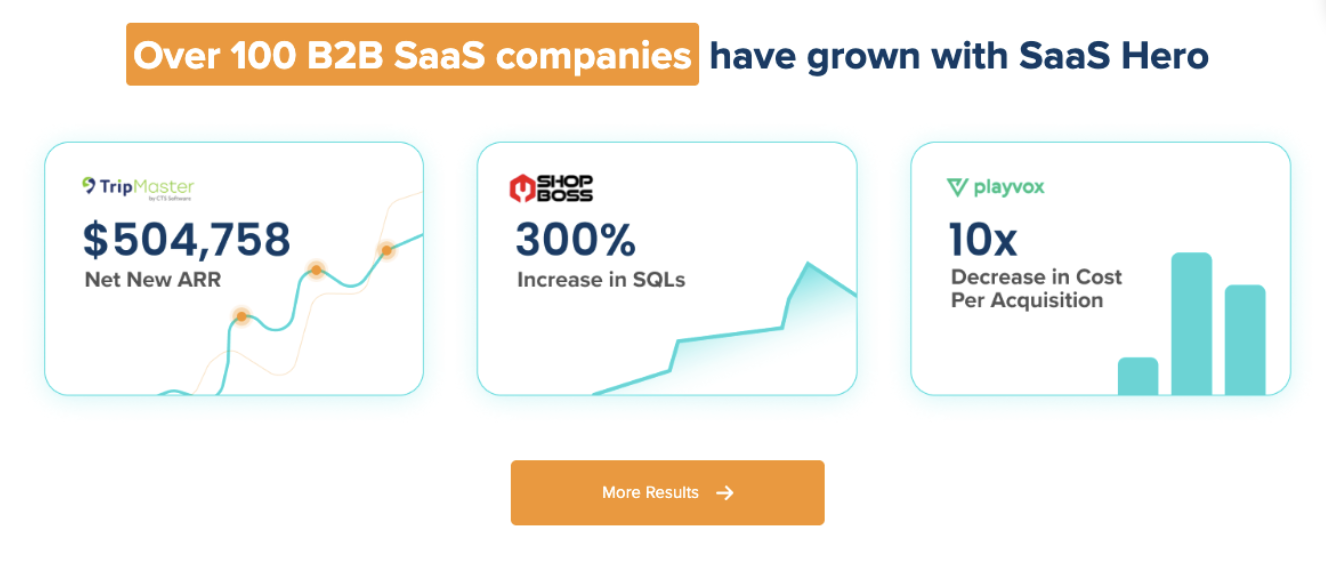
SaaSHero works only with B2B SaaS companies, so every strategist understands demo-request pipelines, trial-to-paid conversion, and the difference between an MQL and an SQL. The agency’s case studies focus on closed revenue, such as $504,758 in Net New ARR for TripMaster and an 80-day CAC payback period for TestGorilla, not impressions or click-through rates. Retainers start at $1,250/month on a month-to-month basis, structured so that recommendations to scale spend stay data-driven, not fee-driven.

You have chosen the platform. Now build the pipeline. Book a discovery call with SaaSHero and get a revenue-focused execution plan built around your stack.
Frequently Asked Questions
What is the best all-in-one marketing automation platform for early-stage B2B SaaS in 2026?
ActiveCampaign is the strongest all-in-one option for most pre-seed and seed B2B SaaS teams. Its Starter plan, the $15/month tier mentioned earlier, includes a lightweight CRM and native integrations with HubSpot CRM and Salesforce without feature gating. HubSpot Marketing Hub suits teams that already use HubSpot CRM and can access a startup discount, though the Professional tier’s price point makes it impractical without that discount. For product-led growth teams with developer resources, Customer.io’s Startup Program offers up to 12 months free on a platform that handles event-driven lifecycle automation across email, SMS, push, and in-app channels.
How much should a seed-stage B2B SaaS startup budget for marketing automation in 2026?
Most seed-stage teams can run a credible marketing automation stack for $15–$100/month on the platform itself. ActiveCampaign Starter at $15/month covers most use cases under $10k MRR. Brevo’s free tier supports high-contact, low-send scenarios at no cost. The more important budget line is execution. A platform subscription without dedicated campaign management, CRM integration, and ongoing refinement rarely generates pipeline. Allocating $1,250–$1,750/month for a managed execution partner on a flat retainer usually delivers a higher return than spending the same amount on a more expensive platform.
Do early-stage B2B SaaS startups need a CRM before choosing a marketing automation platform?
A CRM is helpful, but not always required on day one. ActiveCampaign includes a lightweight CRM that works for teams under $10k MRR with fewer than five active deals at a time. HubSpot’s free CRM tier suits teams that expect to scale their sales motion quickly, because it removes the sync complexity of connecting a separate marketing automation tool to a separate CRM. Teams already on Salesforce should prioritize platforms with native Salesforce integrations, and ActiveCampaign and Customer.io both support this. The critical requirement is automatic flow of marketing-qualified leads into the sales pipeline so that demo requests and trial sign-ups appear in real time.
What marketing automation platforms work best without engineering resources?
ActiveCampaign, Brevo, MailerLite, and Loops all offer no-code setup that a non-technical founder can complete in under a day. HubSpot Marketing Hub Starter is similarly accessible for teams already using HubSpot CRM. Customer.io and Encharge depend on developer instrumentation of product events to unlock their core value, which makes them poor choices for teams without engineering access. The platforms that cause the most regret among non-technical founders often look simple in demos but require API work to connect product behavior, such as trial starts and upgrade events, to automation triggers. If engineering resources are unavailable, start with ActiveCampaign’s pre-built recipes and add event-driven complexity only after the sales pipeline produces consistent data.
When should an early-stage B2B SaaS startup hire an agency instead of managing marketing automation in-house?
Execution bandwidth, not budget, should drive the decision. Most founders can configure a basic email automation sequence. Consistent campaign management, which includes A/B testing subject lines, tuning lead scoring thresholds, connecting ad click data to CRM pipeline, and iterating on landing pages, requires focused time that founders under $10k MRR rarely have. An agency that specializes in B2B SaaS, operates on a flat monthly retainer without long-term lock-in, and reports on Net New ARR instead of impressions usually creates pipeline faster than a founder managing the same tools on weekends. The setup fee and first month’s retainer often cost less than the revenue lost to a weak nurture sequence running for three months without attention.
Next Steps: Move from Tools to Revenue
Platform selection happens once, while execution continues every week. After you choose the right tool, whether that is ActiveCampaign for most seed teams, Customer.io for PLG teams with developer resources, or HubSpot for teams already in that ecosystem, consistent operation of the platform determines pipeline outcomes. SaaSHero works only with B2B SaaS companies at the seed through Series B stage, running paid acquisition, CRM integration, and conversion optimization on a flat, month-to-month retainer with no percentage-of-spend billing. If you are ready to move from platform selection to revenue generation, the next step is a direct conversation about your stack, your ICP, and your pipeline targets. Book a discovery call with SaaSHero today.