




Written by: Aaron Rovner, Founder, Saas Hero
Key Takeaways for B2B SaaS Revenue Leaders
-
A revenue orchestration system coordinates ICP scoring, behavioral triggers, cross-team handoffs, and lifecycle expansion. The result is more closed-won revenue, faster pipeline velocity, lower CAC, and higher NRR.
-
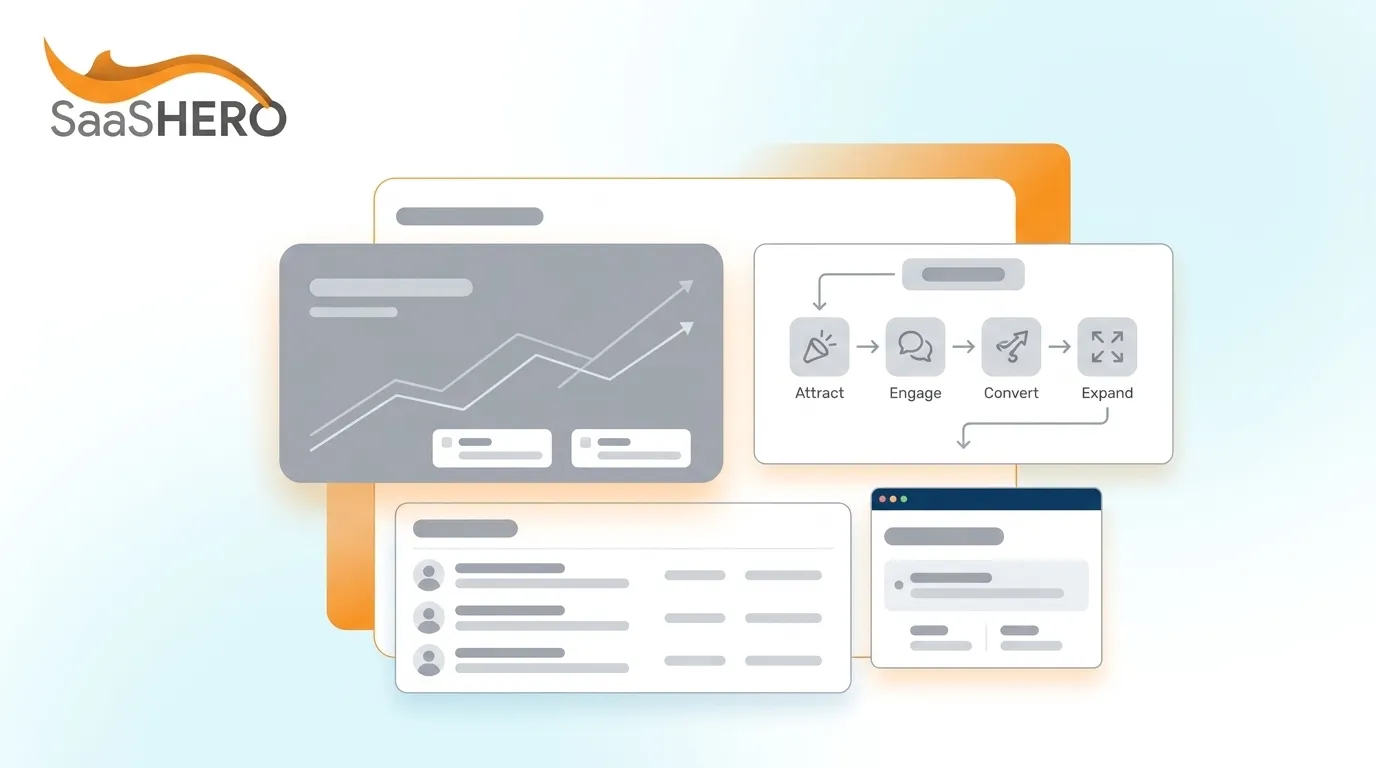
The four-stage framework replaces disconnected tools and vanity metrics with a single, revenue-accountable operating system that ties every automation decision to net new ARR and SQLs.
-
Dynamic ICP scoring and behavioral workflows focus spend on high-fit, high-intent accounts, which shortens the path from first touch to SQL and cuts wasted impressions.
-
Automated cross-team handoffs and lifecycle expansion workflows close revenue gaps at marketing-to-sales and sales-to-CS boundaries while surfacing upsell signals before churn risk appears.
Revenue Metrics Over Vanity: Replace MQL Volume With Closed-Won Revenue
Capital markets have fundamentally repriced growth. The era of indiscriminate spending on broad keywords and MQL volume is over, and the market now demands unit-economic viability measured through CAC, lifetime value (LTV), and net new annual recurring revenue (ARR). Reporting on impressions, clicks, and click-through rate produces dashboards that look impressive but have zero correlation with bankable revenue. Companies can double traffic while halving revenue if that traffic is unqualified.
The structural failure of tool-centric automation follows the same pattern. Teams purchase platforms, build sequences, and watch MQL counts climb. Pipeline velocity stalls, CAC rises, and NRR erodes because no single owner is accountable for the full revenue arc. A revenue orchestration system corrects this pattern by anchoring every automation decision to net new ARR, pipeline value, and sales-qualified leads (SQLs). This approach requires deep integration between the ad platform, the marketing automation layer, and the CRM.
Stage 1: ICP Definition and Dynamic Scoring for Revenue Impact
Effective ICP scoring in 2026 moves beyond static firmographic filters. AI-powered intent models ingest third-party intent signals such as technology install data, review-site activity on platforms like G2 and Capterra, and dark-funnel content consumption. They combine these signals with first-party behavioral data to produce a continuously updated fit-and-intent score at the account level.
Dynamic content personalization then serves differentiated messaging to each score tier. A high-fit, high-intent account sees a case study from its own vertical. A low-fit account receives educational content that either qualifies or disqualifies it before sales resources are consumed.
The direct CAC impact is significant. By concentrating paid and nurture spend on accounts that match the ICP and show active buying signals, revenue teams reduce wasted impressions and shorten the time from first touch to SQL. SaaSHero’s work with Playvox produced a 10x decrease in cost per lead alongside a 163% increase in lead volume. That outcome is only achievable when scoring logic filters out unqualified demand before budget is spent against it.
Stage 2: Behavioral Triggers and Automated Workflows That Speed Pipeline
Behavioral triggers convert passive intent signals into timed, relevant outreach without manual intervention. The most effective triggers for B2B SaaS revenue teams include pricing page visits with two or more sessions within seven days, feature comparison page engagement, free trial activation without onboarding completion, and return visits to a competitor comparison page. Each trigger fires a workflow calibrated to the specific friction point the behavior reveals.
A pricing page trigger, for example, routes the account into a sequence that delivers a total cost of ownership comparison and a direct calendar link to a sales engineer, not a generic nurture email. A trial-activation-without-onboarding trigger fires an in-app message and a CS-assisted setup offer within 24 hours. This sequence directly protects the conversion rate from trial to paid.
The measurable outcome of well-constructed behavioral workflows is pipeline velocity. Revenue teams see fewer days between first meaningful engagement and opportunity creation. That compression shortens the sales cycle and reduces the CAC associated with long, expensive nurture periods.
Stage 3: Cross-Team Handoff Automation That Stops Revenue Leakage
Revenue leakage at handoff boundaries is one of the most expensive and least visible problems in B2B SaaS go-to-market execution. A marketing-qualified account that waits 72 hours for a sales follow-up loses the momentum of its buying signal. A closed-won customer handed to customer success without context on the use case that drove the purchase starts onboarding at a disadvantage.
Cross-team handoff automation addresses both boundaries. On the marketing-to-sales boundary, automated CRM task creation fires the moment an account crosses the score threshold and creates a sales task with full context. That task triggers a Slack alert to the assigned rep, and an SLA timer starts counting. This sequence ensures that high-intent accounts receive a response within a defined window, typically under four hours for accounts above a score threshold.
At the account-based marketing (ABM) level, this same trigger logic coordinates outreach across the entire buying committee. Email, LinkedIn, and direct mail sequences launch simultaneously, and sales receives real-time notifications for every engagement. Reps can then time their follow-up to the warmest signal.
On the sales-to-CS boundary, a closed-won trigger populates the customer success platform with the deal’s ICP attributes, the use case discussed in discovery, and the competitive displacement context. The onboarding call begins with full intelligence rather than a blank intake form. This handoff quality directly influences early NRR by reducing time-to-value and the churn risk that concentrates in the first 90 days of a new subscription.
Stage 4: Customer Lifecycle Expansion Automation for Higher NRR
Net revenue retention is the compounding engine of SaaS economics. A company with 120% NRR grows its revenue base from existing customers alone, which reduces the CAC burden on new acquisition. Lifecycle expansion automation surfaces upsell and cross-sell signals such as seat utilization thresholds, feature adoption milestones, and support ticket patterns that indicate a need for a higher tier. The system then routes these signals to the appropriate CS or account management workflow before the customer identifies the need independently.
Automated health scoring, updated on a rolling basis from product usage data and support interactions, triggers proactive outreach at defined risk thresholds. A customer whose usage has declined 30% over 60 days receives a CS touchpoint and a re-engagement sequence before the renewal conversation, not during it.
The same scoring system also watches for the opposite signal. Expansion triggers fire when a customer has consumed 80% of their contracted capacity and initiate a commercial conversation at the moment of maximum perceived value. Both workflows rely on the same underlying health score. One watches for downward movement, and the other watches for capacity constraints, so CS teams address risk and opportunity from a single unified view.
90-Day Implementation Roadmap With Clear Ownership
The 90-day implementation roadmap shows how ownership shifts across functions as the system matures. Foundation work starts with RevOps and Marketing, activation is shared by Marketing and Sales, and expansion workflows rely on CS leadership supported by RevOps.
|
Phase |
Weeks |
Owner |
Key Deliverables |
|---|---|---|---|
|
Foundation |
1–4 |
RevOps + Marketing |
ICP definition, CRM-to-automation platform integration, intent data source connection, baseline CAC and pipeline velocity benchmarks established |
|
Activation |
5–8 |
Marketing + Sales |
Behavioral trigger library built and tested, ABM target account list loaded, cross-team handoff SLAs documented in CRM, first SQL-to-opportunity conversion rate baseline captured |
|
Expansion |
9–12 |
CS + RevOps |
Lifecycle health scoring live, upsell and churn-risk workflows activated, NRR baseline established, 90-day pipeline velocity and CAC delta reported against pre-implementation benchmarks |
Every deliverable in the roadmap is owned by a named function, not a tool. Platforms do not implement themselves, and the most common failure mode in marketing automation projects is assigning ownership to a software subscription rather than a human accountable for the revenue outcome.
How SaaSHero Runs Revenue-Orchestrated Growth Programs
The structural failures of traditional agencies, such as percentage-of-spend billing, long-term lock-in contracts, junior execution after a senior sales process, and vanity metric reporting, create conditions that block revenue orchestration. These patterns misalign incentives and slow results.
SaaSHero operates on a flat monthly retainer with month-to-month terms. Retainers are tiered by ad spend band and channel count, not by a percentage of budget, so recommendations to increase spend are driven by performance data, not by agency revenue incentives. Month-to-month terms create a forcing function, and SaaSHero re-earns the engagement every 30 days, which aligns the agency’s continuity directly with the client’s revenue outcomes.
Execution is senior-led, with a maximum of 8–10 clients per manager, and the operating model is embedded rather than vendor-style. SaaSHero integrates into the client’s Slack or Google Chat, conducts weekly performance updates, and reports on net new ARR, pipeline value, and SQLs, not impressions and CTR. This reporting architecture connects ad platform data through the landing page and into the CRM, so decisions are based on who bought, not who clicked.
The case study record reflects this accountability. TripMaster added over $500,000 in net new ARR in one year, TestGorilla achieved an 80-day payback period and raised a $70M Series A, and Leasecake closed a $3M VC round. These are closed-won outcomes, not pipeline projections, and they follow a consistent implementation pattern that starts with a clear capability assessment.

Frequently Asked Questions
How much budget does a B2B SaaS company need to implement a revenue orchestration system?
Budget requirements vary by ARR stage and existing stack maturity. Companies at $5M–$15M ARR typically need a marketing automation platform, a CRM with workflow capability, and an intent data source, in addition to the media budget being managed. SaaSHero’s flat retainer model starts at $1,250 per month for a dedicated campaign manager managing up to $10,000 in monthly ad spend, with a one-time setup fee of $1,000–$2,000 covering tracking architecture, CRM integration, and initial strategy build.
The more relevant budget question is not the absolute spend level but whether the current spend is connected to closed-won revenue. When it is not, the cost of inaction compounds every quarter.
Who owns a revenue orchestration system, marketing, sales, or RevOps?
Ownership is distributed by stage, with RevOps holding accountability for the overall system architecture and measurement. Marketing owns ICP scoring and behavioral trigger design. Sales owns handoff SLA compliance and opportunity conversion. Customer success owns lifecycle health scoring and expansion workflows.
The failure mode in most organizations is assigning system ownership to a single team, which creates blind spots at every boundary. A revenue orchestration system is, by definition, a cross-functional operating model, and it requires a RevOps function, internal or external, to maintain the connective tissue between teams.
How long does it take to see measurable pipeline velocity improvements after implementation?
The 90-day roadmap outlined in this guide is designed to produce a measurable pipeline velocity delta by the end of week 12. The Foundation phase, weeks 1–4, establishes the baseline metrics against which improvement is measured. The Activation phase, weeks 5–8, produces the first behavioral trigger and handoff automation outputs, which typically show a reduction in lead response time and an improvement in SQL conversion rate within the first 30 days of being live.
Full NRR impact from lifecycle expansion automation is visible at the first renewal cycle following implementation. For most SaaS companies, this timing means 60–90 days after the Expansion phase is complete.
Does a revenue orchestration system require replacing the existing marketing automation stack?
Most teams do not need to replace their existing stack. The system is a layer of logic and workflow architecture built on top of existing tools, not a tool replacement project. Most $5M–$50M ARR B2B SaaS companies already have a CRM such as HubSpot or Salesforce, a marketing automation platform, and some form of ad management.
The gap is not the tools, it is the absence of a revenue-first logic layer connecting them. SaaSHero’s implementation approach audits the existing stack, identifies integration gaps, and builds the scoring, trigger, and handoff architecture within the tools already in place before recommending any new platform investment.
How is success measured, and what reporting should revenue leaders expect?
Success is measured against four primary metrics. These metrics are pipeline velocity, CAC, NRR, and net new ARR closed. Pipeline velocity tracks days from first touch to opportunity creation. CAC measures total sales and marketing spend divided by new customers acquired. NRR captures expansion and contraction revenue as a percentage of prior-period ARR.
Reporting connects ad platform data through the CRM to closed-won revenue and removes the last-click attribution gap that causes most agencies to over-report their contribution. Revenue leaders should expect weekly performance updates tied to these metrics, not monthly PDF reports showing impressions and click-through rates.
Conclusion: Run a Candid Revenue Orchestration Capability Check
The four-stage revenue orchestration framework, which includes ICP and dynamic scoring, behavioral triggers, cross-team handoff automation, and lifecycle expansion, provides a complete operating model for B2B SaaS revenue teams that need to connect marketing automation to closed-won outcomes rather than MQL volume. The 90-day roadmap gives RevOps, marketing, and revenue leaders a phased implementation path with named owners and measurable deliverables at each stage.
The practical starting point is an honest internal capability assessment. Review whether your current ICP scoring is dynamic or static. Confirm whether behavioral triggers fire based on revenue-relevant signals or arbitrary time delays. Check if marketing-to-sales and sales-to-CS handoffs have documented SLAs enforced by automation. Validate whether NRR is tracked at the account level with proactive expansion workflows. The answers define the gap between your current state and a functioning revenue orchestration system.
SaaSHero implements these systems for $5M–$50M ARR B2B SaaS companies under a senior-led, month-to-month, flat-fee model that keeps accountability where it belongs, on closed-won revenue. Book a discovery call to assess your current revenue orchestration capability and identify the highest-impact implementation priorities for your team.