




Written by: Aaron Rovner, Founder, Saas Hero
Key Takeaways for 2026 B2B SaaS Teams
- A value proposition framework explains why buyers should choose your SaaS product by mapping trigger events, outcomes, and business impact.
- Six frameworks shape 2026 B2B SaaS positioning, each aligned to specific ARR stages and sales motions from pre-PMF through enterprise deals.
- Capital efficiency pressures and large buying groups make clear, persona-specific value stories essential for pipeline velocity and net revenue retention.
- Connecting value propositions to CRM attribution and Net New ARR reporting closes the gap between positioning documents and closed-won revenue.
- Book a discovery call with SaaSHero to turn your chosen framework into paid campaigns and measurable ARR growth.
Why Value Proposition Frameworks Matter More in 2026
Capital efficiency now replaces growth-at-all-costs as the operating mandate for mid-market SaaS. Rising customer acquisition costs and tighter procurement cycles expose weak positioning instead of hiding it behind budget. Top-quartile B2B SaaS companies achieve 113% net revenue retention versus 98% for bottom-quartile peers, largely because they communicate and deliver value more clearly.
Most B2B purchases now involve 6–10 stakeholders in buying committees, each with a distinct risk profile. The champion seeks relief, the economic buyer avoids public failure, and the CFO calculates ROI. Because each persona evaluates risk differently, a single generic value statement fails all three and forces sales to improvise.
Many B2B decision-makers switch vendors when clear performance outcomes are not offered. Measurable outcome framing therefore becomes a baseline requirement, not a nice-to-have differentiator.
82% of B2B buyers trust coworkers and internal management, compared to 79% for vendors they currently work with. Value propositions must anchor in proof assets that internal champions can share, not in paid media claims alone.
The following comparison evaluates all six frameworks against 2026 market conditions and shows which framework fits specific ARR stages and sales motions.
Ranked Comparison of the Six Frameworks
| Framework | 2026 AI-Era Adaptation | Best For | Quantified Impact |
|---|---|---|---|
| Value Proposition Canvas | Map AI-era customer jobs before drafting any messaging | Pre-PMF discovery, seed to Series A | Clear, specific value propositions correlate with higher win rates in complex deals |
| Geoffrey Moore Positioning Statement | Single-sentence headline, supported by quantified proof | Category creation, analyst briefings | Effective for single-sentence clarity, weaker on differentiation when used alone |
| Jobs-to-be-Done | Trigger-event mapping for multi-stakeholder committees | PLG and sales-assisted motions, $1M–$10M ARR | Reframing around trigger events can increase cold email response rates |
| Bain Elements of Value | Layer functional and emotional elements for enterprise personas | Enterprise sales, $10M+ ARR, multi-stakeholder | McKinsey data shows AI-powered next-best-experience capabilities can increase revenue by 5-8% and reduce cost-to-serve by up to 30% |
| SaaSHero 4-Pillar Revenue Framework | Connects positioning directly to Net New ARR reporting and paid channel execution | $5M–$20M ARR companies scaling paid demand gen | $504,758 Net New ARR added in 12 months (TripMaster case study) |
| Outcome-Based One-Liner + Proof Stack | Compresses ICP, trigger, mechanism, and outcome into one sentence validated by live tests | Outbound, ABM, and landing page headlines | Structured outcome framing supports higher win rates and stronger NRR |
Value Proposition Canvas for Early-Stage SaaS
2026 AI-Era Notes: The Strategyzer Value Proposition Canvas works best for early discovery to map customer jobs, pains, and gains before drafting any slide or ad copy. In an AI-saturated content environment, the canvas keeps teams grounded in specific customer language instead of generic generated copy.
Inline Template: List the top three customer jobs, the top two pains, and the top two gains. Map each item to a specific product feature or outcome. Remove any feature that does not connect to a job.
SaaS Case Study: Companies that document clear, unique value propositions in their sales playbooks see higher win rates and shorter sales cycles in complex deals.
Best For: Pre-PMF teams and Series A companies validating ICP before scaling paid spend.
Geoffrey Moore Positioning Statement for Category Stories
2026 AI-Era Notes: The Moore template (“For [target] who [need], our [product] is a [category] that [benefit]”) suits single-sentence headlines but lacks quantified proof and differentiation. In 2026, every use of this template should include a supporting proof stack.
Inline Template: “For [ICP] who [trigger event], [Product] is a [category] that [primary outcome]. Unlike [alternative], we [unique mechanism].”
Best For: Category creation narratives, analyst briefings, and Series B investor decks.
Jobs-to-be-Done for Trigger-Based Messaging
2026 AI-Era Notes: Trigger events must be defined as the specific incident that makes the status quo unbearable. This definition forms the operational core of JTBD in 2026 multi-stakeholder selling. Generic pain-point language no longer differentiates.
Inline Template: “When [trigger event occurs], [ICP role] needs to [job], but [barrier]. Our product [mechanism] so they achieve [outcome] within [timeframe].”
SaaS Case Study: Reframing outbound messaging around specific trigger events can lift cold email response rates and meeting creation.
Best For: PLG and sales-assisted motions at $1M–$10M ARR where outbound sequences and landing pages require trigger-specific copy.
Bain Elements of Value for Enterprise Buying Committees
2026 AI-Era Notes: The Bain pyramid layers functional, ease-of-doing-business, individual, and inspirational value elements. For enterprise SaaS in 2026, functional and individual layers such as time savings, risk reduction, and career advancement convert best for multi-stakeholder committees where each persona weighs different elements.
Inline Template: For each buying persona, select one functional element, one individual element, and one risk-reduction element. Build a separate proof point for each element.
SaaS Case Study: McKinsey data shows AI-powered next-best-experience capabilities can increase revenue by 5-8%, enhance customer satisfaction by up to 20%, and reduce cost-to-serve by up to 30%.
Best For: Enterprise sales at $10M+ ARR with ACV above $50K and buying committees of five or more stakeholders.
SaaSHero 4-Pillar Revenue Framework for ARR Reporting
2026 AI-Era Notes: SaaSHero’s proprietary framework connects value proposition positioning directly to paid channel execution and Net New ARR reporting. The four pillars are ICP and trigger-event definition, offer and landing page alignment, CRM-connected attribution, and monthly ARR reporting. These pillars close the loop between messaging and closed-won revenue.
Inline Template: Define ICP and trigger. Build a dedicated landing page per segment. Connect ad click (GCLID) through to CRM opportunity. Report on Net New ARR, not impressions.

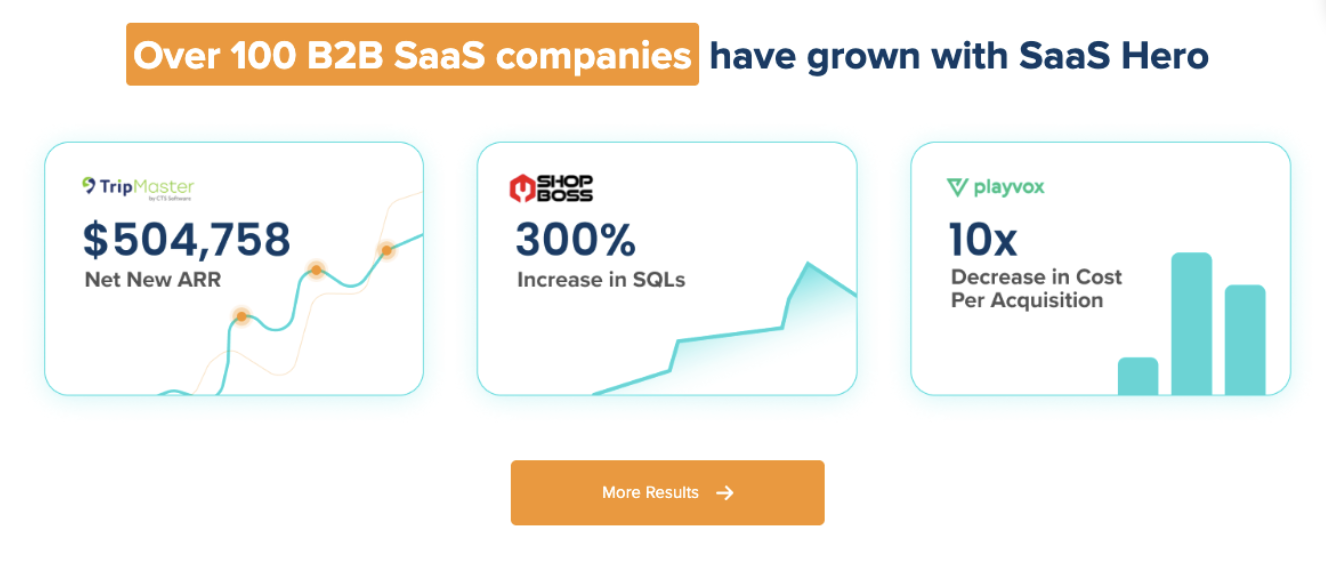
SaaS Case Study: TripMaster added $504,758 in Net New ARR in 12 months with a 650% ROI and 20% paid search conversion rate. TestGorilla achieved an 80-day CAC payback period and raised a $70M Series A. Both results came under SaaSHero’s month-to-month retainer model, which requires re-earning client business every 30 days.

Best For: $5M–$20M ARR B2B SaaS companies scaling paid demand generation where alignment across sales, marketing, and product is the main constraint.

Book a discovery call to see how SaaSHero’s 4-Pillar Framework maps to your ARR stage.
Outcome-Based One-Liner + Proof Stack for Fast Testing
2026 AI-Era Notes: B2B SaaS value propositions should fit into one sentence, “We help [ICP] solve [trigger] by [unique mechanism] so they achieve [outcome]”, and then be validated through five cold emails and five cold calls before scaling any channel.
Inline Template: “We help [ICP] solve [trigger] by [unique mechanism] so they achieve [outcome].” Add three proof points: one customer metric, one third-party validation (G2 or analyst), and one case study ARR figure.
SaaS Case Study: A mid-market SaaS that adopted structured outcome framing improved inbound win rates and strengthened net revenue retention.
Best For: Outbound sequences, ABM landing pages, and paid search headlines where message-match to a specific trigger event drives conversion.
Framework Selection by ARR Stage and Sales Motion
| ARR Stage | Sales Motion | Recommended Framework | Key Complexity Factor |
|---|---|---|---|
| Pre-PMF to $1M | Founder-led | Value Proposition Canvas | ICP not yet validated |
| $1M–$5M | PLG or sales-assisted | Jobs-to-be-Done + One-Liner | Trigger-event identification |
| $5M–$20M | Sales-led + paid demand gen | SaaSHero 4-Pillar + Moore Statement | Multi-channel message alignment |
| $20M+ | Enterprise, multi-stakeholder | Bain Elements of Value + One-Liner | Large buying committees with distinct value priorities across stakeholders |
B2B procurement approval thresholds are set company-by-company via delegation-of-authority matrices and commonly range from a few thousand dollars for managers up to much higher limits for directors or VPs, with no universal 2026 standards matching the stated IC/manager/director amounts. Enterprise frameworks therefore need persona-specific value narratives instead of a single company-wide statement.
How to Quantify Value Proposition ROI
Each framework connects to a specific revenue metric.
- Pipeline velocity: Structured CVP templates reduce sales cycle times by removing the need for reps to build a “why now” story from scratch.
- CAC payback: SaaSHero’s CRM-connected attribution model tracks ad click through to closed-won revenue and produced the 80-day payback period in the TestGorilla engagement.
- Net New ARR: Targeted value framing and intent signals support higher win rates on intent accounts and help expansion motions that lift NRR.
- Win rate: The earlier correlation between clear, unique value propositions and win rates becomes measurable when you track it against closed-won deals in your CRM.
Measurement infrastructure carries as much weight as the framework itself. SaaSHero connects GCLID data from ad platforms through landing pages into HubSpot or Salesforce, which allows teams to optimize against closed-won ARR instead of form fills.
Value Proposition Maturity Model for B2B SaaS
Use this self-assessment to identify your current stage.
- Level 1 – Feature-Centric: Messaging lists product features. No ICP trigger defined. Win rates sit below 15%.
- Level 2 – Pain-Aware: Messaging references generic pain points. ICP is defined but trigger events are not mapped. Sales cycle runs longer than the industry median.
- Level 3 – Outcome-Oriented: One-liner is validated by live outbound tests. Persona-specific proof points exist. Leading indicators such as pipeline generation, conversion rates, CAC, and payback period are tracked.
- Level 4 – Revenue-Connected: Value proposition ties directly to CRM data. Net New ARR is reported by channel. NRR sits above 110%. The framework is reviewed quarterly against closed-won data.
Value proposition messaging should evolve across maturity stages instead of remaining static, progressing from MVP through product-market fit to scaled growth and earlier profitability prioritization. Most $5M–$20M ARR companies operate at Level 2 and leave measurable ARR on the table.
Conclusion: Turning Frameworks into Revenue
No single framework wins across all ARR stages and sales motions. The Value Proposition Canvas provides the right starting point for discovery. Jobs-to-be-Done converts trigger events into outbound copy. Geoffrey Moore’s template supplies the single-sentence headline. Bain Elements of Value structures multi-stakeholder enterprise narratives. The Outcome-Based One-Liner with Proof Stack becomes the execution-ready output of any framework. SaaSHero’s 4-Pillar Revenue Framework connects all of these to paid channels, CRM data, and Net New ARR reporting.
Most mid-market SaaS teams struggle more with execution than with framework selection. Positioning documents sit in Notion while campaigns run on misaligned messaging, CAC climbs, and pipeline velocity slows.
Book a discovery call with SaaSHero to turn your chosen framework into closed-won ARR.
Frequently Asked Questions
Fastest Framework for B2B SaaS at $5M–$10M ARR
The Outcome-Based One-Liner with Proof Stack is the fastest to deploy. It requires a defined ICP, one trigger event, one unique mechanism, and one measurable outcome, followed by three proof points. Teams can complete the full draft in a single working session and validate it within one week of outbound testing.
For companies at $5M–$10M ARR with active paid search or LinkedIn programs, this one-liner becomes the headline on every landing page and ad creative. That shift produces immediate message-match improvements without a full repositioning project.
How SaaSHero Measures Value Proposition ROI
SaaSHero connects ad platform data through GCLID tracking into landing pages and then into the client’s CRM, typically HubSpot or Salesforce. This setup attributes closed-won revenue and Net New ARR directly to specific campaigns, ad groups, and landing page variants.
When a value proposition changes, such as moving from a feature-centric headline to a trigger-event-specific outcome statement, SaaSHero measures impact through pipeline value generated, sales cycle length, CAC payback period, and Net New ARR added per month. Vanity metrics like impressions and CTR do not serve as primary KPIs.
Best Framework Combination for Enterprise SaaS
Bain Elements of Value combined with the Outcome-Based One-Liner works best for enterprise SaaS with ACV above $50K and buying committees of five or more stakeholders. The Bain framework structures persona-specific value narratives across functional, individual, and risk-reduction elements for each committee member.
The One-Liner then compresses the most relevant outcome for each persona into a single sentence used in outbound, ABM landing pages, and executive presentations. For account-based marketing teams, this combination maps cleanly to intent signals and personalized account experiences that move enterprise deals through approval chains.
Using Multiple Value Proposition Frameworks Together
B2B SaaS companies can use more than one framework at the same time, and most mature teams do. The Value Proposition Canvas supports discovery and maps customer jobs and pains. Jobs-to-be-Done converts that research into trigger-event-specific messaging for outbound and paid campaigns.
The Geoffrey Moore Positioning Statement produces the category-level headline for the website and investor materials. Bain Elements of Value structures the multi-stakeholder narrative for enterprise sales decks. These frameworks operate at different layers of the positioning and execution stack and should align to the same ICP definition and trigger event.
How SaaSHero Differs from Standard B2B Marketing Agencies
Three structural differences separate SaaSHero from standard agencies. SaaSHero operates on a month-to-month retainer with no long-term lock-in, so the team must re-earn client business every 30 days with measurable results. SaaSHero reports on Net New ARR and pipeline value instead of impressions, clicks, or CTR, which requires deep CRM integration that most generalist agencies do not build.
SaaSHero also serves only B2B SaaS and technology companies. Every strategist understands demo-request funnels, sales cycle dynamics, and churn economics without a learning curve. Once a value proposition framework is selected, SaaSHero translates it directly into paid search campaigns, landing page copy, competitor conquesting pages, and CRM-connected attribution to close the gap between positioning strategy and closed-won revenue.