




Key Takeaways
- Traditional ROI metrics fail ConTech marketers in 2026 because of long sales cycles, dark funnels, and project-based budgets. Adopt revenue-first frameworks like payback periods and Net New ARR.
- The 4-Pillar Framework adapts ROI for construction with subcontractor weighting, LTV:CAC greater than 3:1, and 80-day payback benchmarks tailored to multi-year contracts.
- Top alternatives to ROI include LTV:CAC ratio (greater than 3:1 target), payback period (80 days), Net New Pipeline Value, and Marketing-Influenced Revenue (60%+). These metrics address complex attribution.
- Implement tracking through CRM integration (HubSpot or Salesforce), GCLID-to-ARR connections, multi-touch attribution, and Looker Studio dashboards for accurate ConTech ROI measurement.
- Partner with SaaSHero for proven ConTech ROI frameworks and flat-fee execution. Book a discovery call to reach 80-day paybacks and VC-ready metrics.
Executive Summary: Core ConTech ROI Metrics You Need
ConTech-specific metrics create accurate ROI measurement and credible board reporting.
- CAC Payback: Customer acquisition cost recovery adjusted for 6 to 12-month demo cycles typical in construction software.
- LTV from Multi-Year Contracts: Lifetime value calculations that reflect construction’s project-based renewal patterns.
- Pipeline Velocity: Deal acceleration metrics that factor in subcontractor influence and multi-stakeholder approval processes.
- Net New ARR: Annual recurring revenue growth that excludes expansions and focuses on true market penetration.
- 80-Day Payback Benchmark: Aggressive but achievable standard for ConTech marketing efficiency.
The 4-Pillar Framework Built for ConTech Marketing ROI
ConTech marketers need a clear mental model that respects industry realities and still passes a CFO review. This framework adapts traditional metrics to construction’s unique ecosystem.
|
Pillar |
Description |
ConTech Tweak |
Metric Example |
|
Traditional ROI |
(Revenue – Cost) / Cost |
Adjust for project cycles |
650% on field SaaS campaign |
|
ConTech Tweaks |
15*15*15 rule adapted |
Subcontractor weighting |
LTV:CAC >3:1 |
|
Revenue Alternatives |
Payback, pipeline velocity, Net New ARR |
Long-cycle attribution |
80-day payback |
|
Tracking Systems |
CRM/GCLID integration |
HubSpot-to-ARR dashboards |
Marketing-Influenced Revenue |
This framework recognizes that construction tech ROI must account for adoption rates, implementation costs, and value-added efficiency gains beyond simple cost calculations. Each pillar addresses a specific ConTech challenge while keeping outcomes measurable.
How ConTech Marketing Teams and Agencies Really Operate
The shift from vanity metrics to revenue outcomes has created distinct approaches in ConTech marketing. In-house teams often lack deep knowledge of construction workflows, and generalist agencies rely on percentage-of-spend models that inflate CAC while ignoring subcontractor dynamics.
Specialized agencies like SaaSHero use flat retainers and senior-led execution focused on B2B SaaS verticals, including Construction. This structure aligns incentives with revenue instead of ad spend.
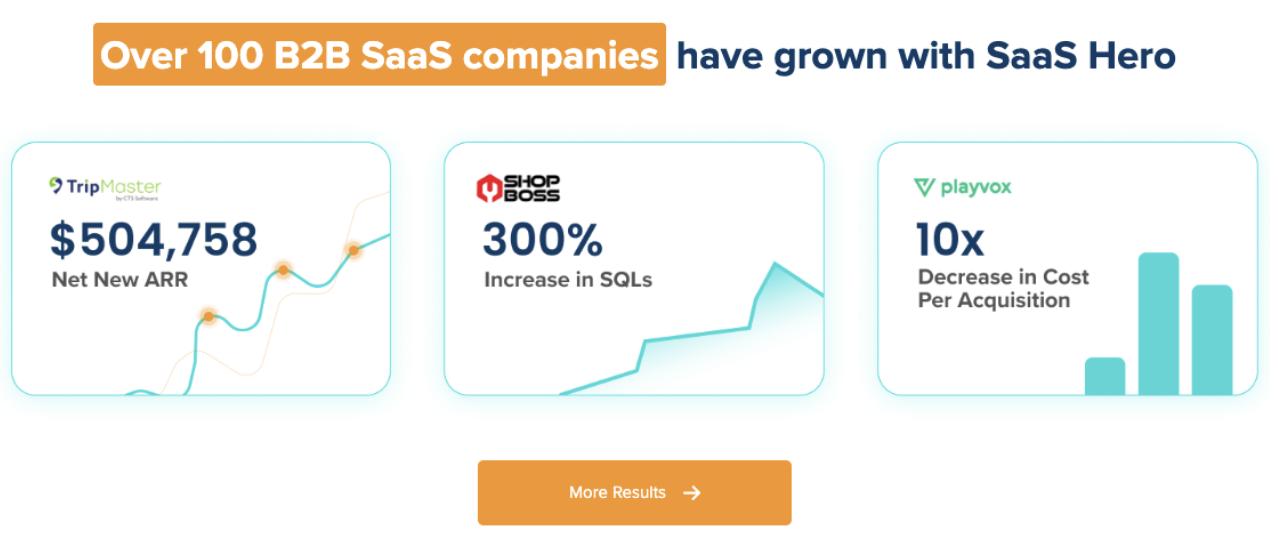
This shift reflects broader market pressure where 87% of marketers report better results from account-based marketing strategies that prioritize quality leads over volume. Outsourcing to specialists can reduce CAC by up to 10x through targeted conquesting strategies.
Ditch inefficient agencies and their percentage-based fees. Book a discovery call for SaaSHero’s transparent $1,250 entry plan designed for B2B SaaS growth.
Five Practical ROI Frameworks for ConTech Teams
ConTech marketers should implement these proven frameworks with construction-specific adjustments.
- Standard ROI: (Revenue – Marketing Cost) / Marketing Cost × 100. Example: a BIM software campaign generates $650,000 revenue from $100,000 spend, which equals 550% ROI.
- 15*15*15 Adapted: 15% of revenue as CAC target, 15-month payback period, and 15% annual churn maximum. ConTech teams extend payback for longer decision cycles while keeping churn tight.
- Magic Triangle: Awareness (brand searches) to Pipeline (qualified demos) to Revenue (closed ARR). This framework tracks full funnel progression in a simple way.
- LTV:CAC Ratio: Customer lifetime value divided by acquisition cost. ConTech targets a ratio above 3:1 to reflect multi-year contracts and high switching costs.
- Net New Pipeline Value: Total pipeline generated minus existing customer expansions. This metric focuses on true market penetration growth.
These frameworks address construction marketing’s varying channel performance, with SEO delivering 681% ROI and content marketing achieving 400 to 450% when attribution is set up correctly.
Revenue-First Alternatives That Improve on Basic ROI
Traditional ROI misses much of ConTech’s long-term value creation, so four alternatives provide clearer insight.
|
Alternative |
Formula |
ConTech Application |
Target Benchmark |
|
LTV:CAC Ratio |
Customer Lifetime Value ÷ Customer Acquisition Cost |
Multi-year construction contracts |
>3:1 |
|
Payback Period |
CAC ÷ Monthly Gross Margin |
Project-based revenue cycles |
80 days |
|
Net New Pipeline Value |
Total Pipeline – Expansion Revenue |
Market penetration focus |
Monthly growth |
|
Marketing-Influenced Revenue |
Revenue with marketing touchpoints ÷ Total Revenue |
Multi-stakeholder attribution |
60%+ |
Step-by-Step Process to Measure ConTech Marketing ROI
Accurate ConTech ROI measurement depends on a clear, repeatable process.
- Audit Current Tracking: Identify gaps in attribution from ad click through to closed deal.
- Integrate CRM Systems: Connect HubSpot or Salesforce to marketing platforms so revenue flows back to campaigns.
- Segment by Intent: Separate navigational searches from high-intent comparison queries for cleaner data.
- Implement Negative Keywords: Exclude low-intent traffic and protect budget efficiency.
- Set Up GCLID-to-ARR Tracking: Connect Google Ads clicks directly to revenue outcomes inside the CRM.
- Deploy Multi-Touch Attribution: Capture complex B2B buyer journeys that involve several stakeholders and channels.
- Create Revenue Dashboards: Use Looker Studio to visualize marketing’s impact on pipeline and closed deals.
Best Tools and Maturity Stages for ConTech ROI Tracking
Effective ConTech ROI tracking relies on the right tools and a realistic maturity path. Core platforms include Looker Studio for visualization, Google Ads GCLID for click-to-revenue tracking, and HubSpot for CRM integration.
Companies using CRM systems and analytics platforms report 15 to 20% higher marketing ROI than teams that rely on manual tracking.
Organizations usually move through three maturity stages. Stage 1 focuses on vanity metrics such as impressions and clicks. Stage 2 introduces lead quality metrics. Stage 3 reaches full revenue attribution with clear visibility into CAC and payback.
Common pitfalls include dark funnel attribution gaps and percentage-based agency fee bloat. These issues hide true CAC and slow down scaling decisions.
Real-world scenarios highlight how this framework performs. A BIM software founder can reach 650% ROI through competitor conquesting. A post-funding field management scaler can hit the 80-day payback benchmark through disciplined pipeline tracking.
SaaSHero has validated this approach, delivering $504,758 in Net New ARR through conquesting strategies with 20% conversion rates. Book a discovery call to apply the same structure.

Frequently Asked Questions
How to calculate ROI for a construction project?
Construction project ROI uses the formula (Project Value – Project Cost) / Project Cost × 100. For ConTech marketing, this adapts to (Revenue Generated – Marketing Cost) / Marketing Cost × 100 and must account for long sales cycles and multi-stakeholder decision processes common in construction software purchases.
How to measure ROI for marketing?
Marketing ROI measurement requires connecting ad spend to closed revenue through CRM integration, multi-touch attribution, and pipeline tracking. ConTech marketers should focus on Net New ARR instead of the total pipeline, so results do not get inflated by existing customer expansions.
What is the best way to track marketing ROI?
The most effective approach combines GCLID tracking from Google Ads, CRM integration with HubSpot or Salesforce, and revenue dashboards in Looker Studio. This stack creates end-to-end visibility from initial ad click through to closed deal, which is essential for ConTech’s complex buyer journeys.
What is the alternative to ROI?
Primary alternatives include LTV:CAC ratios with a target above 3:1, payback periods with an 80-day target, pipeline velocity metrics, and Net New ARR tracking. These alternatives capture ConTech’s long-term value creation and multi-year contract structures more accurately than simple ROI.
What is the 15*15*15 rule?
The 15*15*15 rule suggests 15% of revenue as maximum CAC, 15-month payback periods, and 15% annual churn limits. For ConTech, teams adapt this to longer sales cycles with 18-month payback periods and lower churn rates because switching costs in construction workflows remain high.
Conclusion: Use Revenue Metrics and Choose the Right Partner
ConTech marketing success in 2026 requires a move away from vanity metrics and toward revenue-focused frameworks. The four-pillar approach, which combines traditional ROI with ConTech tweaks, alternative metrics like payback periods, and robust tracking systems, creates a foundation for sustainable growth and VC readiness.
Next steps include auditing current tracking capabilities and partnering with specialists who understand construction industry dynamics. SaaSHero’s track record in B2B SaaS verticals, including Construction, combined with flat-fee structures and revenue-focused reporting, sets a strong benchmark for effective agency partnerships.

Teams ready to achieve 80-day payback periods and prove marketing value to their board should act now. Book a discovery call to implement these frameworks with B2B SaaS expertise.