




Last updated: January 25, 2026
Key Takeaways for B2B SaaS Teams
- Demand generation outperforms lead generation in B2B SaaS by focusing on revenue metrics like pipeline value and Net New ARR instead of vanity metrics like MQLs and CPL.
- Demand gen targets the top and middle of the funnel with ungated content and education, reaching the dark funnel where most B2B decisions happen, while lead gen focuses on bottom-funnel capture.
- Demand gen delivers stronger ROI with 12 to 18 month CAC payback, 120 to 125% NRR, and 50 to 60% MQL-to-SQL conversion rates, compared with lead gen’s longer cycles and lower quality.
- Hybrid strategies perform best. Demand gen creates awareness and intent, and lead gen converts that intent, supported by a four-phase transition from volume to quality.
- B2B SaaS leaders drive capital-efficient growth with expert demand gen. Schedule a discovery call with SaaSHero to improve your strategy today.
How Demand Gen and Lead Gen Fit the B2B SaaS Buyer Journey
Demand generation and lead generation sit at different points in the B2B buyer journey and support different revenue goals. This positioning shapes how each strategy contributes to pipeline and ARR.
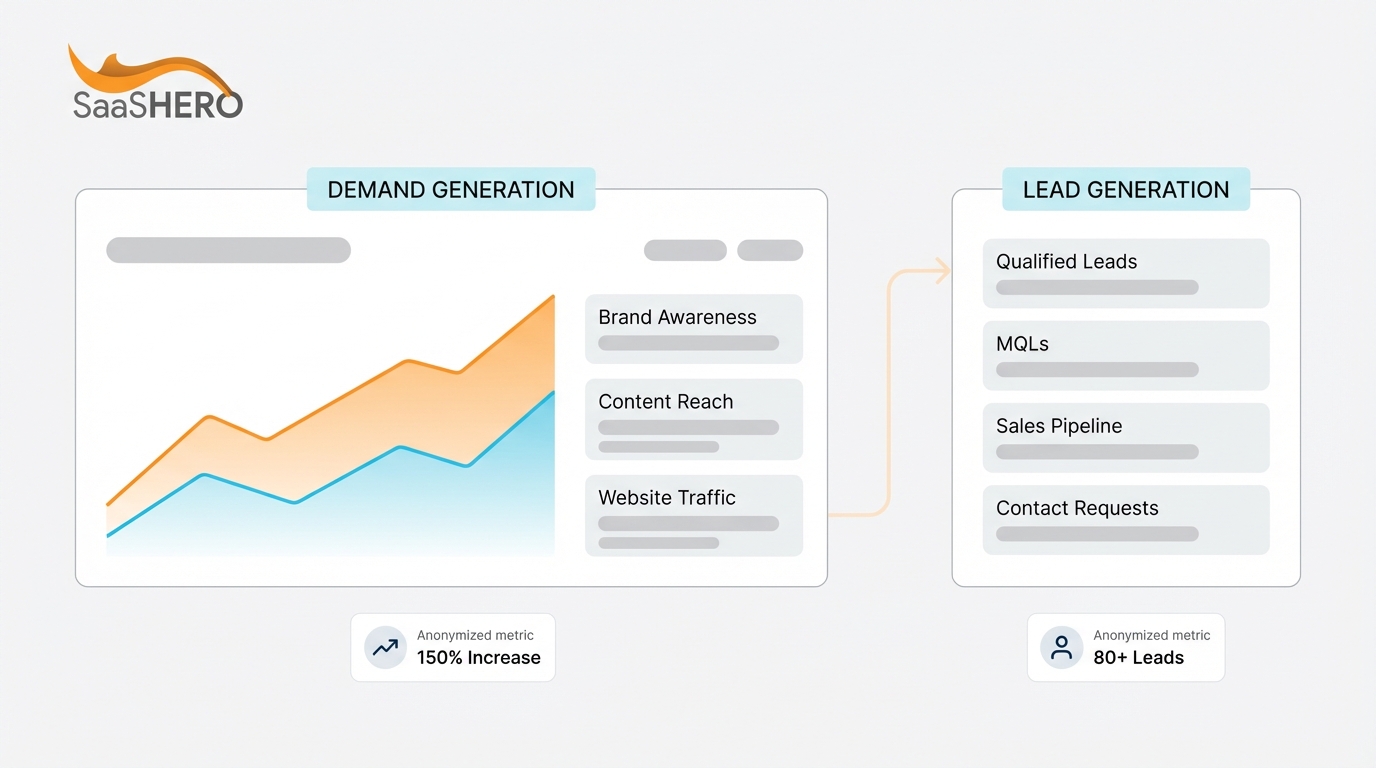
Demand Generation operates at the top and middle of the funnel. It creates broad market awareness and educates prospects with ungated content, thought leadership, and clear brand positioning. Demand generation builds awareness and interest in a brand or product before someone is ready to buy. It reaches the “dark funnel,” where most B2B buying decisions form before prospects ever fill out a form.
Lead Generation focuses on the middle and bottom of the funnel. It converts existing interest into sales opportunities through gated content, direct response campaigns, and qualification workflows. Lead generation captures buyer intent and turns that interest into actionable leads.
|
Strategy |
Funnel Stage |
Primary Tactics |
Content Type |
Key Metrics |
|
Demand Generation |
ToFU/MoFU |
Content syndication, LinkedIn events, competitor conquesting |
Ungated content, thought leadership |
Pipeline value, Net New ARR, brand awareness |
|
Lead Generation |
MoFU/BoFU |
Gated assets, webinars, direct response |
Whitepapers, demos, trials |
MQLs, SQLs, conversion rates |
Gartner reports that the average B2B software purchase decision involves 6 to 10 decision-makers. This complexity demands a strategy that educates and influences multiple stakeholders over long cycles. Demand generation fits that requirement more effectively than a narrow lead capture approach.
Demand Gen vs Lead Gen: Metrics, Tactics, and ROI
The gap between demand generation and lead generation becomes clear when you compare metrics and tactics side by side. Lead generation often centers on activity metrics like click-through rate and cost per lead. Demand generation prioritizes revenue metrics that tie directly to growth.
|
Comparison Factor |
Demand Generation |
Lead Generation |
Revenue Impact |
|
Primary Metrics |
Pipeline value, Net New ARR, CAC payback |
MQLs, CPL, conversion rates |
Direct revenue correlation vs activity metrics |
|
Tactical Focus |
Market education, competitor conquesting, ABM |
Form optimization, gated content, direct response |
Quality over quantity approach |
|
Attribution Model |
Multi-touch, dark funnel tracking |
Last-click, form-based attribution |
Comprehensive buyer journey visibility |
|
ROI Measurement |
LTV:CAC ratio, payback period |
Cost per acquisition, lead volume |
Long-term value vs short-term metrics |
Tactical choices drive these performance differences. B2B SaaS companies spend a median of 8% of ARR on marketing, and demand generation often receives 34 to 38% of marketing budgets once companies scale past $5M ARR. This allocation reflects the stronger ROI that demand gen programs deliver.
Conversion benchmarks also favor demand generation. Top-performing demand generation programs reach 5 to 10% website visitor to lead conversion rates compared to 2 to 5% standard rates. At the same time, they maintain MQL to SQL conversion rates of 50 to 60%.
B2B SaaS companies that want to escape the volume trap of traditional lead gen need specialized demand gen execution. Book a discovery call to see how expert demand generation can lift conversion rates and revenue.

Why Demand Generation Wins in 2026 for B2B SaaS
Demand generation outperforms lead generation in today’s B2B SaaS market because it matches modern buyer behavior and capital constraints. Lead generation mainly captures existing demand. Demand generation creates, shapes, and nurtures demand across long, complex sales cycles.
Attribution challenges that frustrate lead gen teams become an advantage for demand gen teams. Gartner notes B2B buyers spend only 17% of their time with Sales, so most buying happens independently. Demand generation influences that independent research inside the dark funnel and drives revenue before prospects ever talk to sales.
Performance benchmarks highlight demand gen’s capital efficiency. Best-in-class companies achieve CAC payback periods of 12 to 24 months at the lower end. At the same time, KeyBanc’s 2025 SaaS Benchmark Report shows best-in-class public SaaS companies average 120 to 125% NRR.

|
Performance Metric |
Demand Generation |
Lead Generation |
Best-in-Class Target |
|
CAC Payback Period |
12-18 months |
18-24 months |
<12 months |
|
Net Revenue Retention |
120-125% |
98-113% |
120%+ |
|
Pipeline Quality |
High intent, qualified |
Volume-based, mixed quality |
50%+ marketing-sourced |
|
Sales Cycle Impact |
Accelerated through education |
Standard cycle length |
25% reduction |
Demand generation also compounds value through expansion revenue. SerpSculpt’s 2025 analysis shows top SaaS companies generate more than 50% of new ARR from existing customer expansion. Demand gen’s focus on education and relationships supports that expansion more effectively than one-off lead capture.
Building a Hybrid Demand Gen and Lead Gen Engine
The strongest B2B SaaS growth engines combine demand generation and lead generation in a coordinated way. Most B2B marketing teams need both strategies running in parallel: demand generation fills the top of the funnel, and lead generation converts interest into revenue opportunity.
The shift from lead-gen-heavy to demand-gen-led growth works best with a clear four-phase plan.
Phase 1: Audit and Assessment focuses on your current metrics and reporting. Identify dependencies on vanity metrics and uncover attribution gaps. Shift attention from lead volume to pipeline quality and revenue impact.
Phase 2: Content Strategy Shift replaces a gated-asset mindset with educational content across the full journey. Create ungated resources that address specific buyer pain points and questions at each stage.
Phase 3: Attribution Enhancement improves visibility into demand gen influence. Implement multi-touch attribution and deeper CRM integration so you can connect content and channels to pipeline and closed revenue.
Phase 4: Tactical Expansion scales what works. Launch competitor conquesting campaigns, account-based marketing programs, and thought leadership initiatives that reach and convert high-intent accounts.
The most effective B2B SaaS demand generation teams integrate their tech stack for seamless data flow, with content performance guiding creation, CRM data revealing engagement, and attribution showing channel impact on pipeline.
Companies that want expert support for this transition can book a discovery call and use proven demand generation playbooks to grow revenue while staying capital efficient.
Conclusion: Demand Generation as the Growth Engine
Evidence across benchmarks and buyer behavior shows that demand generation is the primary growth engine for B2B SaaS in 2026. Lead generation still matters for capturing and converting active interest, but demand generation creates awareness, educates buyers, and fills the pipeline with higher-intent opportunities.
The move from a volume-focused lead gen model to a revenue-focused demand gen model requires new skills, systems, and execution. B2B SaaS companies ready to make that shift can book a discovery call and see how expert demand generation implementation can reshape their growth trajectory.
Frequently Asked Questions
Is demand generation replacing lead generation in B2B SaaS?
Demand generation is becoming the dominant strategy for B2B SaaS, but it does not eliminate lead generation. The strongest companies use a hybrid model where demand generation builds awareness and educates the market, and lead generation converts that interest into qualified opportunities. This shift reflects a buyer journey where prospects complete extensive independent research before talking to sales. Companies that rely only on lead generation lose influence during those research and evaluation stages.
What are the key metric differences between demand gen and lead gen?
Demand generation centers on revenue metrics such as pipeline value, Net New ARR, CAC payback period, and customer lifetime value. These metrics connect directly to growth and capital efficiency. Lead generation focuses on activity metrics like MQLs, cost per lead, click-through rates, and basic conversion rates. These numbers show marketing activity but do not always reflect revenue impact. Top-performing B2B SaaS companies prioritize demand generation metrics because they reveal real business outcomes and ROI.
What are examples of demand gen vs lead gen for B2B SaaS?
Demand generation examples include ungated educational content on industry challenges, thought leadership webinars, competitor conquesting campaigns, and account-based marketing programs for high-value accounts. These efforts build awareness and trust without forcing an immediate form fill. Lead generation examples include gated whitepapers, demo request forms, free trial signups, and direct response email campaigns. These tactics capture existing intent and route it to sales. The most effective B2B SaaS teams plan both sets of activities as one system.
What steps help a team move from lead gen to demand gen?
A four-phase approach supports a smooth transition. First, audit current metrics and reporting to uncover vanity metric dependence and attribution gaps. Second, shift content from mostly gated assets to ungated educational resources that address buyer pain points across the journey. Third, improve attribution with multi-touch models and deeper CRM integration so you can see demand gen’s impact on revenue. Fourth, expand tactics to include competitor conquesting, account-based marketing, and thought leadership that reach buyers earlier in their process.
Which agencies specialize in B2B SaaS demand generation?
Specialized B2B SaaS demand generation agencies focus on software companies and understand long sales cycles, multiple decision-makers, and complex attribution. These agencies usually offer integrated services such as paid media management, content strategy, CRM integration, and revenue attribution. They track metrics like pipeline influence, Net New ARR, and customer acquisition cost instead of only lead volume. The strongest partners also use transparent pricing and flexible contracts that align their incentives with client revenue outcomes.