




Written by: Aaron Rovner, Founder, Saas Hero | Last updated: October 16, 2026
Key Takeaways
- Choosing an ABM agency for B2B SaaS in 2026 works best with a clear framework instead of agency-written listicles that skip selection criteria.
- More than half of B2B buyers now start research inside LLMs, so lead-focused playbooks no longer support modern account-based marketing.
- Four neutral criteria — ACV threshold, target account list size, tech stack alignment, and engagement model — show whether any agency can deliver real ABM results.
- Most ABM failures come from inherited account lists, lead-level reporting instead of account-level metrics, and agencies that avoid owning the post-click experience.
- SaaSHero delivers end-to-end ABM execution inside the client’s existing stack with flat-retainer pricing that removes channel-mix conflicts.
Talk With SaaSHero About Your ABM Motion
The Four Criteria That Actually Determine Fit
These criteria stay neutral across vendors. Apply them to every agency on your list, including the ones not named here.
1. ACV Threshold
ABM is generally recommended for B2B companies with an ACV of at least $20,000–$50,000, with many practitioners citing $50,000+ as the threshold where ABM economics clearly work, because the motion’s cost per account only pays back on larger deals. The threshold is flexible for vertical SaaS with a very small total addressable market, where a finite universe of accounts makes broad demand generation impractical. Companies below the threshold with a large TAM usually see better unit economics from demand generation. For the B2B SaaS companies this guide addresses — $10M–$50M ARR, $5K–$100K+ average customer value — ABM is typically the right motion.
2. Target Account List Size
A focused ABM program commonly runs anywhere from 10–25 Tier 1 accounts up to a few hundred named accounts, depending on the tier and model, with the list built from CRM data and intent signals rather than a static spreadsheet. True one-to-one ABM rarely exceeds 100 accounts, while one-to-many programs operate at scale across hundreds to thousands. The most common ABM failure pattern appears when marketing builds a list alone, presents it to sales in week six, and watches it go unused by week eight.
3. Tech Stack Alignment
The way an agency operates inside your 6sense, Demandbase, HubSpot, Salesforce, or Marketo environment, or expects you to run the platforms yourself, determines whether account-level optimization is mechanically possible. Dedicated ABM platforms earn their cost only when running one-to-many ABM at scale across more than 200 accounts, and below that threshold, native CRM and marketing automation plus LinkedIn cover most of the value.
4. Engagement Model
The difference between an agency that owns strategy and execution and one that only executes a brief you write is the difference between a partner and a hard-to-fire direct report. An agency that waits to be told what to do is running managed services with an ABM label.
See How SaaSHero Runs ABM Inside Your Stack
How To Choose The Right ABM Agency For Your SaaS Company
The four criteria above explain what to evaluate. The steps below show how to run that evaluation in sequence before you sign anything.
- Define your ACV and target account list before you take calls. An agency cannot assess fit against criteria you have not set.
- Confirm the agency builds or co-builds the account list rather than inheriting it. A list handed to you in week six and ignored by week eight signals a broken ABM motion.
- Ask what their reporting shows at the account level versus the lead level. Answers focused on leads, cost per lead, and impression share describe demand generation.
- Verify CRM integration and lifecycle-stage feedback into ad platforms. Without this, bidding learns from form fills rather than qualified accounts.
- Check whether they own the post-click experience or hand landing pages back to you. An agency that cannot change the page its traffic lands on cannot stay accountable for conversion.
- Ask how they handle AI search visibility for your target accounts. Buyers now form shortlists inside AI assistants before they ever reach your site.
- Request references from companies at your ACV and spend level. Case studies from companies unlike yours rarely transfer.
The Shortlist: Seven ABM Agencies For B2B SaaS
Each agency below is profiled against the same four criteria so you can compare them on equal footing. These profiles provide structured evaluations rather than endorsements.
SaaSHero — Best For Mid-Market And Enterprise B2B SaaS With $15K+ Monthly Ad Spend
SaaSHero serves SaaS companies that already committed to ABM and now need a team to own the motion end to end. Founded in 2018, SaaSHero has spent eight years in the category. It has served more than 100 B2B companies and manages roughly $16M in annual advertising spend, with more than $60M lifetime. That scale matters because the team has already run account-based programs at the spend levels this guide addresses. The team includes about 20 full-time specialists, including in-house designers and copywriters, so landing pages and creative stay in one place. SaaSHero holds Google Premier Partner status (top 3% of partners) and has been a G2 High Performer in digital marketing for over two consecutive years, currently ranked #20 of approximately 6,000 agencies.
Profiled against the four criteria:
- ACV fit: Built for companies where average customer value runs $5K–$100K+ and the sales cycle is measured in months, which is the range where ABM economics pay back.
- Account list: Operates against the client’s target account list and intent signals rather than a static spreadsheet. The list is co-built with sales instead of inherited.
- Tech stack: Operates inside the client’s 6sense, Demandbase, HubSpot, Salesforce, or Marketo environment rather than owning the stack. All accounts, assets, and files remain client property throughout and at offboarding.
- Engagement model: Owns strategy and execution. Separates primary from secondary conversions and pushes lifecycle-stage events back into the ad platforms so bidding learns from qualified accounts rather than form fills. Owns landing page design, copy, build, hosting, and testing in-house. Prices on a flat retainer indexed to total monthly ad spend rather than per channel, so recommending a shift in channel mix carries no fee consequence.
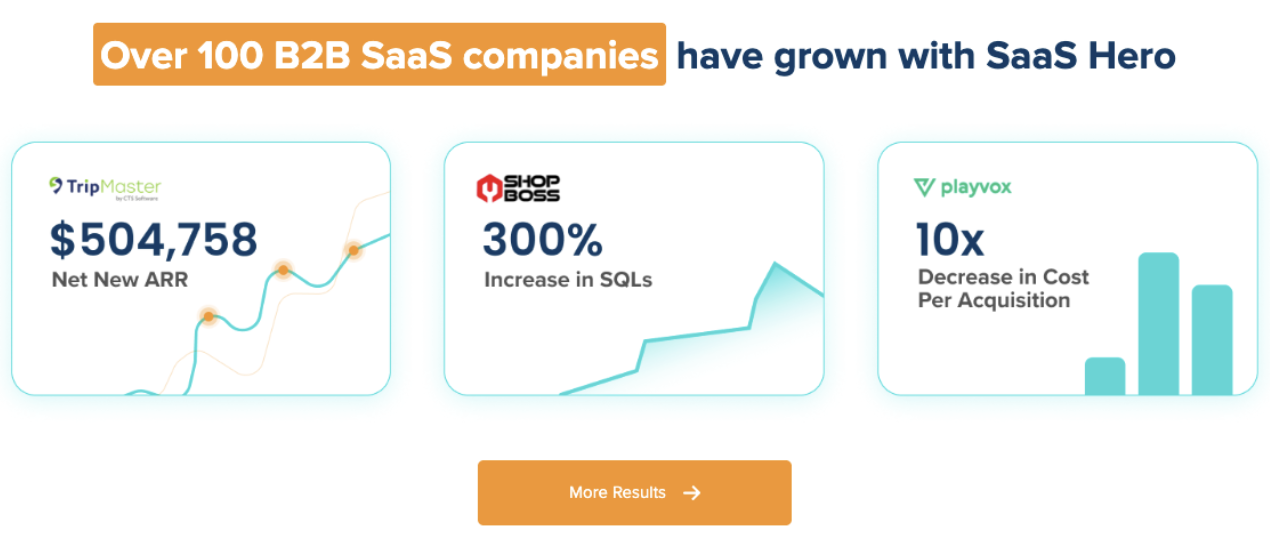
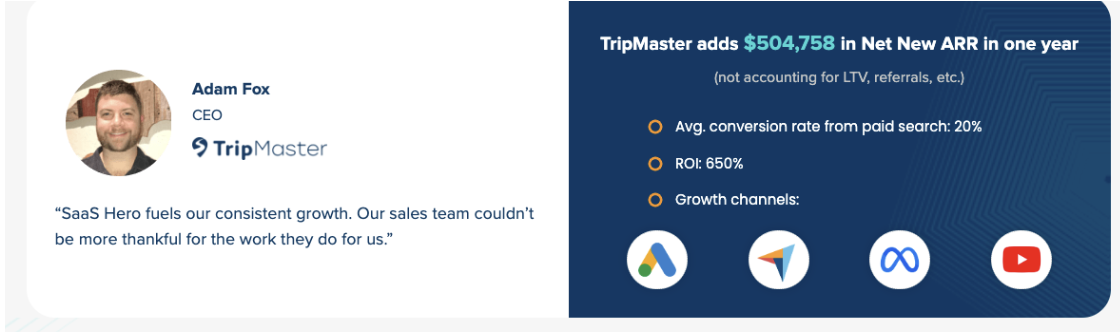
Fit signals include $10M+ annual revenue, $15K+ monthly ad spend already flowing, a 2–4 person internal marketing team without a paid-media specialist, and pressure from a board or PE/VC backer to scale pipeline. Published case studies include $504,758 in Net New ARR for TripMaster, an 80-day CAC payback for TestGorilla, a 10x reduction in cost per lead alongside a 163% increase in lead volume for Playvox, and a 305% increase in conversion rate for Shop Boss.
For a deeper look at how SaaSHero structures ABM campaigns, see Account Based Marketing Agency: 12 ABM Campaign Examples and the B2B SaaS Account-Based Marketing: A 90-Day Playbook.
Ironpaper — Best For Enterprise B2B With Complex Buying Committees
Ironpaper is a New York-based B2B agency with documented ABM execution across enterprise accounts. Its published Lightning Step case study describes account-list activation across several advertising platforms and reports more than $1M in pipeline across 15 target enterprise accounts. On the four criteria, Ironpaper demonstrates account-level reporting and sales alignment, which supports companies with buying committees of ten or more stakeholders and sales cycles exceeding nine months. Its engagement model leans toward full-service delivery, which suits buyers who want brand, content, and ABM under one contract.
Directive Consulting — Best For Paid Media-Led Demand Generation At Scale
Directive Consulting is a performance marketing agency with documented SaaS experience and a published TigerConnect example reporting a 31% quarter-over-quarter increase in paid leads after introducing target-company filtering on LinkedIn. On the four criteria, Directive is strongest on tech stack integration and paid media depth. Its engagement model is execution-heavy, which suits buyers who already have a defined ABM strategy and need a specialist to run the paid layer against it.
Refine Labs — Best For Demand Creation Programs Tied To Pipeline Reporting
Refine Labs has published paid-media management pricing starting at $14,000 per month with a six-month minimum. Its Clari case study reports a 67% reduction in advertising acquisition cost and a 64% increase in win rate, though these are company-reported outcomes from a broader demand-generation program rather than an isolated ABM campaign. On the four criteria, Refine Labs is strongest on engagement model, since it owns strategy and brings a documented point of view on demand creation versus demand capture, and on pipeline-level reporting. It fits buyers whose main constraint is measurement and attribution rather than creative production or landing page ownership.
Heinz Marketing — Best For Sales-Marketing Alignment And RevOps Integration
Heinz Marketing is a Redmond-based B2B agency with a documented focus on sales and marketing alignment, pipeline accountability, and RevOps integration. On the four criteria, it is strongest on engagement model for buyers whose primary constraint is the handoff between marketing-qualified accounts and sales action. It works well for companies where the ABM program is already architected and the gap sits in sales adoption and pipeline measurement rather than paid media execution.
Gripped — Best For Structured 90-Day ABM Program Delivery
Gripped structures its ABM delivery as a 90-day program organized into three 30-day sprints, with documented channels including email, LinkedIn, targeted advertising, personalized landing pages, and direct mail. On the four criteria, Gripped is strongest on account list methodology and program structure, which suits buyers who want a defined pilot before committing to a longer program. Its engagement model is more prescriptive than bespoke, which fits buyers who want a proven framework applied to their account list.
TripleDart — Best For B2B SaaS ABM With A Flat Retainer And Separate Media Billing
TripleDart uses a flat retainer model with media spend billed separately and ABM-specific pricing quoted custom. Its published Lucidity case study describes account and persona filtering associated with 55 qualified leads during one quarter. On the four criteria, TripleDart is strongest on pricing model alignment, since the flat retainer structure removes the percentage-of-spend conflict, and on SaaS-specific execution. It fits growth-stage buyers who want a specialist with a clean fee structure and documented SaaS ABM experience.
How To Verify An Agency Actually Runs ABM
Most ranking listicles skip verification. The questions below separate real ABM operators from repackaged demand generation, and you can run them against every proposal on your desk.
Questions to ask in a proposal or discovery call:
- Do you build the target account list or do we?
- How do you measure account engagement versus lead volume?
- What does your reporting show, accounts or leads?
- How do you feed CRM lifecycle stages back into the ad platforms?
- How do you handle intent data from 6sense or Demandbase?
- Who owns the post-click experience, you or us?
- What happens to our accounts, assets, and data if we end the engagement?
Red flags in proposals and contracts often cluster around reporting, ownership, and incentives. Watch for reporting that focuses on leads instead of accounts, no CRM integration, and no intent data usage or methodology. Lack of ownership of the post-click experience, per-channel pricing that discourages testing new channels, and case studies from companies unlike yours in ACV, sales cycle, or team size also signal risk. Guaranteed pipeline or meeting numbers without a written qualification definition and contracts where the agency retains ownership of ad accounts, analytics, or data on exit complete the pattern.
The biggest red flag in an ABM agency pitch is one that never mentions the client’s sales team, because a pitch that discusses only marketing tactics, targeting, and technology without asking hard questions about sales handoff, BDR capacity, and deal-desk friction produces activity the revenue organization cannot convert.
For a deeper comparison of ABM versus lead generation approaches, see Lead Generation Agency vs. ABM: The Executive’s Guide.
Audit Your Current ABM Program With SaaSHero
ABM And AI Search Visibility In 2026
Target accounts now research through ChatGPT, Google AI Overviews, Gemini, and Perplexity before they ever visit a landing page. 89% of B2B buyers have adopted generative AI for research, and 69% of B2B software buyers chose a different vendor than they originally planned based on AI chatbot guidance, with one in three buying from a vendor they had never heard of. An ABM agency that ignores this shift still runs a 2022 playbook.
Key signals in an agency’s AI search visibility capability include whether the agency monitors what AI surfaces say about your brand and competitors and whether it produces comparison and category pages that machine readers can cite. You also want tracking of citation share alongside traditional organic performance and a documented methodology for Answer Engine Optimization (AEO), not just a claim.
AI-referred traffic converts at 14.2% versus Google organic’s 2.8%, and brand mentions correlate 3x more strongly with AI citations than backlinks do. A vendor absent from AI-generated shortlists is not in the conversation at all.
SaaSHero offers programmatic SEO and AI search visibility alongside its paid media and ABM work, sharing the same account and measurement layer. The same intent signals that inform paid targeting also inform which comparison and category pages get built next. For more on how this connects to ABM strategy, see Account-Based Marketing Strategy for B2B SaaS Demand Gen.
Plan Your ABM And AI Visibility With SaaSHero
Pricing Models And Incentives
The pricing model determines what the agency is structurally paid to care about. The table below shows how each of the three most common models responds when the right call is to shift budget between channels, which is the moment when incentives become visible.
| Pricing Model | What It Optimizes For | How It Responds to a Channel-Mix Change |
|---|---|---|
| Flat retainer indexed to total ad spend | Efficiency and reallocation | Unchanged — no fee consequence in either direction |
| Percentage of ad spend | Larger budgets | Rises with spend regardless of performance |
| Per-channel pricing | Channel count | Rises when a channel is added, falls when one is dropped |
Percentage-of-ad-spend pricing structurally ties agency revenue to client costs rather than outcomes. At a 15% fee on $50,000 monthly spend, the agency earns $7,500 that month. Double the budget and the fee doubles, whether or not pipeline does. Per-channel pricing makes adding or testing a channel a contract amendment, so the agency has a financial interest in the channel mix staying exactly as it is. A flat retainer indexed to total ad spend decouples the recommendation from the invoice. Moving budget between channels, testing a new one, or shutting one down costs the client nothing in fees.
The test for any paid media engagement stays simple: if spending less became the right call for the client, what happens to the agency’s revenue? Under a flat retainer, nothing.
FAQ
The questions below come up most often once a buyer has applied the four criteria and started evaluating specific agencies. Each answer builds on earlier sections instead of repeating them.
What ACV Justifies ABM For A B2B SaaS Company?
The threshold discussed earlier, $20,000–$50,000 ACV with $50,000+ where economics clearly work, provides the starting point. Vertical SaaS with a very small total addressable market, such as 500 or fewer nameable accounts, can justify ABM at lower ACV because the finite market limits broad demand generation. Companies below the threshold with a large TAM usually see better unit economics from demand generation, and the right answer depends on TAM size, sales cycle length, and the number of stakeholders involved in a purchase decision.
How Many Target Accounts Do You Need To Run ABM?
The list sizes discussed earlier, 10–25 Tier 1 accounts up to a few hundred named accounts with one-to-one rarely exceeding 100, give you the ranges to plan against. One-to-few programs cluster 50–500 accounts with semi-customized plays, and one-to-many programs operate at scale across hundreds to thousands using intent-triggered, technology-driven personalization. The variable that matters most is your team’s capacity to service accounts, not the raw number.
Do We Need 6sense Or Demandbase Before Hiring An ABM Agency?
A CRM, a marketing automation platform, and LinkedIn targeting cover most of the value for programs running fewer than 200 accounts. The minimum viable stack includes an existing CRM, a marketing automation platform already owned, LinkedIn Matched Audiences, and a shared target account list. Dedicated ABM platforms like 6sense and Demandbase earn their cost, which typically runs $50,000–$80,000 annually at mid-market, when running one-to-many ABM at scale or when buying-committee research happens primarily off-site and requires third-party predictive data. Most successful programs start with a lighter stack, prove the motion, and then license a full suite.
How Long Before ABM Shows Pipeline?
First engagement signals typically appear within 60 days. First pipeline often appears within 90–120 days. Closed revenue usually appears within 9–12 months for enterprise deals. These timelines assume the program is properly structured with an account list built from CRM data and intent signals, CRM integration in place, and a staged messaging cadence across awareness, consideration, and conversion. Programs that skip the awareness and consideration stages and run conversion campaigns against cold audiences will not see these timelines. That motion is demand generation with a target account list attached.
What Should Be In An ABM Agency Proposal?
A credible ABM agency proposal includes a named account-selection method with a documented refresh cadence and account-level reporting instead of lead-level metrics. It also defines a sales-working cadence that specifies what sales does when an account engagement signal fires, and it separates explicit media fees from the agency retainer. A clear statement of what the agency does not provide, the names of the people who will actually work on the account, and a written definition of what constitutes a qualified account engagement complete the package. Any proposal missing these elements describes a demand generation program with an ABM label.
Conclusion: The Final Pitch
The reader choosing between agencies that all claim ABM faces one core problem: every agency on the shortlist uses the same language. The real difference lies in whether they operate inside your CRM and intent stack or simply run LinkedIn ads with an ABM label.
The criteria and verification questions in this guide are what separate a real ABM partner from a repackaged demand generation shop. Apply them to every vendor, including SaaSHero.
SaaSHero answers every verification question affirmatively. It operates inside the client’s stack, pushes lifecycle-stage events back into the ad platforms, owns the post-click experience, and prices on a flat retainer indexed to total ad spend so the channel-mix recommendation carries no fee consequence. For companies at $10M+ revenue with $15K+ monthly ad spend already flowing and a board expecting pipeline, that operating model supports the motion.
For additional context on how to evaluate any digital marketing partner, see How to Choose a Digital Marketing Agency: A 7-Step Guide.
Schedule Your ABM Strategy Session With SaaSHero