




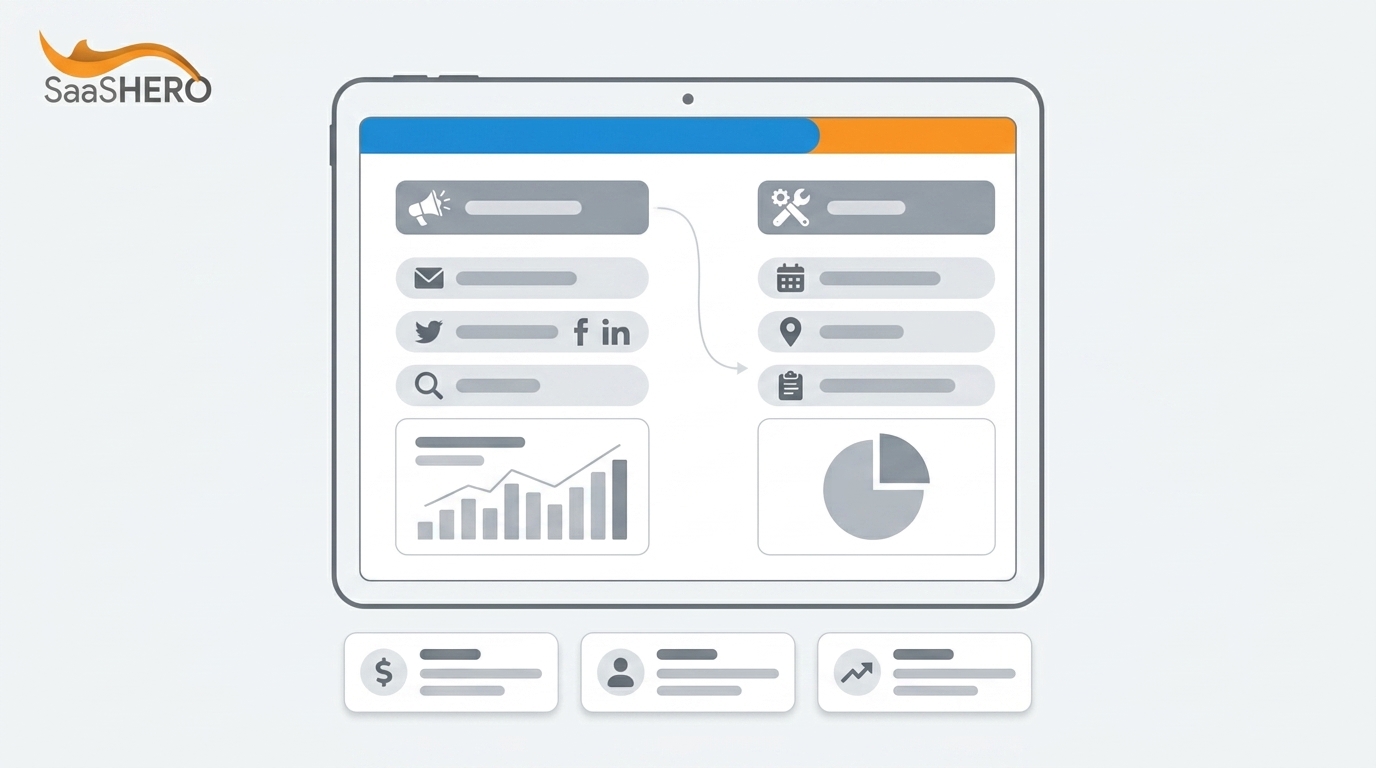
Key Takeaways for FSM Growth in 2026
- The FSM market reaches $5.88B in 2026 with 15% CAGR, so marketing must focus on revenue, not vanity metrics.
- Use the 7-step framework: local SEO, PPC conquesting, content, reviews, CRM connections, nurture sequences, and ARR tracking.
- Favor flat retainer agency models ($1,250+/mo) that deliver 650% ROI instead of percentage-of-spend fees that reward higher ad costs.
- Prioritize GBP improvements, competitor conquesting, AI video testimonials, and IoT-driven campaigns to capture high-intent leads.
- Audit your setup and schedule a strategy session with SaaSHero to launch specialized FSM campaigns for 2026 growth.
Executive Summary: A 7-Step FSM Revenue Framework
Effective digital marketing for field service management follows a clear system that ties every activity to revenue. The framework uses seven connected components:
1. Local SEO and Google Business Profile optimization for “near me” searches
2. PPC competitor conquesting campaigns that target alternatives and pricing searches
3. Content marketing with video testimonials and case studies
4. Review automation and reputation management systems
5. FSM CRM connections for clean lead handoffs
6. Email and SMS nurture sequences for multi-touch conversions
7. ARR analytics and revenue attribution tracking
This framework builds on the fact that local services businesses can achieve substantial ROI from local SEO, while focused PPC campaigns deliver median ROAS of 3.5:1 for Google Ads. The main advantage comes from integration, which connects every marketing touchpoint to scheduling, dispatching, and revenue outcomes.

How FSM Digital Marketing Works in 2026
To see how this integration works in practice, look at the platforms and buyer behaviors that shape the modern FSM ecosystem. Digital marketing for field service management now runs across a connected stack of tools, data flows, and campaigns.
The modern FSM marketing stack typically uses Google Ads and LinkedIn Ads for paid acquisition, connected to platforms like Salesforce Field Service, ServiceTitan, or Jobber for scheduling and dispatch. These connections allow marketers to track which campaigns create booked jobs and recurring revenue.
The 2026 landscape centers on AI-powered automation and IoT data. Top FSM platforms use AI-driven scheduling and routing to match jobs to technicians based on skills, location, and availability, reducing travel time by up to 40%. This operational efficiency supports predictive maintenance campaigns and proactive service offers that reach customers before breakdowns occur.
The buyer journey for field service solutions usually involves several stakeholders who research competitors, compare pricing, and study reviews before reaching out. Smart marketers intercept this journey with competitor conquesting campaigns that target searches like “[Competitor] pricing” or “[Competitor] alternatives” and send traffic to comparison landing pages. This focused approach produces higher-intent leads than broad keyword targeting.

Key Strategic Decisions and Trade-offs for FSM Leaders
Field service businesses must make deliberate choices about agency partnerships, channel mix, and measurement. The most impactful decision involves agency billing models, because traditional percentage-of-spend structures often reward higher ad spend instead of better results. The following comparison shows how these two models differ for FSM companies:

| Model | Billing | FSM Fit | ROI Example |
|---|---|---|---|
| Percentage-of-Spend | 10-20% ad budget | Wasteful (incentivizes spend) | Vanity CTR focus |
| Flat Retainer | $1,250/mo entry | Scalable ARR tracking | 650% ROI, 80-day payback |
Channel allocation must balance fast lead generation with long-term compounding results. Local SEO delivers strong ROI but often needs 6-12 months for full impact, while PPC can generate leads immediately at a higher cost per acquisition. The typical mix assigns about 60% to local SEO and 40% to PPC for established businesses, then shifts toward 70% PPC for aggressive scaling.
Attribution complexity creates the biggest measurement challenge and directly affects these allocation choices. Field service sales cycles often include several touchpoints, such as a Google search, a website visit, a phone call, and an in-person estimate before conversion. Weak attribution hides which touchpoints drive revenue and causes budget misallocation and channel conflict.
Current FSM Tactics and Emerging 2026 Practices
Leading field service companies now use digital strategies that go far beyond basic Google Ads and Facebook campaigns. The most effective approaches include several specific tactics.
1. Google Business Profile Optimization: As noted earlier, the 76% conversion rate for “near me” searches makes GBP work the highest-priority local channel for field services. Strong profiles capture ready-to-book customers.
2. Competitor Conquesting Campaigns: Campaigns target searches for “[Competitor] alternatives,” “[Competitor] pricing,” and “[Competitor] reviews” with comparison pages that highlight switching benefits and clear advantages.
3. AI-Powered Video Testimonials: Tools like Synthesia or HeyGen create scalable video content that features customer success stories and before-and-after project results.
4. Negative Keyword Hygiene: Campaigns exclude navigational searches that only include competitor brand names while targeting evaluative modifiers. This approach improves efficiency and cuts wasted spend.
Emerging practices for 2026 include predictive maintenance marketing campaigns that use IoT sensor data to trigger proactive service offers. These campaigns can reduce truck rolls and create new recurring revenue streams.
Readiness, Maturity, and FSM Implementation Planning
These advanced tactics reflect the current state of FSM digital marketing, but successful execution requires solid foundations and a phased rollout. Use this readiness checklist to assess your current state before scaling spend.
Foundation Requirements:
• Google Business Profile claimed and optimized
• CRM system with lead tracking capabilities
• Website with mobile-responsive design
• Basic review management process
• Phone tracking and call recording setup
Implementation Timeline:
Week 1: Technical audit and tracking setup
Week 2-3: Landing page improvements and competitor research
Month 1: Launch local SEO work and initial PPC campaigns
Month 2: Add competitor conquesting and review automation
Month 3: Connect advanced attribution and ARR tracking
Successful implementations combine clear project management, fast communication, and tight links between marketing and operations. Teams often use platforms like Slack or Microsoft Teams for real-time updates between marketers and dispatch. This structure helps ensure that marketing qualified leads receive quick follow-up and accurate scheduling.
Common FSM Marketing Pitfalls and Quick Diagnostics
Field service businesses often run into predictable digital marketing problems that drain budgets and slow growth. The most frequent pitfalls include several agency and reporting issues.
Vanity Metric Focus: Some agencies report clicks, impressions, and CTR while ignoring booked appointments and closed jobs. Revenue-focused partners track SQLs, pipeline value, and Net New ARR.
Junior Account Management: Senior strategists sell the engagement, then junior staff run the campaigns. Strong partnerships provide direct senior involvement and reasonable client-to-manager ratios.
Long-Term Contract Locks: Twelve-month agreements reduce accountability and performance pressure. Month-to-month arrangements keep agencies focused on results.
Diagnostic Questions:
• Does your agency report on revenue metrics or only traffic?
• Can you track marketing ROI to closed jobs and ARR?
• Do you have consistent senior strategist involvement?
• Are you locked into long-term contracts without performance guarantees?
Illustrative FSM Scenarios and Team Archetypes
Different field service organizations need tailored digital marketing approaches based on size, maturity, and growth goals. The following archetypes show how strategy and budget shift as ARR grows.
The Bootstrap Founder ($500K ARR): A plumbing company owner who manages Google Ads on weekends needs a $1,250 per month dedicated campaign manager to handle daily work while keeping strategic control. The focus stays on local SEO, simple PPC, and clear ROI tracking.
The Scaling HVAC Operation ($2M ARR): A regional HVAC company with several locations requires full marketing team support at about $3,500 per month. The plan includes competitor conquesting, multi-location SEO, and advanced CRM connections for territory management.
The Logistics Enterprise ($10M ARR): A commercial logistics provider needs detailed attribution modeling, account-based marketing for enterprise clients, and predictive maintenance campaigns that use IoT data.
Each archetype gains more from specialized FSM marketing expertise than from generalist agencies. Industry-specific knowledge of scheduling software, dispatch efficiency, and field service buyer behavior directly improves campaign performance.
Conclusion and Practical Next Steps for FSM Teams
Digital marketing for field service management in 2026 demands specialized expertise, revenue-first measurement, and tight integration with operational systems. The $5.88 billion market rewards businesses that move beyond vanity metrics and focus on trackable ARR growth through local SEO strength, competitor conquesting, and accurate attribution.
The seven-step framework offers a clear roadmap for FSM digital marketing success, yet results depend on partners who understand field operations. Generic agencies that chase clicks instead of closed jobs will burn budget and miss growth in this expanding market.
Begin your FSM digital marketing transformation with a thorough audit of current performance, competitive position, and revenue attribution. Schedule a consultation to explore how specialized digital marketing field service management strategies can accelerate your growth in 2026.
Frequently Asked Questions
What is field service management in marketing?
Field service management in marketing refers to digital strategies that generate leads and revenue for companies that provide on-site services. These companies include HVAC contractors, plumbing firms, electrical services, logistics providers, and other businesses that dispatch technicians to customer locations. FSM marketing differs from traditional B2B or B2C marketing because it must address local search behavior, urgent scheduling needs, multi-stakeholder decisions, and the operational complexity of routing and dispatch.
What are the best digital marketing channels for field service businesses?
The most effective channels for field service businesses are local SEO and Google Business Profile work, which can deliver strong ROI, followed by Google Ads with focused competitor conquesting campaigns that reach about 3.5:1 ROAS. LinkedIn Ads perform well for commercial and enterprise field services that target facility managers and procurement teams. Email and SMS automation support multi-touch nurture sequences, while review management and reputation marketing build trust for high-consideration services. The key requirement is integration that connects all channels to scheduling systems and revenue tracking instead of running isolated campaigns.
How much should field service companies budget for digital marketing?
Field service companies usually allocate 5-10% of revenue to digital marketing, with many investing $1,250-$5,000 per month depending on market size and growth goals. Companies under $1M ARR often start around $1,250 per month focused on local SEO and basic PPC. Businesses over $5M ARR may invest $3,500-$7,000 per month for multi-location campaigns, competitor conquesting, and advanced attribution. Budgets should favor flat-fee retainers instead of percentage-of-spend models to avoid misaligned incentives. Reasonable expectations include about 80-day payback for PPC and 6-12 months to breakeven for SEO.
How do you integrate digital marketing with FSM software platforms?
Integration between digital marketing and FSM software connects lead capture forms, phone tracking, and CRM data to scheduling and dispatch systems like Salesforce Field Service, ServiceTitan, or Jobber. The technical setup passes lead source data through APIs, uses call tracking with dynamic number insertion, and configures automated workflows that route qualified leads to the right technicians based on location, skills, and availability. Advanced setups include predictive maintenance marketing triggered by IoT sensor data and automated follow-up sequences based on job completion. The goal is smooth data flow from first touch through job completion and invoicing.
What metrics should field service companies track for digital marketing ROI?
Field service companies should track revenue-focused metrics instead of vanity indicators like clicks or impressions. Key performance indicators include Cost Per Acquisition by channel, with a benchmark of $34.84 for PPC in home services (2023). Lead-to-appointment conversion rates usually range from 5-15% depending on service type and follow-up speed. Job completion rates, average job value, and customer lifetime value provide deeper ROI insight. Advanced tracking covers Net New ARR attribution, pipeline velocity, and payback periods. The strongest FSM companies use closed-loop reporting that connects marketing spend to completed jobs and collected revenue, which supports precise channel and budget decisions.