




Written by: Aaron Rovner, Founder, Saas Hero
Key Takeaways
- Audit current MQL-to-SQL conversion rates, then build CRM-based lookalike audiences from closed-won customers to cut low-quality leads and increase intent.
- Use qualifying lead forms with 10 or more screening questions and educational, pain-focused ad creatives to attract serious B2B SaaS buyers.
- Run full-funnel campaigns with CAPI tracking and offline SQL conversions so Facebook optimizes for revenue, not vanity metrics like CTR.
- Combine strategic retargeting, focused landing pages, and revenue-based reporting to reach 3X SQL rates and a 30% drop in CAC.
- Partner with SaaSHero for a discovery call to apply these revenue-first Facebook ads strategies to your B2B SaaS growth.
Foundations You Need Before Scaling Facebook Lead Quality
Agencies need the right infrastructure in place before rolling out these strategies. Set up Facebook Ads Manager with CAPI integration, a CRM such as HubSpot or Salesforce, and Looker Studio for attribution tracking. Track SQL rate, pipeline value, Net New ARR, and 80-day payback periods instead of CTR or impressions.
The 2026 environment favors AI-enhanced targeting with 90-day attribution windows that match longer B2B sales cycles. Plan for 4 to 6 weeks before you see clear ROI signals, and avoid optimizing for vanity metrics that inflate performance without increasing revenue.
9-Step Revenue-First Framework for Facebook Ads
This framework follows nine steps. First, audit existing lead quality. Second, build CRM-based lookalike audiences. Third, implement qualifying lead forms. Fourth, create educational ad creatives. Fifth, deploy full-funnel campaigns. Sixth, set up CAPI and offline SQL tracking. Seventh, refine conversion-focused landing pages. Eighth, execute strategic retargeting and nurture flows. Ninth, build revenue-focused reporting systems.
The blueprint keeps ARR growth ahead of lead volume. It fixes the misalignment between agency incentives and client outcomes that often appears in percentage-of-spend models.
Step 1: Audit Lead Quality to Stop MQL Waste
Start by reviewing your current MQL-to-SQL conversion rates and identifying qualification gaps. Many B2B SaaS Facebook campaigns generate large volumes of low-quality leads because they optimize for form fills instead of buyer intent.
Analyze CRM data to compare SQLs with unqualified leads. Review demographic, firmographic, and behavioral differences. Establish a baseline that includes current SQL rates, average deal size, and sales cycle length from Facebook-sourced leads.
Document lead sources that consistently produce SQLs and flag those that send junk traffic. This audit highlights improvement opportunities and sets benchmarks for the next steps.
Step 2: Build CRM Lookalike Audiences for Higher Intent
Lookalike audiences based on best customers can increase lead volume by 3X while keeping quality strong. Upload your highest-value customer lists from your CRM and create 1% lookalike audiences based on closed-won deals, not all leads.
Layer several data sources, including email lists of paying customers, visitors who viewed pricing pages, and users who completed product demos. ClipHire increased CTR by 492% using lookalike audiences combined with funnel-specific creative.
Exclude current customers from these audiences to avoid wasted spend. Test 1%, 2%, and 5% lookalikes to find the right balance between reach and relevance for your SaaS niche.
Step 3: Use Qualifying Forms to Get Better Facebook Leads
Replace generic lead forms with qualification-focused forms that pre-screen prospects. Add 10 or more qualifying questions, such as company size, current tools, budget range, and implementation timeline. Expect lower lead volume and significantly higher SQL rates.
Facebook Lead Forms increase lead volume 3X with less friction, while Messenger ads qualify leads via automated questions to schedule demos for SQLs. Use progressive profiling so you collect data in stages instead of overwhelming prospects.
Apply lead scoring based on form responses and route high-scoring leads directly to sales. Nurture lower-scoring leads through marketing automation. This approach keeps sales teams focused on qualified opportunities instead of unfiltered form fills.
Step 4: Build Educational Ad Creatives That Attract Buyers
Shift from vague “transform your business” claims to specific, problem-led creative that speaks to real SaaS buyer challenges. Facebook acts as a “first date platform” for creating new demand rather than capturing intent like Google, so education matters.
Create assets around common objections, implementation risks, and ROI expectations. Use case studies, product demos, and comparison content that match your ICP’s pain points. Refresh creatives every 2 to 3 weeks to avoid fatigue.
Prioritize video that shows real product functionality instead of generic lifestyle images. 40% of SMB budgets go to video ads versus 60% static, with Reels and short-form predicted at 35 to 55% of impressions by end-2025.
Step 5: Run Full-Funnel Campaigns Across the Buyer Journey
Full-funnel B2B ad strategies on Facebook boost conversions by up to 63% because they match messaging to each buyer stage.
Structure campaigns around awareness, consideration, and decision stages. Use broad targeting for awareness, retargeting for consideration, and narrow, high-intent audiences for decision campaigns.
Match ad creative and landing pages to each stage. Share educational content for awareness, comparison guides for consideration, and demo or trial offers for decision. This approach supports the full B2B buying process instead of forcing instant conversions.
Step 6: Use CAPI and Offline SQL Tracking for Accurate Attribution
Set up Facebook’s Conversions API to work around iOS tracking limits and improve attribution accuracy. CAPI helps consolidate data and align Meta and GA4 data for more accurate B2B lead attribution amid privacy limits.
Configure offline conversions so you track when MQLs become SQLs and then customers. This server-side data gives Facebook a full view of the funnel and lets the algorithm optimize for revenue instead of simple form submissions.
Use custom attribution windows, such as 7-day view and 30-day click, that reflect B2B sales cycles. Proper attribution reveals retargeting drives 40% of the pipeline despite poor Facebook attribution.
Step 7: Improve Landing Pages for Conversion and Lead Quality
Align landing pages with ad messaging and buyer intent, so you improve conversion rates and lead quality together. Build dedicated pages for each campaign objective instead of sending all traffic to a generic homepage.
Use progressive disclosure that delivers value before asking for contact details. Add social proof, customer logos, and specific ROI metrics that match your audience’s industry and use case.
A/B test form length, placement, and required fields with a focus on qualified leads, not raw volume. Add qualifying questions on the page so you pre-screen visitors before they enter your sales funnel.

Step 8: Run Strategic Retargeting and Nurture Sequences
Facebook retargeting for B2B SaaS drives 3 to 4 times higher conversions, with examples like a 164% increase in qualified leads and a 67% drop in CPL. Build custom audiences based on specific behaviors and engagement depth.
Retarget visitors who viewed pricing pages, downloaded resources, or watched product demo videos. Use engagement for qualification and treat users who watched 75% of product explainers as more qualified than simple demographic matches.
Create nurture sequences that add value and handle common objections. Retargeting shows 40 to 60% lower cost per qualified lead than cold Facebook campaigns and 20 to 30% lower than Google Ads retargeting.
Step 9: Report and Optimize Around Revenue Outcomes
Replace vanity metrics with revenue-focused KPIs that match client goals. Track SQL conversion rates, pipeline value, average deal size, and Net New ARR from Facebook campaigns instead of clicks, impressions, or raw lead counts.
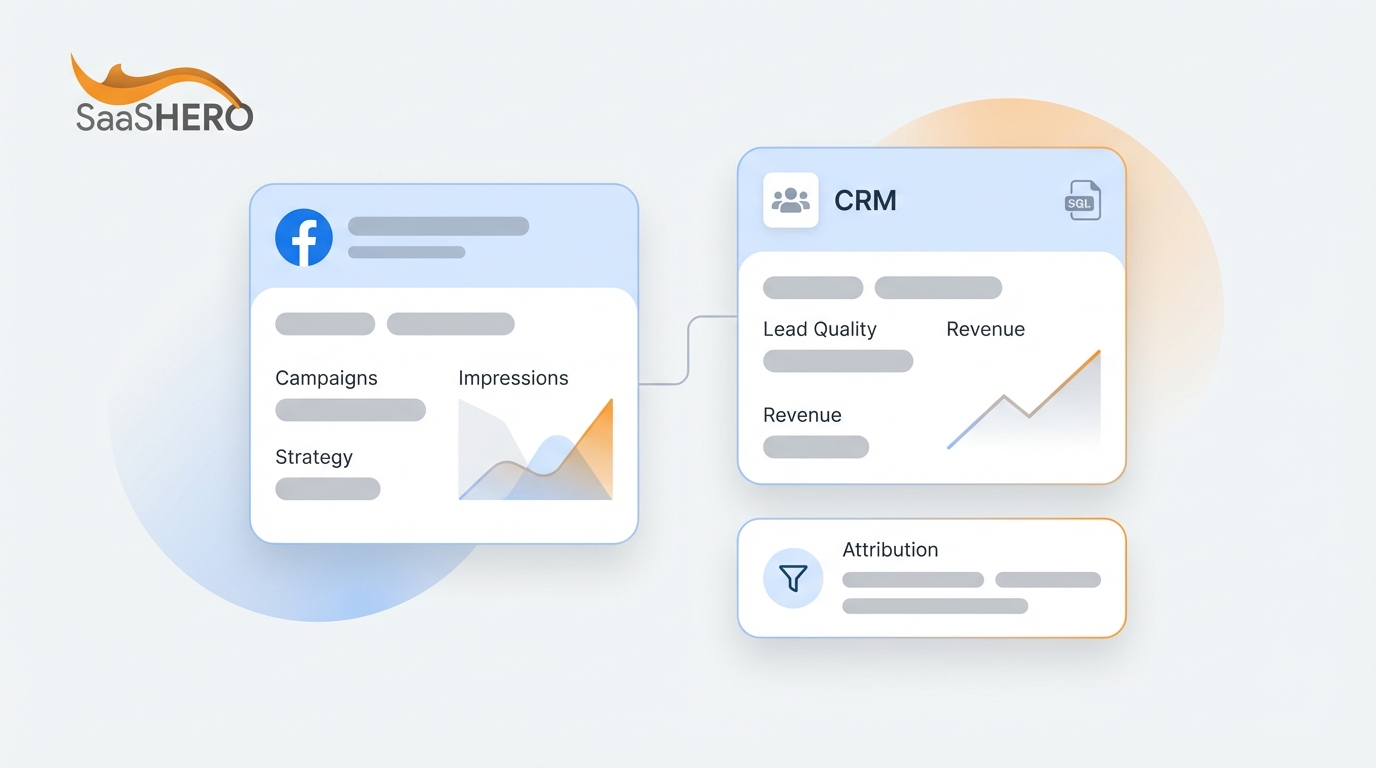
Build dashboards that connect Facebook performance to CRM outcomes and show the full journey from impression to closed deal. Use tools such as Looker Studio to visualize attribution across the funnel.
Run regular optimization cycles based on SQL quality. Pause audiences, creatives, and campaigns that drive high MQL volume but weak SQL conversion, and move budget to segments that produce revenue.
How to Measure and Prove Lead Quality Gains
Key success metrics include a 3X lift in SQL conversion rates, a 30% reduction in CAC, and clear Net New ARR growth from Facebook campaigns. Use CAPI and CRM integrations to track these outcomes accurately.
Build Looker Studio dashboards that connect ad spend to revenue. Compare performance before and after this framework so you can show clients a clear ROI story.
|
Metric |
Vanity Focus |
Revenue Reality |
Expected Uplift |
|
Primary KPI |
CTR, Impressions |
SQL Rate, Net New ARR |
3X SQL improvement |
|
Cost Efficiency |
CPM, CPC |
CAC, LTV:CAC Ratio |
30% CAC reduction |
|
Quality Measure |
Lead Volume |
Pipeline Value |
Higher deal sizes |
Why SaaSHero Aligns Fees With B2B SaaS Revenue
SaaSHero uses flat retainer pricing from $1,250 to $7,000 per month and month-to-month contracts that align agency success with client revenue. This structure removes the incentive to overspend that often appears in percentage-of-spend models. The team focuses on Google Ads and LinkedIn Ads for B2B SaaS, yet the same revenue-first approach works across channels, including Facebook.
Client results include TripMaster with $504k Net New ARR and 650% ROI, TestGorilla with an 80-day payback period, and Playvox with a 10X decrease in cost per lead. These outcomes highlight the impact of revenue-first strategies compared with volume-driven approaches.

SaaSHero’s senior-led team specializes in B2B SaaS metrics, sales cycles, and buyer behavior. Campaigns focus on business outcomes instead of vanity metrics.

Next Steps to Turn Facebook Into an ARR Channel
These nine revenue-first steps turn Facebook from a basic lead source into a reliable SQL and ARR channel for B2B SaaS. Start with a detailed audit of current lead quality, then roll out CRM-based targeting, qualifying forms, and full-funnel campaigns in sequence.
The main shift involves optimizing for revenue outcomes instead of lead volume. This shift requires accurate tracking and tight alignment between marketing and sales teams. Agencies that master this approach deliver measurable impact and stronger client relationships.
Frequently Asked Questions
How to get quality leads from Facebook ads for B2B SaaS?
Use qualifying lead forms with 10 or more screening questions, CRM-based lookalike audiences from closed-won customers, and educational ad creatives that attract buyers instead of casual browsers. Add CAPI tracking so Facebook can optimize for SQL conversions instead of form completions, and use retargeting to guide prospects through the B2B buying journey.
Is Facebook good for B2B SaaS lead generation?
Facebook works well for B2B SaaS when you use full-funnel strategies. Facebook leads for SaaS close at 18% with $11K average contract values, compared with 12% and $8K for Google Ads. The platform excels at creating new demand and nurturing prospects with educational content, which helps B2B SaaS companies grow beyond existing search volume.
How do you integrate CRM data with Facebook ads for better targeting?
Upload customer lists from your CRM and build lookalike audiences based on your highest-value clients. Use offline conversions to track when MQLs become SQLs and then customers, and send that data back to Facebook for smarter optimization. Implement CAPI so you avoid iOS tracking gaps and maintain accurate attribution from click to closed deal.
What are the biggest mistakes agencies make with B2B SaaS Facebook ads?
Common mistakes include optimizing for clicks instead of conversions, using broad generic targeting without a clear ICP, and treating Facebook like Google Ads for intent capture. Many agencies also report on vanity metrics such as CTR instead of SQL rates and pipeline value. Percentage-of-spend pricing models further push volume over quality and waste budget on unqualified leads.
How long does it take to see improved lead quality from Facebook ads?
Most teams see early gains in lead quality within 4 to 6 weeks after adding qualification forms and CRM-based targeting. Full optimization for SQL conversion and revenue attribution usually takes 2 to 3 months while Facebook learns from offline conversion data and campaigns complete full testing cycles across the funnel.