





Written by: Aaron Rovner, Founder, Saas Hero | Last updated: September 4, 2026
Key Takeaways
- A fractional CMO agency delivers part-time senior marketing leadership plus a team, usually at $5,000–$20,000 per month, for B2B SaaS companies that are not ready for a full-time CMO.
- Buyers should watch for bait-and-switch staffing, execution gaps, and retainers that charge per channel instead of performance.
- Third-party data from Clutch, GoodFirms, and Reddit shows wide variance in quality; the top seven agencies reviewed range from strategy-only to full growth teams.
- Most B2B SaaS retainers land between $8,000–$15,000/month, with SaaSHero standing out for in-house execution, CRM-tied reporting, and a flat-fee model indexed to ad spend.
- Companies that need both strategy and hands-on execution can schedule a discovery call with SaaSHero to see if their full growth team fits.
Why Fractional CMO Decisions Require Skepticism
The stakes are high. Monthly retainers run $5,000–$20,000, contracts typically span 6–12 months, and GTM 80/20 data puts the failure rate for full-time CMO hires at 42% within 18 months. Fractional engagements aim to reduce that risk instead of repeating it.
The market has grown fast enough to blur quality signals. The global fractional executive market reached $5.7 billion in 2026 and is growing at a 14% CAGR, and LinkedIn profiles with “fractional” in the title grew 5,400% between 2022 and 2024. That surge created a flood of operators with uneven quality and little reliable signal to separate them.
The top buyer fear is the bait-and-switch, where a senior person sells the engagement and junior staff execute the work. This article reviews the top fractional CMO agencies using Clutch ratings, GoodFirms scores, and Reddit sentiment, and it provides a framework to avoid the most costly mistakes.
2026 Fractional CMO Cost Benchmarks
Most B2B SaaS fractional CMO retainers land between $8,000 and $15,000 per month, with the US average near $10,000–$12,000. Hourly rates run $200–$500 depending on seniority and specialization.
Retainers vary by company stage:
- Seed ($2M–$5M ARR): $8,000–$15,000/month
- Growth ($5M–$15M ARR): $12,000–$18,000/month
- Mid-Market ($15M–$50M ARR): $8,000–$20,000/month
Most retainers cover strategy, team leadership, and vendor oversight. They usually exclude hands-on execution of paid media, creative production, and landing page improvement. This “strategy without execution” gap is the most common client complaint in the category.
For context on the full-time alternative, a full-time CMO at a $10M–$50M revenue company carries a total first-year loaded cost of $300,000–$500,000+. A fractional engagement at $10,000–$15,000/month comes in roughly 40–60% less expensive on an annualized basis.
| Model | Typical Monthly Cost | Strategic Ownership | Execution Included |
|---|---|---|---|
| Solo Fractional CMO | $8,000–$15,000 | High | Rarely |
| Fractional CMO Agency | $8,000–$25,000+ | High | Often (varies by firm) |
| Full-Service Marketing Agency | $3,000–$12,000 | Low, no CMO-level ownership | Yes |
Top 7 Fractional CMO Agencies Backed by Real Reviews
The agencies below were evaluated using Clutch ratings, GoodFirms scores, FeaturedCustomers data, and Reddit sentiment across r/marketing and r/SaaS. The data highlights strengths, weaknesses, and fit for different stages.
1. Chief Outsiders: Enterprise Strategy With Limited Execution
Focus: Mid-market and PE-backed B2B companies ($10M–$150M revenue).
Third-party evidence: Chief Outsiders has been in the fractional CMO market for more than 12 years with a bench of 120+ CMO and CSO executives. The firm holds a 4.9/5 rating on Clutch across 50+ reviews.
Pros: Deep bench of senior operators, strong strategic frameworks, and credible named case work tied to revenue outcomes, including engagements with Baker Hill and Service Objects.
Cons: Client teams often retain the execution burden, as fractional CMOs focus on strategy rather than hands-on execution. Chief Outsiders engagements are reported at $8,000–$18,000/month, though the firm does not publicly disclose pricing. The firm is less suited for large-scale enterprise transformations that require cultural reshaping and multi-year continuity.
Best for: Companies in transition, such as M&A, post-merger integration, or leadership changes, that need senior strategy more than channel execution.
2. Kalungi: Early-Stage SaaS Specialists at a Premium Price
Focus: B2B SaaS companies at $1M–$5M ARR, post-product-market fit.
Third-party evidence: Kalungi’s FeaturedCustomers profile carries a 4.8/5 rating across 906 reference ratings and 30 testimonials as of July 2026, with zero reviews on Clutch. A FeaturedCustomers review credited Kalungi with positioning and messaging work that “felt like a partner.”
Pros: Combines a fractional CMO with a full GTM execution team covering content, SEO, and RevOps. Documented results include $4.7M in sourced pipeline for CPGvision.
Cons: The $25,000 project minimum is steep for early-stage companies, and the $45,000/month full-service tier sits among the most expensive in the category. Senior attention is split across multiple clients. Antoine Vial became CEO in March 2026, with founder Stijn Hendrikse moving to Chairman, so leadership continuity deserves monitoring.
Best for: Funded post-PMF SaaS companies that need both strategy and execution under one roof and have budget to support it.
3. The Growth Syndicate: Strong Strategy, Light Execution
Focus: B2B companies that need robust strategic marketing functions.
Third-party evidence: Frequently cited in AI Overviews and industry roundups, with limited independent review volume on Clutch.
Pros: Strong strategic frameworks and senior operators with CMO-level experience.
Cons: Reviews point to a focus on strategy over hands-on channel execution. The firm is less suited for companies that need day-to-day ownership of paid media. Limited Clutch review volume makes independent verification harder.
Best for: Companies with an existing execution team that need senior strategic direction.
4. Strativera: Top-Rated Senior Operators Who Also Execute
Focus: Startups and growth-stage B2B/SaaS companies, including PE-backed firms.
Third-party evidence: Strativera publicly reports a 5.0/5 on Clutch (24 reviews), 5.0/5 on Google (59 reviews), and 5.0/5 on GoodFirms (11 reviews).
Pros: Verified reviews cite specific outcomes. Andrew Booth, Director of Marketing Technology at Medical Guardian, reported $5 million in annualized savings from a reduced cost per sale. Strativera states “no junior pods, no account-manager relay” and gives clients ownership of all ad accounts, CRM, and dashboards.
Cons: The client list includes Goettl Air Conditioning, Servpro, and Window World, which leans toward home services and healthcare instead of pure B2B SaaS. The bench is smaller than Chief Outsiders.
Best for: Growth-stage companies that want senior operators who also execute, backed by third-party proof.
5. CMOx: Budget-Friendly With Platform Tradeoffs
Focus: Seed to Series A B2B SaaS.
Third-party evidence: Reported results include 180% pipeline growth in 90 days and a 34% CAC reduction for clients.
Pros: Lower price point at $3,000–$15,000/month with flexible hourly options at $200–$300/hour.
Cons: Platform-matched fractional CMO engagements are typically 10–20% more expensive than direct engagements for the same operator, because network platforms take a margin of 20–35%. The platform model introduces a structural bait-and-switch risk, because the operator you meet may differ from the operator who delivers.
Best for: Early-stage companies testing fractional leadership for the first time with limited budget.
6. GTM 80/20: Vetted Network With Strategy Emphasis
Focus: B2B SaaS from pre-seed to scale-stage.
Third-party evidence: GTM 80/20 reports a 98% trial-to-hire success rate across 120+ clients, a 3% acceptance rate for operators, and 24–48 hour matching time.
Pros: Stage-based pricing from $3,000–$25,000+/month with no long-term lock-in contracts. The network uses rigorous operator vetting.
Cons: The network model means quality varies by operator. Strategy-focused retainers may exclude hands-on execution. A standard fractional CMO retainer typically excludes hands-on execution of paid media, creative production, and technical implementation.
Best for: Companies that want vetted senior talent without agency overhead and already have an internal execution team.
7. SaaSHero: Full Growth Team for B2B SaaS
Focus: B2B SaaS and professional services companies ($10M+ revenue, $15K+ monthly ad spend) that need an outsourced inbound growth team.

Third-party evidence: Google Premier Partner (top 3% of agencies), G2 High Performer in Digital Marketing for 2+ consecutive years and currently ranked #20 of approximately 6,000 agencies, with $60M+ in lifetime ad spend managed across 100+ B2B companies.
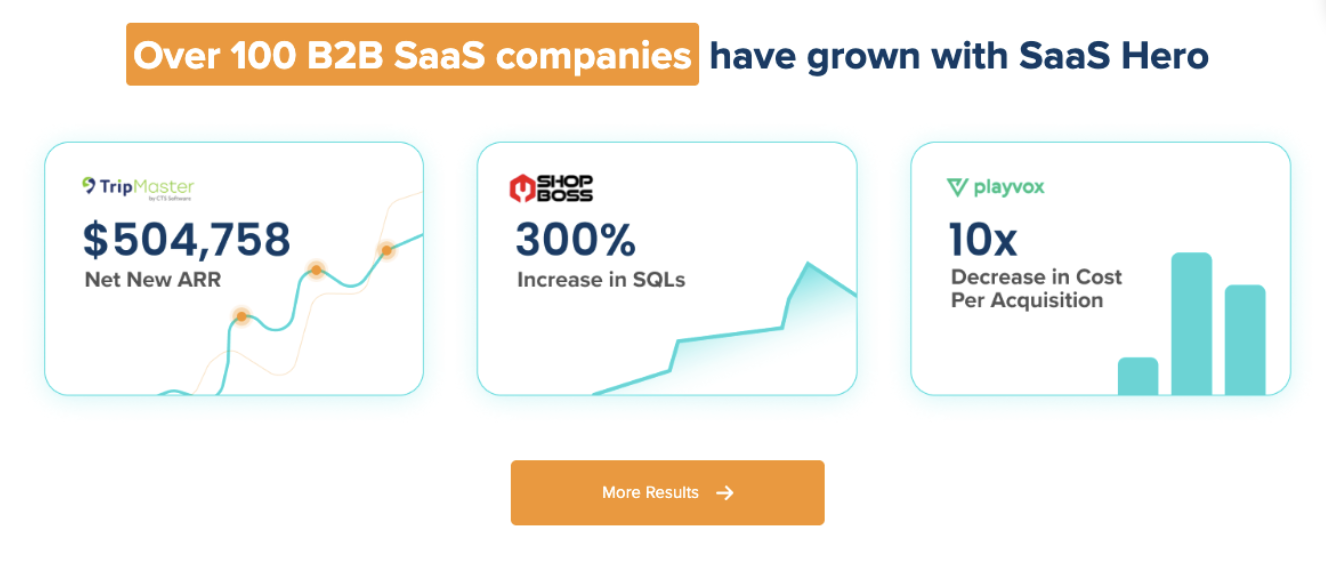
Pros: SaaSHero provides a full growth team with in-house specialists across paid media, creative, landing pages, and reporting. Published case results include $504,758 in net new ARR and 650% ROI for TripMaster, plus a 10x cost per lead reduction and 163% lead volume increase for Playvox. Reporting connects to the CRM and optimizes against pipeline outcomes instead of form-fill counts. The retainer is flat and indexed to total ad spend, so budget shifts across channels do not trigger fee changes.

Cons: The model does not fit companies below $10M revenue or $15K monthly ad spend. The team does not handle organic social. CRM tracking implementation is required to unlock the full performance model.
Best for: B2B SaaS companies that need more than a CMO and want a team that owns strategy and execution, optimizing against CRM revenue data rather than form submissions.

Book a discovery call to see if SaaSHero is the right fit for your growth stage.
Six Bait-and-Switch Red Flags to Catch Early
Reddit users on r/marketing frequently warn about agencies that promise a CMO but hand off work to juniors after the contract is signed. The most common execution gap is launching campaigns in week one without a diagnostic phase, customer interviews, or an audit. That pattern creates motion without strategy while retainer fees continue.
- The pitch is led by a senior person who will not work on your account. Ask directly who will be in the account in month seven. The bait-and-switch problem, where a seasoned senior leader sells the engagement but a junior associate executes the work, is the most cited risk in third-party agency reviews.
- The agency cannot name who does the day-to-day work. A real fractional CMO agency should name your account strategist, coordinator, and campaign manager before you sign. Red flags include no clear answer on weekly hours committed and references from companies where the operator was never accountable to revenue.
- They avoid owning landing pages or conversion rate improvement. If the agency cannot change the page your ads point to, they cannot be accountable for performance. This structure creates the single biggest flaw in many agency relationships.
- They optimize for form fills instead of CRM revenue data. An agency that optimizes to form submissions tells the ad platform that a form fill is the goal. The platform then finds the cheapest people to fill forms, not the people who buy.
- They charge per channel and resist budget shifts. When adding a channel raises your fee, the agency gains a financial interest in keeping the channel mix static. Red flags in fractional CMO engagements include vague deliverables and no 90-day plan in writing.
- They report on activity instead of pipeline. If the monthly report leads with impressions and clicks instead of pipeline, CAC, and payback period, you are buying activity instead of outcomes. Red flags indicating an engagement is missing ROI include activity without outcomes, blame-shifting to sales, and resistance to measurement.
Seven Vetting Questions for Any Fractional CMO Agency
- Who will be on my account, and are they full-time employees?
- What is your reporting cadence, and does it tie to CRM revenue data or form fills?
- How do you measure success: leads, qualified pipeline, or closed revenue?
- Can you share case studies from B2B SaaS companies at my revenue stage?
- What happens if we leave, and do we own our accounts and data?
- How do you handle creative and landing pages, in-house or outsourced?
- What does your fee structure incentivize, channel growth or performance?
What Reddit and Clutch Reviews Highlight Most
Complaints cluster around the same themes. Across Reddit threads on r/marketing and r/SaaS and Clutch reviews, buyers most often mention execution gaps, bait-and-switch staffing, and reporting that fails to show whether spend produced pipeline. The “strategy without execution” gap, where founders pay $8,000–$15,000 per month for strategy decks with no implementation support, appears as the most common complaint among fractional CMO clients.
A fractional CMO running eight retainers at 20 hours per week each would be doing 160 billable hours per week, which is unrealistic. The practical maximum is 3–5 concurrent clients. When a provider’s LinkedIn shows “CMO” at five companies in 24 months, that pattern usually signals a placement or delivery problem instead of a strong track record.
FAQ
What is the average rate for a fractional CMO?
Most fractional CMO retainers for B2B SaaS range from $8,000 to $15,000 per month, with the US average near $10,000–$12,000 for 10–20 hours per week. Hourly rates run $200–$500 depending on seniority. Full-time CMO equivalents carry a total first-year loaded cost of $300,000–$500,000+, so fractional engagements usually come in 40–60% less expensive on an annualized basis. Stage matters, with seed-stage companies typically paying $8,000–$15,000/month, growth-stage companies $12,000–$18,000/month, and mid-market companies $8,000–$20,000/month.
How is a fractional CMO different from a marketing agency?
A fractional CMO provides senior strategic leadership and typically works 10–30 hours per week, owning the marketing function, reporting to the board, and remaining accountable for pipeline outcomes. A marketing agency provides execution such as paid media, content, and SEO, but usually lacks CMO-level strategic ownership and accountability for revenue. Many B2B SaaS companies benefit most from a fractional CMO agency that combines strategy and execution under one roof and optimizes against CRM data instead of channel-level metrics. When strategy and execution sit in separate organizations, nobody clearly owns the chain from impression to CRM record.
Can a fractional CMO replace a full-time CMO?
For companies between $5M–$50M ARR, a fractional CMO can replace a significant portion of a full-time CMO’s strategic value at a lower cost. The crossover point for a full-time hire usually appears around $8M–$10M ARR, when marketing becomes core to competitive advantage, the team grows to 3–5 people, and the function requires 40+ hours per week of leadership. Below that threshold, the fractional model delivers senior judgment without equity dilution, recruiting cost, or a 3–6 month ramp. Above $50M ARR with a large marketing organization, a full-time CMO almost always makes more sense.
How do I choose between a fractional CMO and a full-service agency?
Companies that need strategy and leadership but already have an execution team should consider a solo fractional CMO. Companies that need execution but already have strategic leadership should consider a channel-specific agency. Companies that need both, and that operate as B2B SaaS with $15K+ in monthly ad spend, should consider a fractional CMO agency like SaaSHero that provides a full growth team owning strategy, creative, landing pages, and reporting, all tied to CRM revenue data. A clear signal that you need both appears when you act as strategist, project manager, and quality control for your existing agency.
What should a fractional CMO engagement deliver in the first 90 days?
A well-structured engagement should deliver a written diagnostic and 90-day plan within the first 30 days. Days 31–60 should show leading indicators such as improved ICP definition, better targeting, and new channel tests. By day 90, you should see measurable improvement in at least two of four ROI categories: pipeline contribution, customer acquisition cost, brand and awareness metrics, and marketing infrastructure. If the first 90 days produce only a strategy deck with no implementation, the engagement has already failed its most important test. Ask for a written 90-day scope of work before signing.
Conclusion: Match the Model to Your Stage and Risk
The fractional CMO market is growing at 14% annually and will hit $19.1 billion by 2033, and that growth brings variable quality. Buyers need clear criteria and a structured vetting process.
Verify who executes the work before you sign. Check third-party reviews on Clutch, GoodFirms, and Reddit to spot patterns that agency websites omit. Match the model to your need, using strategy-only retainers when you already have an execution team. When you need strategy and execution, look for a fractional CMO agency that owns paid media, creative, landing pages, and reporting, and that optimizes against CRM revenue data instead of form fills.
For B2B SaaS companies that need more than a part-time strategist, SaaSHero offers a model that avoids common pitfalls. The team uses a flat retainer indexed to ad spend, in-house specialists instead of a contractor bench, and reporting tied to pipeline instead of impressions. Every asset built during the engagement belongs to the client, and offboarding follows a clear, documented process instead of creating a hostage situation.
Ready to see how SaaSHero can own your paid acquisition? Book a discovery call.