




Written by: Aaron Rovner, Founder, Saas Hero | Last updated: September 4, 2026
Key Takeaways
- A fractional CMO can deliver 60–70% cost savings versus a full-time hire when your business has a clear strategy gap.
- Most small businesses fail with fractional CMOs when they lack an internal team or agency ready to execute the strategy.
- Companies with revenue above $2M–$3M, product-market fit, and a marketing budget of $5,000–$10,000 per month are the best candidates.
- Compared to agencies or freelancers, a fractional CMO is ideal for strategic leadership and accountability to business outcomes, not hands-on execution.
- When you need both strategy and execution under one roof, explore an outsourced growth team model with SaaSHero to reduce vendor management overhead.
What a Fractional CMO Actually Does for a Small Business
A fractional CMO is a senior marketing executive who works part-time for your business and provides strategic leadership without the cost of a full-time hire. They typically work 10–20 hours per week across multiple clients, set marketing strategy, build and manage teams or agencies, and report directly to the CEO.
The role sits between a full-time CMO and a marketing consultant. Unlike a consultant who delivers recommendations and leaves, a fractional CMO takes ownership of marketing outcomes. Unlike a full-time CMO, they are not embedded in your business daily, and they do not come with the $200,000+ salary, equity, and benefits package.
Typical responsibilities for a fractional CMO include:
- Auditing your current marketing efforts and building a strategic roadmap
- Setting positioning, messaging, and channel strategy
- Managing internal marketing staff or external agencies
- Reporting to the CEO on marketing performance against business goals
Most fractional CMOs do not handle day-to-day execution. In practice, they rarely:
- Write ad copy, design landing pages, or manage ad accounts directly
- Execute campaigns hands-on, except in very small engagements
- Provide daily availability for urgent issues
This distinction matters. A fractional CMO provides leadership and direction, and your team or partners still need to do the work.
The Benefits: How a Fractional CMO Helps a Small Business Grow
When the fit is right, a fractional CMO delivers significant value for a growing small business. The benefits owners most often report include cost savings, senior expertise, flexibility, and stronger teams.
Cost savings of 60–70% versus a full-time CMO. For a sub-$20 million company, a full-time CMO typically costs $180,000–$240,000 in base salary, plus $40,000–$70,000 in bonus, 0.5%–1.5% equity, and benefits, for an estimated $300,000–$400,000 all-in. A fractional CMO at $7,500/month costs $90,000/year, roughly 30–40% of a full-time hire’s cost, with no equity dilution, no severance risk, and easier exit options.
Access to senior expertise you could not otherwise afford. About 72.8% of fractional executives have 15 or more years of experience. You gain pattern recognition from someone who has seen what works and what fails across many growth scenarios.
Flexibility to scale up or down. You can increase hours during a product launch or fundraising round, then reduce them during a slower quarter. A fractional engagement flexes with your business in ways a full-time hire cannot.
A fresh, objective perspective. An outsider is not invested in your legacy channels, long-tenured agency, or a founder’s favorite campaign. They can make hard calls, such as cutting an underperforming vendor or shutting down a channel that no longer works.
Team building and mentorship. If you have 1–3 junior marketers, a fractional CMO can provide strategic direction and professional development. They often prevent costly hiring mistakes by helping you define what you truly need in a full-time leader.
Companies working with fractional CMOs report a 3.2x average ROI on marketing investments within 12 months. They also see 40–65% growth in marketing-attributed pipeline and 18–32% reductions in customer acquisition costs, according to MarkCMO’s 2026 statistics. Averi’s 2025 cost analysis similarly found 29% revenue growth versus 19% for companies without a fractional CMO, with CAC reductions of 15–25%.
The Drawbacks: When a Fractional CMO Is the Wrong Fit
A fractional CMO does not suit every small business. You need to understand the limitations before committing $5,000–$10,000 per month.
Part-time availability. A fractional CMO typically works 10–20 hours per week for a client and is not available 24/7 for crises or urgent opportunities, since they allocate remaining hours to other clients. If your business requires daily marketing leadership, this model will feel too light.
The strategy-without-execution trap. This is the most common failure mode. A fractional CMO builds a strong strategy, then no one executes it. Your team is too small, your agency is too slow, and the roadmap sits on a shelf. As one source notes, a fractional CMO without execution capacity underneath becomes an expensive advisor, essentially a $10,000/month strategy document.
Cost threshold. The biggest risk is hiring a fractional CMO with no execution budget behind them. Strategy without resources produces a roadmap and nothing else, which makes the engagement look like a bad investment when the real problem was scope.
Integration challenges. Integration problems are common when a fractional CMO is not fully aligned with the in-house team. Misalignment leads to disjointed work, duplicated effort, and wasted time, especially when the CMO is remote or part-time.
Given these limitations, it helps to be explicit about the situations where a fractional CMO is the wrong answer.
When NOT to Hire a Fractional CMO
Industry experts highlight several scenarios where a different model serves you better:
- You need hands-on execution more than strategy. A clear sign you do not need a fractional CMO is the ability to write down your marketing plan for the next two quarters and believe it. That situation points to an execution gap rather than a strategy gap discussed earlier.
- Your revenue is below $1M–$2M. The FractionalCXO.to hiring guide advises waiting to hire a fractional CMO if revenue is below $1M and the company is still finding product-market fit. At that stage, marketing leadership cannot fix a product the market has not validated.
- You have no internal team or budget to execute. Mordor Intelligence identifies limited client-side execution bandwidth as the top restraint on fractional CMO effectiveness. The model works best when clients have internal capacity to execute.
- You need a full-time presence. If the company needs 30 or more hours per week of marketing leadership, a full-time hire is more appropriate than a fractional CMO.
- Leadership is not ready to change. The most wasteful scenario is hiring a fractional CMO when leadership is not prepared to act on recommendations. The first 30 days produce an honest diagnosis that implicates something the leadership team will not touch, leaving the executive as an expensive observer.
What Does a Fractional CMO Cost in 2026?
Fractional CMO retainers for small businesses typically range from $3,000 to $8,000 per month, depending on experience, scope, and hours. Multiply CMO’s 2026 pricing guide breaks out retainer tiers as $5,000–$6,500/month for 2 days/week, $6,500–$8,500/month for 3 days/week, and $8,500–$10,000/month for 4 days/week. The table below summarizes these tiers and what each level of investment buys you.
| Price Point | Hours/Week | What You Get | Best For |
|---|---|---|---|
| $3,000–$5,000/month | 5–10 hours | A mid-level fractional CMO for strategy sessions, roadmap development, and vendor oversight | Companies with an internal team that needs direction |
| $5,000–$8,000/month | 10–15 hours | A senior fractional CMO who owns strategy, manages agencies, and mentors staff | Companies with 1–3 marketers who need strategic leadership |
| $8,000–$15,000/month | 15–20 hours | An experienced CMO with deep industry expertise, often including some hands-on work | Companies at $5M–$10M revenue scaling marketing significantly |
The break-even point where a full-time CMO becomes the better economic decision typically lands around $25–30M annual revenue. Below that level, a fractional engagement almost always offers the stronger trade. Treetop Growth Strategy’s 2026 benchmarks put the first-year all-in cost of a full-time CMO at $430,000–$700,000+ when you add variable compensation, equity, benefits, recruiter fees, and onboarding.
Most serious fractional CMO engagements run 6–18 months. The first 30 days focus on diagnosis, months 2–6 on building and launching, and months 6+ on optimization and transition. Short engagements of 1–3 months rarely produce meaningful results.
How to Decide: A Self-Assessment Checklist
Use this checklist before investing in a fractional CMO so you can confirm the model fits your stage and needs.
- Do you have a marketing budget of at least $5,000–$10,000 per month beyond the fractional CMO’s fee?
- Have you achieved product-market fit, with a clear understanding of who buys, why they buy, and what they pay?
- Do you have a small marketing team (1–3 people) that needs strategic direction and has execution capacity?
- Are you spending on marketing but not seeing a clear return or connection to pipeline?
- Do you need a senior strategist but cannot afford a full-time CMO’s $300,000+ total compensation?
- Is your revenue above $2M–$3M, with a proven sales process and CRM data you trust?
- Are you prepared to make changes based on the fractional CMO’s recommendations, even if it means cutting a long-tenured agency or a founder’s favorite channel?
If you answered “yes” to most of these, a fractional CMO might be a fit. The next step is clarifying who will execute the strategy. If your honest answer is that you also need someone to do the work, you need a model that combines strategy with execution under one roof.
Fractional CMO vs. Marketing Agency vs. Freelancer: Matching the Model to Your Need
The choice extends beyond a fractional CMO versus a full-time hire. Most small businesses weigh three external options and often pick based on budget or convenience. Choosing an external marketing model without matching it to the real problem is one of the most expensive mistakes businesses make. The table below compares the three options across key factors.
| Factor | Fractional CMO | Marketing Agency | Freelancer |
|---|---|---|---|
| Cost | $7,000–$15,000/month | $5,000–$30,000+/month | $375–$1,000+/day |
| Primary role | Strategic leadership, owns outcomes | Channel execution, campaign management | Specific skill gap, defined projects |
| Accountability | Business outcomes (pipeline, revenue) | Campaign KPIs (conversions, ROI) | Deliverables within scope |
| Best for | Strategy gap, leadership vacuum | Execution gap, multi-channel campaigns | Specific project or skill need |
A fractional CMO is best when you need strategic leadership and have an internal team or agency to execute. In that situation, the main problem is the strategy gap described earlier.
An agency is best when you have strategic clarity but need execution muscle. You know what to do and need a team to run the campaigns.
A freelancer is best for a specific project with a clear deliverable, such as an account audit, a campaign rebuild, or a tracking implementation.
The hybrid option. Many mid-market B2B companies combine a fractional CMO with an agency. The fractional CMO owns strategy and holds the agency accountable, and the agency executes. This approach works, yet it is expensive. When execution resources are added to a fractional CMO, total costs reach $10,000 to $25,000 per month, with two vendors to manage, communication overhead, and potential finger-pointing when results are slow.
For many small businesses, the real need is both strategic leadership and execution without the cost and complexity of managing two vendors. That situation calls for an outsourced growth team model.
The Solution: An Outsourced Growth Team Like SaaSHero
Owners who work through the checklist and realize they need both strategy and execution often turn to an outsourced growth team model, such as SaaSHero.
SaaSHero is an outsourced inbound growth team for B2B companies, with one team owning strategy and execution across paid media, creative, landing pages, and reporting. Founded in 2018, SaaSHero has served 100+ B2B companies, manages $16M in annual ad spend (over $60M lifetime), and is a Google Premier Partner (top 3% of agencies) and G2 High Performer, currently ranked #20 out of approximately 6,000 agencies.
Several aspects differentiate SaaSHero from a typical fractional CMO engagement:

- Strategy and execution under one roof. You get the strategic leadership of a CMO and the execution of a full team of 20 specialists, including in-house designers and copywriters. The work stays with one integrated team.
- One team, one fee, all channels. Paid media, creative, landing pages, attribution, and strategy come from one group on a single accountability line, instead of five separate capabilities you coordinate yourself.
- Optimization against CRM revenue data. SaaSHero optimizes campaigns around qualified pipeline, lifecycle stage, and closed revenue, rather than the conversion counts ad platforms report. This focus creates marketing that produces revenue, not just leads.
- You own every asset. Ad accounts, conversion tracking, landing page files, and dashboards belong to you. If you leave, SaaSHero sends all files, so you retain control of your infrastructure.
- Minimal management required. SaaSHero brings ideas, testing plans, creative, and recommendations. You approve what goes live, and their team handles the execution.
The cost comparison. A fractional CMO at $7,500/month plus an agency at $10,000/month for execution totals $17,500/month, before you factor in the time you spend managing both. SaaSHero’s growth team starts at $4,000/month, indexed to your total ad spend rather than the number of channels managed. You get senior strategy and full execution for less than the cost of a fractional CMO alone.
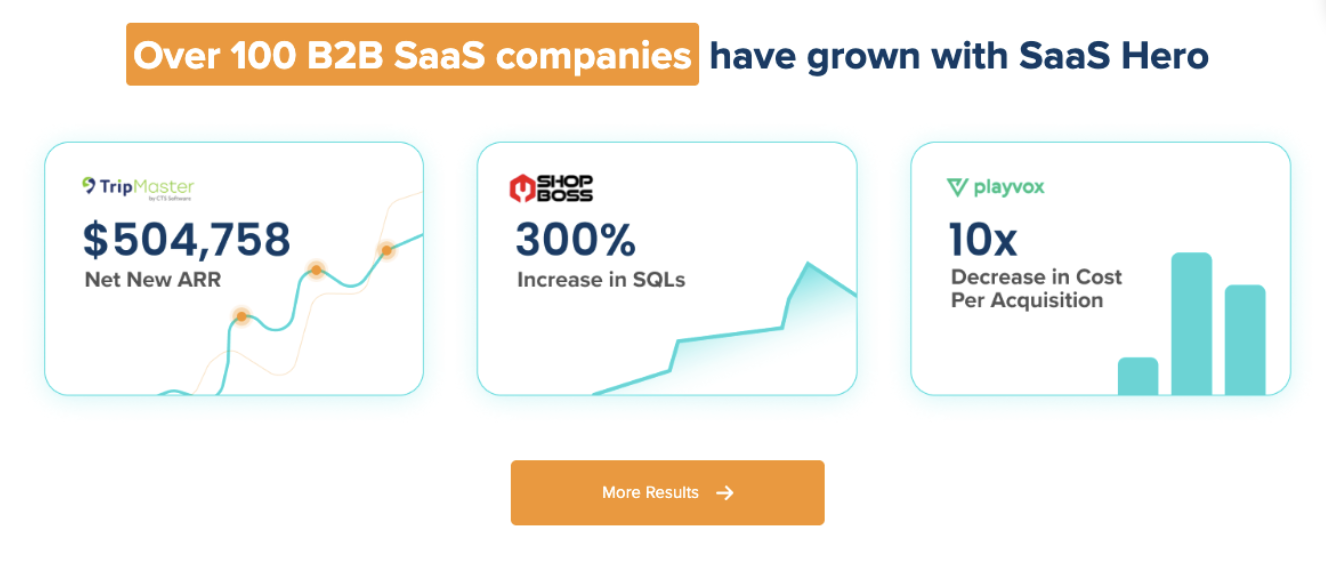
SaaSHero’s client results illustrate how this model performs in practice. TripMaster added $504,758 in Net New ARR over one year with a 650% return on ad spend. TestGorilla achieved an 80-day payback period on paid acquisition while adding 5,000+ new customers. Playvox achieved a 10x reduction in cost per lead alongside a 163% increase in lead volume. Shop Boss saw a 305% increase in conversion rate.

Frequently Asked Questions
What is the average rate for a fractional CMO in 2026?
Fractional CMO retainers for small businesses typically range from $3,000 to $8,000 per month, depending on experience and scope. More senior fractional CMOs with deep industry expertise command $8,000–$15,000 per month. Hourly rates range from $200–$500, though most engagements use a monthly retainer model rather than hourly billing. Advisory-only arrangements, where a senior CMO provides oversight rather than active leadership, can run as low as $2,500–$4,000 per month for 2–4 hours of availability. Anything priced under $2,000 per month typically provides too little availability to meaningfully own a marketing function.
How many hours does a fractional CMO work per week?
Most fractional CMOs work 10–20 hours per week for each client, typically spread across 2–4 days. Some engagements are lighter, at 5–10 hours per week for advisory work, while intensive engagements can reach 20+ hours. The key limitation is that fractional CMOs split their time across multiple clients, typically 4–6 at once, so they are not available for daily firefighting or the constant presence a growing team sometimes needs. If your marketing function requires 30 or more hours per week of leadership, a full-time hire is more appropriate.
Can a fractional CMO replace a full-time CMO?
For companies under $25M–$30M in revenue, a fractional CMO can provide comparable strategic leadership at a fraction of the cost of a full-time hire. Above that threshold, the complexity of the marketing function, including larger teams, more channels, and more cross-functional dependencies, typically justifies a full-time CMO. Many companies use a fractional CMO as a 6–18 month bridge while they grow into a full-time role, or as a way to define exactly what they need before making a permanent hire. The fractional model also carries significantly lower downside risk. A failed full-time CMO hire can cost $300,000–$500,000 in direct costs and six to eighteen months of lost momentum, while a failed fractional engagement usually costs one to two months of fees.
What are the most common reasons fractional CMO engagements fail?
The most common failure modes are predictable and avoidable. First, companies hire without execution capacity, so a fractional CMO builds a strategy that no one implements because the internal team is too small and there is no agency or budget to execute. Second, companies hire before product-market fit, and marketing leadership cannot manufacture demand for a product the market has not validated. Third, leadership refuses to act on recommendations, so if the diagnosis implicates pricing, a long-tenured agency, or a founder’s favorite channel, the engagement produces an expensive report and nothing else. Fourth, companies treat the fractional CMO like a vendor rather than an executive, which limits decision authority, access to data, and organizational buy-in, and reduces the role to observation.
Is a fractional CMO worth it for a small business?
A fractional CMO is worth it when you face the strategy gap described earlier, have a marketing budget of at least $5,000–$10,000 per month beyond the CMO’s fee, generate revenue above $2M–$3M, have product-market fit, and maintain an internal team or agency to execute the strategy. When those conditions are met, the cost savings versus a full-time hire are substantial and the strategic value is well documented. If you primarily need hands-on execution and lack resources underneath, a fractional CMO alone will not solve the problem. In that case, a model that combines strategy with execution, such as an outsourced growth team, delivers more value at a comparable or lower total cost while reducing the overhead of managing two separate vendors.