




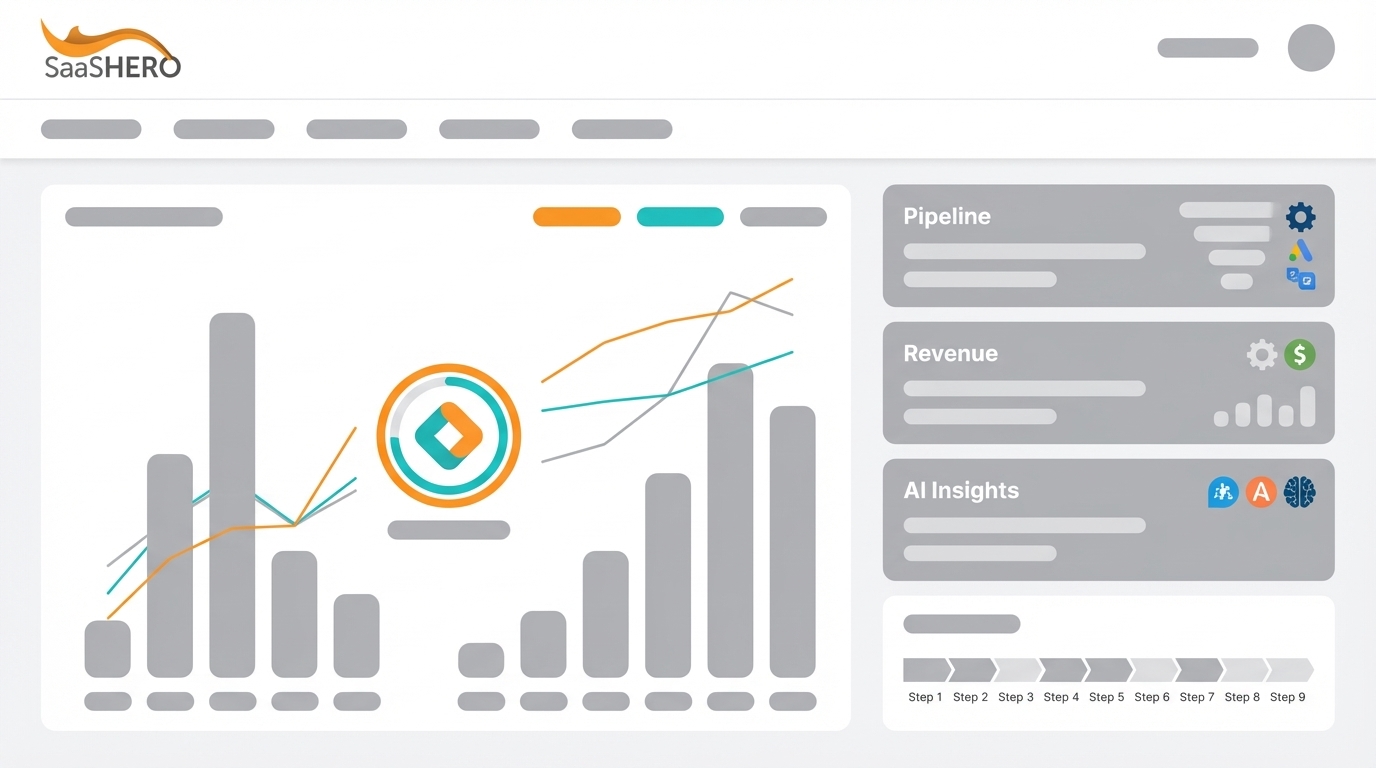
Key Takeaways for Your SaaS Revenue Engine
- Define a precise ICP and clear personas using firmographics, behavioral signals, and intent data to guide every sales activity.
- Match sales motion to ACV: PLG for under $5k, hybrid for $5k–$50k, and sales-led for enterprise deals above $50k.
- Run lead generation with competitor conquesting, omnichannel nurture, and ABM that reaches high-intent prospects across at least five touches.
- Track revenue KPIs such as LTV:CAC of 3:1 or higher, CAC payback under 12 months, and SQL conversion above 20% using multi-touch attribution.
- Partner with SaaSHero to apply this 9-step framework and build predictable ARR growth.

The 2026 B2B SaaS Revenue Crisis
B2B SaaS companies face rising acquisition costs and slowing growth efficiency. Benchmarkit’s analysis of 936 SaaS companies found a median New CAC Ratio of $2.00, up 14% from 2023, so teams now spend $2 to acquire $1 of new ARR. At the same time, B2B buying groups typically involve 6 to 10 stakeholders, which stretches sales cycles and complicates attribution.
The core problems behind this efficiency crisis include:
- Misaligned sales and marketing incentives that create pipeline gaps
- Poor attribution models that hide true revenue drivers
- Immature PLG implementations that lose qualified prospects
- Vanity metrics that mask deteriorating unit economics
- Dark funnel journeys that obscure buyer intent signals
This framework solves these issues by aligning GTM strategy and sales execution around revenue outcomes. Schedule a GTM audit to review your current GTM-sales integration and uncover near-term improvement opportunities.
Executive Summary: 9 Steps to a Revenue-First GTM Motion
This framework focuses on Net New ARR growth through a tightly integrated sales process. Success shows up in specific metrics:
- LTV:CAC ratio of 3:1 or higher
- CAC payback periods under 12 months
- SQL-to-customer conversion rates above 20%
- Pipeline velocity improvement of at least 25%
Companies that follow this approach see tangible results. TripMaster added $504k in Net New ARR, and TestGorilla reached an 80-day CAC payback period that supported their $70M Series A raise.
Step 1: Define ICP and Buyer Personas with Precision
Clear ICP definition anchors every downstream sales and marketing decision. Map firmographics such as company size, industry, and tech stack, then layer in behavioral signals like pricing page visits and competitor research, along with pain indicators. Over 70% of B2B marketers now use intent data to identify ideal customer profiles and prioritize accounts for tailored outreach.
Build detailed buyer personas that cover decision authority, budget cycles, and evaluation criteria. Use AI tools to track digital body language and engagement patterns across your website, content, and competitor mentions so your team focuses on accounts that are actively researching solutions.
Step 2: Match Sales Motion to ACV and Buying Complexity
Your Average Contract Value should guide your primary sales motion. PLG typically delivers lower CAC, averaging $8,000, with faster time to value, while sales-led motions drive higher initial ACV from $10,000 to $500,000+ but require 30 to 180 day sales cycles.
Use PLG for ACV under $5k where customers can experience value through self-serve onboarding. For $5k–$50k ACV, run a hybrid motion that combines PLG acquisition with inside sales support to convert and expand accounts. For enterprise deals above $50k, rely on a full sales-led approach that supports multi-stakeholder navigation and complex evaluations.
Step 3: Build Lead Generation and Nurture That Targets Intent
Systematic lead capture across high-intent channels keeps your pipeline healthy. Run competitor conquesting campaigns that target searches like “[Competitor] pricing” and “[Competitor] alternatives.” Support these campaigns with comparison landing pages that address specific pain points and switching barriers.
Use account-based marketing for enterprise accounts and rely on intent data to spot active buying windows. Modern GTM programs coordinate LinkedIn, email, phone, and ads with at least five touches over two to three weeks, which now serves as the baseline for 2026 outreach.
Step 4: Equip Sales and Configure CRM for Revenue Clarity
A well-configured CRM gives you clear visibility from first touch through closed-won. Track revenue attribution at each stage, and implement lead scoring that blends behavioral signals, firmographic fit, and engagement intensity. Create sales playbooks that map talk tracks to buyer personas and deal stages so reps stay consistent.
Establish qualification frameworks such as BANT or MEDDIC to keep lead evaluation consistent across the team. For deals that pass qualification and enter complex enterprise cycles, build mutual action plans that outline shared milestones and responsibilities, which helps maintain momentum through long evaluations.
Step 5: Shorten Sales Cycles with Structured Discovery
Thoughtful discovery and clear micro-commitments move deals faster. Strategic discovery conversations that use 11–14 targeted, problem-centered questions help reps close 30% more deals and increase close rates by 74%.
Define stage-gate criteria so opportunities cannot advance without proper qualification and next steps. Use regular pipeline reviews to uncover bottlenecks, coach individual reps, and refine your process where deals consistently stall.
Step 6: Use Templates and Scripts Across the Buyer Journey
Structured messaging keeps your team aligned at every stage. Develop AI-personalized outreach templates that speak to specific use cases and pain points to start relevant conversations. Once prospects engage and request demos, use scripts that highlight differentiated value and ROI tailored to their stated needs.
Prepare objection-handling frameworks for common competitive situations that arise during evaluations so reps can respond with confidence. Standardize follow-up sequences with automated nurture campaigns that trigger based on behaviors or engagement thresholds, which ensures no warm prospect slips through the cracks.
Step 7: Track Attribution and KPIs That Reflect Revenue Impact
Revenue-focused metrics keep teams aligned on outcomes that matter. Track Net New ARR, pipeline velocity, and customer acquisition efficiency. Aim for an LTV:CAC ratio of at least 3.6:1 with CAC payback periods under 12 months.
As outlined in the framework overview, focus on reaching the 3:1+ LTV:CAC and sub-12-month payback targets through multi-touch attribution that connects ad clicks and campaigns to closed revenue. Monitor conversion rates at each funnel stage so you can pinpoint where to refine messaging, qualification, or channel mix.
Step 8: Integrate AI Across Your GTM and Sales Workflow
AI expands sales capacity by handling repetitive work and surfacing insights. Deploy AI agents for lead enrichment, qualification, and automated follow-up. Sales reps currently spend only 28% of their time on selling activities, and AI tools can automate CRM updates, research, and scheduling so more time goes to revenue-generating work.
Use predictive analytics to score deal probability and highlight expansion opportunities inside existing accounts. Implement chatbots for initial qualification and meeting scheduling so prospects receive fast responses and your reps focus on high-value conversations.
Step 9: Iterate and Scale What Consistently Works
Regular iteration keeps your GTM motion efficient as markets shift. Run monthly performance reviews that analyze win rates, cycle times, and pipeline health by segment. A/B test messaging, pricing narratives, and demo flows, then roll out the variants that improve conversion.
Document successful motions in clear playbooks and use them to train new team members as you scale. Refine your ICP and personas based on closed-won analysis and churn patterns so your targeting stays aligned with accounts that retain and expand.
Sales Motion Trade-offs for PLG, Sales-Led, and Hybrid Models
Before you scale any motion, understand how PLG, sales-led, and hybrid approaches affect your economics and operations. The comparison below highlights how each motion influences acquisition efficiency, deal size, and complexity so you can choose the right mix for your ACV bands.
| Motion | Pros | Cons |
|---|---|---|
| PLG | Efficient customer acquisition, fast time-to-value, viral growth potential | Limited enterprise penetration, requires strong product maturity |
| Sales-Led | High ACV ($50k+), deep relationships, support for complex deals | Higher CAC, longer cycles (3–6 months), scaling challenges |
| Hybrid | Balanced economics, broad market coverage, flexibility across segments | Operational complexity, resource allocation challenges |
SaaS Case Studies and How They Applied the Framework
TripMaster generated $504,758 in Net New ARR by running comprehensive paid search and social campaigns supported by disciplined conversion optimization. Their 650% ROI and 20% conversion rate from paid search show how integrated GTM and sales execution can transform paid channels into reliable revenue engines.

TestGorilla scaled to more than 5,000 new customers while maintaining an 80-day CAC payback period, which gave investors confidence in the scalability of their revenue model and supported a $70M Series A raise.
Playvox cut Cost Per Lead by 10x through account restructuring and negative keyword optimization. This result illustrates how targeted tactical changes can dramatically improve efficiency without increasing budget.
Work with our team to apply these approaches inside your own SaaS motion and pursue similar outcomes.

Common Pitfalls and Revenue-Focused Success KPIs
While these case studies show what strong execution can deliver, many SaaS companies still stumble on predictable mistakes that block similar results. Avoid these critical errors:
- Chasing vanity metrics instead of revenue outcomes
- Allowing misaligned sales and marketing handoffs to create friction
- Accepting weak lead qualification that bloats the pipeline
- Using poor attribution that hides true channel performance
- Scaling spend before validating unit economics
To confirm that you are avoiding these pitfalls, track KPIs that reflect revenue quality and efficiency. The benchmarks below show where most SaaS companies sit today compared with best-in-class targets.
| KPI | Industry Benchmark | Best-in-Class Target |
|---|---|---|
| CAC Payback | 20 months | Under 12 months |
| LTV:CAC Ratio | 3.6:1 | 5:1+ |
| SQL Conversion | 13–25% | 30%+ |
Conclusion and Practical Next Steps
This 9-step framework gives you a clear structure for revenue-driven GTM execution. When you focus on unit economics, accurate attribution, and continuous optimization, you create a growth engine that fits 2026’s capital-efficient environment.
Start by auditing your current ICP definition and how well your sales motion aligns with it so you understand your baseline. Before you scale any spend, put proper tracking and attribution in place, because you cannot improve what you cannot measure. If your team lacks deep experience with B2B SaaS unit economics, partner with specialists who can apply this framework systematically instead of learning through costly trial and error.
Partner with SaaS growth specialists to implement this framework and build predictable Net New ARR with proven methods.
FAQ
What are the essential GTM strategy sales process steps?
The 9 essential steps cover ICP definition, sales motion selection, lead generation systems, CRM enablement, cycle optimization, template and script development, attribution tracking, AI integration, and continuous iteration. Each step builds on the previous one to form a complete revenue engine.
How do I choose between PLG and sales-led GTM motions?
Your ACV and buying complexity guide this choice, as outlined in Step 2. The key decision points are whether your product can deliver self-serve value through PLG, needs sales assistance to convert and expand accounts in a hybrid model, or requires full sales-led engagement to manage complex stakeholders and long evaluations.
What KPIs should I track for GTM sales process effectiveness?
Track revenue-focused metrics such as Net New ARR, CAC payback periods, LTV:CAC ratios, SQL conversion rates, pipeline velocity, and win rates by segment. Avoid vanity metrics like impressions or raw clicks that do not connect directly to closed revenue.
How can I reduce CAC payback periods in my SaaS business?
Improve ICP targeting so you focus on segments with the highest conversion and retention. Run competitor conquesting campaigns for high-intent prospects, tighten lead qualification to remove low-quality opportunities from the pipeline, and use AI automation to increase rep productivity. These changes work together to bring CAC payback under 12 months.
What role does AI play in modern GTM sales processes?
AI handles administrative tasks such as lead enrichment, CRM updates, and follow-up scheduling so reps can spend more time selling. It also powers predictive lead scoring, personalized outreach at scale, and real-time coaching recommendations that improve conversion rates and shorten sales cycles.