




Written by: Aaron Rovner, Founder, Saas Hero | Last updated: September 6, 2026
Key Takeaways For Insurtech Revenue Teams
- Insurtech email marketing works as a lifecycle-driven, behavior-triggered revenue engine that far outperforms paid search and social.
- Automated flows beat batch newsletters. Triggered emails achieve 31.4% open rates and 5.31% CTR versus 21.33% and 2.62% for standard sends.
- B2B insurtech audiences need longer, multi-stakeholder nurture sequences. B2C flows are shorter and more direct. Segmented campaigns generate 760% more revenue than non-segmented blasts.
- The five highest-impact flows are quote abandonment, onboarding, renewal, cross-sell and upsell, and win-back. Each one triggers from customer behavior rather than calendar dates.
- Teams that want email to become a measurable ARR driver can schedule a strategy session with SaaSHero to map the full lifecycle program.
Why Email Is Your Most Underutilized ARR Driver
Most insurtech marketing teams send batch newsletters and stop there. The gap between that approach and a true lifecycle program is where revenue quietly leaks out of the funnel. Consider the channel comparison: paid search returns roughly $2 per $1 spent and paid social around $2.80, while email delivers a far higher return on average.
Email also functions as an owned channel. Performance compounds over time and continues even when paid budgets tighten. The performance gap between batch sends and automated flows is equally stark. Automated or triggered emails achieve an average open rate of 31.4% and a CTR of 5.31%, compared to 21.33% and 2.62% for standard campaign sends. B2B email marketing generates $0.47 revenue per email sent, significantly higher than typical B2C performance. The real lever is the shift from broadcast to lifecycle automation, not the channel itself.
The table below summarizes the ROI gap across channels and shows why email deserves a larger share of your budget.
| Channel | Average ROI Per $1 Spent |
|---|---|
| Email Marketing | $36–$42 |
| Paid Search | $2 |
| Social Advertising | $2.80 |
| Display Ads | $1.35 |
If you are ready to turn your email channel into a measurable ARR driver, talk with SaaSHero about building a lifecycle program.
Segmentation For B2B And B2C Insurtech Audiences
Insurtech programs perform best when they respect the different journeys of carriers, brokers, MGAs, and consumers. The buyer journey, messaging, and required flows differ fundamentally between B2B and B2C motions.
For B2B: Multi-touch, committee-based buying is the norm. Messaging stays educational and ROI-focused and addresses the specific pain points of each stakeholder role. A Chief Claims Officer cares about different outcomes than a Chief Actuarial Officer. Flows run longer, feel more consultative, and trigger from behaviors such as content downloads, pricing page visits, or demo requests.
For B2C: The buyer is an individual making a personal decision under time pressure. Messaging stays clear, benefit-driven, and anxiety-reducing. Flows remain shorter and more direct, with a single clear call to action in each email.
The revenue case for segmentation is unambiguous. Segmented campaigns generate 760% more revenue than non-segmented broadcasts. Use first-party data to segment by policy type, risk tier, company size, or geography. For B2B insurtechs, layering in intent signals such as product pages viewed allows messaging that meets buyers at their current decision stage.
Five Core Lifecycle Flows That Drive Revenue
Teams unlock the largest gains when they move from batch blasts to automated, behavior-triggered flows. Each flow below is event-based rather than calendar-based, which explains why these programs convert at levels newsletters rarely reach.
- Quote Abandonment: Trigger this flow when a prospect starts a quote or application but does not complete it. For B2B commercial lines, this often means a complex multi-step form. Send the first email within one hour with a direct link back to the saved application and an offer of assistance. A well-configured B2B abandoned action sequence can recover 15–25% of incomplete conversions, with the first email alone recovering 12–18% within 24 hours. Recovery rate drops sharply after 72 hours, so speed becomes the primary variable.
- Onboarding: Trigger this flow immediately after a policy activates or a B2B client signs a contract. Confirm the activation, guide the new customer through portal setup, and introduce key features and support contacts. Welcome emails generate 320% more revenue per email than promotional emails and carry an average open rate of 82%, the highest of any email type.
- Renewal: Send automated alerts at 90, 60, and 30 days before policy expiration to reduce churn. For B2B, the 60-day touchpoint offers a chance to re-engage the economic buyer and demonstrate value delivered over the past year. For B2C, a clear reminder with a single call to action usually suffices. Renewal sequences often deliver strong ROI because they protect existing ARR instead of requiring new acquisition spend.
- Cross-Sell And Upsell: Trigger these flows from behavioral signals such as a B2B client adding a new office location, a policyholder browsing a new coverage type, or a usage milestone in a SaaS platform. Suggest relevant coverage upgrades or complementary products at the moment of highest relevance. These flows extend LTV while holding CAC steady.
- Win-Back: Target lapsed customers or inactive users with a re-engagement sequence. Re-engagement campaigns win back an average of 14% of inactive subscribers. Offer a clear value proposition, ask for feedback, or present a relevant case study. Suppress non-responders after the sequence to protect deliverability.
Compliance For HIPAA, GLBA, And GDPR Programs
Insurtechs carry a compliance burden that generic email marketing guides rarely address. Depending on the data you handle and the markets you serve, three regulatory frameworks may apply at the same time. Non-compliance creates real financial and reputational risk.
HIPAA Requirements For Health Data
- If you use protected health information (PHI) to personalize or target marketing, obtain written patient authorization before sending.
- Ensure your email platform signs a Business Associate Agreement (BAA), since mainstream platforms including standard HubSpot and Mailchimp do not sign BAAs in their base plans.
- Avoid PHI in subject lines. Use generic copy with a secure authenticated link for clinical detail.
- Encrypt data in transit and at rest, and maintain comprehensive audit trails.
- As of January 2026, HIPAA civil penalties range from $145 per violation for unknowing offenses to over $2.1 million annually per violation category for willful neglect.
GLBA Requirements For Financial Data
- Provide clear privacy notices explaining what nonpublic personal information (NPI) is collected and with whom it is shared.
- Implement a comprehensive information security program under the FTC’s updated Safeguards Rule, which extends to customer lists, email addresses, and behavioral data collected through marketing platforms.
- Protect NPI across your entire marketing data layer, including your CRM, marketing automation platform, and ad platforms.
GDPR Requirements For EU Customers
- Obtain valid, explicit, and granular consent. Avoid pre-ticked boxes and bundled consent with terms acceptance.
- Honor data subject rights including access, erasure, and portability within one month.
- Document consent with timestamps, the specific wording used, and the mechanism of capture.
- Plan for potential fines of up to €20 million or 4% of global annual turnover, whichever is higher.
General Requirements For All Email Programs
Regardless of which regulations apply, every email program must meet these baseline requirements to remain compliant.
- Include a clear, functioning opt-out mechanism in every email, and process unsubscribe requests within 10 business days under CAN-SPAM.
- Maintain a physical postal address in every email footer so recipients can identify the sender.
Email Deliverability: How To Stay Out Of The Spam Folder
High-volume lifecycle emails from insurtechs face a specific deliverability challenge. Insurance carriers and enterprise financial institutions often run security filters such as Proofpoint, Mimecast, and Barracuda that scrutinize inbound email aggressively. A technically sound program forms the baseline requirement.
- Authenticate Your Domain: SPF, DKIM, and DMARC are non-negotiable. Senders without proper authentication see inbox placement rates drop to 44.2%, compared to 89.1% for fully authenticated domains, which represents a 45-percentage-point gap.
- Maintain List Hygiene: Keep bounce rates under 2% (ideally under 1%) and spam complaint rates under 0.1%. Remove invalid addresses before sending and suppress unengaged subscribers after 60–90 days of no activity.
- Monitor Sender Reputation: Use Google Postmaster Tools and Microsoft SNDS to track your sender score weekly. If domain reputation drops, reduce volume immediately and send only to your most engaged contacts.
- Warm Up New Domains: Warm new sending domains for 4–6 weeks before scaling volume. Start at 20–30 emails per day and increase gradually.
- Use Multipart MIME: Send both HTML and plain-text versions. HTML-only messages tend to score worse with modern filters.
Once your emails reliably reach the inbox, the next frontier is making them relevant enough that recipients act on them.
Personalization And Behavioral Triggers For 2026 Programs
First-name personalization now counts as a basic requirement. The programs generating outsized returns in 2026 rely on behavioral data such as page visits, content downloads, product usage events, and CRM lifecycle stage changes to trigger emails at the moment of highest relevance.
For B2B insurtechs, consider a practical example. A prospect visits your pricing page twice in one week. That behavioral signal triggers a targeted follow-up with a relevant case study or a direct offer to schedule a demo. This approach consistently outperforms newsletters because the message aligns with demonstrated intent.
AI further amplifies these gains. AI-generated subject lines outperform human-written ones by 26%, and combining AI subject lines with dynamic send-time optimization adds another 14% lift. AI-powered email programs see 41% higher revenue than manual programs. Predictive send-time optimization increases open rates by 23%. These gains compound across every send in a high-volume lifecycle program.
Measuring Success With Revenue-Focused Metrics
Revenue-focused teams treat open rates as a directional signal rather than a primary metric. Apple’s Mail Privacy Protection inflates open rates by 8–15% by pre-loading tracking pixels. Click-through rate and pipeline attribution provide a more accurate basis for board reporting.
The metrics that matter for a B2B insurtech marketing leader are clear.
- Email-Attributed Pipeline: Use multi-touch attribution in your CRM to identify which emails influenced deals in progress. Only 23% of B2B marketers consistently track pipeline influenced by email, while most teams still focus on opens and clicks.
- Renewal Rate Lift: Measure the retention impact of your renewal sequences against a baseline. This metric provides the clearest direct link between email activity and ARR protection.
- Cross-Sell Revenue: Track revenue generated from cross-sell and upsell campaigns separately to demonstrate email’s contribution to expansion ARR.
- CAC Payback: Understand how email-driven customers affect your payback period. A healthy B2B SaaS target sits under 12 months.
For context on strong performance, B2B email marketing generates $0.47 revenue per email sent. Lending and insurtech email campaigns achieve open rates of 22–27% and CTRs of 2.2–3.0%. A strong B2B CTR falls between 2.5% and 4.0%, yet the metric that matters to your board remains pipeline rather than clicks.
Get a personalized walkthrough from SaaSHero to connect your email program to CRM revenue data so you can report pipeline instead of platform vanity metrics.
Why SaaSHero Is The Right Partner For Insurtech Email Marketing
Building a revenue-focused email program requires specialized skills in lifecycle marketing, compliance awareness, and CRM-connected reporting. Most insurtech marketing teams, typically two to four people, lack the capacity to cover campaign strategy, creative, landing pages, attribution, and deliverability at a high level.
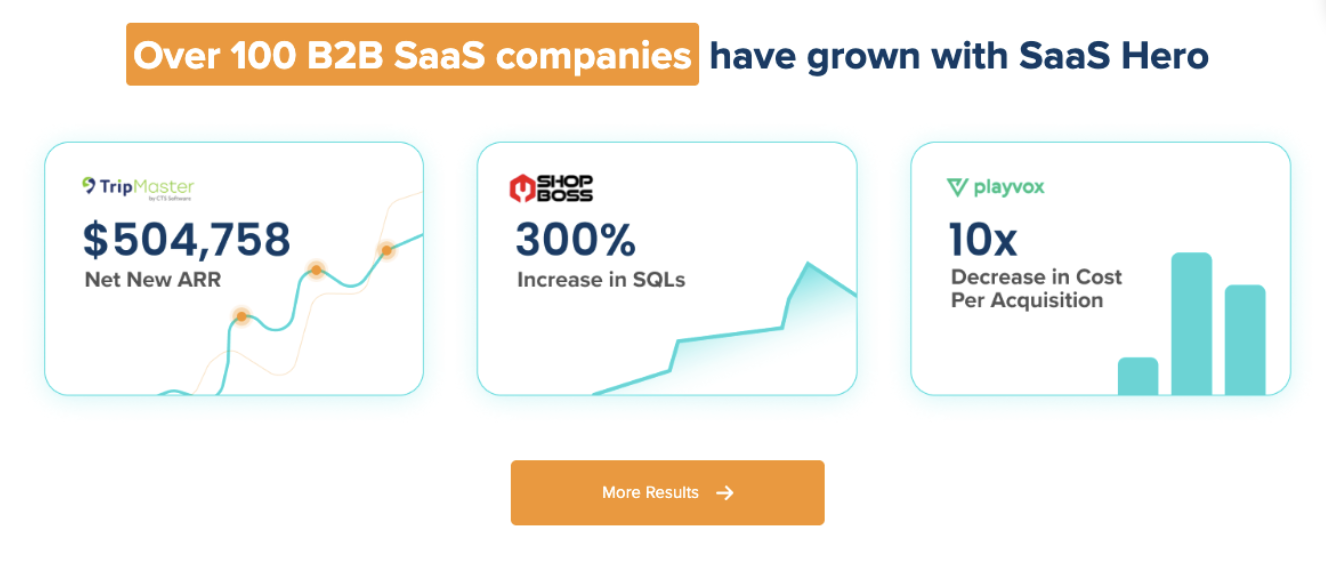
SaaSHero serves as the outsourced inbound growth team for B2B companies. Founded in 2018, SaaSHero has managed over $60 million in lifetime ad spend and served more than 100 B2B companies. The team owns the entire inbound acquisition engine, including paid media, creative, landing pages, and reporting, and optimizes everything against CRM revenue data rather than form-fill counts. The team connects campaign activity to qualified pipeline, lifecycle stage, and closed revenue, not just opens and clicks.
The SaaSHero model gives insurtech marketing leaders a single team that owns strategy and execution across every capability area. Creative comes from full-time in-house designers and copywriters. The same team designs, builds, hosts, and tests landing pages while running the campaigns that drive traffic. Reporting runs inside your CRM, whether HubSpot or Salesforce, so the numbers your board requests match the numbers your dashboard shows. The retainer is indexed to total monthly ad spend rather than channel count, so adding or removing a channel carries no fee consequence and every recommendation rests on performance data.

SaaSHero is a Google Premier Partner, placing it in the top 3% of agencies, and a G2 High Performer in Digital Marketing, currently ranked #20 of approximately 6,000 agencies. Every asset built during an engagement belongs to the client during and after the relationship.

Frequently Asked Questions
Is Email Marketing Still Worth It For Insurtechs In 2026?
Email marketing continues to deliver the strongest ROI among digital channels. For B2B insurtechs, the case is even stronger than the averages suggest. B2B email revenue per send significantly outperforms B2C because deal sizes are larger, sales cycles are longer, and a well-timed email to the right stakeholder can move a six-figure deal forward. Unlike paid media, email functions as an owned channel that compounds over time. A well-maintained, segmented list becomes a business asset that grows in value as behavioral data accumulates.
How Is B2B Insurtech Email Marketing Different From Insurance Agent Email Marketing?
The top search results for “insurance email marketing” focus on individual agents doing B2C lead generation for personal auto, home, and life policies. B2B insurtech email marketing follows a different discipline. The buyer is a carrier, broker, MGA, or enterprise business rather than an individual consumer. Sales cycles typically run six to eighteen months or longer, with some segments extending to 18–36 months. Buying committees generally involve five to ten decision-makers across different functions. Messaging must stay educational, ROI-focused, and role-specific. Compliance obligations such as HIPAA, GLBA, and GDPR are more complex. Measurement frameworks must connect email activity to pipeline and ARR instead of policy quotes, so generic agent advice rarely works for a B2B insurtech audience.
What Compliance Regulations Apply To Insurtech Email Marketing?
The compliance landscape for insurtechs is more complex than for most B2B SaaS companies. Three frameworks commonly apply at the same time. HIPAA governs any email program that uses protected health information to target or personalize content and requires written patient authorization, a signed Business Associate Agreement with your email platform, and strict content controls. GLBA applies to insurtechs handling consumer financial data and requires privacy notices, a comprehensive information security program under the FTC Safeguards Rule, and protection of nonpublic personal information across the marketing data layer. GDPR applies to any insurtech with EU customers and requires explicit and granular consent, documented consent records, and the ability to honor data subject rights within one month. CAN-SPAM applies to all commercial email in the US and requires a functioning opt-out mechanism, a physical postal address, and processing of unsubscribe requests within 10 business days. A practical starting point is to audit which regulations apply to your specific data flows, then confirm that your email platform will sign the necessary agreements before any campaign goes live.
What Are The Most Important Lifecycle Flows For A B2B Insurtech?
The five flows with the highest revenue impact are quote abandonment, onboarding, renewal, cross-sell and upsell, and win-back. Quote abandonment often delivers the fastest win because a sequence triggered within one hour of an incomplete application can recover a meaningful share of those prospects. Onboarding represents the highest-engagement moment in the customer lifecycle, as the welcome email revenue lift mentioned earlier demonstrates. Renewal sequences protect existing ARR by reducing churn at the moment of highest risk. Cross-sell and upsell flows extend LTV by triggering on behavioral signals rather than calendar dates. Win-back campaigns recover a portion of inactive subscribers. All five flows trigger from customer behavior rather than a send schedule, which explains their superior conversion rates compared with newsletters.
How Should Insurtechs Measure Email Marketing ROI?
Insurtechs need a measurement framework that shifts from engagement metrics to revenue metrics. Open rates remain unreliable because Apple’s Mail Privacy Protection inflates them by 8–15%. The metrics that matter to a board include email-attributed pipeline, renewal rate lift, cross-sell revenue, and CAC payback period. Email-attributed pipeline tracks which deals were influenced by email, measured via multi-touch attribution in your CRM. Renewal rate lift captures the retention impact of renewal sequences. Cross-sell revenue quantifies expansion ARR generated by upsell campaigns. CAC payback shows how quickly email-driven customers repay acquisition costs. A CRM-connected reporting layer that joins email activity to lifecycle stage changes and closed revenue replaces static monthly PDFs of platform metrics. Only 23% of B2B marketers consistently track pipeline influenced by email, so most teams still underreport their strongest channel to leadership.
Conclusion: Turn Email Into Your Insurtech Growth Engine
Email functions as a growth engine rather than a simple newsletter tool. For B2B insurtechs, it becomes the highest-ROI channel in the marketing stack when executed as a lifecycle system with behavioral triggers, precise segmentation, and measurement tied to CRM revenue data. The gap between batch blasts and automated lifecycle flows represents the ARR most insurtech marketing teams leave on the table.
The playbook stays straightforward. Build the five core lifecycle flows, segment B2B and B2C audiences separately, authenticate your domain and maintain list hygiene, navigate HIPAA, GLBA, and GDPR with documented processes, and measure pipeline and renewal rate lift instead of opens and clicks. The challenge for a two-to-four-person marketing team rarely comes from knowing the right moves. Capacity and specialist expertise usually limit execution.
SaaSHero owns this entire engine for B2B companies. From lifecycle flow strategy and segmentation to deliverability, CRM attribution, and board-ready reporting, the team operates as your outsourced inbound growth function and focuses on revenue outcomes rather than form fills. Request a free email program audit to see exactly where the revenue opportunity sits in your current setup.