




Written by: Aaron Rovner, Founder, Saas Hero
Key Takeaways for B2B SaaS Leaders
-
No-percentage models like fixed retainers ($1,250-$7,000/mo) and pay-per-lead ($50-200/SQL) align agency incentives with B2B SaaS revenue outcomes and prevent ad spend inflation.
-
Flyweel’s 2026 study reports pay-per-lead models deliver 23% lower CPA and 2x higher qualified lead volume compared to traditional percentage-based agencies.
-
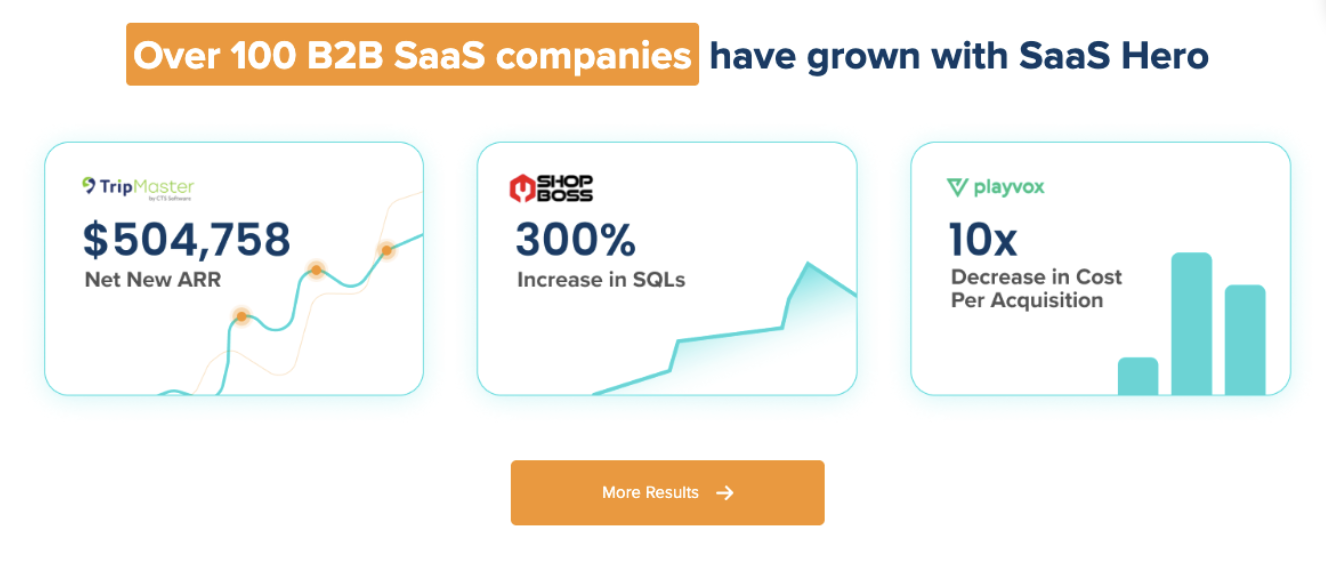
SaaSHero ranks #1 with tiered fixed retainers, generating $504k Net New ARR for clients like TripMaster at 650% ROI and an 80-day payback.
-
Key red flags include percentage fees, long-term contracts, and vanity metrics. Demand month-to-month terms and Net New ARR tracking.
-
Ready for predictable SaaS growth? Schedule a discovery call with SaaSHero to benchmark your lead generation performance against proven revenue outcomes.
3 No-Percentage Spend Models for B2B SaaS
Comparing these three structures side by side helps you match pricing to your growth stage, sales cycle, and appetite for performance risk. Review the trade-offs, then map them to your current pipeline goals.
|
Model |
Pros |
Cons |
SaaS Example |
|---|---|---|---|
|
Fixed Retainer |
Predictable costs, no spend inflation |
Fixed scope limitations |
SaaSHero: $1,250-$7k/mo by spend band |
|
Pay-Per-Lead |
Agency assumes performance risk |
Quality control challenges |
$75-150 per SQL |
|
Pay-Per-Appointment |
Sales-aligned outcomes |
Higher per-unit costs |
$200-500 per qualified meeting |
Fixed Retainer Benefits: SaaSHero’s tiered structure ($1,250-$7k monthly based on spend bands) provides cost predictability without percentage inflation. When they recommend scaling from $15k to $20k monthly spend, their fee remains constant, which shows the recommendation supports your growth rather than their revenue.
Pay-Per-Lead Advantages: Agencies like UnboundB2B operate on 100% performance models, charging $75-150 per sales-qualified lead. This shifts performance risk to the agency and ensures you only pay for leads that meet agreed qualification criteria.
Month-to-Month Flexibility: Hidden minimum spends and long-term commitments restrict your ability to adjust strategy. SaaSHero’s month-to-month agreements remove long-term lock-ins and keep pressure on performance, because the team must re-earn your business every 30 days.

Once you understand how these pricing models work, you can evaluate which agencies actually deliver on no-percentage promises. The next section highlights four providers that pair transparent pricing with measurable revenue impact.
Top 4 Lead Generation Agencies With No Percentage Spend (2026)
|
Rank |
Agency |
Model |
Pricing Range |
Key Result |
|---|---|---|---|---|
|
1 |
SaaSHero |
Fixed Retainer |
$1,250-$7,000/mo |
$504k Net New ARR (TripMaster) |
|
2 |
Belkins |
Fixed Retainer |
$5,000-$15,000/mo |
200% pipeline increase |
|
3 |
UnboundB2B |
Pay-Per-Performance |
$75-200/lead |
227% ROI increase |
|
4 |
Martal Group |
Fixed Retainer |
$8,000-$20,000/mo |
35 SQLs/month average |
#1 SaaSHero: SaaSHero leads this list as a specialist partner for B2B SaaS companies. Their flat retainer structure removes spend-push incentives and focuses every decision on Net New ARR. TripMaster achieved the results mentioned above through a program that tied campaigns directly to pipeline and revenue. Senior-led execution keeps strategy and optimization in experienced hands instead of passing accounts to junior managers after onboarding.

#2 Belkins: Belkins reports 200% pipeline increases within 3 months for SaaS companies through multi-channel outbound campaigns. Fixed monthly retainers prevent percentage-based conflicts and support consistent outreach volume. Pricing starts higher at $5k monthly, which suits teams with established budgets and clear ICP definitions.
#3 UnboundB2B: UnboundB2B runs a pure performance model and charges only for qualified leads delivered. They generated 154 high-quality leads in 12 weeks for a US SaaS firm with 227% ROI using intent-based targeting and strict qualification rules. This structure fits SaaS teams that want to cap risk while validating new markets or offers.
#4 Martal Group: Martal Group uses a retainer-based model focused on outbound prospecting for technology and SaaS firms. Typical programs generate around 35 SQLs per month, which supports steady pipeline growth for mid-market sales teams. Higher retainers reflect the senior talent and multi-channel outreach included in their service.
SaaSHero’s main advantage comes from revenue-first reporting. While many competitors highlight impressions, clicks, and generic lead counts, SaaSHero tracks Net New ARR through CRM integration that connects ad clicks and outbound touches to closed-won revenue. This approach lets SaaS leaders compare agency performance directly against board-level growth targets.

After you identify the right model and shortlist agencies, you need realistic pricing benchmarks. The next section breaks down what B2B SaaS companies actually pay for lead generation in 2026.
Lead Generation Agency Costs in 2026: What B2B SaaS Teams Pay
|
Model |
Range |
SaaS Notes |
|---|---|---|
|
Fixed Retainer |
$1,000-$7,000/mo |
SaaSHero offers strong value tiers |
|
Pay-Per-Lead |
$75-$150/SQL |
Under $100 often signals precise targeting |
|
Pay-Per-Appointment |
$200-$500/meeting |
Higher pricing for C-suite or enterprise targets |
Belkins’ 2026 benchmarks show B2B SaaS SQL costs range from $420-$3,080 depending on company size, with startups averaging $980 and enterprises reaching $1,400. However, optimized campaigns achieve $75-100 per SQL through precise targeting and disciplined qualification.
The tiered structure mentioned earlier offers specific entry points for SaaSHero clients. Their $1,250 entry point covers up to $10k monthly spend on a single channel and gives startups professional management without enterprise pricing. At the upper end, tiers reach $7,000 per month for $50k+ spend across multiple channels, which keeps fees predictable as budgets grow.

Red Flags & Buyer Checklist for SaaS Lead Gen Agencies
-
Demand month-to-month contracts like SaaSHero, because 12-month lock-ins protect mediocrity by removing the agency’s incentive to perform.
-
Once you secure flexibility, insist on Net New ARR tracking so you can judge whether month-to-month performance truly justifies renewal, since vanity metrics hide poor results.
-
Verify senior-led execution because even strong metrics lose value if the team delivering them gets swapped for junior managers after you sign.
-
Require transparent pricing so you can see exactly what you pay for and avoid hidden fees that signal misaligned incentives.
-
Check SaaS-specific experience to ensure the agency understands your sales cycle, product complexity, and ICP instead of applying generic B2B playbooks.
-
Avoid percentage-based models because they reward higher spend instead of better efficiency and encourage budget inflation.
-
Request case studies with revenue metrics so you can evaluate performance on pipeline and ARR, not just lead volume.
Common red flags include agencies focusing on quick volume over targeted qualification and rushing prospects through the funnel instead of nurturing them properly. Quality agencies prioritize ICP alignment, qualification frameworks, and real-time CRM integration to protect sales team time.
If you want an outside perspective on your current setup, you can request a structured review. Get a free agency audit from SaaSHero to see how your provider compares against this checklist.
Frequently Asked Questions
What is a good price per lead for B2B SaaS?
For sales-qualified leads, $75-100 usually reflects strong targeting and qualification. Higher costs above $200 can make sense for enterprise software with large deal sizes and long cycles. Most SaaS companies can reach sub-$150 SQLs with focused campaigns and disciplined negative keyword management.
Which pay-per-lead generation companies serve the USA market?
Top agencies serving the US market include SaaSHero (fixed retainers), UnboundB2B (pure performance), Belkins (hybrid model), and Martal Group (retainer-based). SaaSHero stands out for its exclusive B2B SaaS focus, revenue reporting, and month-to-month flexibility.
Fixed fee vs pay-per-lead: which works better for SaaS?
Fixed retainers support budget predictability and deeper strategic partnerships over time. Pay-per-lead models shift more performance risk to the agency and fit teams that want to validate channels before committing to larger retainers. SaaS companies with stable budgets often favor fixed retainers, while early-stage teams testing new channels may start with pay-per-lead.
What does SaaSHero charge for lead generation?
SaaSHero uses transparent tiered pricing. Plans start at $1,250 per month for up to $10k ad spend on a single channel and scale to $7,000 per month for $50k+ spend across multiple channels. Setup fees range from $1,000 to $2,000, and optional landing page design costs $750. No percentage-based fees or long-term contracts apply.
How do no-percentage models improve ROI?
No-percentage models remove incentives tied to higher spend and redirect focus toward efficiency. Agencies concentrate on better targeting, negative keyword refinement, and conversion rate improvements instead of budget increases. This shift typically produces 20-30% lower cost-per-acquisition for B2B SaaS teams.
Conclusion: Moving to Performance-Aligned Lead Generation
No-percentage lead generation models now set the standard for modern B2B SaaS marketing partnerships. Fixed retainers, pay-per-lead, and pay-per-appointment structures align agency incentives with your revenue outcomes and remove the conflicts built into percentage-based billing.
SaaSHero leads this shift with transparent pricing, month-to-month flexibility, and proven Net New ARR impact. Their track record with clients like TripMaster shows how aligned incentives can compress payback periods and support aggressive growth targets.
Next steps are straightforward. Audit your current agency against the red flag checklist, compare their pricing and reporting to SaaSHero’s transparent model, and start your transition to performance-aligned pricing with a SaaSHero strategy session. This change helps you escape percentage-based traps and build a more predictable SaaS growth engine.