




Written by: Aaron Rovner, Founder, Saas Hero | Last updated: July 13, 2026
Key Takeaways for B2B SaaS Revenue Leaders
- B2B SaaS teams in 2026 must tie every demand-generation dollar directly to closed revenue as ad costs rise and capital tightens.
- A four-stage marketing supply chain framework (Data Integration, Demand Sensing, Campaign Orchestration, Revenue Attribution) aligns marketing execution with real-time inventory and fulfillment signals.
- Inventory-aware campaigns and connected supply-chain platforms reduce wasted spend by activating or pausing promotions based on live stock levels and fulfillment capacity.
- Agentic AI now acts as an autonomous operator that ingests real-time signals to adjust forecasts, trigger replenishment, and orchestrate campaigns without weekly planning cycles.
- Ready to connect your demand generation to real-time supply chain signals? Schedule a diagnostic assessment with SaaSHero.
Why Demand Sensing, Inventory-Aware Campaigns, and Connected Platforms Matter
Modern marketing supply chains rely on three core capabilities that keep demand generation aligned with real-world capacity.
Demand sensing uses AI and machine learning to analyze real-time data signals such as weather, competitor pricing, social trends, and POS data. Teams adjust inventory and campaign forecasts on a daily or hourly basis instead of static weekly or monthly cycles.
Inventory-aware campaigns ingest live stock levels, fulfillment capacity, and order data before activating or suppressing promotional spend. This approach prevents the common failure of driving pipeline into products or service tiers that cannot be delivered.
Connected supply-chain platforms create an integrated technology environment where CRM, ERP, warehouse management, and marketing orchestration layers share a common data schema. This shared foundation allows the four-stage framework to run without manual reconciliation.
What Is a Marketing Supply Chain?
A marketing supply chain is the end-to-end system that aligns demand generation with the physical and digital capacity to fulfill the demand it creates. In traditional B2B SaaS, marketing and supply chain operate in separate silos. Campaigns run on impression budgets while inventory and fulfillment teams manage stock on separate systems. The result is predictable: inventory fragmentation across disconnected systems costs organizations 5–15% of potential revenue, equating to $1.75 trillion globally.
In 2026, B2B supply chain marketing has shifted from lead capture to demand influence, with success measured by Pipeline Velocity and Buying Group Engagement. That shift requires closing the loop between demand generation and fulfillment capacity. A connected marketing supply chain delivers that loop: real-time inventory APIs feed campaign orchestration layers, which activate or pause spend based on fulfillment capacity, and every outcome traces back to closed revenue.
The Four-Stage Marketing Supply Chain Framework
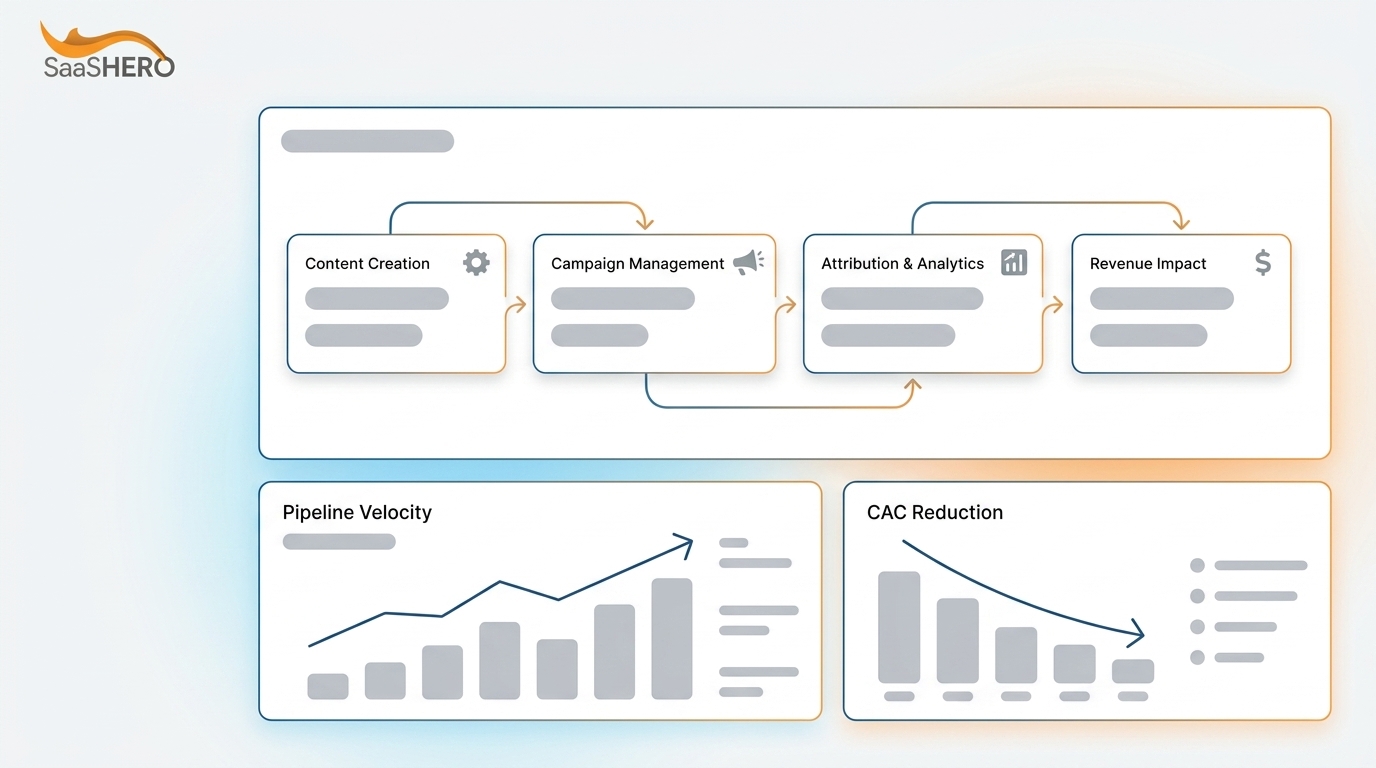
A connected marketing supply chain operates across four linked stages that share a common data foundation.
- Data Integration. Unify CRM, ERP, and fulfillment data on a common schema so every team sees the same customer, inventory, and revenue picture.
- Demand Sensing. Use AI to adjust forecasts based on real-time signals instead of relying only on historical sales patterns.
- Campaign Orchestration. Activate or suppress spend based on inventory and capacity, and coordinate channels around live demand signals.
- Revenue Attribution. Connect every campaign dollar to closed-won deals and pipeline value, not vanity metrics.
Each stage builds on the previous one. Data Integration enables accurate Demand Sensing. Demand Sensing informs Campaign Orchestration. Revenue Attribution measures the impact of all three. The three-stage implementation roadmap later in this guide (Foundation, Integration, Orchestration) describes how teams mature across these four stages over time.
Core Technologies in a Marketing Supply Chain Stack
Four technology layers form the infrastructure of a connected marketing supply chain. These layers give AI and revenue teams the data and controls they need.
| Technology Layer | Primary Function | 2026 Capability Note | Representative Example |
|---|---|---|---|
| Real-Time Inventory APIs | Surface live stock levels and fulfillment capacity to marketing systems | Businesses using real-time ERP report various operational gains such as over 50% higher revenue growth for top performers and up to 94% reductions in reporting time, but the specific figures of 95% process improvements and 91% better inventory management are not supported. | SAP S/4HANA, Oracle Fusion |
| CDP / CRM Connectors | Unify customer identity across ad platforms, CRM, and fulfillment data | API-led integrations enable composable architectures where discrete applications communicate via standardized APIs | HubSpot, Salesforce Data Cloud |
| Promotion Planning Engines | Model promotional ROI against inventory and margin constraints before activation | Advanced analytics for trade promotion planning improve promotional ROI by 15–25% | o9 Solutions, Anaplan |
| Agentic AI Orchestration | Autonomously execute demand sensing, replenishment triggers, and campaign adjustments | Gartner predicts 40% of enterprise applications will integrate task-specific AI agents by end of 2026, up from less than 5% in 2025 | Automation Anywhere APA, FourKites |
These four technology layers create the backbone of a connected marketing supply chain. Infrastructure alone does not create autonomous execution, though. That shift comes from how AI now operates inside this stack.
How AI Reshapes the Four Marketing Supply Chain Stages
The defining shift in 2026 is the move from AI as a dashboard to AI as an operator that autonomously executes solutions, bridging the insight-action gap in complex logistics networks. For B2B SaaS revenue teams, this shift shows up across the four-stage framework. AI now handles Demand Sensing (stage 2) autonomously, automates promotion planning within Campaign Orchestration (stage 3), and connects both to Revenue Attribution (stage 4) without manual intervention.
Three AI patterns drive this transformation and automate the demand-to-fulfillment loop without constant human input.
Agentic demand sensing (Stage 2). Agentic demand planning systems monitor real-time sales signals, weather data, economic indicators, social media trends, and competitor pricing to dynamically adjust forecasts and trigger immediate inventory replenishment or redistribution. These systems replace weekly cycles and reduce forecast error and manual planning hours.
Real-time promotion planning automation (Stage 3). Around 70% of trade promotions lose money in the US (with global and Western rates near 60%), even though trade spend routinely accounts for 15–25% of gross sales. AI-enabled promotion engines connect pricing, assortment, and trade investment decisions into a single planning environment with full P&L visibility. They identify genuine incremental volume instead of discounted sales that would have occurred anyway.
Signal-based campaign orchestration (Stage 3). Signal-based marketing replaces static funnels by using intent monitoring to detect surges in account activity and automatically trigger personalized ABM campaigns for the full buying group. Agentic AI agents align demand surges with logistics constraints to decrease stockouts and increase marketing-driven revenue.
Platform Comparison: Legacy DAM/MRM vs Modern B2B SaaS-Native Solutions
The table below shows why legacy DAM and MRM platforms cannot support the four-stage marketing supply chain framework. They lack real-time integration, operate on static forecast cycles, and report on vanity metrics instead of closed revenue.
| Dimension | Legacy DAM / MRM Platforms | Modern B2B SaaS-Native Solutions | Revenue Impact Difference |
|---|---|---|---|
| Integration Depth | File-based exports, manual ERP sync cycles | Real-time API connectors to ERP, CRM, and WMS on a common data schema | 49.2% of businesses report real-time data as their top ERP benefit, and legacy batch sync cannot capture this advantage |
| Demand Sensing | Static weekly or monthly forecast cycles | AI-driven daily or hourly signal ingestion from POS, weather, and competitor data | AI-driven demand forecasting can improve forecast accuracy and reduce manual planning effort |
| Campaign Activation | Manual approval workflows, disconnected from inventory state | Inventory-aware triggers that activate or suppress spend based on fulfillment capacity | Retailers and SaaS vendors can lose significant revenue from stockouts caused by inventory visibility gaps |
| Attribution Model | Last-click or impression-based reporting, vanity metrics | Pipeline value and closed-won revenue tied to CRM data | Companies with AI-mature supply chains are 23% more profitable than peers per Accenture’s 2024 analysis of 1,148 companies |
Integration depth and attribution model differences are directly comparable because both affect the same revenue outcome, specifically the ability to tie ad spend to new recurring revenue. Deployment timelines and licensing structures vary too widely across vendors to compare on a shared scale and are better evaluated through a direct vendor assessment.
Business Benefits and ROI Metrics from Connected Supply Chain Marketing
Moving from legacy platforms to modern, AI-enabled supply chain marketing technology produces measurable gains across inventory, promotion, and fulfillment performance.
| Outcome Area | Typical Improvement Range | Source |
|---|---|---|
| Stockout reduction | Excess inventory can be reduced and availability improved | Redwood 2026 AI and Automation Outlook |
| Promotional ROI improvement | Lift from AI-enabled promotion planning | McKinsey via o9 Solutions RGM analysis |
| Inventory cost reduction | 20–30% reduction in inventory costs | McKinsey 2024 AI-enabled distribution research |
| Order fulfillment speed | 30–40% faster order fulfillment | Redwood 2026 AI and Automation Outlook |
| Planning automation payback | Payback within months for supply chain planning automation | Redwood and Deloitte 2026 data |
| Mature transformation ROI | Strong ROI over multiple years with payback within months | Mature digital supply chain transformation benchmarks |
Implementation Roadmap: Three Maturity Stages Across the Framework
Most B2B SaaS teams sit at early maturity and need a staged path into the four-stage framework. Based on marketing operations maturity research showing only 12% of organizations operate at high maturity, most B2B SaaS teams sit at Stage 1 or early Stage 2. The roadmap below reflects that reality and maps to progressive capability across Data Integration, Demand Sensing, Campaign Orchestration, and Revenue Attribution.
Stage 1 — Foundation (Months 1–3). Teams establish the data and tracking base that supports Data Integration and early Revenue Attribution. Audit the existing marketing and supply chain stack. Establish a data governance baseline. Connect CRM to at least one real-time inventory or fulfillment data source. Use the questions below to confirm Stage 1 completion.
- Can the marketing team query current inventory levels without opening a separate system?
- Is campaign spend paused automatically when a SKU or service tier reaches capacity?
- Are closed-won CRM records linked back to the originating ad click?
Stage 2 — Integration (Months 4–6). Teams deepen Data Integration and activate Demand Sensing across priority channels. Build a unified data layer with bidirectional CRM sync and multi-touch attribution. Activate demand sensing on at least one high-spend campaign channel. Use these questions to validate Stage 2 maturity.
- Does the demand sensing model ingest signals beyond historical sales, such as weather, competitor pricing, and social intent?
- Is promotional spend governed by a promotion planning engine with P&L visibility?
- Are pipeline value and revenue contribution the primary campaign performance metrics?
Stage 3 — Orchestration (Months 7–12). Teams deploy agentic AI layers that automate Demand Sensing and Campaign Orchestration while Revenue Attribution tracks impact. Deploy AI that autonomously adjusts forecasts, triggers replenishment, and activates or suppresses campaigns within predefined guardrails. Use the questions below to confirm Stage 3 readiness.
- Do AI agents operate across demand, inventory, and campaign layers without requiring human approval at each step?
- Is the organization tracking AI Citation Share of Voice alongside Pipeline Velocity?
- Can the system resolve a supply disruption and adjust campaign spend within hours, not days?
Not sure which maturity stage your team is at? Get a free stack audit and maturity assessment.
Common Pitfalls to Avoid During Implementation
Even teams that follow the three-stage roadmap encounter predictable failure modes. Two pitfalls account for most stalled implementations.
Siloed data ownership. B2B marketing technology stacks comprise multiple tools, yet 45% of data used for decision-making is estimated to be incomplete, inaccurate, or outdated. When marketing, operations, and finance each own separate data domains without a shared schema, demand sensing models produce unreliable forecasts and inventory-aware campaigns fire on stale signals. Enabling agentic supply chains requires a data architecture that includes a data fabric for unified access, data mesh principles for domain ownership, and a common data ontology.
Vanity-metric reporting. Reporting on impressions, clicks, and CTR while the CEO asks about pipeline and CAC often causes marketing supply chain investments to lose funding. MIT NANDA’s GenAI Divide report found that 95% of GenAI pilots delivered no measurable P&L impact, and most of those cases trace back to measuring the wrong outcomes. To avoid this failure mode, Revenue Attribution, the fourth stage of the framework, must be established before Stage 3 agentic capabilities are deployed, not after. Deploying autonomous AI agents without revenue-based success metrics almost guarantees the same pilot-to-production failure pattern.
Frequently Asked Questions
What budget should a B2B SaaS company allocate to marketing supply chain technology?
Budget allocation depends on current maturity stage and desired speed. Stage 1 Foundation work, such as stack audits, data governance, and CRM-to-inventory connectors, is primarily a labor and integration cost that teams often absorb within existing MarTech licensing. Stage 2 Integration adds a unified data layer and multi-touch attribution tooling, where total cost of ownership commonly runs two to three times visible license fees once implementation, integration, and maintenance are included. Stage 3 Orchestration introduces agentic AI layers, which carry higher upfront investment but deliver rapid payback for planning automation based on industry benchmarks. Use these stage profiles to size your budget, then audit the existing 12–20 tool stack for redundancy before adding new platforms.
Who owns marketing supply chain technology inside a B2B SaaS organization?
Ownership works best when a Revenue Operations leader holds accountability for the full four-stage framework, with shared execution across Marketing, Product, and Supply Chain or Fulfillment teams. Many $5M–$50M ARR companies lack a dedicated RevOps function, so the CMO or VP of Marketing often owns the Demand Sensing and Campaign Orchestration layers while the CTO or Head of Engineering owns Data Integration. The critical failure point appears when no single owner is accountable for Revenue Attribution, which connects ad spend to closed-won revenue.
How long does it take to see measurable results from an inventory-aware campaign program?
Stage 1 Foundation work usually produces measurable improvements in data quality and campaign waste reduction within the first 90 days. Stage 2 Integration, which enables true inventory-aware campaign activation, generally shows pipeline impact within four to six months. Full Stage 3 Orchestration with agentic AI delivers the most significant revenue outcomes, including reductions in forecast error and faster order fulfillment cited in research, but requires nine to twelve months of embedded operation before those gains stabilize. The 80-day payback period achieved by high-performing SaaS companies reflects Stage 2 and early Stage 3 maturity, not a baseline starting point.
How is success measured in a marketing supply chain technology program?
Primary metrics include new recurring revenue, Pipeline Velocity, and Customer Acquisition Cost, not impressions, MQLs, or CTR. Secondary metrics include stockout rate reduction, promotional ROI improvement, and order fulfillment cycle time. At Stage 3 maturity, organizations also track AI Citation Share of Voice, which measures how often the brand is cited by AI search engines during buyer research, alongside traditional pipeline metrics. This shift reflects how 51% of B2B software buyers now begin vendor research in AI chatbots rather than search engines.
Which tooling choices matter most at the start of a marketing supply chain technology implementation?
The highest-leverage early investment is a bidirectional CRM-to-ERP connector that surfaces real-time inventory and fulfillment data inside the marketing workflow. This single integration unlocks inventory-aware campaign activation without requiring a full platform replacement. CDP and CRM connectors from platforms like HubSpot and Salesforce Data Cloud provide this capability at relatively low implementation cost. Promotion planning engines and agentic AI orchestration layers deliver the largest ROI gains but require the Stage 1 data foundation to function reliably. Deploying them on a fragmented data architecture produces the coordination breakdowns and value erosion that characterize failed AI pilots.
What is the primary risk of delaying marketing supply chain technology adoption?
The primary risk is compounding revenue leakage. The 5–15% revenue loss from fragmentation cited earlier does not account for wasted ad spend on campaigns driving demand into unfulfillable capacity. As supply chain leaders expect disruptions to intensify, teams without real-time demand sensing and inventory-aware campaign controls will face increasing exposure to stockout-driven pipeline waste. A secondary risk is competitive displacement. Around 95% of B2B purchases go to a vendor already on the buyer’s Day One shortlist, and AI-driven signal-based marketing is now a primary mechanism by which vendors earn that shortlist position before a buyer raises a hand.
How SaaSHero Supports B2B SaaS Marketing Supply Chain Programs
SaaSHero is a specialized B2B SaaS marketing agency that operates exclusively within the technology vertical, including HR Tech, Procurement, Logistics, Cybersecurity, and adjacent sectors. The agency’s operational model follows the same revenue-first principles that define effective marketing supply chain technology. Engagements use flat-fee, month-to-month structures that remove the percentage-of-spend conflict of interest and reporting anchored in new recurring revenue and pipeline value rather than impressions or MQLs.
Where many agencies report on CTR and call it a campaign, SaaSHero connects ad click data through to CRM closed-won records using GCLID tracking and HubSpot or Salesforce integration. This approach mirrors the Revenue Attribution discipline at Stage 4 of the marketing supply chain framework. Case results include $504,758 in new recurring revenue for TripMaster, an 80-day payback period for TestGorilla’s $70M Series A, and a 10x reduction in Cost Per Lead for Playvox.

The agency’s month-to-month contract structure creates a forcing function for performance. SaaSHero must re-earn client business every 30 days, which aligns agency incentives with the capital-efficiency pressure that makes marketing supply chain technology a strategic priority in 2026. Engagements begin with a setup and tracking audit, move through campaign architecture and landing page improvements, and scale into multi-channel orchestration as data quality and attribution maturity improve. This progression mirrors the three-stage implementation roadmap outlined above.
For B2B SaaS directors and product leaders who need to connect demand generation with real-time supply chain signals, SaaSHero provides implementation expertise, a revenue-focused reporting framework, and a flat-fee pricing structure that remains defensible to a CFO from day one.