




Last updated: February 5, 2026
Key Takeaways
- B2B SaaS marketing in 2026 focuses on capital efficiency, sub-90-day payback periods, and scrutiny of every marketing dollar over vanity metrics.
- Seven performance-based pricing models exist, from pure CPL ($237 average) and CPA to revenue share (5-15%) and hybrid retainers, each with clear pros, cons, and benchmarks.
- Hybrid retainer models dominate because complex B2B journeys create attribution challenges, and hybrids offer predictable costs and aligned incentives without overspend risk.
- SaaSHero’s tiered flat retainers ($1,250-$7,000 per month) delivered results like TripMaster’s $504,758 Net New ARR at 650% ROI and TestGorilla’s 80-day payback that supported a $70M raise.
- Choose SaaSHero’s proven performance-based partnerships for capital-efficient growth, and book a discovery call to transform your SaaS strategy today.
The 2026 B2B SaaS Performance Marketing Reality
Performance-based B2B digital marketing services replace hourly or percentage-based agency models with outcome-based compensation. Agencies tie their fees to measurable results like cost-per-lead (CPL), cost-per-acquisition (CPA), or revenue milestones, which directly connect agency success to client growth.
The complexity of B2B SaaS marketing makes this alignment essential. Multiple stakeholders and devices create non-linear customer journeys that often stretch across months or quarters. B2B SaaS sales cycles involve long research phases, buying committees, and proof-of-concept evaluations instead of quick, single-decision purchases.
Current benchmarks highlight the opportunity. B2B SaaS cost-per-lead averages $237, while top-performing campaigns reach 2.3-9.1 ROAS with payback periods under 90 days. The gap between average and elite performance rewards agencies that deliver consistent revenue outcomes instead of vanity metrics like impressions or click-through rates.
Seven Performance-Based Pricing Models for B2B SaaS
The performance-based agency market offers seven core pricing models, and each one fits different B2B SaaS needs and risk profiles.
1. Pure Cost-Per-Lead (CPL)
Agencies charge a fixed rate for each qualified lead, often $200-500 for B2B SaaS. This structure creates clear accountability but frequently triggers disputes over lead quality and attribution windows.
2. Cost-Per-Acquisition (CPA)
Clients pay only when leads convert to paying customers. This setup maximizes risk transfer to the agency and demands strong CRM integration plus precise conversion definitions.
3. Revenue Share
Agencies earn a percentage of generated revenue, usually 5-15%. This model aligns long-term incentives but can become expensive as client revenue grows and requires accurate revenue tracking.
4. Hybrid Retainer + Performance Bonus
Agencies combine a base monthly retainer with performance bonuses tied to specific metrics. This approach balances agency cash flow with client risk management and keeps both sides focused on results.
5. Tiered Retainers by Spend
Agencies charge fixed monthly fees based on ad spend bands. This removes percentage-based overspend incentives and gives finance teams predictable monthly costs.
6. ARR Guarantees
Agencies commit to specific Annual Recurring Revenue targets and often accept penalty clauses for underperformance. This structure suits companies with clear baselines and strong data.
7. Equity or Outcome Milestones
Agencies receive compensation tied to major outcomes like funding rounds or acquisitions. Companies usually reserve this model for strategic, long-term partnerships.
|
Model |
Pros |
Cons |
SaaS Benchmark |
|
Pure CPL |
Clear accountability, pay per result |
Lead quality disputes, attribution challenges |
$237 average CPL |
|
CPA |
Maximum risk transfer, true ROI focus |
Long attribution windows, CRM complexity |
Varies by ACV |
|
Revenue Share |
Long-term alignment scales with success |
Expensive at scale, complex tracking |
5-15% of revenue |
|
Hybrid Retainer |
Balanced risk, predictable base costs |
Complex bonus structures |
$1,250-$7,000/month |
SaaSHero’s tiered retainer model follows these best practices with fixed monthly fees from $1,250 to $7,000 based on spend bands and channel count. Month-to-month flexibility removes long-term contract risk while keeping incentives aligned with performance.
Why Hybrid Retainers Win in B2B SaaS
Hybrid models dominate B2B SaaS because pure performance structures struggle with attribution complexity and agency cash flow. Inaccurate attribution models like last-click often overcredit certain channels, which sparks disputes over lead sources and conversion credit. Hybrid models reduce these conflicts by pairing predictable base revenue with performance upside.
SaaSHero’s flat retainer approach removes overspend incentives that appear in percentage-based models. Their month-to-month agreements create a built-in accountability mechanism, and the team must re-earn client trust every 30 days through performance. This structure supports advanced tactics like competitor conquesting and heuristic conversion rate optimization while limiting attribution battles that often derail pure performance contracts.
TripMaster’s results illustrate this impact. The company generated 650% ROI and $504,758 in Net New ARR through SaaSHero’s retainer model. This outcome shows how aligned incentives and clear pricing outperform traditional agencies that chase vanity metrics.
|
Scenario |
Investment |
ROI |
Net ARR |
vs. Industry |
|
SaaSHero Retainer |
$10,000 |
650% |
$504,758 |
4x average |
|
Industry Average |
$10,000 |
155% |
$125,000 |
Baseline |
SaaSHero vs. Industry: 2026 SaaS Case Studies
Performance-based B2B digital marketing delivers measurable gains when handled by specialists. SaaSHero’s case studies show how revenue-aligned partnerships perform across several SaaS verticals.
TripMaster (Transit Software)
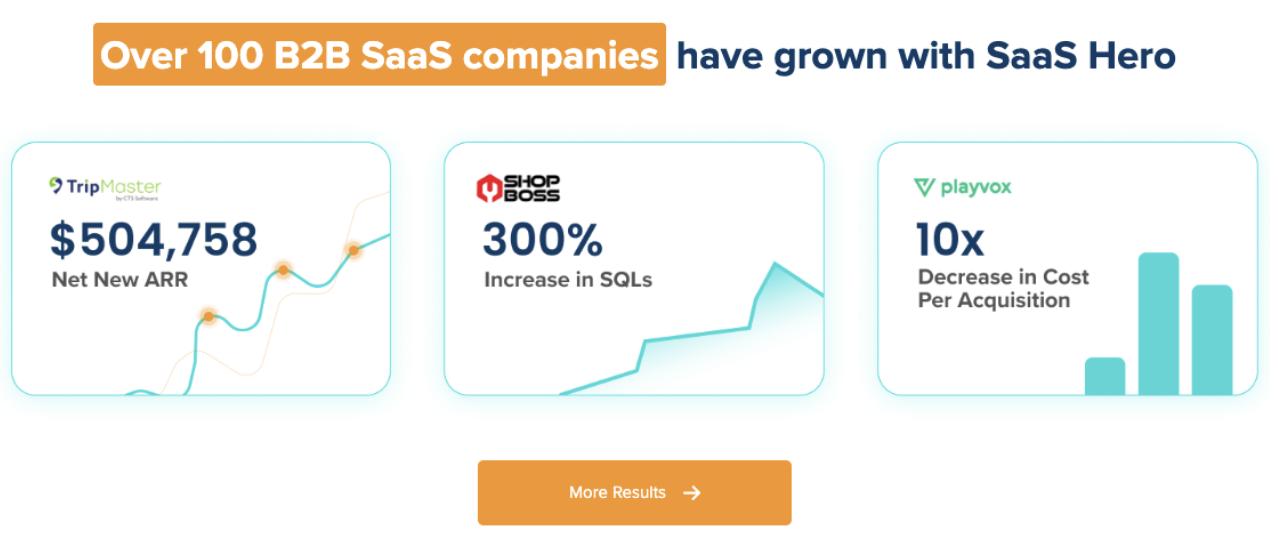
This mature SaaS platform needed growth beyond organic channels. SaaSHero launched comprehensive paid search and social programs with rigorous conversion rate optimization. TripMaster generated $504,758 in Net New ARR, 650% ROI, and 20% conversion rates from paid search, which is exceptional for B2B SaaS.

TestGorilla (HR Tech)
TestGorilla needed investor-ready unit economics before a major raise. SaaSHero’s performance-based strategy delivered an 80-day payback period and more than 5,000 new customers. This efficiency supported a $70M Series A and proved the “cash machine” profile investors expect.
Playvox (CX Software)
Playvox previously relied on broad, inefficient keyword targeting. Under SaaSHero’s management, the company saw a 10x decrease in cost-per-lead and 163% lead volume growth. Negative keyword hygiene and competitor conquesting played a central role in this shift.
Leasecake (Real Estate Tech)
Leasecake used targeted LinkedIn campaigns focused on specific job titles and real estate segments. These programs produced record growth that supported a $3M VC round. The founder highlighted SaaSHero’s “extension of team” style instead of a transactional vendor relationship.
|
Client |
Key Metric |
SaaSHero Result |
Industry Average |
|
TripMaster |
Net New ARR |
$504,758 |
$125,000 |
|
TestGorilla |
Payback Period |
80 days |
120+ days |
|
Playvox |
Cost Per Lead |
10x reduction |
Baseline |
|
Leasecake |
Funding Outcome |
$3M raised |
N/A |
These outcomes position SaaSHero as a strong choice for SaaS companies that must protect unit economics. Book a discovery call to see how a performance-based partnership can support your next growth phase.
Roadmap for Launching Performance-Based SaaS Campaigns
Successful performance-based B2B digital marketing starts with clean data and tracking. Teams begin with detailed tracking audits and CRM checks to capture the full customer journey from first ad click through closed-won revenue.
High-performing programs often include competitor comparison landing pages with sharp value propositions and clear differentiation. Negative keyword strategies remove wasteful navigational traffic and protect budgets for high-intent searches.

Risk mitigation relies on hybrid contracts that balance agency cash flow with client performance expectations. Month-to-month agreements keep both sides flexible, while performance bonuses maintain focus on outcomes. Clear attribution windows and lead quality definitions reduce disputes that often appear in pure performance deals.
Different growth stages require tailored support. Bootstrapped founders usually benefit from lower-cost dedicated campaign management, while post-funding companies need full marketing teams that can scale across multiple channels quickly.
Frequently Asked Questions
What are the Key differences between hybrid and pure performance pricing models?
Hybrid models combine a base monthly retainer with performance bonuses, which gives agencies a predictable cash flow and keeps incentives aligned with client goals. Pure performance models tie all compensation to outcomes like leads or revenue and shift maximum risk to the agency. Pure structures often create attribution disputes and cash flow strain, while hybrid approaches balance risk and support more advanced tracking and testing.
How does SaaSHero’s pricing support different company stages?
SaaSHero uses tiered pricing based on monthly ad spend and channel count. Dedicated campaign management starts at $1,250 per month for up to $10,000 in spend across one channel and scales to $5,750 for three or more channels. Full marketing team services range from $2,500 to $7,000 monthly. Month-to-month agreements remove long-term contract risk, and 6-month prepay options offer 20% discounts for companies that want stronger cash flow planning.
How does SaaSHero tackle B2B attribution challenges?
B2B SaaS attribution relies on multi-touch models that reflect dark funnel behavior and long decision cycles. Effective agencies integrate deeply with client CRMs and track prospects from first ad interaction through closed-won revenue. This work includes UTM standardization, lead scoring frameworks, and recurring attribution reviews to keep performance measurement accurate across all touchpoints.
What are the Realistic CPL benchmarks for B2B SaaS in 2026?
B2B SaaS cost-per-lead averages $237 across channels, with wide variation by vertical and campaign strategy. High-intent competitor conquesting campaigns often produce lower CPLs because they convert at higher rates. Broad awareness campaigns can exceed $500 per lead. The priority should be lead quality and downstream conversion, not the lowest possible CPL in isolation.
Why does hybrid pricing support SaaS ARR growth?
SaaS companies need predictable, scalable growth that matches subscription revenue patterns. Hybrid pricing gives agencies a stable base revenue to fund advanced tracking and experimentation, while performance bonuses keep attention on Net New ARR instead of vanity metrics. This structure supports long-term relationship building across complex B2B sales cycles and maintains accountability through month-to-month flexibility.
Conclusion: Turn Performance Pricing into Predictable ARR
Performance-based B2B digital marketing now defines modern agency partnerships in a capital-efficient SaaS environment. Hybrid models like SaaSHero’s tiered retainers remove misaligned incentives from percentage-based pricing and still deliver the accountability that pure performance models often miss.
Companies that work with revenue-aligned agencies consistently outperform peers, from TripMaster’s 650% ROI to TestGorilla’s investor-ready unit economics. As media costs rise and attribution grows more complex, agencies that thrive will commit to transparent pricing, strong tracking, and genuine partnership.
Book a discovery call today to see how a performance-based partnership can reshape your SaaS growth strategy and deliver the Net New ARR your business targets.