




Written by: Aaron Rovner, Founder, Saas Hero | Last updated: September 1, 2026
Key Takeaways
- Three distinct agency models sit under the performance label: revenue share, hybrid retainer-plus-bonus, and pay-per-meeting. Each model creates different incentives and risks for B2B SaaS buyers.
- Revenue-share structures create the strongest alignment because agencies earn only when closed-won revenue appears in the CRM. This model depends on accurate multi-touch attribution.
- Five red flags quickly expose misaligned agencies: optimizing for form fills, avoiding post-click ownership, charging per channel, using vague qualification criteria, and reporting vanity metrics.
- A seven-point buyer’s checklist covering lead definitions, CRM access, CAC payback data, and offboarding terms helps CMOs vet partners before signing.
- Ready to evaluate a revenue-aligned agency against this checklist? Talk with SaaSHero’s team and compare their answers to each question.
The 3 Agency Models and How They Align Incentives
Performance-based describes three different pricing structures, each with its own incentive mechanics and risk profile for the client.
| Model | Compensation Structure | Incentive Alignment | Risk to Client |
|---|---|---|---|
| Revenue Share | 10–20% of first-year closed-won contract value, sometimes with a small base retainer | Maximum, because the agency earns only when the client wins | Attribution complexity in long sales cycles; agency selectivity on client fit |
| Hybrid (Retainer + Bonus) | Base retainer covering costs, plus a performance bonus tied to SQLs or pipeline created; a typical 2026 hybrid contract might be a £4,000 monthly retainer plus £150 per qualified meeting beyond a minimum threshold | Balanced, because the agency has resources for strategy and still cares about outcomes | Quiet inversion when the variable component dominates and the model behaves like pure performance pricing with extra reconciliation work |
| Pay-Per-Meeting | $75–$500 per appointment in 2026, or $200–$600 per qualified meeting for cold email agencies | Misaligned, because the agency is rewarded for booking meetings instead of generating revenue | Volume over quality; incentive distortion drives loose qualification and wasted sales time |
1. Revenue Share (True Alignment)
The agency receives a percentage of closed-won revenue, typically 10–30% of attributed revenue. The agency earns nothing until the client does, which creates the highest alignment available. Attribution becomes the main constraint. In a B2B SaaS sales cycle with a buying committee of 8 to 12 stakeholders and a 30 to 90 day or longer timeline, proving which revenue the agency drove requires airtight CRM integration and multi-touch attribution. Agencies that offer pure revenue share usually act selectively and accept only clients where they feel confident about winning, which signals quality.
2. Hybrid (Retainer + Performance Bonus)
A base retainer covers the agency’s operating costs. A performance bonus then ties compensation to outcomes such as SQLs or pipeline created. Workable hybrid pricing has three traits. The variable component is capped. Trigger definitions appear in the agreement. The base fee is large enough that the agency does not depend on the variable half. Quiet inversion appears when the variable component dominates the economics and the model behaves like performance pricing with extra reconciliation overhead. When you evaluate a hybrid offer, model the fee at realistic spend and at double that level. Then identify which half actually drives the agency’s revenue.
3. Pay-Per-Meeting (The Trap)
The agency charges a flat fee per qualified meeting or demo booked. The model appears low-risk because the unit of measurement is visible and immediate. The structural problem is clear. The agency’s goal is to book a meeting instead of generating revenue. Per-qualified-meeting pricing rewards meeting volume, not opportunity quality or revenue, because payment depends on the count of meetings rather than the pipeline value they create. Guaranteed meeting volumes without quality criteria are a red flag. Agencies may book meetings outside the ideal customer profile to hit volume targets, which wastes sales time.
5 Red Flags That Reveal a “Fake” Performance Agency
Red Flag #1: They Optimize for Form Fills Instead of CRM Revenue
Agencies that report on CPL and lead volume without connecting spend to pipeline and revenue in your CRM focus on the wrong metric. Ad platforms optimize for their own conversion events, such as form fills, trial signups, and page views, rather than closed-won opportunities in the CRM. The algorithm then finds the cheapest people to fill out forms, including students, competitors, job seekers, and existing customers. Cost per lead falls, lead volume rises, and pipeline stays flat. See how SaaSHero optimizes against CRM lifecycle stage events instead of form submissions.
Red Flag #2: They Avoid Owning the Post-Click Experience
Agencies that stop at the ad click and avoid owning or testing landing pages cannot be held accountable for conversion. Performance depends on the weakest link in the chain, and a scope boundary that cuts through that chain breaks accountability. An agency responsible only for the ad account cannot change the landing page headline. That headline is the single most impactful lever for getting more conversions from a landing page. A credible partner shows the thinking and the work, not just the outcome, which requires ownership of the entire post-click experience.

Red Flag #3: They Charge Per Channel
Percentage-of-ad-spend pricing structurally punishes efficiency. When an agency improves performance enough for the client to hit targets on lower spend, it cuts its own fee. Per-channel pricing creates the same distortion. If each additional channel carries its own fee, every test of a new placement raises the client invoice. This gives the agency a financial interest in keeping the channel mix exactly as it is and gives the client a financial reason to refuse experiments. As a result, budget calcifies where it was first placed, long after the opportunity has moved.
Red Flag #4: They Can’t Clearly Define a “Qualified” Meeting
Vague definitions of a qualified lead, such as “a prospect who accepts a meeting,” cause clients to pay for low-quality appointments. The definition of a qualified meeting must be in writing, including minimum company size, job title, intent signal, and whether no-shows count. Without a strict ICP-aligned definition and a rejection window with credit-back, a common failure mode is an agency booking 18 meetings in month one, with only 6 of 12 accepted by month three because the qualified-meeting definition was not tight enough to enforce.
Red Flag #5: They Report Vanity Metrics Instead of Board Metrics
Agencies that report impressions, clicks, and CTR instead of pipeline, CAC, and payback period fail to measure what matters to the board. Review a live example of board-ready, CRM-connected reporting from SaaSHero. The industry benchmark for a healthy B2B SaaS CAC payback period is under 12 months, with a healthy LTV:CAC ratio for B2B SaaS generally considered to be at least 3:1. Agencies that cannot report against these metrics operate in a different language than the CFO and board.
The 7-Point Buyer’s Checklist for Performance-Based Agencies
1. “How Do You Define a Qualified Lead or SQL?”
This question reveals whether the agency’s definition aligns with the sales team’s acceptance criteria. The answer should reference ICP attributes such as company size, title, confirmed problem, and budget authority instead of “a prospect who books a call.” Written clarity on what qualifies as a meeting, including decision-maker title, company size, confirmed problem, and minimum engagement level, is required before signing any pay-per-meeting agreement.
2. “What Metrics Are You Optimizing Against in the Ad Platforms?”
The strongest answer focuses on qualified pipeline or lifecycle stage events instead of form fills. Optimizing for MQL volume often fills the pipeline with low-intent prospects that sales cannot close. Agencies that cannot explain how they feed CRM outcomes back into the ad platform bidding algorithm target the wrong audience.
3. “Can You Show Me a Case Study with CAC Payback Data?”
This question proves whether the agency measures and accepts accountability for revenue outcomes instead of lead volume. The 2026 Aleph and Benchmarkit SaaS benchmarks found an overall median CAC payback period of 16 months across 198 B2B SaaS companies. An agency that cannot show CAC payback data from a comparable client does not operate at the level of accountability this benchmark implies.
4. “Who Owns the Landing Pages and CRO?”
A true partner owns the entire post-click experience to ensure the traffic it buys converts. If the answer is “we make recommendations for your web team to implement,” the agency cannot be held accountable for conversion rate. A credible partner shows the working, not just the chart, and proactively flags underperforming campaigns before being asked.
5. “Do You Have Access to Our CRM for Reporting?”
CRM access is mandatory for true revenue attribution and optimization. Accurate revenue attribution requires tracing every marketing touchpoint and connecting those touchpoints to real, verifiable revenue, meaning actual closed customers, rather than platform-estimated conversions or MQL counts. Without CRM integration, the agency reports on a different reality than the one the sales team and board see.
6. “Who Specifically Will Be Working on Our Account?”
Senior specialists must execute the strategy instead of a junior-only team. Ask SaaSHero who will be in your account in month seven. The answer should name a Senior Account Strategist, a Campaign Manager, and an Account Coordinator, all full-time employees rather than contractors.
7. “What Happens If We Want to Leave?”
The client should own all assets, accounts, and data. Buyers should insist on owning the domains, inboxes, and contact lists, because some agencies set up sending infrastructure under their own accounts, and when you leave, you lose everything. A good agency treats offboarding as a normal event and keeps accounts accessible.
Why SaaSHero Is the Revenue-Aligned Partner for B2B SaaS
SaaSHero serves as an outsourced inbound growth team for B2B SaaS companies. One team owns paid media, creative, landing pages, and reporting while optimizing against CRM revenue data instead of form-fill counts. The evaluation criteria above describe what a revenue-aligned partner looks like, and SaaSHero is built to meet each one.

The differentiators that directly address the red flags and checklist items above include:
- Optimization against CRM revenue data such as qualified pipeline, lifecycle stage events, and closed revenue. The ad platform bidding algorithm is trained on what the sales team actually accepts.
- Full ownership of the post-click experience. Landing page design, copy, build, hosting, and A/B testing happen in-house instead of as recommendations for the client’s web team.
- A flat retainer indexed to total monthly ad spend instead of channel count. Channel mix recommendations carry no fee consequence in either direction, so adding, removing, or reweighting a channel does not change the invoice.
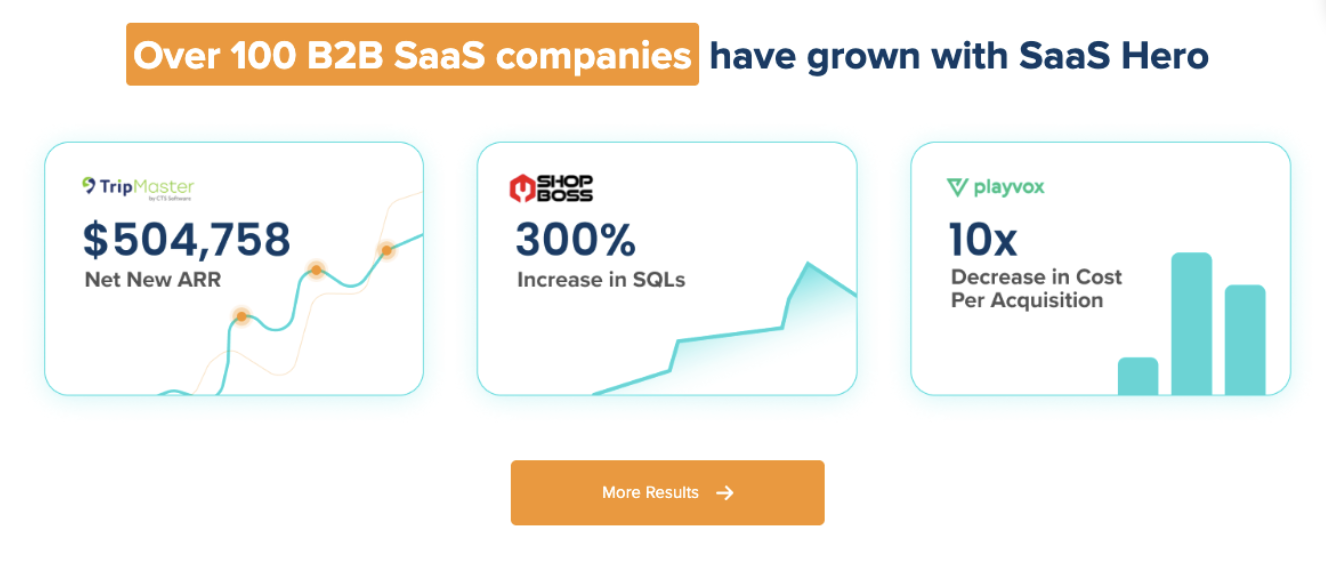
- Proven revenue outcomes that align with these criteria. SaaSHero has delivered a 650% ROAS for TripMaster, a 10x CPL reduction with a 163% lead volume increase for Playvox, and a 305% conversion rate lift for Shop Boss, all while optimizing against CRM revenue data.
Ready to stop managing your agency and start working with a revenue partner that matches this checklist? Schedule a strategy conversation with SaaSHero and compare their model to every question above.
Frequently Asked Questions
What is the difference between a performance-based and a traditional retainer agency?
A traditional retainer pays for time and activities such as managing campaigns, producing reports, and attending calls. The agency earns its fee regardless of whether those activities produce pipeline or revenue. A performance-based agency ties at least part of its compensation to outcomes such as qualified pipeline, sales-accepted opportunities, or closed revenue. Incentive alignment creates the critical distinction. A traditional retainer agency is incentivized to keep the engagement running. A true performance agency is incentivized to make the engagement produce results. In practice, the most sustainable version is a hybrid model with a base retainer that covers operating costs and a performance bonus tied to clearly defined revenue outcomes. The base ensures the agency has resources for strategy, and the bonus ensures accountability for results.
Is pay-per-meeting a good model for B2B SaaS?
Pay-per-meeting can appear attractive because the unit of measurement is visible and the risk seems contained. The structural problem is that the agency is incentivized to book meetings instead of generating revenue. Without a very strict written definition of a qualified meeting, as described in the red flags section, the agency will optimize for volume. The result is a calendar full of appointments that the sales team cannot convert, wasted sales capacity, and a cost-per-closed-deal that far exceeds what a well-structured retainer or hybrid model would produce. Pay-per-meeting works best as a short-term test in a new market with a tightly defined ICP rather than as a primary demand generation model for a B2B SaaS company with a multi-month sales cycle.
How long does it take to see results from a performance-based agency?
Traffic and leads can arrive within the first few weeks of a well-structured engagement. Qualified pipeline in B2B SaaS typically takes one to three months to read properly because of longer sales cycles. A true performance partner will focus on leading indicators such as lead quality, SQL conversion rate, and pipeline velocity in the early months instead of raw lead volume. The first 30 days focus on setup, including conversion tracking, campaign architecture, landing page production, and approvals. Days 31 through 60 narrow the account based on early data. Day 90 provides a meaningful validation point with enough data to assess whether the channel, structure, and messaging thesis are sound. Agencies that promise meaningful pipeline in the first days of an engagement either describe luck or redefine pipeline.
Can performance-based agencies work for early-stage SaaS?
Performance-based agencies can work for early-stage SaaS, but the model matters. Pure revenue share is rare for early-stage companies without a proven sales motion because the agency cannot price the risk of a business that has not yet demonstrated repeatable conversion from pipeline to closed revenue. A hybrid model with a base retainer plus performance bonus is typically more effective at this stage. It gives the agency resources to build the acquisition engine while still aligning on outcomes. The hard prerequisites include product-market fit, a defined ICP, a functioning CRM, and a sales team to work the leads. Without those elements, no agency model produces reliable results because the inputs the optimization system depends on do not exist yet.