




Written by: Aaron Rovner, Founder, Saas Hero | Last updated: July 13, 2026
What You Will Learn About Performance-Based vs Retainer Agencies
- Performance-based marketing operations tie agency compensation directly to CRM-attributed revenue outcomes like pipeline value and closed-won ARR, while traditional retainer agencies charge fixed fees regardless of results.
- Traditional retainer models create incentive misalignment because agencies earn revenue from media spend or activity metrics rather than actual business outcomes, which shifts performance risk to the client.
- B2B SaaS companies face multi-stakeholder buyer journeys and capital-efficiency pressure that make vanity metrics like impressions and CTR poor indicators of real impact.
- Performance-based models use month-to-month contracts, flat fees, and CRM-connected reporting to transfer risk to the agency and align incentives around CAC payback and net new ARR.
- For B2B SaaS companies ready to move beyond vanity metrics, schedule a discovery call with SaaSHero to evaluate a revenue-aligned partnership.
The Problem: Incentive Misalignment and Risk in Traditional Retainer Models
The structural flaw in most traditional retainer demand gen agency relationships is simple and costly. The agency’s revenue is decoupled from the client’s revenue. Percentage-of-ad-spend models pay agencies 10–20% of client media spend, so agency income grows when the media bill grows, whether or not pipeline follows. A client spending $100,000 per month generates $15,000–$20,000 in agency fees under percentage-of-spend models.
Long-term lock-in compounds this problem. Agencies that secure 6–12 month contracts get paid whether they deliver results or not, with little financial motivation to optimize for quality once the budget is secured. The client absorbs all performance risk while the agency collects guaranteed revenue.
The measurement layer reinforces this misalignment. Reporting on impressions, CTR, and raw MQL volume obscures the metrics that actually matter to a SaaS board. Median blended CAC payback for $5M–$25M ARR SaaS companies reached 18 months in Q1 2026, up from 15 months in 2023, per OpenView SaaS Benchmarks 2026, as paid acquisition costs rose and efficiency declined. Paid acquisition’s share of qualified pipeline has also fallen, while agencies billing on spend often hide these trends instead of fixing them.
Compare your current agency’s performance against revenue-aligned benchmarks
Why Misaligned Agency Models Hit B2B SaaS Harder
B2B SaaS amplifies incentive misalignment in ways that commodity or e-commerce marketing does not. Capital-efficiency pressure is intense, and the median Magic Number for SaaS companies has declined, with fewer companies exceeding 1.0.
Buyer journeys involve multiple stakeholders and non-linear paths. B2B buyers typically consume 13 pieces of content (8 vendor-created and 5 third-party) before making a buying decision, so multi-touch attribution models outperform single-touch models.
This environment rewards agencies that chase activity instead of closed-won revenue. Low MQL-to-SQL conversion rates in B2B SaaS typically indicate sales-marketing handoff problems and hidden channel quality issues rather than insufficient MQL volume. Agencies billing on spend have no structural reason to resolve those handoff problems, because fixing them can reduce reportable lead volume and weaken budget arguments. These structural flaws point to a need to redesign the agency relationship itself.
How Performance-Based Marketing Operations Reframe the Relationship
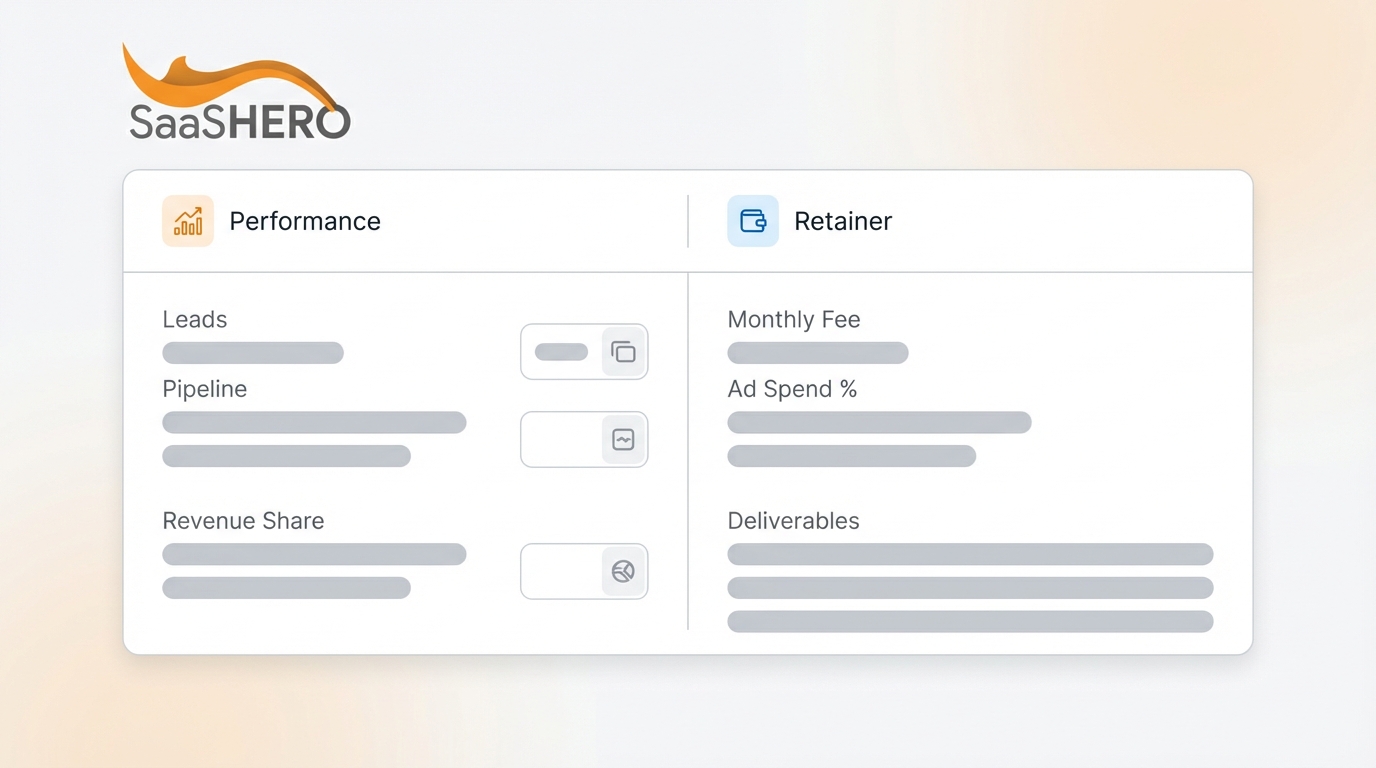
Performance-based marketing operations reorient the agency relationship around CRM-attributed revenue. Fees are flat or outcome-tied, contracts are month-to-month, and reporting anchors to net new ARR, pipeline value, and CAC payback instead of platform-native vanity metrics. A 2025 Stripe survey found that 77% of business leaders agree customers are increasingly pushing for outcome-based pricing, and 84% report strong pricing power according to a 2025 Zilliant survey of senior pricing executives.
The table below compares the two models across four dimensions that matter most to B2B SaaS revenue leaders.
| Dimension | Traditional Retainer Demand Gen Agency | Performance-Based Marketing Operations | Why It Matters |
|---|---|---|---|
| Risk Allocation | Client bears all performance risk, and the agency earns fees under 6–12 month lock-in contracts | Risk shifts toward the partner, and month-to-month terms require the agency to re-earn the engagement every 30 days | Misaligned risk creates complacency, while aligned risk creates urgency |
| Measurement | Impressions, CTR, and raw MQL volume, with last-click attribution that undervalues top-of-funnel and obscures channel quality | CRM-attributed pipeline, closed-won ARR, CAC payback, and LTV:CAC, with multi-touch attribution connected from GCLID to CRM | Marketing-sourced pipeline and CAC payback period connect directly to business outcomes |
| Contract Terms | Standard 6–12 month initial terms, with common early exit penalties | Month-to-month terms, with optional prepay discounts such as about 20% for 6-month prepay and no mandatory lock-in | Long contracts shift risk to the client and reduce agency urgency to perform |
| Incentive Model | Percentage-of-spend billing (10–20%) that rewards higher media spend regardless of pipeline quality | Flat fee decoupled from spend volume, so recommendations to scale budget rely on data instead of fee growth | Fee structure determines whose interests the agency serves when recommending budget changes |
See how flat-fee, month-to-month pricing would change your pipeline economics
Core Principles of Performance-Based Marketing Operations
Revenue-First Measurement for SaaS Economics
The north star shifts from platform metrics to financial outcomes. CAC payback periods of 12–18 months are classified as good, 18–24 months as acceptable, and greater than 24 months as concerning for B2B SaaS, per OpenView benchmarks. Healthy LTV:CAC ratios are 3:1 or better, while ratios below 2:1 are unsustainable. Reporting on net new ARR and pipeline ROI, defined as qualified pipeline value divided by marketing investment, makes agency contribution auditable at the board level.
Risk Transfer Through Month-to-Month Terms
Month-to-month terms create a structural forcing function. Month-to-month agreements reverse the dynamic of long lock-ins and require the agency to re-earn the engagement every 30 days based on measurable outcomes. Performance-based models eliminate transparency issues on lead quality common in retainer models, because revenue ties directly to client success rather than activity reports. The selectivity this creates is a feature, not a limitation, and agencies accepting every client in a performance model are a warning sign, because their economics only work when they can deliver.
Senior-Led Specialization for B2B SaaS
Specialized teams outperform generalists in B2B SaaS. Generalist agencies that manage e-commerce, local services, and SaaS at the same time lack the domain fluency required to manage SaaS unit economics. B2B SaaS demands understanding churn dynamics, MRR expansion, and the difference between a demo request and a free trial signup. Capping client-to-manager ratios at 8–10 clients prevents the account neglect that defines the common bait-and-switch pattern, where senior strategists sell the engagement and junior generalists execute it.
Practical Steps to Implement a Performance-Based Model
Teams need the right infrastructure in place before a performance-based model can scale paid media responsibly.
- Tracking setup: Connect ad platform click IDs (GCLID, LinkedIn Insight Tag) through landing pages and into the CRM (HubSpot or Salesforce). This connection enables optimization against closed-won revenue instead of form fills. With attribution infrastructure in place, you can then focus on spend efficiency.
- Negative keyword strategy: Exclude navigational queries such as brand name alone to remove wasted spend on users seeking a login page. Focus budget on modifiers like pricing, alternatives, and comparison that signal evaluative intent. Once you remove waste on your own brand terms, redirect that budget toward competitive opportunities.
- Competitor conquesting: Build dedicated landing pages for pricing-intent, problem-intent, and review-intent competitor queries. Message match between ad copy and landing page is required for conversion, and generic homepages rarely meet that standard. After these pages exist, you can test bids and creative with clear intent segments.
- Weekly reporting cadence: Replace monthly PDF reports with weekly pipeline updates anchored to SQLs, pipeline value, and CAC. Leading indicators such as qualified pipeline and demo requests become visible in weeks 4–12, while lagging indicators including CAC payback require 3–9 months to assess. This cadence keeps both sides focused on trends instead of one-off snapshots.
- ICP filtering: Define and enforce ideal customer profile criteria at the campaign level, including job title, company size, and vertical. This filtering improves MQL-to-SQL conversion rates before volume targets are set, which protects CAC as spend scales.
Get a free audit of your attribution and reporting setup
Risks and Trade-Offs of Performance-Based and Retainer Models
Performance-based marketing operations carry real trade-offs. Selectivity means not every company qualifies, and partners whose economics depend on delivering results will decline engagements where attribution infrastructure is absent or sales cycles exceed 12 months without a clear pipeline definition. Early-stage companies below $1M ARR may also lack the CRM maturity required to close the attribution loop.
Traditional retainer models provide predictability. Budget forecasting is straightforward, onboarding timelines are defined, and agencies absorb the operational overhead of campaign management regardless of market conditions. For companies with immature attribution stacks or highly experimental channel mixes, a structured retainer with defined deliverables can create a stable foundation before performance accountability enters the picture.
With the CAC payback deterioration noted earlier and rising CPLs on major paid channels, the cost of a misaligned retainer model has increased significantly over the past two years. The risk calculus now tilts toward performance accountability as paid channel costs climb.
When to Choose Performance-Based vs Retainer Demand Gen Agencies
| Scenario | Recommended Model |
|---|---|
| $2M–$20M ARR, CRM in place, sales cycle under 90 days | Performance-based, month-to-month |
| Post-Series A, aggressive growth targets, need immediate team activation | Performance-based, flat-fee full team |
| Pre-product-market fit, no CRM, sales cycle undefined | Traditional retainer or in-house |
| Enterprise SaaS, 6–18 month sales cycle, complex multi-stakeholder buying | Hybrid: flat base plus pipeline milestone |
| Frustrated with current agency’s vanity metric reporting, budget $30k–$100k per month | Performance-based, immediate migration |
For companies with $2M–$20M ARR, a CRM in place, and sales cycles under 90 days, performance-based month-to-month models work well because the attribution loop is closeable and CAC payback is measurable within a quarter. Post-Series A companies with aggressive growth targets benefit from performance-based flat-fee full teams, because speed to deployment and outcome accountability align with investor reporting requirements, and top-quartile SaaS teams achieving 110%+ NRR grow 2.3x faster than peers, per KeyBanc Capital Markets SaaS Survey 2026.
Pre-product-market fit companies without a CRM or defined sales cycle should start with a traditional retainer or in-house team, since attribution infrastructure must exist before performance accountability becomes viable. Enterprise SaaS teams with 6–18 month sales cycles and complex buying committees often succeed with hybrid models that combine a modest base fee with outcome-driven incentives, as hybrid performance-based models balance predictability and alignment. Companies frustrated with vanity metric reporting and budgets between $30k and $100k per month usually gain from an immediate migration to a performance-based model, where flat fees remove percentage-of-spend conflicts and CRM integration replaces impression reporting with pipeline reporting.
Frequently Asked Questions
What is the difference between demand generation and performance marketing?
Demand generation is a broad strategy focused on creating awareness and interest across the entire buyer journey, including content, SEO, events, paid media, and nurture sequences. The goal is to build a pipeline of qualified opportunities over time. Performance marketing is a subset of execution that ties spend directly to measurable outcomes, typically cost-per-click, cost-per-lead, or cost-per-acquisition. In B2B SaaS, the two work together, because demand generation defines which audiences to reach and which problems to address, while performance marketing governs how spend is allocated and measured against those outcomes. The distinction matters for agency selection, since a demand gen retainer agency may optimize for top-of-funnel volume, while a performance-based operator focuses on closed-won revenue and CAC payback.
What is the difference between performance marketing and traditional marketing?
Traditional marketing, including brand advertising, sponsorships, and broad awareness campaigns, is measured on reach, frequency, and brand lift, with revenue attribution indirect and long-cycle. Performance marketing requires direct, trackable connections between spend and outcomes such as a click, a form fill, a demo booked, or a deal closed. In B2B SaaS, capital-efficiency pressure drives the shift from traditional to performance marketing, because boards and investors expect marketing to demonstrate pipeline contribution and CAC payback, not just share of voice. Performance marketing does not replace brand investment, but it requires every paid channel to justify its cost against revenue metrics instead of awareness proxies.
What CAC payback period should B2B SaaS companies target, and how does agency model affect it?
The benchmark range for efficient CAC payback in B2B SaaS is 12–18 months, with under 12 months representing top-quartile performance and over 24 months signaling a capital-efficiency problem. The median across $5M–$25M ARR companies reached 18 months in 2026, up from 15 months in 2023, driven by rising paid acquisition costs. Agency model directly affects payback period because percentage-of-spend billing incentivizes higher media budgets regardless of lead quality, which inflates CAC without improving close rates. A flat-fee model with CRM-attributed reporting creates pressure to reduce CAC by improving targeting precision and conversion rates instead of increasing spend. Companies that deploy AI-assisted ad copy and lifecycle email alongside performance-oriented agency partners have achieved median CAC payback that is 3–5 months shorter than non-adopters.
How does risk allocation differ between performance-based and retainer agency models?
In a traditional retainer model, the client bears all performance risk. The agency receives its fee whether pipeline targets are met or not, and a 6–12 month contract removes financial consequences for underperformance during the contract term. In a performance-based model, risk shifts toward the agency, because month-to-month terms mean the engagement ends if results do not materialize, and flat fees tied to spend bands instead of spend percentages remove the incentive to inflate budgets. This risk transfer changes day-to-day agency behavior, since an agency that must re-earn the client’s business every 30 days optimizes differently than one with 11 months of guaranteed revenue remaining. The trade-off is selectivity, and performance-oriented partners decline engagements where attribution infrastructure or sales cycle length makes outcome measurement unreliable.
Conclusion and Next Steps for B2B SaaS Leaders
The core problem in traditional retainer demand gen agency relationships is structural, not operational. Percentage-of-spend billing, long lock-in contracts, and vanity metric reporting create a model where the agency’s financial interests diverge from the client’s revenue outcomes. As paid acquisition costs rise and capital-efficiency pressure intensifies across the SaaS market, the cost of that misalignment compounds.
Performance-based marketing operations address the problem at its root by transferring risk to the partner, anchoring measurement to CRM-attributed pipeline and closed-won ARR, and removing lock-in through month-to-month terms. The model does not fit every stage or attribution maturity level, but for $2M–$20M ARR SaaS companies with a functioning CRM and a defined ICP, it often represents the most capital-efficient path to measurable revenue outcomes.
Three practical steps help you choose the right model:
- Internal attribution audit: Confirm whether your CRM can connect ad clicks to closed-won revenue. If it cannot, that infrastructure must be built before performance accountability becomes viable.
- Benchmark review: Compare your current CAC payback, LTV:CAC, and pipeline-to-spend ratio against the 2026 benchmarks cited above. Identify whether your current agency model is contributing to or obscuring those gaps.
- Pilot on month-to-month terms: Evaluate any new agency partner on a 90-day pilot with defined pipeline targets before committing to longer terms or higher spend bands.
SAASHERO serves B2B SaaS companies that have outgrown vanity metric reporting and need a revenue-aligned partner. With flat-fee, month-to-month pricing, senior-led account management capped at 8–10 clients per manager, and CRM-integrated reporting anchored to net new ARR, SAASHERO operates as an embedded growth team rather than a traditional vendor. Client outcomes include $504,758 in net new ARR for TripMaster, an 80-day CAC payback period for TestGorilla, and a 10x reduction in cost-per-lead for Playvox.