




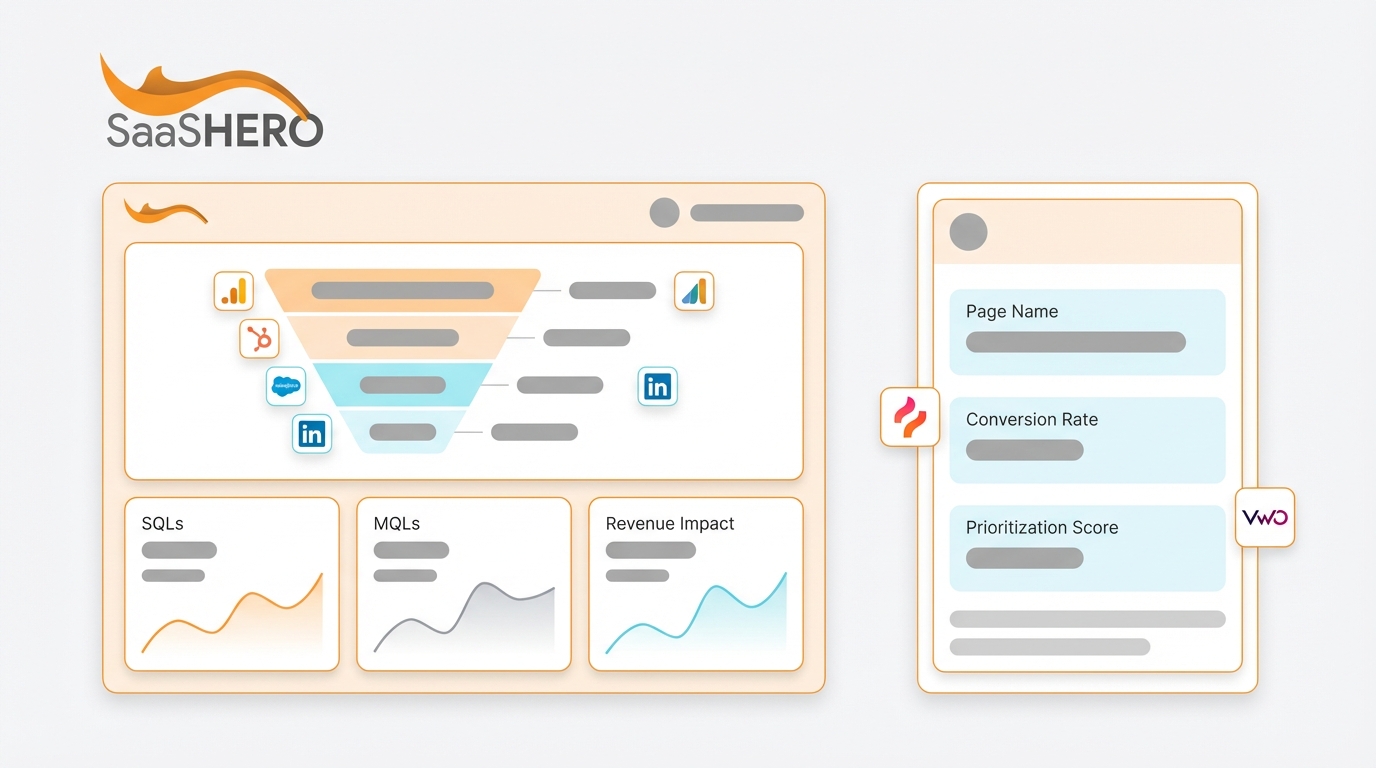
Key Takeaways
- Use the RICE framework (Reach × Impact × Confidence / Effort) tailored for B2B SaaS to rank BOFU pages such as demo requests and pricing that often drive 80% of revenue.
- Audit high-traffic pages (more than 1,000 visits per month) with under 3% CVR using GA4, heatmaps, and CRM data to uncover quick wins.
- Apply low-effort tactics like reducing form fields, adding above-the-fold social proof, and writing benefit-focused CTAs to gain immediate 20-50% lifts.
- Run structured A/B tests and track SQLs and ARR attribution so high-traffic pages show clear results within 30-90 days.
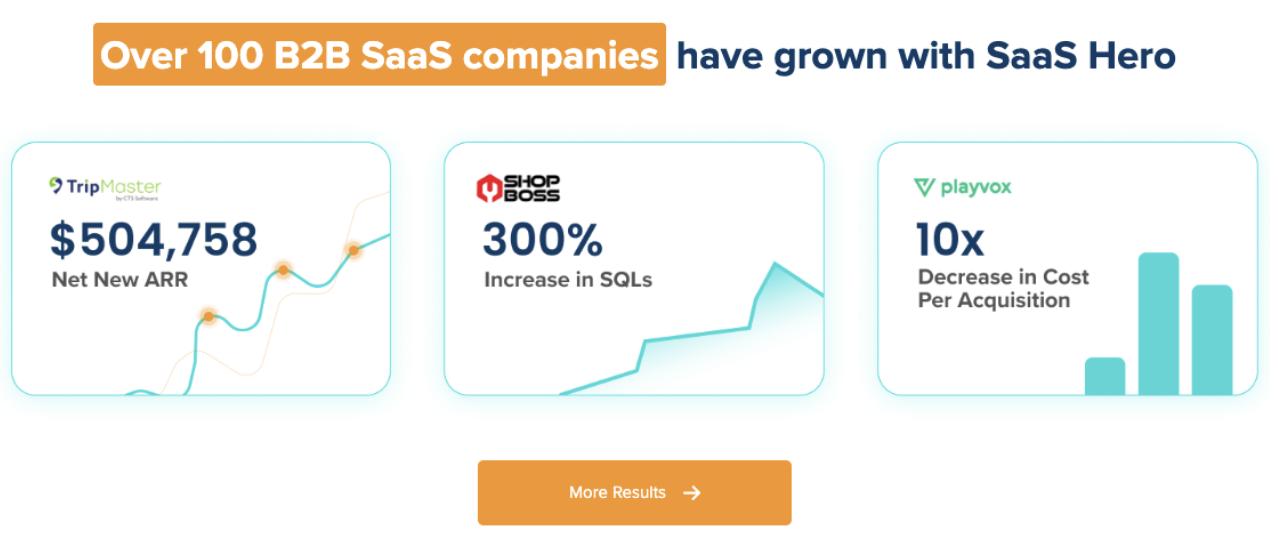
- Scale results with SaaSHero’s CRO services and schedule a discovery call to pursue ARR gains similar to the $504k+ achieved for TripMaster.

Baseline Setup for B2B SaaS CRO Prioritization
Set up core analytics and attribution before you apply the RICE framework. Use Google Analytics 4 for traffic and funnel analysis, heatmap tools like Hotjar or Heap for behavior insights, and CRM integrations with HubSpot or Salesforce to connect conversions to revenue.
Know your benchmarks so targets stay realistic. 2026 benchmarks show average visitor-to-lead conversion rates of 2-5%, while top performers reach 10-20%. CAC payback periods average more than 90 days, and elite companies come in under 80 days. Aim for an LTV:CAC ratio above 3:1 to support sustainable growth.
BOFU pages usually carry most of the revenue impact. Demo request, pricing, and free trial signup pages often generate 80% of qualified leads while representing only a small share of total URLs. Place these pages ahead of TOFU content in your CRO roadmap.

RICE Framework Adapted for B2B SaaS Revenue
The RICE framework (Reach × Impact × Confidence / Effort) needs a revenue lens for B2B SaaS. Traditional RICE focuses on user reach, while SaaS teams should weight pages by ARR potential and SQL generation.
Use a simple five-step flow: first audit traffic and conversion drop-offs, then score pages with SaaS-weighted RICE, next roll out quick-win changes, then A/B test and refine, and finally scale proven changes across similar page types.
|
Page Type |
Reach (Visits/mo) |
Impact (ARR Potential) |
Confidence (%) |
Effort (Days) |
RICE Score |
|
Demo Request |
10,000 |
High (SQLs) |
80 |
5 |
1,600 |
|
Pricing Page |
5,000 |
Medium |
90 |
3 |
1,500 |
|
Free Trial |
8,000 |
High |
70 |
7 |
800 |
Demo pages usually score highest because they create SQLs directly. Pricing pages often follow closely and provide fast, high-confidence wins.
How to Prioritize High-Impact B2B SaaS Conversion Pages
Step 1: Audit Pages with GA4 and CRM Data
Start by flagging high-traffic, low-converting pages in Google Analytics 4. Focus on URLs with more than 1,000 monthly visits and conversion rates below 3%. SaaSHero’s innQuest audit shows how 5-second clarity tests quickly reveal messaging and layout issues.
Build a simple checklist that includes traffic above 1,000 monthly visits, drop-off rates above 70%, and a direct tie to revenue actions such as demo requests or trial signups. Use heatmaps to see where users abandon forms, ignore CTAs, or stall on the page.
Step 2: Score Pages with SaaS-Focused RICE
Adjust RICE scoring to reflect B2B SaaS economics. Treat Reach as monthly unique visitors to each page. Score Impact from 1 to 10 based on ARR potential. Demo pages usually earn 9-10 for direct SQL creation, pricing pages often earn 7-8 for strong purchase intent, and feature pages sit around 3-5 for awareness.
Apply an ARR multiplier so demo pages receive 2x impact weighting because of their direct revenue link. Use Confidence to represent how sure you feel about the projected lift, based on similar tests or industry benchmarks. Measure Effort in development days needed to ship the change.
|
Metric |
Average Performance |
Top Performers |
|
Demo CVR |
2-5% |
10-20% |
|
CAC Payback |
90+ days |
<80 days |
|
LTV:CAC Ratio |
3:1 |
>5:1 |
Step 3: Apply Quick-Win CRO Tactics on Key Landing Pages
Roll out high-impact, low-effort changes first. Remove navigation links at critical conversion moments and cut form fields from 12 to 6 to reduce friction immediately.
Place social proof above the fold so visitors see it without scrolling. Use G2 badges, customer logos, and specific testimonials that address common objections. Write contrasting CTAs with clear benefits such as “Get Demo – See 20% Time Savings” instead of vague “Learn More” buttons.
Improve mobile performance with tappable buttons sized 48×48 pixels and sticky CTAs. Use smart defaults and autofill to shorten forms, especially for enterprise buyers who expect a smooth, fast experience.
Step 4: Run A/B Tests and Track Revenue Impact
Test one change at a time so results stay clear. Begin with headline variations, then move to CTA copy, and then adjust form length. Track SQL rate, pipeline value, and closed-won revenue attribution, not only raw conversion rate.
SaaSHero delivered a 20% conversion lift for Shop Boss through structured testing. Set minimum test durations based on traffic. High-traffic pages usually need 2-4 weeks, while enterprise pages with lower volume often require longer windows.
Step 5: Scale with a Dedicated CRO Partner
DIY optimization reaches a ceiling quickly. Professional CRO support adds consistent testing, technical execution, and deeper analysis. Book a discovery call with SaaSHero to access systematic conversion work starting at $750 for landing page design and $1,250 monthly retainers.
SaaSHero’s competitor conquest programs delivered 650% ROI for TripMaster by capturing high-intent searches with tuned comparison pages. Their month-to-month model avoids long contracts while keeping continuous optimization in motion.

Measurement Framework for B2B SaaS CRO
Measure success beyond surface-level conversion lifts. Track 20% CVR gains alongside CAC payback improvements and Net New ARR attribution. Use GCLID-to-revenue tracking through your CRM to see the real impact on growth.
Capture pre-test baselines for visitor-to-lead rates, SQL conversion percentages, and average deal size. B2B SaaS demo pages benchmark around 2%, which gives a clear starting target. Watch attribution accuracy closely and fix tracking gaps that hide the effect of your CRO work.
Scaling CRO Wins Across Campaigns and Channels
Roll out successful changes across similar page types once results look solid. Apply demo page learnings to free trial and consultation request pages. Add AI-driven personalization for enterprise visitors who return to pricing pages multiple times.
Advanced teams can pair CRO with competitor conquest campaigns and tuned landing pages. AI-generated content for ChargeHub achieved 46% lower cost per install than traditional content, which shows how scaled experimentation can cut acquisition costs.
|
Monthly Ad Spend |
SaaSHero Retainer |
|
Up to $10k |
$1,250 |
|
$10k-$25k |
$1,750 |
|
$25k-$50k |
$2,250 |
Action Plan and Next Steps
RICE-based prioritization turns scattered CRO ideas into a focused revenue strategy. Start with high-traffic BOFU pages, ship quick wins, then scale what works with a consistent process or partner.
Begin your audit now using the steps above. Book a discovery call with SaaSHero to launch systematic conversion optimization that supports measurable ARR growth.
Frequently Asked Questions
Average Conversion Rates for B2B SaaS Pages
Average B2B SaaS conversion rates vary by page type and model. Visitor-to-lead conversion often falls between 2-5% for most companies, while top performers reach 10-20%. Demo request pages usually convert around 2% for average teams and 8-12% for well-optimized experiences. Free trial pages often convert at 8-12% for no-credit-card trials and 20-25% for credit-card-required trials. Focus on your own funnel stage performance instead of relying only on broad industry averages.
Timeline for B2B SaaS CRO Results
B2B SaaS CRO usually shows results within 30-90 days, depending on traffic and test scope. Quick wins such as CTA copy updates or form field reductions often show impact within 2-4 weeks on high-traffic pages. Larger changes like full page redesigns or multi-step funnel improvements usually need 60-90 days to reach significance. Enterprise pages with lower traffic may require 3-6 months for reliable data. Start with high-impact quick wins while you run longer strategic tests in parallel.
Focusing on High-Impact Pages vs All Pages
Concentrate on high-impact pages with the RICE framework instead of spreading effort across every URL. The 80/20 rule applies strongly, since demo, pricing, and trial signup pages usually drive most revenue. Broad optimization across all pages dilutes resources and clouds attribution. Begin with your highest RICE scores, capture measurable gains, then roll proven tactics into similar page types.
Essential Tools for B2B SaaS CRO
Core CRO tools include Google Analytics 4 for traffic and conversion tracking, heatmap tools like Hotjar or Heap for behavior insights, and CRM integrations with HubSpot or Salesforce for revenue tracking. A/B testing platforms such as Google Optimize or Optimizely support structured experiments. Form analytics tools highlight drop-off points in multi-step flows. Above all, confirm that tracking connects ad clicks and GCLIDs through landing pages to closed-won revenue in your CRM so you can see true business impact.
Scaling CRO Beyond Initial Quick Wins
Scaling CRO after early wins requires a repeatable testing process, dedicated ownership, and often a specialist partner. Build a testing roadmap based on RICE scores, with clear hypotheses and success metrics for each experiment. Create reusable page templates and modules so you can roll out proven patterns across similar pages quickly. Consider working with agencies like SaaSHero that run structured optimization programs, from $750 landing page builds to $1,250+ monthly retainers for ongoing testing. Shift from one-off tweaks to a continuous, data-driven improvement engine that compounds over time.