




Written by: Aaron Rovner, Founder, Saas Hero | Last updated: August 6, 2026
Key Takeaways
- SaaS boards now prioritize unit economics over top-of-funnel volume, so leaders must reassess agencies that reward spend instead of closed-won revenue.
- Revenue-focused agencies stand out by reporting Net New ARR and Pipeline Value, billing on flat-fee retainers, and offering month-to-month contracts instead of 12-month lock-ins.
- Percentage-of-spend billing creates a conflict of interest, while flat-fee structures align agency incentives with client growth and budget predictability.
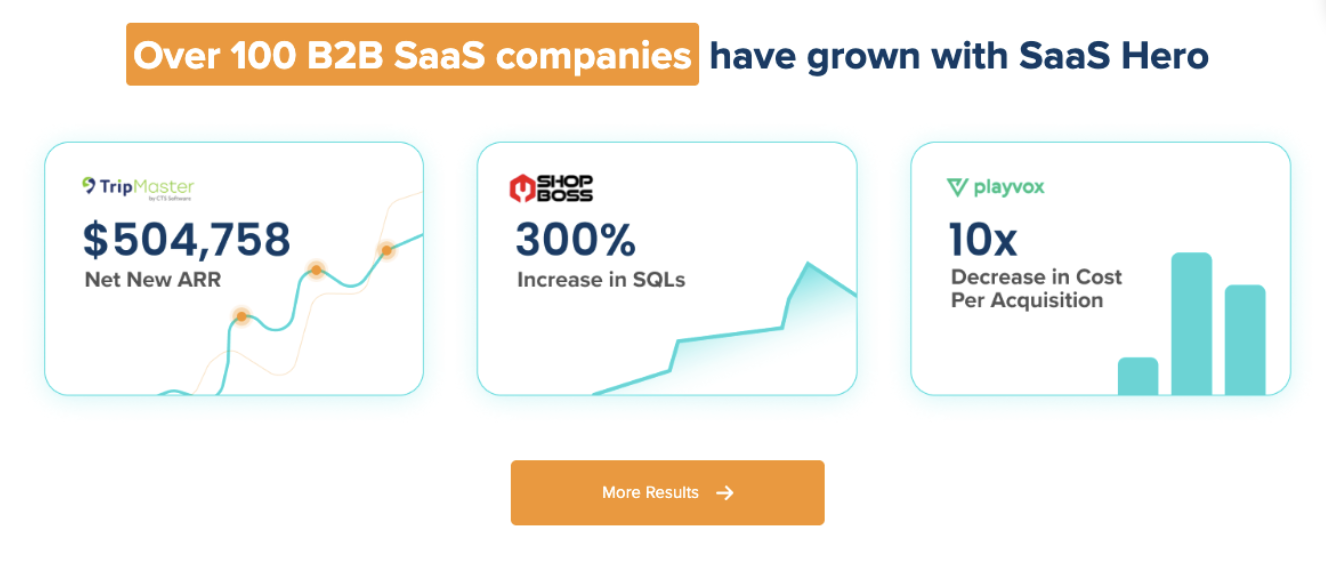
- Real client results such as TripMaster’s $504k ARR, TestGorilla’s 80-day CAC payback, and Playvox’s 10× CPL reduction show the impact of revenue-metric reporting and senior-led execution.
- Evaluate your current partner against these criteria and schedule a pipeline gap analysis to align your marketing investment with ARR outcomes.
Defining a Revenue-Focused SaaS Digital Marketing Agency
A revenue-focused SaaS digital marketing agency is a B2B specialist that ties every campaign decision, reporting metric, and billing structure to closed-won ARR and pipeline value. It does not anchor success to ad spend volume, impressions, or click-through rates.

Evaluating whether a prospective agency meets that standard works best with a clear legitimacy checklist. The following criteria answer the question of whether your digital marketing agency is truly aligned with revenue.
- Revenue metrics in every report. The agency reports Net New ARR, Pipeline Value, and Sales Qualified Leads (SQLs), not just impressions and CTR.
- Flat-fee billing. Fees stay fixed within spend bands, which removes any financial incentive to inflate your budget.
- Month-to-month contract option. The agency does not demand a 12-month commitment before it has earned your trust.
- B2B SaaS exclusivity. The team understands churn, MRR, demo-request funnels, and multi-stakeholder sales cycles, rather than e-commerce or local services.
- Senior-led execution. The strategist who closes the deal also manages your account, with a client-to-manager ratio capped at 8–10 clients.
- CRM integration. Tracking passes click data (GCLID) through the landing page and into HubSpot or Salesforce so campaigns focus on who bought, not who clicked.
- Transparent setup fees. All onboarding costs appear upfront with no hidden retainer escalations.
How Much Should I Pay a Digital Marketing Agency for SaaS?
The two dominant billing structures in the SaaS agency market are percentage-of-spend and flat-fee retainers. The table below reveals how each model creates different incentives, with one rewarding spend volume and the other rewarding efficiency within a fixed cost.
| Dimension | Percentage-of-Spend (10–20%) | Flat-Fee Retainer |
|---|---|---|
| Agency incentive | Maximize ad spend regardless of performance efficiency | Maximize results within a fixed cost structure |
| Client cost predictability | Variable, rises automatically as budget scales | Fixed within spend bands, CFO-friendly |
| Budget recommendation trust | Low, every increase also raises agency revenue | High, increases are data-driven, not fee-driven |
| Incentive alignment with ARR | None, fee tied to spend, not closed-won revenue | Direct, agency survival depends on client retention |
The percentage-of-spend model creates a fundamental conflict of interest, because the agency is financially rewarded for recommending higher budgets, not better outcomes. A flat-fee structure separates agency revenue from spend volume entirely and restores trust in budget recommendations.
SaaS Digital Marketing Agency Pricing Models Explained
SaaSHero publishes its full pricing matrix publicly, which remains rare in the agency market and signals clear incentive alignment. Two tiers support different ARR stages and different levels of internal marketing maturity.
Dedicated Campaign Manager serves founder-led teams or pilot programs that want execution support while keeping strategy in-house. This tier answers a practical question: what is the minimum viable investment to offload paid channel management before hiring in-house?
| Monthly Ad Spend | 1 Channel (Month-to-Month) | 1 Channel (6-Mo Prepay) | 2 Channels (Month-to-Month) |
|---|---|---|---|
| Up to $10k | $1,250 | $1,000 | $2,500 |
| $10k – $25k | $1,750 | $1,400 | $3,000 |
| $25k – $50k | $2,250 | $1,800 | $3,500 |
| $50k+ | $3,250 | $2,600 | $4,500 |
Full Marketing Team supports scale-ups that need strategy plus execution across one or more channels. This tier helps leaders replace a generalist vendor with a partner that reports pipeline and unit economics.
| Monthly Ad Spend | 1 Channel (Month-to-Month) | 1 Channel (6-Mo Prepay) | 2 Channels (Month-to-Month) |
|---|---|---|---|
| Up to $10k | $2,500 | $2,000 | $3,750 |
| $10k – $25k | $3,000 | $2,400 | $4,250 |
| $25k – $50k | $3,500 | $2,800 | $4,750 |
| $50k+ | $4,500 | $3,600 | $5,750 |
The 6-month prepay discount of approximately 20% funds the campaign learning phase at a lower rate and secures cash-flow predictability for both parties. A one-time setup fee of $1,000–$2,000 covers the initial audit, tracking architecture, and strategy build. Once pricing structure is transparent, the next question becomes which metrics that investment should actually produce.
Revenue vs Vanity Metrics: What Actually Moves ARR?
The metrics an agency reports signal whose interests it serves and how you should judge performance. The table below contrasts the vanity metrics common in generalist agency reports with the revenue metrics that SaaS boards actually use for decisions.
| Metric Type | Vanity Metric | Revenue Metric |
|---|---|---|
| Awareness | Impressions, Reach | Pipeline Value sourced from paid channels |
| Engagement | CTR, Clicks, Sessions | Sales Qualified Leads (SQLs) |
| Conversion | Form fills, MQLs | Net New ARR, CAC Payback Period |
This distinction matters because it changes how you evaluate your agency and what you demand in reports. When you anchor reviews to revenue metrics, you can cut channels that do not build pipeline and double down on those that shorten payback.
Three SaaSHero client outcomes show what revenue-metric reporting produces in practice.

- TripMaster (Transit Software): $504,758 in Net New ARR added in 12 months, with a 650% ROI and a 20% conversion rate from paid search, which is exceptionally high for B2B SaaS.
- TestGorilla (HR Tech): An 80-day CAC payback period, the unit-economic benchmark that supported a $70M Series A raise and the addition of 5,000+ new customers.
- Playvox (CX Software): A 10× reduction in Cost Per Lead alongside a 163% increase in lead volume, achieved by restructuring the account and eliminating wasteful spend.
Month-to-Month vs 12-Month Contracts: Who Bears the Risk?
Contract structure determines where performance risk sits and how urgently your agency must deliver. The table below maps that risk allocation across the two dominant models.
| Dimension | 12-Month Lock-In | Month-to-Month |
|---|---|---|
| Risk bearer | Client, locked in regardless of results | Agency, must re-earn the relationship every 30 days |
| Agency performance urgency | Low, revenue is guaranteed for 12 months | High, churn is always one bad month away |
| Incentive alignment | Misaligned, contract protects mediocrity | Aligned, agency survival tied to client growth |
| Exit cost | High, early termination fees or sunk retainers | Zero, cancel with standard notice |
A 12-month contract is described as "the kiss of death" for agency accountability, because once the contract is signed, the urgency to deliver immediate results drops. Month-to-month terms act as a forcing mechanism, so the agency must perform or lose the account.
Compare your current contract terms against SaaSHero's month-to-month model in a 30-minute discovery call.
Matching Agency Fit to Your Company ARR Stage
Agency models fit specific ARR stages, and misalignment wastes both budget and time. The maturity model below maps the right engagement type to where a SaaS company sits on the growth curve.

- $500k ARR — The Overwhelmed Founder: A Dedicated Campaign Manager at $1,250/month costs less than a junior in-house hire, operates on a month-to-month basis, and offloads execution without giving up strategic control. The entry price point stays accessible before a formal marketing team exists.
- $5M ARR — The Frustrated VP of Marketing: A Full Marketing Team at $4,500/month for a $50k+ spend account replaces a generalist agency that reports impressions with a partner that reports pipeline. CRM integration into HubSpot or Salesforce enables board-level CAC and LTV reporting.
- $10M+ ARR — The Post-Funding Scaler: Multi-channel deployment across Google Ads, LinkedIn Ads, and competitor conquesting campaigns activates an instant growth team faster than a three-month in-house hiring cycle. The TestGorilla 80-day payback benchmark becomes the target outcome at this stage.
Frequently Asked Questions
How do I know if a SaaS digital marketing agency is legitimate?
A legitimate agency meets the seven criteria outlined earlier. It anchors reporting to closed-won revenue, removes percentage-of-spend conflicts through flat fees, and operates month-to-month so performance risk sits with the agency, not the client. The full checklist appears in the opening section and should guide your evaluation.
What are the hidden fees I should watch for in a SaaS agency contract?
The most common hidden costs are percentage-of-spend escalators, where fees rise automatically as your budget grows, early-termination penalties embedded in 12-month contracts, and unbundled charges for landing page design, creative assets, and tracking setup that appear as "add-ons" after the retainer is signed. A transparent agency publishes a complete pricing matrix that includes setup fees, per-channel costs, and any prepay discounts before the first call. SaaSHero discloses a one-time setup fee of $1,000–$2,000, a $750 flat fee for landing page design, and $300 for five ad creative assets, all stated upfront with no retainer escalations.
What is the risk of junior execution at a SaaS marketing agency?
The "bait-and-switch" is one of the most documented failure modes in the agency industry. A senior partner closes the deal, then hands the account to a junior account manager who may be running 30 or more clients simultaneously. The result is templated campaigns, slow iteration cycles, and reporting that never connects to revenue.
The structural fix is a hard cap on client-to-manager ratios, and SaaSHero limits each manager to 8–10 clients. This cap pairs with a senior-led model where the strategist who designs the campaign also manages its execution. When you evaluate any agency, ask directly who will manage your account day-to-day and what their current client load is.
How should I evaluate revenue attribution from a SaaS agency?
Reliable revenue attribution requires passing click-level data (Google Click ID, or GCLID) from the ad platform through the landing page and into your CRM, such as HubSpot or Salesforce. Closed deals can then be traced back to the specific campaign and keyword that sourced them. Agencies that rely solely on Google Analytics last-click attribution systematically undervalue top-of-funnel activity and cannot tell you which campaigns produced closed-won ARR.
Before signing any retainer, confirm that the agency will implement end-to-end CRM tracking and that your weekly reports will show pipeline value and Net New ARR by channel, not just conversion counts from the ad platform.
Is a month-to-month SaaS agency contract actually better than a 12-month commitment?
For a new agency relationship where trust has not yet been established, a month-to-month contract places performance risk on the agency rather than the client. The agency cannot rely on guaranteed revenue for 12 months and must deliver results every 30 days or risk losing the account. This structure creates strong incentives for urgency and accountability that long-term contracts remove.
A 6-month prepay option, where the client commits voluntarily in exchange for a discount of approximately 20%, can make sense once the agency has demonstrated early results. That structure funds the campaign learning phase at a lower effective rate while preserving alignment.
Conclusion: Choose the Partner Whose Incentives Match Your Pipeline
In 2026, the evaluation criteria for a SaaS digital marketing agency converge on a single issue: whose interests the billing model serves. Percentage-of-spend fees reward budget inflation. Twelve-month contracts reward mediocrity. Vanity-metric reporting rewards the appearance of activity over the reality of closed-won revenue.
A revenue-focused agency that bills on flat-fee retainers, operates month-to-month, reports Net New ARR, and works exclusively in B2B SaaS removes those misalignments. The outcomes described earlier, such as TripMaster's half-million in new ARR, TestGorilla's sub-90-day payback, and Playvox's order-of-magnitude efficiency gain, reflect an economic model where the agency's survival depends on the client's growth.
SaaSHero is the only agency that combines all four structural differentiators, flat fees, month-to-month terms, ARR-anchored reporting, and exclusive B2B SaaS specialization, in a single engagement model. For Series A and B founders and marketing leaders who can no longer afford misaligned partners, that combination provides a clear evaluation framework.
Request a revenue-focused audit of your current agency performance and see where ARR is being left on the table.