





Written by: Aaron Rovner, Founder, Saas Hero | Last updated: September 5, 2026
Key Takeaways
- Scaling EdTech ads means increasing spend while holding or improving ROAS and CAC through audience expansion, creative testing, and funnel improvements.
- The 2026 ad landscape requires revenue-first measurement. Meta’s 1-day attribution and signal loss make CRM data more reliable than platform dashboards.
- Before scaling, confirm five foundations: accurate server-side tracking, CRM-connected optimization, a clear funnel with 15–25% trial-to-paid conversion, a strong offer, and a proven sales process.
- Follow the 70/20/10 budget rule, raise budgets 10–20% every 24–48 hours, and use the 3-2-2 creative testing method to prevent fatigue.
- EdTech teams ready for a revenue-first scaling system can book a discovery call with SaaSHero today.
How EdTech Ad Scaling Has Changed in 2026
The EdTech advertising landscape now splits sharply between institutional and consumer buying. Institutional EdTech deals involve 4–7 decision-makers per deal and sales cycles of 6–18 months. B2C EdTech runs on fast funnels where trial-to-paid conversion drives profitability.
Meta consolidated all attribution windows to 1-day click and 1-day view in early 2026, removing the 7-day and 28-day click options. Reported conversions dropped 15–30% overnight across many accounts. Google kept third-party cookies in Chrome, yet signal loss on Safari and iOS continues, where client-side pixels capture only 50–65% of actual conversions on iOS traffic.
The gap between platform numbers and reality keeps growing. Platform-reported ROAS now runs 30–60% higher than true incrementality. EdTech companies that scale profitably in this environment build measurement around CRM data instead of ad platform dashboards.
SaaSHero has managed more than $60M in ad spend for B2B companies and sees these shifts daily. The teams that win treat measurement, creative, and funnel performance as one system. Book a discovery call to see how this revenue-first system fits your account.
Pre-Scale Checklist: Five Foundations to Confirm First
Scaling only works when the core system is sound. Confirm these five foundations before raising budgets.
- Accurate tracking: Server-side tracking through Meta Conversions API and Google Enhanced Conversions is mandatory. Brands that add server-side tracking typically recover 25–40% of conversions that browser pixels miss.
- CRM-connected optimization: Campaigns must optimize against CRM events, not just form submissions. This single shift often drives the largest improvement in EdTech scaling.
- Clear funnel: A 15–25% trial-to-paid conversion rate is healthy for EdTech. A rate below 10% usually signals a product or onboarding issue that media cannot solve.
- Compelling offer: Landing page headlines should speak directly to the buyer’s problem and outcome. Category labels and feature lists convert poorly on cold traffic.
- Proven sales process: B2B teams need a repeatable process that converts qualified leads into pipeline and revenue.
Most ad accounts waste 30–40% of budget on campaigns that generate no measurable revenue. Scaling that kind of setup multiplies waste instead of growth.

Budget Scaling: Vertical, Horizontal, and the 70/20/10 Rule
Effective scaling blends vertical and horizontal moves. Vertical scaling raises budgets on proven campaigns. Horizontal scaling adds new audiences, channels, or regions once unit economics hold.
Use these vertical scaling rules:
- Increase budgets by a maximum of 20% every 48–72 hours, and avoid large jumps.
- Scale only when CPA sits at or below target for at least 20 conversions over 7 days.
- Pause scaling if CPA rises more than 15% above target.
- Budget jumps above 30% reset the learning phase and often raise CPA by 20–50%.
Use these horizontal scaling rules:
- Duplicate winning ad sets into new audiences such as fresh lookalike tiers, demographics, or regions while keeping creative identical.
- When the duplicate performs within 20% of the original, treat creative as the main driver.
- Use 3–5 broad audience segments instead of many micro-audiences. Meta’s algorithm needs volume to learn effectively.
Apply the 70/20/10 Rule for budget allocation. Assign 70% to top-performing “Performance Engines,” 20% to structured tests, and 10% to higher-risk experiments. For EdTech, max out brand and high-intent non-brand search first. Then expand into category and problem-aware demand, with each campaign held to its own CPA target and scorecard.
Set daily budgets at a minimum of 3× target CPA. This level gives algorithms enough room to find 2–4 conversions per day. Accounts that spend less usually face longer learning phases and volatile results.
Creative Scaling: Using the 3-2-2 Method
Creative fatigue is the top driver of CPA increases in scaled Meta campaigns. Many ads fatigue after 3–5 days, while manual checks often spot the issue a week or more later.
The 3-2-2 testing method keeps creative fresh and structured:
- Three creative concepts that use different angles or hooks
- Two variations for each concept, such as new copy or format
- Two audience signals, usually broad and interest-based
This structure produces six ads per test, which gives clear directional data without draining budget. Run tests for 3–5 days and aim for 50+ conversions per variant. Look for a 10% or greater performance gap at 95% confidence before choosing a winner.
Watch for these fatigue signals:
- Frequency above 3.0
- CTR dropping more than 20% from its peak
- CPA rising more than 15%
- CPM rising more than 40% above baseline
B2B and B2C EdTech respond differently to creative styles. UGC creative outperforms studio creative for B2C, with higher CTR, stronger hooks, and lower CPMs. A 60% UGC and 40% studio mix works well for many B2C brands. For B2B EdTech, a case study that swapped a static dashboard for a 20-second workflow screen recording lifted CTR from 0.6% to 1.9% and cut cost per trial by 64%.
Under Meta’s Andromeda update, accounts that run 8–12 distinct concepts per campaign with 2–3 variations each often see 20–35% higher ROAS. Keep the Creative Similarity Score under 40% to avoid internal competition between similar ads.
SaaSHero’s in-house designers and copywriters ship new creative on a rolling basis. Book a discovery call to see how continuous creative production supports a revenue-first scaling system.
Audience Scaling for B2C and B2B EdTech
B2C EdTech scales fastest when it feeds platforms high-quality customer data. Meta’s 2026 move toward Advantage+ predictive audiences increased the value of clean first-party data. Optimize toward trial-to-paid events instead of raw signups. Optimizing for free signups or installs often fills accounts with users who never convert.
B2B EdTech needs a different audience strategy:
- Build LinkedIn audiences by job function and seniority instead of title alone.
- Use LinkedIn Lead Gen Forms, which often reach 8–13% completion rates versus 2–4% on external pages.
- Layer multiple LinkedIn ad formats, since multi-format exposure more than doubles conversion rates compared to a single format.
- Evaluate LinkedIn on qualified pipeline and opportunity creation instead of raw signup counts.
Retargeting windows should match the buying cycle. B2B EdTech often needs 60–90 day windows because sales cycles run 3–6 months for mid-market and 6–12+ months for enterprise. B2C EdTech usually performs well with 7–14 day windows.
Channel Playbook: Meta, Google, YouTube, and LinkedIn
Meta: Use Advantage+ campaigns with dynamic creative. Meta’s Andromeda update made creative the primary targeting mechanism, so ad content now shapes delivery more than detailed audience settings. Reels placements often deliver 35% lower CPM than Feed for 18–34 audiences.
Google: Exclude brand terms from Performance Max campaigns so the system cannot claim conversions from demand you already own. Use Maximize Conversions with a Target CPA guardrail while scaling. For B2B and high-ticket EdTech, use enhanced conversions and import offline CRM events back into Google Ads.
YouTube: Use video campaigns to create demand and educate the market. Since 85% of users watch without sound, captions raise completion rates by about 12%.
LinkedIn: Education CPC on LinkedIn often ranges from $3–$5, which sits below many B2B verticals. LinkedIn works best as a pipeline channel and should be judged on qualified opportunities and revenue influence.
SaaSHero manages Meta, Google, YouTube, and LinkedIn as one system. Budget flows to the channels that produce revenue, since the retainer indexes to total ad spend rather than channel count.
Revenue-First Metrics for EdTech Scaling
| Metric | B2C EdTech | B2B EdTech |
|---|---|---|
| Primary metrics | CAC, trial-to-paid conversion, CAC payback, LTV:CAC | Qualified pipeline, cost per opportunity, sales cycle length |
| CAC payback target | Under 6 months is excellent, under 12 months is acceptable | Under 12 months is strong, while 16–18 months matches the current B2B SaaS median |
| LTV:CAC | 3:1 minimum, with one-time purchase models often struggling to reach this | 5:1 to 8:1 for multi-year contracts |
| Sales cycle | Days to weeks | 6–18 months, tied to budget cycles and the academic calendar |
| Attribution model | 7–14 day retargeting windows, optimized toward purchase or trial-to-paid events | Media Mix Modeling for CAC, with multi-touch attribution for creative decisions |
A 3:1 ROAS usually works as a baseline target for EdTech. For B2B with long cycles, CAC payback under 12 months matters more than any single ROAS number. Platform ROAS can show 1,140% while blended P&L ROAS sits at 77%. P&L ROAS should win when the two conflict.

Five Common Scaling Mistakes to Fix Now
- Scaling too quickly: Budget jumps above 30% reset the learning phase. Use 10–20% increases every 24–48 hours instead.
- Ignoring creative fatigue: Most Meta ads fatigue after 3–5 days. Use the 3-2-2 method and ship new creative continuously.
- Optimizing toward form fills instead of revenue: Platforms find more of the event they receive as a signal. Feed algorithms CRM events such as qualified opportunities and lifecycle stages.
- Blending brand and non-brand traffic: Mixing brand and non-brand in one campaign hides weak non-brand performance behind cheap brand conversions. Separate campaigns with distinct targets.
- Judging B2B on B2C metrics: A 1-day attribution window breaks for long sales cycles. Track pipeline contribution and CAC payback instead.
Summary: Revenue-First Rules for Scaling EdTech Ads
- Use a revenue-first framework where LTV and payback period guide budget decisions instead of ROAS alone.
- Raise budgets 10–20% every 24–48 hours and avoid increases above 30% in a single step.
- Run the 3-2-2 creative testing method to prevent fatigue and keep creative velocity high.
- Treat B2B and B2C EdTech as distinct systems with different scaling strategies, metrics, and attribution models.
- Invest in first-party data quality and CRM-connected optimization, since these two factors now define scaling success.
Why SaaSHero Scales EdTech Ads Across the Full Funnel
Profitable EdTech scaling needs one team that owns paid media, landing pages, and CRM reporting. SaaSHero fills that role.
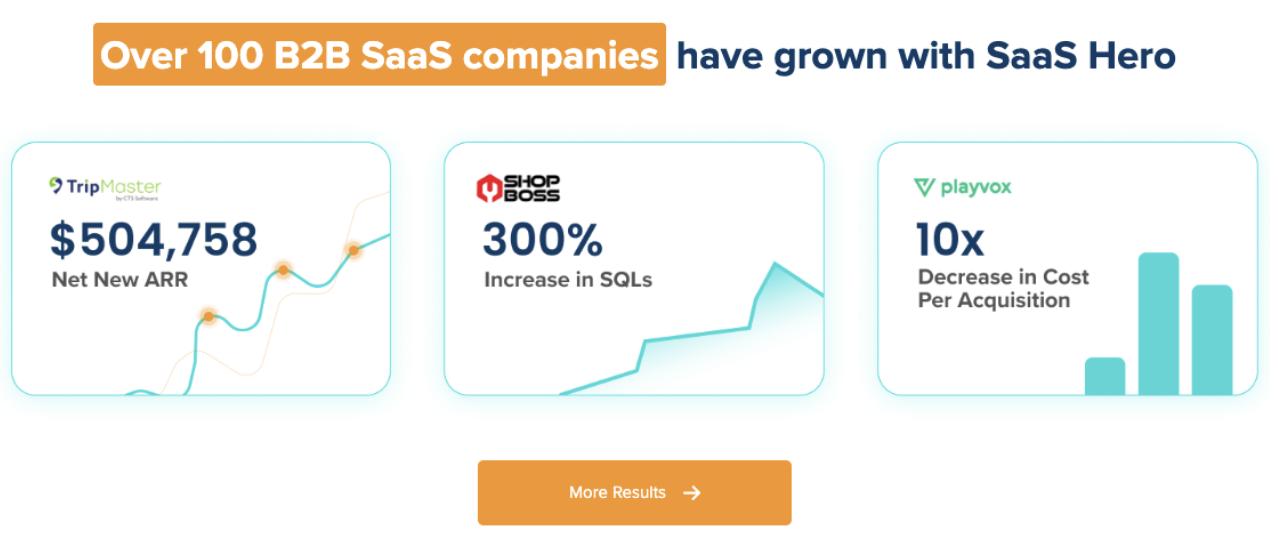
As an outsourced growth team for B2B companies, SaaSHero brings:
- $60M+ in lifetime ad spend managed across more than 100 B2B companies.
- In-house creative specialists who ship new assets continuously instead of reacting to one-off requests.
- CRM-based optimization that tunes campaigns to qualified pipeline and closed revenue instead of surface-level form fills.
- Flat retainers indexed to ad spend, so channel-mix recommendations stay aligned with performance rather than fees.
- Google Premier Partner status in the top 3% of agencies and a G2 High Performer ranking at #20 of roughly 6,000 agencies.
SaaSHero asks every prospect a single discovery question that reveals the core issue: “Are campaigns optimized around CRM data or only around form submissions?” Many EdTech teams cannot answer confidently, and that gap usually marks the budget leak.
Teams ready to scale EdTech ads profitably can book a discovery call with SaaSHero today.
Frequently Asked Questions
What is scaling in advertising?
Scaling in advertising means raising ad spend in a structured way while keeping or improving efficiency metrics such as ROAS and CAC. It differs from simple budget boosts that push more money through the same setup. Those boosts often degrade performance as algorithms reach beyond proven audiences. True scaling expands audiences, refreshes creative, improves conversion paths, and confirms that unit economics support higher spend before committing more budget. In EdTech, B2C scaling focuses on trial-to-paid conversion and lookalike expansion, while B2B scaling focuses on lead quality, sales cycle speed, and expansion into new segments or channels once the primary channel works.
What is a good ROAS for EdTech ads?
A 3:1 ROAS usually works as a healthy target for EdTech, meaning three dollars of revenue for every dollar spent. ROAS alone, however, gives an incomplete picture, especially for B2B. Platforms overstate performance because they use their own attribution rules and count view-through activity. P&L ROAS, calculated from CRM revenue against total ad spend, provides a more accurate view. For B2B EdTech with 6–18 month cycles, CAC payback under 12 months and an LTV:CAC ratio of at least 3:1 matter more. Multi-year contracts can often reach 5:1 to 8:1. For B2C EdTech, a 15–25% trial-to-paid rate and CAC payback under 6 months signal strong performance. Set ROAS targets against these downstream economics instead of platform dashboards.
How do I scale EdTech ads without increasing CPA?
Scaling without a sharp CPA increase requires discipline across budgets, creative, and audiences. Keep budget increases within 10–20% every 24–48 hours, since jumps above 30% often reset learning and raise CPA by 20–50%. Refresh creative continuously with a structure like the 3-2-2 method, because fatigue usually drives CPA up in scaled campaigns. Sequence audience expansion by saturating high-intent segments first, then moving into colder audiences through horizontal scaling that duplicates winning ad sets into new segments. Underneath all of this, optimize toward CRM-qualified outcomes instead of form fills, since surface-level events can show lower CPA while pipeline stays flat.
Meta vs. Google for EdTech scaling — which is better?
Meta and Google solve different parts of the EdTech growth problem. Google captures existing intent from people already searching for solutions, which makes it ideal for demand capture on brand, high-intent non-brand, and competitor terms. Meta creates demand among people who have the problem but are not actively searching, which suits B2C EdTech targeting parents, students, and teachers in feed. For B2B EdTech, LinkedIn reaches institutional decision-makers by function and seniority in ways Meta and Google cannot match and should be measured on qualified pipeline. Most EdTech companies see the best results when they first fund profitable Google demand capture, then add Meta or LinkedIn for demand creation. Running these channels under one team with a shared measurement layer allows honest evaluation of each channel’s true impact.