




Key Takeaways for B2B SaaS Founders
- B2B SaaS startups should target 101%+ NRR, a 3:1 LTV:CAC ratio, and 80-day payback periods to sustain growth in 2026.
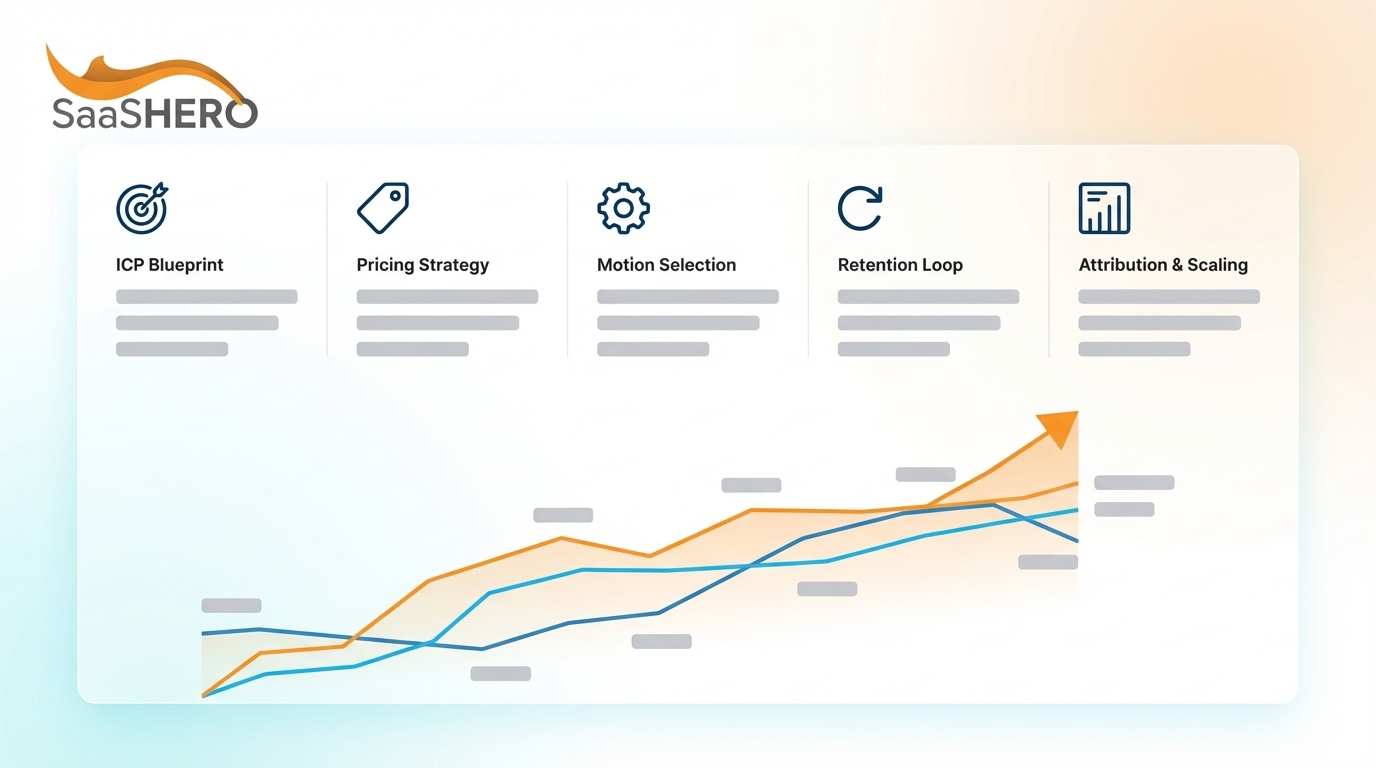
- Use the 7-step revenue-first framework: ICP definition, value pricing, motion selection, retention loops, conquesting ads, CRO pages, and attributed scaling.
- Prioritize high-intent channels such as competitor conquesting and heuristic CRO instead of vanity metrics to generate pipeline faster.
- Well-defined ICPs drive 40% higher close rates, while hybrid pricing models typically lift NRR into the 104-107% range.
- Partner with SaaSHero for month-to-month execution at $1,250 per month and discuss implementing this playbook for your startup.
Executive Summary & Core 7-Step Framework
This sustainable GTM framework uses seven connected steps that keep revenue outcomes ahead of surface-level metrics.
- Nail ICP/Personas – Define ideal customer profiles with precise firmographic and technographic criteria.
- Value Pricing Matrix – Use hybrid pricing models that align how you charge with the outcomes customers receive.
- PLG vs Sales-Led Choice – Match your motion to average selling price and product complexity.
- Retention Loops for NRR – Build expansion systems that target elite NRR performance above 113%.
- Competitor Conquesting Ads – Capture high-intent buyers who actively compare alternatives.
- Heuristic CRO Landing Pages – Improve conversion paths using proven B2B testing frameworks.
- Revenue-Attributed Scaling – Scale channels based on closed-won revenue attribution instead of clicks.
Success metrics focus on Net New ARR growth, SQL conversion rates, and achieving elite Gross Revenue Retention above 90%. By centering on these revenue-driven indicators instead of vanity metrics, this plug-and-play approach helps founders deploy capital-efficient growth strategies without typical agency overhead or misaligned incentives.
How the B2B SaaS GTM Landscape Has Shifted
The B2B SaaS GTM environment changed significantly after 2024. Traditional agencies that rely on percentage-of-spend billing and long-term contracts now conflict with startup cash flow realities. AI Search and Answer Engine Optimization now receives 51% of strategic investment, while traditional SEO captures only 14% of focus from growth-stage companies.
Successful B2B SaaS teams now run an average of five core GTM channels plus 5.5 experimental ones. They emphasize cross-functional alignment instead of squeezing incremental gains from a single channel. The rise of flat-fee, month-to-month partnerships reflects founder demand for accountability and flexibility. SaaSHero’s B2B SaaS-only focus supports this shift by providing senior-led execution without junior handoffs or generic, non-SaaS playbooks.
Partner ecosystems now represent the fastest-growing GTM motion, with 67% of companies planning indirect revenue growth above 30%. This move toward performance-aligned partnerships mirrors the broader shift away from traditional agency models and toward outcome-based relationships.
With this landscape in mind, the following seven-step framework gives you a tactical path to build a sustainable, outcome-focused GTM engine. Each step builds on the previous one and starts with defining your ideal customer.
Step-by-Step Sustainable GTM Build
Step 1: ICP Blueprint Development
As noted earlier, ICP clarity dramatically improves close rates and also doubles revenue growth. The ICP development process starts with your top 20% of accounts by revenue, retention, and NPS. Analyze those accounts to find patterns in industry, company size, and specific challenges.
The table below shows the three core ICP dimensions you must define to reach this level of targeting precision.
|
ICP Element |
Definition |
Example for HR Tech SaaS |
|
Firmographics |
Company size, industry, revenue |
200-1,000 employees, HR Tech users |
|
Technographics |
Software stack compatibility |
HubSpot plus rapid hiring growth |
|
Intent Signals |
Pain points and buying triggers |
“Competitor alternatives” searches |
Step 2: Value-Based Pricing Strategy
Hybrid pricing models that blend subscription and usage components consistently reach NRR ranges of 104-107%. About one-third of $1M-$5M ARR companies now use outcome-based pricing that ties revenue to delivered value. This approach improves retention and also signals market sophistication to investors.
Step 3: Motion Selection Framework
Adding sales too early at low price points, especially below a $100 ASP, slows growth. Companies with lower ASP products should emphasize self-service product experiences and smooth onboarding. Complex, high-value solutions benefit more from sales-led motions that support multi-stakeholder decisions.
Step 4: Retention Loop Architecture
Retention initiatives create two to three times more lifetime ARR impact than acquisition efforts, which makes them your highest-leverage growth investment. To capture this value, build systematic expansion mechanisms through feature adoption tracking, usage-based upsells, and proactive customer success interventions. Each mechanism directly supports the path toward elite NRR performance above 113%.
Step 5: Competitor Conquesting Psychology
Prospects who search for competitor pricing, alternatives, or reviews show the strongest purchase intent and convert at the highest rates. Conquesting campaigns should focus on three intent types: pricing comparison, problem or complaint resolution, and validation or review seeking. Each intent type needs its own landing page and tailored messaging framework.
Step 6: Conversion Rate Optimization
Heuristic analysis frameworks reveal conversion killers without waiting weeks for traffic data, which enables rapid improvements even with modest volume. Specific techniques such as the 5-second test, strategic trust signal placement, and friction reduction drive measurable gains in demo request and trial conversion rates. These gains depend on including elements B2B buyers expect, such as benefit-focused headlines, strong social proof, and clear value propositions.

Step 7: Attribution and Scaling
Revenue-attributed scaling relies on tracking that connects ad clicks to CRM closed-won data. This connection allows you to adjust budgets based on actual customer acquisition instead of impressions or click-through rates.
Executing this seven-step framework requires expertise in B2B SaaS attribution, conversion improvements, and channel management. Most early-stage teams lack this capability in-house, which makes the right execution partner essential.
SaaSHero as Your B2B SaaS Execution Partner
SaaSHero’s month-to-month retainer model removes the common risks of long-term contracts and percentage-of-spend billing. The $1,250 monthly entry point for up to $10k in ad spend gives startups professional campaign management at a practical price. Senior-led execution with an 8:1 client-to-manager ratio keeps strategy and decision-making in experienced hands.
The pricing structure below shows how fees scale with ad spend while staying flat within each band. This structure keeps costs predictable and avoids incentives to push unnecessary budget increases.
|
Monthly Spend |
1 Channel (Month-to-Month) |
2 Channels (Month-to-Month) |
|
Up to $10k |
$1,250 |
$2,500 |
|
$10k-$25k |
$1,750 |
$3,000 |
|
$25k-$50k |
$2,250 |
$3,500 |
This transparent pricing model removes the incentive to recommend unnecessary spend increases because fees stay fixed within each band. The flat-fee approach keeps recommendations tied to performance data instead of agency revenue goals. Find your pricing tier and discuss your growth stage to see how this execution model fits your budget.

Case Studies & Proof of Outcomes
SaaSHero’s work delivers measurable results across multiple B2B SaaS segments. TripMaster generated $504,758 in Net New ARR with a 650% ROI and a 20% conversion rate from paid search. TestGorilla achieved the target 80-day payback period while adding more than 5,000 new customers, which supported their $70M Series A raise. Playvox cut Cost Per Lead by 10x while increasing lead volume by 163%.

The table below summarizes how each client hit key benchmarks from the framework and turned them into revenue outcomes.
|
Client |
Outcome |
Key Benchmark |
|
TripMaster |
$504k Net New ARR |
650% ROI |
|
TestGorilla |
80-day payback period |
$70M Series A |
|
Playvox |
10x lower CPL |
163% volume increase |
While these results show what effective execution can achieve, reaching similar outcomes requires avoiding the common mistakes that derail most B2B SaaS GTM efforts.
Common Pitfalls & 90-Day Rollout Checklist
Five recurring pitfalls undermine sustainable GTM execution. These include ignoring dark funnel attribution, hiring sales too early at low ASPs, misaligned sales and marketing definitions of qualified leads, scaling channels before message-market fit, and choosing value metrics that punish product adoption.
90-Day Implementation Checklist:
- Complete ICP analysis and validation (Days 1-14).
- Set up tracking and attribution systems (Days 15-30).
- Launch competitor conquesting campaigns (Days 31-45).
- Improve landing pages and conversion paths (Days 46-60).
- Scale winning channels based on closed-won data (Days 61-90).
Conclusion & Next Steps
The 7-step revenue-first framework offers a clear, repeatable system for sustainable B2B SaaS growth without the capital waste of traditional marketing approaches. Success depends on partners who understand B2B SaaS unit economics, buyer behavior, and the realities of each growth stage.
SaaSHero’s methodology, transparent pricing, and month-to-month accountability provide the execution support most $500k-$5M ARR companies need to reach the NRR and payback benchmarks outlined in this framework. Start implementing this framework for your market and discuss how these seven steps map to your position and growth goals.
Frequently Asked Questions
What budget should B2B SaaS startups allocate for sustainable GTM execution?
B2B SaaS startups should allocate 15-25% of ARR to marketing and sales activities, with the exact level shaped by growth stage and market maturity. For companies in the $500k-$5M ARR range, this usually equals $5k-$25k per month in combined ad spend and execution costs.
Every dollar should connect to pipeline and closed-won revenue instead of vanity metrics. Start with smaller budgets to validate unit economics, then scale channels that deliver the shortest payback periods.
How long does it take to see results from a revenue-first GTM strategy?
Most companies see early results within 30-45 days on high-intent channels such as competitor conquesting and search campaigns. Reaching sustainable unit economics and consistent pipeline usually takes 90-120 days of testing and refinement.
Timelines vary based on competition, product complexity, and sales cycle length. Companies with longer sales cycles may need six months or more to see full impact on closed-won revenue, although leading indicators such as qualified pipeline and demo requests should improve within the first quarter.
Should we hire an agency or build an in-house team for GTM execution?
The right choice depends on ARR level, growth trajectory, and internal skills. Companies below $2M ARR often gain more from specialized agencies that provide immediate expertise without the cost of hiring and training a full team. Building in-house capability usually takes 3-6 months and requires investment in tools, training, and recruiting.
Agencies offer faster time-to-value and access to proven playbooks, while in-house teams provide deeper company context and long-term control. Many successful firms use a hybrid model that pairs specialist partners for technical execution with internal strategic oversight.
What are the most important metrics to track for sustainable B2B SaaS growth?
Key metrics include Net Revenue Retention, with a target above 113% for top-quartile performance, CAC payback period of 80 days or less, and an LTV:CAC ratio of at least 3:1, ideally 4:1 or higher. You should also track Gross Revenue Retention above 90%, MRR growth rate, and SQL conversion rates. Together, these metrics show both acquisition efficiency and retention strength. Avoid vanity metrics such as raw website traffic or follower counts that do not connect to revenue.
How do we avoid common agency pitfalls when selecting a GTM partner?
Avoid agencies that insist on long-term contracts, use percentage-of-spend billing, or lack specific B2B SaaS case studies with clear results. Red flags include guaranteed instant wins, opaque reporting, and junior account teams after senior-led sales calls.
Look for partners that offer month-to-month agreements, flat-fee pricing, and tight integration with your tools and processes. Strong agencies ask detailed questions about unit economics, sales process, and growth goals before proposing solutions. They also provide clear attribution methods and focus on pipeline quality instead of raw lead volume.