




Key Takeaways
- B2B SaaS agencies should replace vanity metrics with revenue-tied KPIs like Pipeline Generated Value and CAC by Channel to prove ROI and reduce client churn.
- W-shaped attribution and CRM integrations track performance from ad spend to Net New ARR and typically improve budget efficiency by 22%.
- Core performance benchmarks include 35-45% MQL-to-SQL rates, 20-30% win rates, and 80-120 day CAC payback periods for top performers.
- Automated Looker Studio dashboards and weekly reporting cadences build client trust through real-time revenue visibility.
- Case studies show 650% or higher ROI; schedule a discovery call with SaaSHero for fast, transparent demand gen implementation.
Required Tools and Context for Transparent Metrics
Successful implementation depends on the right tools and shared definitions. Teams need Google Analytics 4, HubSpot or Salesforce CRM, and Looker Studio for reporting. Everyone should align on funnel stages such as Marketing Qualified Leads (MQLs) and Sales Qualified Leads (SQLs), plus dark funnel behavior where buyers research independently before speaking with sales.
The setup process usually takes about two weeks for initial configuration, followed by weekly review cycles for refinement. The main risk involves attribution gaps between ad clicks and closed deals. Agencies reduce this risk through strong CRM integrations and multi-touch attribution models.
Six-Step Framework for Transparent SaaS Reporting
This transparent metrics framework follows six steps that agencies can roll out across B2B SaaS accounts.
- Define revenue-tied KPIs aligned with client business objectives
- Implement W-shaped attribution for comprehensive tracking
- Establish benchmarks using industry data and client baselines
- Build automated Looker Studio dashboards for real-time visibility
- Create weekly reporting cadences with actionable insights
- Adjust quarterly based on performance data and market shifts
|
Step |
Primary Action |
Required Tools |
Success Benchmark |
|
1 |
KPI Definition |
CRM + Analytics |
5 Core Metrics Defined |
|
2 |
Attribution Setup |
HubSpot/Salesforce |
Multi-Touch Tracking Active |
|
3 |
Benchmark Establishment |
Historical Data |
Baseline Metrics Set |
|
4 |
Dashboard Creation |
Looker Studio |
Automated Reporting Live |
Revenue-Focused Metrics for B2B SaaS Demand Gen
Transparent demand generation for B2B SaaS centers on seven revenue-tied KPIs that connect marketing activity to growth. These metrics replace vanity stats with numbers that CFOs and CEOs use to judge performance.
Pipeline Generated Value tracks the total dollar value of sales opportunities created by demand generation. Use this formula: Number of Opportunities × Average Deal Size, segmented by channel. Industry benchmarks show top-performing agencies generate about 40% of total pipeline value through demand gen activities.

Marketing Qualified Lead to Sales Qualified Lead Conversion Rate measures the percentage of MQLs that advance to SQL status. Current 2025-2026 benchmarks show healthy MQL-to-SQL conversion rates between 35-45%, with top quartile performers above 50%.
Cost Per Lead by Channel breaks out acquisition cost across Google Ads, LinkedIn, content, and other channels. B2B SaaS agencies often see CPLs from $50-150 for search campaigns and $75-200 for LinkedIn, depending on vertical and competition.
Blended Customer Acquisition Cost calculates total marketing and sales spend divided by new customers acquired. Industry data shows median CAC at $2.00 per $1.00 of new ARR, while efficient agencies keep this ratio below 1.5:1.
|
KPI |
Formula |
Industry Benchmark |
Transparency Value |
|
Pipeline Value |
Opportunities × Deal Size |
40% of Total Pipeline |
Direct Revenue Attribution |
|
MQL-to-SQL Rate |
SQLs ÷ MQLs × 100 |
35-45% |
Lead Quality Measurement |
|
CAC Payback |
CAC ÷ Monthly Gross Margin |
80-120 Days |
Cash Flow Impact |
|
Win Rate |
Closed Won ÷ Total Opps |
20-30% |
Sales Efficiency |
CAC Payback Period Benchmarks for SaaS
The CAC payback period shows how long it takes to recover acquisition costs through gross margin. Calculate it by dividing total customer acquisition cost by monthly gross margin per customer. Healthy SaaS companies usually maintain CAC payback periods between 12-18 months, with top performers under 12 months.
SQL to Close Win Rate Targets
SQL-to-close win rate measures the percentage of sales qualified leads that become paying customers. This metric reflects both lead quality and sales execution. Typical B2B SaaS benchmarks range from 20-30%, depending on deal size and sales cycle length.
W-Shaped Attribution for Full-Funnel SaaS Tracking
W-shaped attribution gives a fuller view of the B2B buyer journey by assigning credit to several key touchpoints. This model addresses dark funnel behavior where prospects research quietly before they talk with sales.
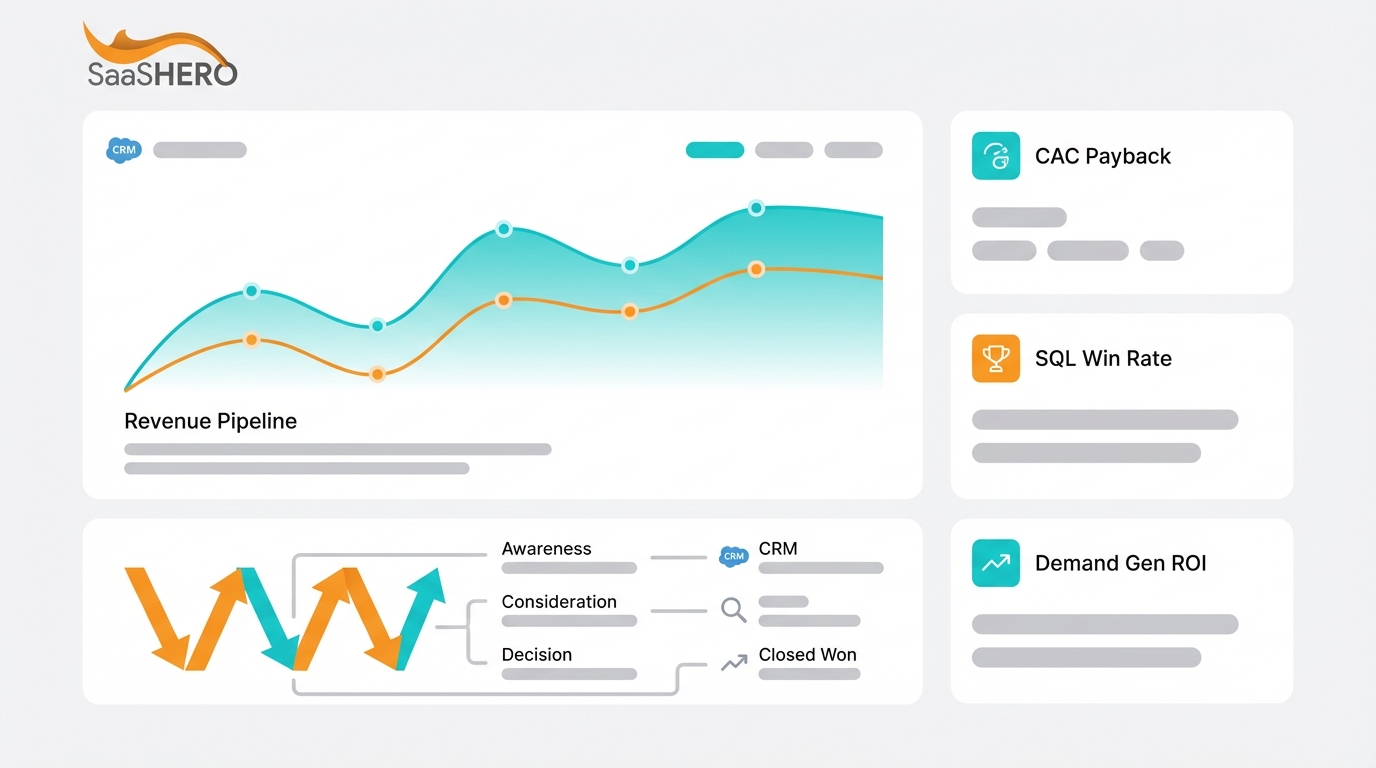
The W-shaped model assigns 30% credit to first touch, 30% to lead creation, and 30% to opportunity creation. It then spreads the remaining 10% across other interactions. Companies using W-shaped attribution often see a 22% increase in budget efficiency compared to single-touch models.
Implementation Steps:
- Set UTM parameters and GCLID tracking to capture first interactions.
- Apply negative keyword strategies to remove unqualified traffic.
- Build CRM workflows that track lead progression through each stage.
- Create custom fields for multi-touch attribution data.
- Set weekly Slack reporting for real-time performance visibility.
Many teams rely on last-click attribution, which undervalues top-of-funnel awareness. Dark funnel tracking needs strong UTM management and CRM integration to capture the full journey. Agencies should run heuristic conversion audits to find and fix attribution gaps before they scale ad spend.
The setup connects Google Ads GCLID data directly to CRM records for end-to-end revenue attribution. This integration lets agencies adjust campaigns based on closed-won revenue instead of lead volume, which improves ROI for B2B SaaS clients.
Demand Gen ROI Dashboards and Reporting Rhythm
Automated Looker Studio dashboards give clients real-time visibility into demand generation performance. The layout focuses on revenue visuals that connect ad spend to Net New ARR.
Key dashboard views include an ARR funnel from MQL to closed-won revenue, CAC trends by channel and time, pipeline velocity charts that show deal speed, and win rate analysis by lead source and campaign type.
Reporting follows a clear rhythm. Teams run weekly pipeline reviews in Slack channels, bi-weekly strategy calls with deeper analysis, and monthly executive summaries that highlight revenue impact. This extension-of-team approach keeps clients informed and keeps agencies accountable.
Client-facing templates should highlight revenue metrics instead of vanity stats. Reports should prioritize pipeline generated, opportunities created, and Net New ARR tied to specific campaigns. This focus builds trust and supports ongoing investment in demand generation.
Start with SaaSHero’s transparent dashboard setup, and book a discovery call today.

Benchmarks and Case Studies from SaaS Campaigns
Real performance data shows how transparent demand generation metrics drive B2B SaaS growth. Leading agencies often reach 650% ROI or higher once they implement strong attribution and reporting systems.
TripMaster, a transit software company, generated $504,758 in Net New ARR from transparent demand gen campaigns and hit a 20% conversion rate from paid search. TestGorilla reached an 80-day CAC payback period while adding more than 5,000 new customers, which supported their $70M Series A round.

Playvox cut Cost Per Lead by 10x after restructuring campaigns and tightening negative keywords, while also increasing lead volume by 163%. These outcomes show how transparent metrics guide better campaign decisions.
|
Company |
Primary Outcome |
Key Metric |
Industry Benchmark |
|
TripMaster |
$504k Net New ARR |
20% Conversion Rate |
15% Average |
|
TestGorilla |
$70M Series A |
80-Day Payback |
120-Day Average |
|
Playvox |
10x Lower CPL |
163% Volume Increase |
25% Typical Growth |
Industry analysis shows best-in-class public SaaS companies average 120-125% Net Revenue Retention, and transparent demand generation supports this expansion revenue.
Advanced Strategies for Scaling Transparent Demand Gen
Scaling transparent demand generation relies on competitor conquesting and multi-channel attribution. Advanced programs run LinkedIn and Google Ads together while maintaining LTV:CAC ratios above 3:1, with top performers above 5:1.
Multi-channel campaigns need careful budget splits and cross-platform attribution to avoid double-counting conversions. Agencies should use unified tracking that captures the full journey while still reporting performance by channel.
Implementation Wrap-Up and Next Steps
Transparent demand generation metrics for B2B SaaS agencies now sit at the center of ROI-focused client relationships. Five core metrics, Pipeline Value, CAC by Channel, Win Rate, Payback Period, and Velocity, create a clear story of revenue impact.
Strong attribution, automated dashboards, and consistent reporting that highlight revenue over vanity metrics drive successful execution. Agencies that master this approach keep clients longer and earn premium fees through proven ROI.
Book a discovery call today to implement transparent demand generation metrics.

Frequently Asked Questions
How long does it take to set up transparent demand generation metrics?
Most agencies need 2-3 weeks for full implementation, including CRM integration, attribution setup, and dashboard builds. The first week focuses on technical configuration and data connections. The second week covers attribution testing and automated report creation. Initial data usually appears within 7-10 days, with full attribution visibility by week three.
What are realistic benchmarks for B2B SaaS demand generation ROI?
Top B2B SaaS agencies often reach 650% ROI or higher with transparent metrics in place. CAC payback should land between 80-120 days, and MQL-to-SQL conversion should sit between 35-45%. SQL-to-close win rates typically range from 20-30%, depending on deal size and sales cycle complexity. These targets guide agencies moving from vanity metrics to revenue reporting.
How does W-shaped attribution impact demand generation efficiency?
W-shaped attribution usually improves budget efficiency by about 22% compared to single-touch systems. The model gives clear visibility into the B2B buyer journey by assigning credit to first touch, lead creation, and opportunity creation. Better attribution accuracy supports smarter budget allocation and campaign changes based on revenue contribution instead of last-click data.
What risks should agencies consider when implementing transparent metrics?
Key risks include attribution gaps between ad clicks and closed deals, poor data quality from weak CRM integration, and client expectations for instant results in long B2B cycles. Agencies reduce these risks through careful technical setup, frequent data audits, and clear explanations of attribution methods. Setting realistic expectations for accuracy and timelines prevents disappointment during rollout.
How do transparent metrics affect client retention for B2B SaaS agencies?
Agencies that use transparent demand generation metrics usually see higher client retention because they prove ROI and build trust. Clients can connect marketing spend directly to pipeline and revenue, which removes the black box feeling of traditional reporting. This clarity builds confidence in the agency and supports continued investment, even when budgets tighten.