




Key Takeaways
- The 4 Ps of Product, Price, Place, and Promotion guide B2B SaaS marketing for self-service buyers and ARR growth in 2026.
- Product success depends on pain-solving features, intuitive onboarding, strong integrations, and ongoing iteration from G2 reviews and user feedback.
- Pricing with value-based tiers, freemium access, and clear TCO comparisons supports retention and expansion revenue against competitors.
- Place focuses on high-intent channels such as G2, LinkedIn, and integration marketplaces, strengthened by conquesting competitor searches.
- Schedule a discovery call with SaaSHero to execute your 4 Ps strategy and drive measurable ARR growth like TripMaster’s $504k win.

Defining the 4 Ps of Product Marketing for SaaS
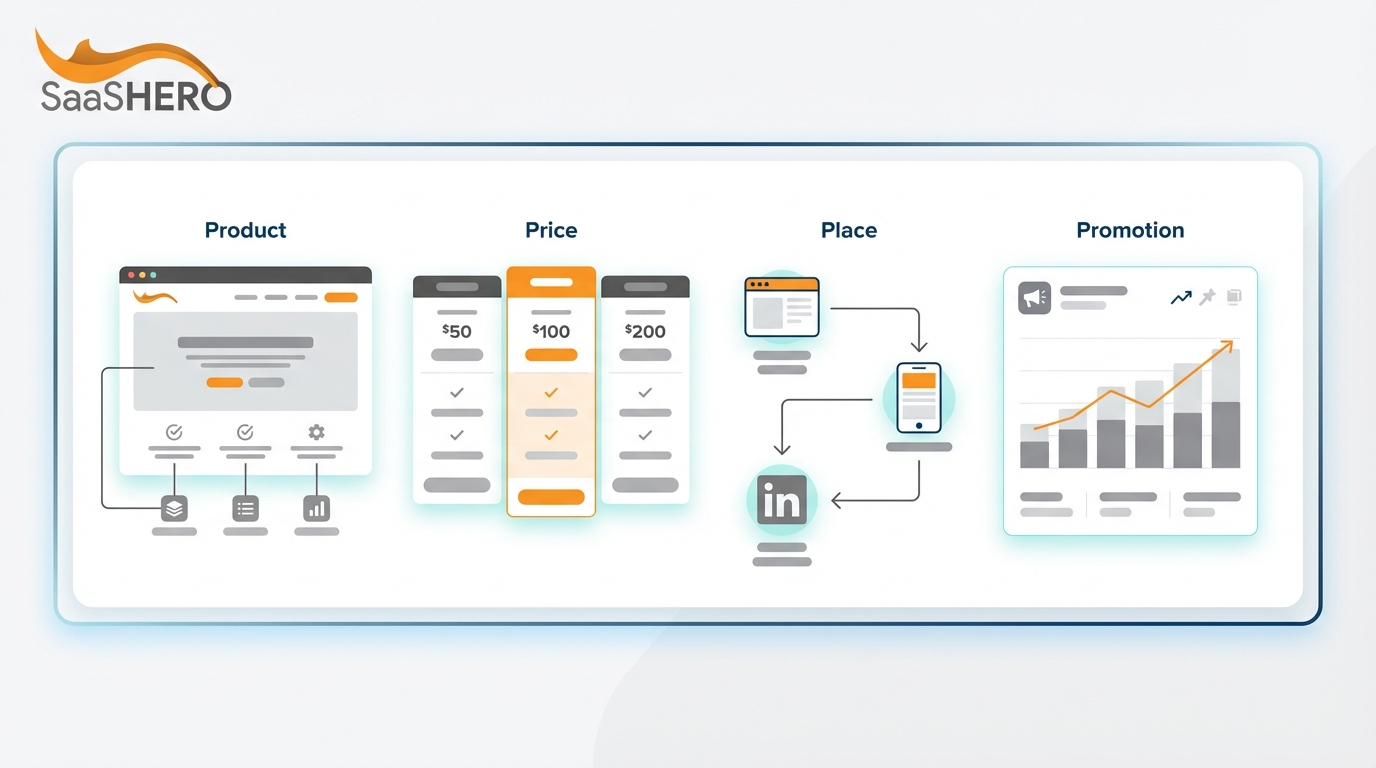
The 4 Ps describe the core elements of any effective marketing strategy.
- Product – Features and benefits that solve specific customer pain points
- Price – Value-based tiers designed for retention and expansion
- Place – High-intent channels where buyers make decisions
- Promotion – Content and conquesting strategies that generate qualified leads
|
P |
Traditional (Consumer) |
SaaS (B2B ARR-Driven) |
|
Product |
Physical goods |
Features plus onboarding ease |
|
Price |
Fixed retail |
Tiers, freemium, TCO |
|
Place |
Stores |
G2, LinkedIn, marketplaces |
|
Promotion |
Ads, TV |
Conquering, content |
Product: Building a SaaS Experience That Solves Real Pain
How the product works inside the 4 Ps for SaaS
In B2B SaaS, the product covers the full user experience from onboarding through value realization. Modern SaaS teams use self-service experiences such as ROI calculators and product tours to support buyers who prefer independent research instead of early sales calls.
Successful SaaS products focus on:
- Pain-solving features validated through customer feedback
- Intuitive onboarding that reduces time-to-value
- Integration capabilities that fit into existing workflows
- AI-powered personalization tailored to individual user contexts
Product validation depends on continuous iteration guided by user behavior and market feedback. G2 reviews, customer success metrics, and feature adoption rates provide concrete signals for product positioning and development priorities.
Book a discovery call to align your product positioning with market demand and clear competitive differentiation.
Price: Value-Based SaaS Tiers That Protect Retention
Examples of pricing inside the 4 Ps for SaaS
Pricing strategies such as tiered plans, usage-based models, feature upgrades, and cross-product bundles increase expansion revenue from existing customers. TestGorilla’s transparent pricing approach supported their $70M Series A raise by showing clear value propositions for each customer segment.
Modern SaaS pricing strategies include:
- Freemium models that support product-led growth
- Usage-based pricing aligned with delivered value
- Tiered structures that encourage account expansion
- Total Cost of Ownership (TCO) positioning against competitors
|
Tier |
Competitor A |
Competitor B |
Your SaaS |
|
Freemium |
Limited features |
No free tier |
Full trial plus support |
|
Pro |
$99/month |
$149/month |
$79/month |
|
Enterprise |
Custom pricing |
$499/month |
$299/month |
AI-driven dynamic pricing supports real-time adjustments based on customer behavior, competitor moves, and changing market conditions.
Place: Channels Where SaaS Buyers Actually Decide
Modern place strategies and conquesting in SaaS
B2B SaaS buyers research and purchase through a small set of high-intent channels. Place strategies use integration partnerships, marketplace listings, and co-marketing with non-competing partners to expand distribution efficiently when budgets stay tight.
Critical SaaS distribution channels include:
- Review platforms such as G2, Capterra, and TrustRadius
- LinkedIn for targeting decision-makers
- Integration marketplaces such as Salesforce AppExchange and Zapier
- Partner ecosystems and referral networks
Playvox cut cost per lead by 10x through careful channel selection and negative keyword management, which shows how a focused place strategy improves acquisition efficiency.
Conquesting strategies focus on competitor-branded searches to reach high-intent prospects who already compare alternatives. This approach works best with dedicated landing pages that address switching concerns directly and highlight clear competitive advantages.
Promotion: Conquesting and Content That Attract High-Intent Leads
Leading B2B SaaS companies update Promotion with AI-powered personalization, community-led growth, and omnichannel content strategies to keep buyers engaged in crowded and skeptical markets.
Effective SaaS promotion tactics include:
- Competitor keyword campaigns supported by dedicated landing pages
- Educational content that addresses specific buyer pain points
- Webinars and demos that validate product fit
- Account-based marketing programs for enterprise prospects
Short-form educational videos that show real outcomes support demand generation and connect emotionally with skeptical buyers. Leasecake’s LinkedIn advertising strategy contributed to their $3M VC round by targeting defined job titles and industry segments with tailored messaging.

Content needs clear structure for both human readers and AI systems so it appears in AI-powered search results and recommendation engines.
Book a discovery call to design promotion strategies that turn high-intent prospects into qualified pipeline.
Modern Relevance of the 4 Ps for B2B SaaS
The 4 Ps framework still anchors modern B2B marketing by organizing decisions around product, price, place, and promotion so teams stay aligned and build differentiated propositions.
|
Framework |
Traditional 4 Ps |
7 Ps Additions |
4 As/SaaS Twist |
|
Core Elements |
Product, Price, Place, Promotion |
Plus People, Process, Physical Evidence |
Audience, Acquisition, Activation, Analytics |
|
Focus |
Product-centric |
Service-centric |
Customer-centric |
|
Application |
Traditional marketing |
Service industries |
Digital and SaaS |
The 4Es framework of Experience, Exchange, Everyplace, and Evangelism shifts focus toward customer-centric approaches that fit engagement-driven markets. AI now shapes each P through dynamic personalization, algorithmic distribution, and content that machines can parse reliably.
Actionable Checklist for Applying the 4 Ps to Your SaaS Launch
Use this checklist to turn the 4 Ps into concrete launch steps.
- Product: Validate your MVP through G2 reviews and structured customer interviews.
- Price: Audit competitor pricing and build a clear value gap analysis.
- Place: Improve your G2 profile and test focused LinkedIn targeting.
- Promotion: Launch competitor keyword campaigns with dedicated landing pages.
- Measurement: Track Net New ARR instead of only lead volume.
- Iteration: A/B test messaging across every major touchpoint.
Keep attention on high-intent activities that correlate with revenue instead of vanity metrics such as impressions or clicks.
Why SaaSHero Is a Strong Partner for Your 4 Ps Strategy
SaaSHero focuses on B2B SaaS growth with flat-fee pricing that starts at $1,250 and month-to-month agreements that align incentives with your success. The ARR-first approach has generated $504k in Net New ARR for clients such as TripMaster through disciplined execution.

Book a discovery call to turn your 4 Ps framework into measurable revenue growth.
FAQs
What is the product in the 4 Ps of marketing for SaaS?
In SaaS, the product covers the entire user experience from initial trial through ongoing value realization. This scope includes core features, onboarding flows, integration capabilities, and customer success touchpoints. Unlike physical products, SaaS products evolve continuously based on user feedback and market demands, so teams must iterate often to protect competitive advantage.
Are the 4 Ps still relevant for modern B2B SaaS marketing?
The 4 Ps remain highly relevant for SaaS, although the model has shifted for digital-first, subscription-based businesses. Modern SaaS teams use AI-powered personalization in promotion, dynamic pricing models, multi-channel distribution through marketplaces and partnerships, and product-led growth strategies. The framework still provides structure while adapting to current buyer behavior and technology.
What are some 4 Ps of marketing examples specific to SaaS?
TestGorilla shows strong SaaS pricing with transparent tiers that supported their $70M Series A raise. Playvox illustrates a place strategy by achieving a 10x lower cost per lead through careful channel management. TripMaster highlights integrated 4 Ps execution, generating $504k in Net New ARR through coordinated product positioning, competitive pricing, targeted distribution, and conquesting campaigns.
How do the modern 4 Ps differ from traditional marketing approaches?
Modern 4 Ps focus on customer-centricity instead of pure product-centricity, with AI enabling dynamic personalization across every element. Product shifts toward experience with self-service capabilities. Pricing moves toward value-based and usage-driven models. Place expands into digital ecosystems and integration partnerships. Promotion relies on data-driven content and community-led growth strategies.
What metrics should SaaS companies track when implementing the 4 Ps?
SaaS companies should track revenue-linked metrics instead of vanity indicators. Key measurements include Net New ARR, customer acquisition cost (CAC), lifetime value (LTV), payback period, conversion rates by channel, feature adoption rates, and expansion revenue. These metrics connect 4 Ps activities to business outcomes and support data-driven decisions.